Hubbry Logo
Parity gameParity gameMain
Open search
Parity game
Community hub
Parity game
logo
8 pages, 0 posts
0 subscribers
Be the first to start a discussion here.
Parity game
Parity game
from Wikipedia
A parity game. Circular nodes belong to player 0, rectangular nodes belong to player 1. On the left side is the winning region of player 0, on the right side is the winning region of player 1.

A parity game is played on a colored directed graph, where each node has been colored by a priority – one of (usually) finitely many natural numbers. Two players, 0 and 1, move a (single, shared) token along the edges of the graph. The owner of the node that the token falls on selects the successor node (does the next move). The players keep moving the token, resulting in a (possibly infinite) path, called a play.

The winner of a finite play is the player whose opponent is unable to move. The winner of an infinite play is determined by the priorities appearing in the play. Typically, player 0 wins an infinite play if the largest priority that occurs infinitely often in the play is even. Player 1 wins otherwise. This explains the word "parity" in the title.

Parity games lie in the third level of the Borel hierarchy, and are consequently determined.[1]

Games related to parity games were implicitly used in Rabin's proof of decidability of the monadic second-order theory of n successors (S2S for n = 2), where determinacy of such games was proven.[2] The Knaster–Tarski theorem leads to a relatively simple proof of determinacy of parity games.[3]

Moreover, parity games are history-free determined.[3][4][5] This means that if a player has a winning strategy then that player has a winning strategy that depends only on the current board position, and not on the history of the play.

Solving a game

[edit]
Unsolved problem in computer science
Can parity games be solved in polynomial time?

Solving a parity game played on a finite graph means deciding, for a given starting position, which of the two players has a winning strategy. It has been shown that this problem is in NP and co-NP, more precisely UP and co-UP,[6] as well as in QP (quasipolynomial time).[7] It remains an open question whether this decision problem is solvable in PTime.

Given that parity games are history-free determined, solving a given parity game is equivalent to solving the following simple looking graph-theoretic problem. Given a finite colored directed bipartite graph with n vertices , and V colored with colors from 1 to m, is there a choice function selecting a single out-going edge from each vertex of , such that the resulting subgraph has the property that in each cycle the largest occurring color is even.

Recursive algorithm for solving parity games

[edit]

Zielonka outlined a recursive algorithm that solves parity games. Let be a parity game, where resp. are the sets of nodes belonging to player 0 resp. 1, is the set of all nodes, is the total set of edges, and is the priority assignment function.

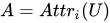
Zielonka's algorithm is based on the notation of attractors. Let be a set of nodes and be a player. The i-attractor of U is the least set of nodes containing U such that i can force a visit to U from every node in . It can be defined by a fix-point computation:

In other words, one starts with the initial set U. Then, for each step () one adds all nodes belonging to player 0 that can reach the previous set () with a single edge and all nodes belonging to player 1 that must reach the previous set () no matter which edge player 1 takes.

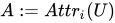
Zielonka's algorithm is based on a recursive descent on the number of priorities. If the maximal priority is 0, it is immediate to see that player 0 wins the whole game (with an arbitrary strategy). Otherwise, let p be the largest one and let be the player associated with the priority. Let be the set of nodes with priority p and let be the corresponding attractor of player i. Player i can now ensure that every play that visits A infinitely often is won by player i.


Consider the game in which all nodes and affected edges of A are removed. We can now solve the smaller game by recursion and obtain a pair of winning sets . If is empty, then so is for the game G, because player can only decide to escape from to A which also results in a win for player i.

Otherwise, if is not empty, we only know for sure that player can win on as player i cannot escape from to A (since A is an i-attractor). We therefore compute the attractor and remove it from G to obtain the smaller game . We again solve it by recursion and obtain a pair of winning sets . It follows that and .

In simple pseudocode, the algorithm might be expressed as this:

function 
    p := maximal priority in G
    if 
        return 
    else
        U := nodes in G with priority p


        if 
            return 
        
        
        return 
[edit]

A slight modification of the above game, and the related graph-theoretic problem, makes solving the game NP-hard. The modified game has the Rabin acceptance condition, and thus every vertex is colored by a set of colors instead of a single color. Accordingly, we say a vertex v has color j if the color j belongs to the color set of v. An infinite play is winning for player 0 if there exists i such that infinitely many vertices in the play have color 2i, yet finitely many have color 2i+1.

Note that as opposed to parity games, this game is no longer symmetric with respect to players 0 and 1.

Relation with logic and automata theory

[edit]
Most common applications of parity game solving.

Despite its interesting complexity theoretic status, parity game solving can be seen as the algorithmic backend to problems in automated verification and controller synthesis. The model-checking problem for the modal μ-calculus for instance is known to be equivalent to parity game solving. Also, decision problems like validity or satisfiability for modal logics can be reduced to parity game solving.

References

[edit]

Further reading

[edit]
[edit]
Revisions and contributorsEdit on WikipediaRead on Wikipedia
from Grokipedia
A parity game is a two-player, of played on a finite , where the two players—typically called Even and Odd—alternate turns moving a token from vertex to vertex along edges, generating an infinite path, and the winner is decided by the parity (even or odd nature) of the highest-priority vertex visited infinitely often along that path, with Even winning if the parity is even and Odd winning if odd. Formally, a parity game is defined as a G=(V,VEven,VOdd,E,pr)\mathcal{G} = (V, V_\text{Even}, V_\text{Odd}, E, \text{pr}), where VV is a of vertices partitioned into VEvenV_\text{Even} (positions controlled by Even) and VOddV_\text{Odd} (positions controlled by Odd), EV×VE \subseteq V \times V is a set of edges such that every vertex has at least one outgoing edge, and pr:V{0,1,,d}\text{pr}: V \to \{0, 1, \dots, d\} assigns a priority (non-negative ) to each vertex, with dd being the maximum priority. A play begins at a starting vertex and proceeds infinitely, with each player choosing successors from their controlled vertices; the infinite sequence of vertices determines the winner based on max(Inf(π))\max(\text{Inf}(\pi))'s parity, where Inf(π)\text{Inf}(\pi) is the set of vertices appearing infinitely often in the path π\pi. Equivalent formulations exist where the minimum recurring priority decides the outcome, achieved by inverting the priority numbering, but the highest-infinitely-often convention is standard in much of the literature. Parity games serve as a foundational model in , particularly for tasks, as they are polynomial-time interreducible with the model-checking problem for the modal μ-calculus, a logic expressive enough to capture fixed-point properties in reactive systems. They also arise in solving specifications like LTL and CTL*, enabling the synthesis of strategies for system controllers against environmental adversaries. From a complexity perspective, solving a parity game—determining, for each starting vertex, which player has a winning strategy—is known to lie in NP ∩ , with memoryless determinacy ensuring optimal strategies require no history beyond the current position; however, whether it is solvable in polynomial time remains open, though landmark quasi-polynomial-time algorithms have been developed since 2017, and a claimed polynomial-time solution appeared in late 2025.

Fundamentals

Definition

A parity game is a two-player zero-sum game of perfect information played over an infinite horizon on a finite directed graph. Formally, it consists of a tuple G=(V,E,V0,V1,pri)G = (V, E, V_0, V_1, \mathrm{pri}), where (V,E)(V, E) is a finite directed graph serving as the game arena with vertex set VV and edge set EV×VE \subseteq V \times V such that every vertex has at least one outgoing edge, the vertices are partitioned into disjoint sets V0V_0 and V1V_1 representing positions controlled by the even player (Player 0) and the odd player (Player 1), respectively, pri:V{0,1,,d}\mathrm{pri}: V \to \{0, 1, \dots, d\} is a priority function assigning each vertex vVv \in V a priority from the finite set of natural numbers {0,1,,d}\{0, 1, \dots, d\}. A play in the game is an infinite path π=v0v1v2\pi = v_0 v_1 v_2 \dots in the (V,E)(V, E), where each consecutive pair (vi,vi+1)E(v_i, v_{i+1}) \in E, beginning at a starting vertex vVv \in V, and with players alternating turns according to vertex ownership: at positions in V0V_0, Player 0 selects the successor, and at positions in V1V_1, Player 1 selects the successor. A for Player 0 (Even) is a function σ:VV0V\sigma: V^* V_0 \to V that, for every finite path π\pi in the arena ending at a vertex uV0u \in V_0, prescribes a successor σ(π)V\sigma(\pi) \in V such that (u,σ(π))E(u, \sigma(\pi)) \in E; analogously, a strategy τ:VV1V\tau: V^* V_1 \to V for Player 1 (Odd) is defined over finite paths ending in V1V_1. Here, VViV^* V_i denotes the set of all finite paths ending in a position owned by Player ii. These games, introduced by Emerson and Jutla, form a foundational class of infinite games in descriptive set theory and formal verification.

Basic Example

To illustrate a basic parity game, consider a simple directed graph with four vertices labeled v0,v1,v2,v3v_0, v_1, v_2, v_3, partitioned into positions for Even (V0={v0,v3}V_0 = \{v_0, v_3\}) and Odd (V1={v1,v2}V_1 = \{v_1, v_2\}), along with the following edges and priorities: v0v1v_0 \to v_1, v1v2v_1 \to v_2, v2v3v_2 \to v_3, v3v2v_3 \to v_2, where pri(v0)=1\mathrm{pri}(v_0) = 1, pri(v1)=1\mathrm{pri}(v_1) = 1, pri(v2)=2\mathrm{pri}(v_2) = 2, and pri(v3)=3\mathrm{pri}(v_3) = 3. This graph encodes player choices through the ownership and outgoing edges; for instance, from v0v_0 (Even's position), the only successor is v1v_1 (transferring control to Odd), while from v2v_2 (Odd's position), successors include v3v_3 (Even's position). A notable feature is the cycle v2v3v2v_2 \to v_3 \to v_2, where priorities 2 and 3 repeat, which will highlight parity evaluation in play. This setup will be used to demonstrate play in subsequent sections.

Gameplay and Winning Conditions

Turn-Based Play

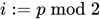
In parity games, two players—typically referred to as Player Even (or Player 0) and Player Odd (or Player 1)—alternate turns in a perfect-information setting on a finite whose vertices are partitioned into two disjoint sets V0V_0 and V1V_1, owned respectively by Even and Odd. A play begins at an initial vertex v0Vv_0 \in V, and on each turn, the player whose set contains the current vertex selects an outgoing edge to a successor vertex, with Even moving from vertices in V0V_0 and Odd from those in V1V_1. This alternation continues indefinitely, generating an infinite path through the graph without termination. Formally, a play, also called a run, is an infinite sequence of vertices π=v0,v1,v2,Vω\pi = v_0, v_1, v_2, \dots \in V^\omega such that (vi,vi+1)E(v_i, v_{i+1}) \in E for all i0i \geq 0, with the parity of the index ii determining the owning player: even indices correspond to moves from V0V_0 and odd indices from V1V_1. To guide their decisions, each player employs a deterministic perfect-information σi\sigma_i, which for player i{0,1}i \in \{0,1\} is a function mapping every finite —a non-empty finite path ρ=w0,,wkVk+1\rho = w_0, \dots, w_k \in V^{k+1} ending at a vertex wkViw_k \in V_i—to a successor vertex σi(ρ)V\sigma_i(\rho) \in V such that (wk,σi(ρ))E(w_k, \sigma_i(\rho)) \in E. Such strategies allow players to respond based on the full of the play up to their turn. Given a pair of strategies (σ0,σ1)(\sigma_0, \sigma_1) and a starting vertex v0v_0, there exists a unique infinite play πv0σ0,σ1\pi^{\sigma_0, \sigma_1}_{v_0} that is consistent with both strategies, obtained by iteratively applying σ0\sigma_0 at Even's positions and σ1\sigma_1 at Odd's positions along the path from v0v_0. Parity games are determined, meaning that for every starting vertex vVv \in V, exactly one player possesses a winning —though the notion of winning is defined separately—ensuring that the game's outcome under optimal play is resolved in favor of either Even or Odd. This determinacy follows from the Gale-Stewart theorem, which establishes for two-player perfect-information games of infinite duration with Borel payoff sets, and parity conditions yield such Borel sets.

Parity Winning Rule

In parity games, the winner of an infinite play π\pi, which is an infinite sequence of vertices traversed by alternating moves between the two players, is determined solely by the parities of the priorities encountered along the path. Specifically, the infinity set Inf(π)\operatorname{Inf}(\pi) is defined as the set of priorities that appear infinitely often in π\pi, i.e., Inf(π)={pp\operatorname{Inf}(\pi) = \{ p \mid p appears infinitely often in the priorities along π}\pi \}. The highest priority in this set, m=maxInf(π)m = \max \operatorname{Inf}(\pi), then decides the outcome: Player Even wins if mm is even, while Player Odd wins if mm is odd. Equivalently, the winner is the player whose index aligns with the parity of the maximum recurring priority in the play. This rule ensures that there are no draws in standard parity games, as the parity of the highest infinitely recurring priority unambiguously resolves the outcome in favor of one player. This winning condition applies to the infinite plays generated during turn-based alternation between the players.

Algorithms for Solving

Recursive Fixed-Point Algorithm

The recursive fixed-point algorithm for solving parity games, originally developed by Zielonka, computes the winning regions for both players by recursively decomposing the game graph based on priority levels and computing attractor sets as fixed points. The goal is to determine, for each vertex vv, the sets Win0(v)\mathrm{Win}_0(v) and Win1(v)\mathrm{Win}_1(v), where Win0(v)\mathrm{Win}_0(v) is the set of vertices from which player Even (player 0) has a winning strategy assuming the highest priority seen infinitely often is even, and Win1(v)\mathrm{Win}_1(v) is the analogous set for player Odd (player 1). This approach leverages the positional determinacy of parity games, ensuring every vertex belongs to exactly one winning region. The procedure proceeds top-down, starting from the highest priority dd and recursing on s after removing sets. For a parity game graph G=(V,E,V0,V1,pri)G = (V, E, V_0, V_1, \mathrm{pri}) with maximum priority dd, identify the vertices U={vVpri(v)=d}U = \{v \in V \mid \mathrm{pri}(v) = d\}. If dd is even, player 0 owns the highest priority and computes the Attr0(U)\mathrm{Attr}_0(U), the least fixed point of the predecessor operator pre0(X)=X{uV0wsucc(u):wX}{uV1wsucc(u):wX}\mathrm{pre}_0(X) = X \cup \{u \in V_0 \mid \forall w \in \mathrm{succ}(u): w \in X\} \cup \{u \in V_1 \mid \exists w \in \mathrm{succ}(u): w \in X\}. This fixed point is computed iteratively until convergence, adding vertices that player 0 can force into UU in finitely many steps. The Attr0(U)\mathrm{Attr}_0(U) forms part of Win0\mathrm{Win}_0, and the algorithm recurses on the GAttr0(U)G \setminus \mathrm{Attr}_0(U). If the recursive call yields no winning vertices for player 1 in the , then Attr0(U)\mathrm{Attr}_0(U) is the full winning region for player 0; otherwise, it computes the symmetric Attr1(W1)\mathrm{Attr}_1(W_1') for player 1's winning region W1W_1' from the recursion and recurses further on GAttr1(W1)G \setminus \mathrm{Attr}_1(W_1'). For odd priorities, the roles reverse: player 1 computes Attr1(U)\mathrm{Attr}_1(U) using the fixed point of pre1(X)=X{uV1wsucc(u):wX}{uV0wsucc(u):wX}\mathrm{pre}_1(X) = X \cup \{u \in V_1 \mid \forall w \in \mathrm{succ}(u): w \in X\} \cup \{u \in V_0 \mid \exists w \in \mathrm{succ}(u): w \in X\}, and the recursion updates Win1\mathrm{Win}_1 accordingly. This recursive decomposition continues down to priority 0, with base cases for empty graphs returning empty winning regions for both players. The process builds the winning regions incrementally: Win0k=Win0k+1Attr0(Win1k+1)\mathrm{Win}_0^k = \mathrm{Win}_0^{k+1} \cup \mathrm{Attr}_0(\mathrm{Win}_1^{k+1}) for even levels and symmetrically for odd, ensuring all vertices are classified by the end. The algorithm runs in O(Vd)O(|V| \cdot d) time per attractor computation across levels, but the recursion depth and branching lead to exponential time in the input size (specifically, exponential in the bit length of priorities, as dd can be up to 2V2^{|V|}). Despite this worst-case complexity, it performs efficiently in practice due to small effective recursion depths in typical instances.

Quasi-Polynomial Time Algorithms

Prior to 2017, algorithms for solving parity games operated in exponential time in the worst case, with the best known bounds being mildly subexponential, such as O(1.28n1/2)O(1.28^{n^{1/2}}). The landmark breakthrough occurred in 2017 with the succinct progress measures algorithm developed by Marcin Jurdziński and Ranko Lazić, which achieves a quasi-polynomial time complexity of O((VlogV)O(logd))O((|V| \log |V|)^{O(\log d)}), where V|V| denotes the number of vertices and dd the number of distinct priorities. This algorithm marked the first resolution of the long-standing open problem of placing parity games in quasi-polynomial time, building on earlier progress measure concepts but with innovative succinct representations to avoid exponential blowup. The core innovation lies in a recursive decomposition of the game graph into dominions—subgraphs controlled by one player—coupled with compact progress measures that certify winning strategies without enumerating all possibilities. These measures are encoded using ordered structures with bounded adaptive multi-counters, enabling compression to keep the representation size nearly linear in nlognlogdn \log n \cdot \log d. Lifting techniques iteratively refine these measures, ensuring convergence in quasi-polynomial steps by bounding the height and branching of the trees. Unlike traditional exhaustive searches, this method computes partial fixed-points on subgames, avoiding full depth. It improves upon foundational recursive fixed-point approaches by dramatically reducing the computational overhead through these bounded improvements. Subsequent advancements have refined and extended this framework. In 2023, a matrix-based approach introduced efficient manipulations of game representations via linear algebra operations over semirings, allowing quasi-polynomial solving while accelerating practical computations on structured instances through matrix exponentiation and inversion techniques. That same year, odd-fair parity games—variants imposing strong transition fairness constraints on the odd player to prevent infinite avoidance of even priorities—were solved in quasi-polynomial time using a tailored Zielonka-style recursive algorithm that integrates fairness checks into the attractor computations without inflating the complexity bound. Papers from 2024 and 2025 have explored parallel strategy improvement variants, distributing progress measure lifts and dominion decompositions across processors to cut practical runtimes by factors of up to 10 on large benchmarks, though worst-case bounds remain quasi-polynomial. In 2025, a claimed polynomial-time was proposed, running in O(n2(n+m))O(n^2 (n + m)) time, potentially resolving the long-open question if verified. As of 2025, this remains a recent claim without peer-reviewed confirmation, underscoring the ongoing developments in the field. Implementations such as the PGSolver toolkit and its modern extensions incorporate these quasi-polynomial solvers, enabling efficient verification of properties in tools like those for LTL and CTL*.

Complexity and Status

Membership in Complexity Classes

The ParityGame problem asks, given a parity game graph and a starting vertex, whether the player Even (associated with even priorities) has a from that vertex. This lies in NP. A nondeterministic -time can guess a memoryless for Even, which specifies a successor for each of Even's vertices, and then verify its correctness by constructing a finite unfolding of the game graph under that strategy and checking that all infinite paths satisfy the parity condition (i.e., the maximal priority appearing infinitely often is even). The verification step runs in time since the unfolding depth is bounded by the number of vertices. This membership was established in the seminal work introducing the complexity analysis of parity games. Symmetrically, ParityGame is in coNP, as one can nondeterministically guess and verify a memoryless winning strategy for Odd in polynomial time, confirming that Even does not win. Thus, the problem resides in NP ∩ coNP. Regarding upper bounds, ParityGame can be solved in PSPACE using recursive fixed-point computations that evaluate winning regions while reusing space through backtracking, though the time complexity is exponential. A significant improvement came in 2017 with a quasi-polynomial-time algorithm, running in time nO(log3n)n^{O(\log^3 n)} for a game with nn vertices, based on a novel decomposition of the game structure. No matching lower bounds are known; in particular, ParityGame is not known to be PSPACE-hard, as such a result would imply quasi-polynomial algorithms for all of PSPACE, which is considered unlikely. The problem is suspected to reside in NP ∩ without being complete for that class, though this remains unproven. No polynomial-time lower bound has been established as of 2025.

Recent Progress and Open Questions

Since the quasi-polynomial time breakthrough of 2017, several advancements have enhanced the practical and theoretical solving of parity games. In 2023, a matrix-based approach was introduced that leverages algebraic representations, such as matrix manipulations over semirings, to improve the efficiency of solvers in practice by enabling compact encodings and faster computations on large instances. Complementing this, work on fair parity variants, including odd-fair parity games where one player adheres to strong transition fairness constraints, extended quasi-polynomial time algorithms to these constrained settings, achieving the same asymptotic complexity while handling fairness objectives. Further progress in 2024 explored fair ω-regular games, providing polynomial reductions from fair parity games to standard parity games, thus broadening the applicability of existing solvers to fairness-constrained scenarios. In 2025, a direct polynomial-time reduction from parity games to simple stochastic games was established, facilitating the analysis of probabilistic verification problems by transforming quantitative stochastic objectives into qualitative ones solvable via established methods. In November 2025, a polynomial-time was claimed for solving parity games, running in O(n2(n+m))O(n^2 (n + m)) time using computations. These developments build on the quasi-polynomial framework, refining both practical implementations and extensions to stochastic and fair variants. Despite these advances, key open questions persist in the complexity of parity games. A polynomial-time solution was claimed in November 2025, pending and verification; previously, it remained unknown whether parity games can be solved in polynomial time or belong to , with the problem firmly established in NP ∩ coNP but its completeness for this class unresolved. The of quasi-polynomial algorithms depends mildly on the number of distinct priorities dd (up to O(n)O(n)), remaining quasi-polynomial overall, e.g., nO(log3n)n^{O(\log^3 n)}. In practice, modern solvers such as implementations based on Oink and related tools can handle industrial-scale parity games with up to 10^6 states, often outperforming theoretical bounds on real-world verification benchmarks, highlighting a gap where empirical performance surpasses algorithmic guarantees.

Theoretical Connections

Relation to Modal Mu-Calculus

The modal μ-calculus, denoted \Lμ\L_\mu, is a fixed-point extension of propositional modal logic that incorporates least fixed-point (μ\mu) and greatest fixed-point (ν\nu) operators to express properties involving alternating existential and universal quantification over paths in Kripke structures, subsuming the expressiveness of branching-time temporal logics like CTL while allowing more succinct specifications of infinite behaviors. These fixed points enable the definition of recursive predicates that capture coinductive properties, such as safety and liveness conditions on transition systems. Solving a parity game is polynomial-time equivalent to the model-checking problem for an \Lμ\L_\mu formula of size O(d)O(d) against a Kripke structure of size V|V|, where dd is the number of distinct priorities in the game and V|V| is the number of vertices. This equivalence establishes parity games as a core computational mechanism for \Lμ\L_\mu model checking, with the game's outcome determining whether the structure satisfies the formula. The reduction from \Lμ\L_\mu model checking to parity games proceeds by constructing a game graph that mirrors the Kripke structure, where vertices represent pairs of states and subformulas, and priorities on vertices encode the nesting depth of fixed-point operators in the formula. Specifically, odd priorities correspond to least fixed points (μ\mu, existential), while even priorities correspond to greatest fixed points (ν\nu, universal), with the highest-priority color along an infinite play determining the winner according to the parity condition. In this setup, the Even player acts as the universal quantifier (corresponding to \forall and ν\nu-operators, choosing moves to falsify the property), while the Odd player acts as the existential quantifier (corresponding to \exists and μ\mu-operators, choosing moves to satisfy it). Emerson and Jutla (1991) demonstrated that parity games provide a decision procedure for \Lμ\L_\mu acceptance by establishing expressive equivalence between \Lμ\L_\mu formulas and alternating parity tree automata, with solving the associated parity game yielding the model-checking result; this equivalence relies on alternating simulations to preserve winning strategies between game positions and formula satisfaction. In verification applications, parity game solvers enable the checking of \Lμ\L_\mu specifications on finite-state transition systems, facilitating the analysis of complex properties like those in hardware and software , where the game's solution identifies satisfying states or winning strategies for system correctness. Parity automata extend finite automata to infinite words or trees, where acceptance depends on the parity (even or odd nature) of the highest priority that appears infinitely often along a run. In nondeterministic parity automata, a run is accepting if the maximum priority recurring infinitely often is even, providing an intuitive acceptance mechanism that aligns with parity conditions in . These automata are expressively equivalent to nondeterministic Büchi automata, as any Büchi automaton can be converted to a parity automaton with priorities 0 (non-accepting) and 1 (accepting), and vice versa with a quadratic blowup in states. A fundamental connection between parity games and arises from reductions showing that solving parity games is computationally equivalent to determining the emptiness of certain parity automata. Specifically, the problem of deciding the winner in a parity game reduces to checking the emptiness of an alternating parity automaton constructed from the game graph, where Emerson and Jutla established this equivalence in their analysis of tree automata complexity. In this , the game's positions serve as states of the , moves correspond to transitions (existential for one player and universal for the other), and priorities define the condition based on parity. The non-emptiness of this indicates that the existential player (typically Player Even) has a winning , as an accepting run corresponds to a memoryless strategy ensuring the desired parity outcome. Alternating parity automata, which incorporate both existential and universal quantification over transitions, exhibit the same computational complexity as parity games for emptiness checking, both lying in NP ∩ coNP. This equivalence facilitates their use in reactive synthesis, where solving parity games provides an effective method to decide emptiness for alternating parity tree automata, thereby implementing Rabin's 1969 decidability result for monadic second-order logic on infinite trees via more tractable parity conditions. Recent advances, such as matrix-based methods for solving parity games through optimized attractor computations, extend naturally to automata solving by representing transition relations as matrices and leveraging parallel operations for efficiency.

Similar Infinite Graph Games

Parity games belong to the broader class of two-player zero-sum turn-based games on finite directed graphs, where players alternate moves along edges to generate infinite paths, and winning conditions depend on the play's prefix or limit behavior. Similar games include and objectives, which focus on finite-prefix properties, as well as Büchi and co-Büchi objectives, which emphasize infinite visitation patterns. These variants differ structurally from parity games in their winning criteria but share the underlying graph arena and infinite-play horizon. In reachability games, player wins if the infinite play reaches a designated target set of vertices in finitely many steps, while opponent wins otherwise by forcing perpetual avoidance. These games are solvable in time using attractor-set computations that iteratively expand winning positions backward from the target. Safety games form the dual, where wins by remaining indefinitely within a safe set of vertices, avoiding a bad set forever; Adam seeks to force an exit. Like reachability games, safety games admit -time solutions via dual attractor methods, highlighting their structural symmetry as prefix-based objectives. Büchi games extend to limit behaviors, with Eve winning if a target set is visited infinitely often along the play, and Adam winning by confining visits to finitely many occurrences. These games lie in NP ∩ coNP and are solvable in quasi-polynomial time, often via reductions to parity games or maximal end-component decompositions. Co-Büchi games invert this condition, where Eve wins by visiting the target only finitely often, effectively avoiding infinite recurrence; Adam aims to enforce repeated visits. As the dual of Büchi games, co-Büchi objectives also reside in NP ∩ coNP with quasi-polynomial-time algorithms, but they require distinct handling of finite versus infinite thresholds. Parity games generalize , , Büchi, and co-Büchi objectives by labeling vertices with priorities (nonnegative integers) and declaring the winner if the largest priority appearing infinitely often is even. This encoding is achieved through specific priority assignments: for instance, sets odd priorities on non-targets and even on targets, uses even on safe vertices and odd elsewhere, Büchi assigns even to targets and odd to others, and co-Büchi reverses these parities. Unlike the binary or threshold-based conditions of these simpler games, parity conditions capture full ω-regular objectives via on priorities, enabling expressive power without increasing the graph's finiteness. In contrast, mean-payoff games replace parity with quantitative rewards, assigning real-valued weights to vertices or edges; Eve wins if the limit inferior of the average weight along the play meets or exceeds a threshold (often 0), while seeks to drive it below. These differ structurally by focusing on asymptotic averages rather than parity or visitation counts, leading to rational values computable via mean-payoff decomposition, though exact solutions remain in NP ∩ coNP without known polynomial-time algorithms. A related variant, discounted-payoff games, introduces a discount factor to weight future payoffs exponentially less, approximating parity game solutions for algorithmic analysis and enabling efficient approximations where exact parity resolution is quasi-polynomial.

Decision Problems in Verification

Parity games play a central role in formal verification, particularly in model checking problems where the goal is to determine whether a given system model satisfies a temporal specification. In linear temporal logic (LTL) model checking, the problem is reduced to solving a parity game by first translating the LTL formula into a Büchi automaton that accepts infinite words satisfying the formula, then constructing the product of the system's Kripke structure with this automaton to form a game graph where Player Even (the verifier) wins paths accepted by the automaton. This reduction leverages the fact that Büchi acceptance conditions are a special case of parity conditions with priorities 1 and 2, enabling parity game solvers to decide the existence of accepting paths. Reactive synthesis extends this paradigm to the construction of implementations that react correctly to environmental inputs while satisfying LTL specifications. The synthesis problem is solved by building a deterministic from the LTL formula and forming a parity game on the product with the environment's possible behaviors, where a winning for Player Even yields a correct reactive . Tools employ parity game solvers as a backend for checking specifications in the modal μ-calculus and its fragments like CTL*, which are equivalent to parity games, facilitating verification of complex properties in finite-state . These techniques find industrial applications in hardware verification, where parity solvers support the analysis of digital circuits and protocols to ensure correctness under concurrent behaviors. Beyond qualitative verification, parity games address decision problems in alternating-time temporal logics like ATL*, where reduces to solving parity games on multi-agent game structures to verify strategic abilities of coalitions. Quantitative extensions, such as mean-payoff parity games, combine parity conditions with average-reward objectives to model resource-bounded verification, deciding whether strategies achieve both qualitative and quantitative performance thresholds in or timed systems. Recent applications in verification extend parity games to partially Markov decision processes (POMDPs) with ω-regular objectives, enabling decidable checks for properties in uncertain environments modeled as belief-state games.

References

Add your contribution
Related Hubs
User Avatar
No comments yet.