
Recent from talks
Parking lot
Knowledge base stats:
Talk channels stats:
Members stats:
Parking lot
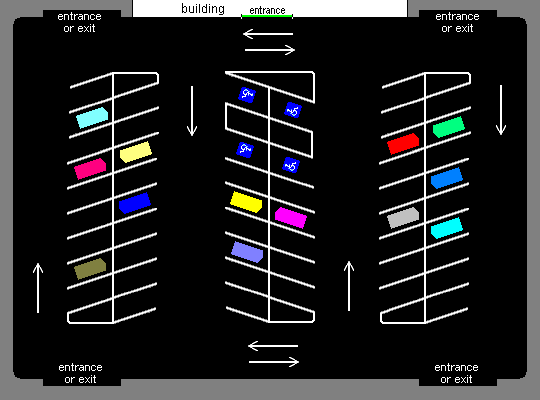
A parking lot (North American English) or car park (British English), also known as a car lot, is a cleared area intended for parking vehicles. The term usually refers to an area dedicated only for parking, with a durable or semi-durable surface. In most jurisdictions where cars are the dominant mode of transportation, parking lots are a major feature of cities and suburban areas. Shopping malls, sports stadiums, and other similar venues often have immense parking lots. (See also: multistorey car park)
Parking lots tend to be sources of water pollution because of their extensive impervious surfaces, and because most have limited or no facilities to control runoff. Many areas today also require minimum landscaping in parking lots to provide shade and help mitigate the extent to which their paved surfaces contribute to heat islands. Many municipalities require a minimum numbers of parking spaces for buildings such as stores (by floor area) and apartment complexes (by number of bedrooms). In the United States, each state's department of transportation requires a fraction of lot spaces to be reserved for people holding a disabled parking permit. Modern parking lots use various technologies to enable motorists to pay parking fees, help them find unoccupied spaces and retrieve their vehicles, and improve their parking experiences.
A 2015 study of US parking lots found that the average cost of construction, excluding the cost of the land purchase, was about US$24000 per space for a surface lot and US$34000 per space for an underground lot. Donald Shoup, professor of urban planning at the University of California, Los Angeles, estimated in 2023 that the United States had between 700 million and 2 billion parking spaces overall, amounting to 2.5 to 7.0 spaces per car.
The effect of large-scale in-city parking has long been contentious. The replacement of historic structures by garages and lots has led to historical preservation movements in many cities. The massive acreage devoted to parking is widely seen as disruptive to walkable urban fabric, maximizing convenience to each individual building but hampering foot traffic between them. Large paved areas have been called "parking craters", "parking deserts", and similar terms, emphasizing their "depopulated" nature and the barriers they can create to walking movement.
Urban planning policies such as parking minimums and maximums can influence the size of private parking lots.
Due to a recent trend[further explanation needed] towards more livable and walkable communities, parking minimums (policies requiring each building to have a minimum number of parking spaces) have been criticized by both livable streets advocates and developers alike. For a time, the British government recommended that local councils should establish maximum parking standards to discourage car use. American cities such as Washington, DC, are now considering removing parking minimums as a way to add more housing for residents while encouraging the use of public transit. Parking lots designed specifically for bicycle parking are also becoming more prevalent in response to increased environmental and health consciousness. These may include bicycle parking racks and locks, as well as more modern technologies for security and convenience. For instance, a growing number of bicycle parking lots in Tokyo include automated parking systems.
Efforts to reduce the amount of space dedicated to parking lots for diminishing the dependence on cars, has been taken in Beijing, Mexico City, Delhi and different cities in California. Portland, Minneapolis, Austin abolished the requirement for parking minimum. As of 2 November 2023, Austin (Texas) is the biggest city in the US that has done so - for encouraging, walking, biking, public transit, lowering the cost of housing and increase the amount of housing units that can be built in the city territory.
In Sweden and Denmark, there are legally two types of car parking, either on streets and roads, or on private land. A parking violation on streets is a traffic crime, resulting in fines. A parking violation on private land (also if owned by the city) is a contract violation and gives additional parking fee (Swedish: kontrollavgift = check fee). The difference is small for the car owner and the owner is always responsible.
Hub AI
Parking lot AI simulator
(@Parking lot_simulator)
Parking lot
A parking lot (North American English) or car park (British English), also known as a car lot, is a cleared area intended for parking vehicles. The term usually refers to an area dedicated only for parking, with a durable or semi-durable surface. In most jurisdictions where cars are the dominant mode of transportation, parking lots are a major feature of cities and suburban areas. Shopping malls, sports stadiums, and other similar venues often have immense parking lots. (See also: multistorey car park)
Parking lots tend to be sources of water pollution because of their extensive impervious surfaces, and because most have limited or no facilities to control runoff. Many areas today also require minimum landscaping in parking lots to provide shade and help mitigate the extent to which their paved surfaces contribute to heat islands. Many municipalities require a minimum numbers of parking spaces for buildings such as stores (by floor area) and apartment complexes (by number of bedrooms). In the United States, each state's department of transportation requires a fraction of lot spaces to be reserved for people holding a disabled parking permit. Modern parking lots use various technologies to enable motorists to pay parking fees, help them find unoccupied spaces and retrieve their vehicles, and improve their parking experiences.
A 2015 study of US parking lots found that the average cost of construction, excluding the cost of the land purchase, was about US$24000 per space for a surface lot and US$34000 per space for an underground lot. Donald Shoup, professor of urban planning at the University of California, Los Angeles, estimated in 2023 that the United States had between 700 million and 2 billion parking spaces overall, amounting to 2.5 to 7.0 spaces per car.
The effect of large-scale in-city parking has long been contentious. The replacement of historic structures by garages and lots has led to historical preservation movements in many cities. The massive acreage devoted to parking is widely seen as disruptive to walkable urban fabric, maximizing convenience to each individual building but hampering foot traffic between them. Large paved areas have been called "parking craters", "parking deserts", and similar terms, emphasizing their "depopulated" nature and the barriers they can create to walking movement.
Urban planning policies such as parking minimums and maximums can influence the size of private parking lots.
Due to a recent trend[further explanation needed] towards more livable and walkable communities, parking minimums (policies requiring each building to have a minimum number of parking spaces) have been criticized by both livable streets advocates and developers alike. For a time, the British government recommended that local councils should establish maximum parking standards to discourage car use. American cities such as Washington, DC, are now considering removing parking minimums as a way to add more housing for residents while encouraging the use of public transit. Parking lots designed specifically for bicycle parking are also becoming more prevalent in response to increased environmental and health consciousness. These may include bicycle parking racks and locks, as well as more modern technologies for security and convenience. For instance, a growing number of bicycle parking lots in Tokyo include automated parking systems.
Efforts to reduce the amount of space dedicated to parking lots for diminishing the dependence on cars, has been taken in Beijing, Mexico City, Delhi and different cities in California. Portland, Minneapolis, Austin abolished the requirement for parking minimum. As of 2 November 2023, Austin (Texas) is the biggest city in the US that has done so - for encouraging, walking, biking, public transit, lowering the cost of housing and increase the amount of housing units that can be built in the city territory.
In Sweden and Denmark, there are legally two types of car parking, either on streets and roads, or on private land. A parking violation on streets is a traffic crime, resulting in fines. A parking violation on private land (also if owned by the city) is a contract violation and gives additional parking fee (Swedish: kontrollavgift = check fee). The difference is small for the car owner and the owner is always responsible.
Recent media