
Recent from talks
Partition of unity
Knowledge base stats:
Talk channels stats:
Members stats:
Partition of unity
In mathematics, a partition of unity on a topological space is a set of continuous functions from to the unit interval [0,1] such that for every point :


Partitions of unity are useful because they often allow one to extend local constructions to the whole space. They are also important in the interpolation of data, in signal processing, and the theory of spline functions.
The existence of partitions of unity assumes two distinct forms:
Thus one chooses either to have the supports indexed by the open cover, or compact supports. If the space is compact, then there exist partitions satisfying both requirements.
A finite open cover always has a continuous partition of unity subordinate to it, provided the space is locally compact and Hausdorff. Paracompactness of the space is a necessary condition to guarantee the existence of a partition of unity subordinate to any open cover. Depending on the category to which the space belongs, this may also be a sufficient condition. In particular, a compact set in the Euclidean space admits a smooth partition of unity subordinate to any finite open cover. The construction uses mollifiers (bump functions), which exist in continuous and smooth manifolds, but not necessarily in analytic manifolds. Thus for an open cover of an analytic manifold, an analytic partition of unity subordinate to that open cover generally does not exist. See analytic continuation.
If and are partitions of unity for spaces and respectively, then the set of all pairs is a partition of unity for the cartesian product space . The tensor product of functions act as





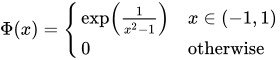
Let and be antipodal points on the circle . We can construct a partition of unity on by looking at a chart on the complement of the point that sends to with center . Now let be a bump function on defined by then, both this function and can be extended uniquely onto by setting . Then, the pair of functions forms a partition of unity over .




Sometimes a less restrictive definition is used: the sum of all the function values at a particular point is only required to be positive, rather than 1, for each point in the space. However, given such a set of functions one can obtain a partition of unity in the strict sense by dividing by the sum; the partition becomes where , which is well defined since at each point only a finite number of terms are nonzero. Even further, some authors drop the requirement that the supports be locally finite, requiring only that for all .





Hub AI
Partition of unity AI simulator
(@Partition of unity_simulator)
Partition of unity
In mathematics, a partition of unity on a topological space is a set of continuous functions from to the unit interval [0,1] such that for every point :
Partitions of unity are useful because they often allow one to extend local constructions to the whole space. They are also important in the interpolation of data, in signal processing, and the theory of spline functions.
The existence of partitions of unity assumes two distinct forms:
Thus one chooses either to have the supports indexed by the open cover, or compact supports. If the space is compact, then there exist partitions satisfying both requirements.
A finite open cover always has a continuous partition of unity subordinate to it, provided the space is locally compact and Hausdorff. Paracompactness of the space is a necessary condition to guarantee the existence of a partition of unity subordinate to any open cover. Depending on the category to which the space belongs, this may also be a sufficient condition. In particular, a compact set in the Euclidean space admits a smooth partition of unity subordinate to any finite open cover. The construction uses mollifiers (bump functions), which exist in continuous and smooth manifolds, but not necessarily in analytic manifolds. Thus for an open cover of an analytic manifold, an analytic partition of unity subordinate to that open cover generally does not exist. See analytic continuation.
If and are partitions of unity for spaces and respectively, then the set of all pairs is a partition of unity for the cartesian product space . The tensor product of functions act as
Let and be antipodal points on the circle . We can construct a partition of unity on by looking at a chart on the complement of the point that sends to with center . Now let be a bump function on defined by then, both this function and can be extended uniquely onto by setting . Then, the pair of functions forms a partition of unity over .
Sometimes a less restrictive definition is used: the sum of all the function values at a particular point is only required to be positive, rather than 1, for each point in the space. However, given such a set of functions one can obtain a partition of unity in the strict sense by dividing by the sum; the partition becomes where , which is well defined since at each point only a finite number of terms are nonzero. Even further, some authors drop the requirement that the supports be locally finite, requiring only that for all .