



Community hub
Recent from talks
Contribute something
Nothing was collected or created yet.
Passer rating
View on WikipediaPasser rating (also known as passing efficiency in college football) is a measure of the performance of passers, primarily quarterbacks, in gridiron football.[1] There are two formulas currently in use: one used by both the National Football League (NFL) and Canadian Football League (CFL), and the other used in NCAA football. Passer rating is calculated using a player's passing attempts, completions, yards, touchdowns, and interceptions. Passer rating in the NFL is on a scale from 0 to 158.3. Passing efficiency in college football is on a scale from −731.6 to 1261.6.
Since 1973, passer rating has been the official formula used by the NFL to determine its passing leader.[2]
Passer rating is sometimes colloquially referred to as quarterback rating or QB rating; however, the statistic applies only to passing (not to other contributions by a quarterback) and applies to any player at any position who throws a forward pass, not just to quarterbacks. Other measurements, such as ESPN's total quarterback rating and Pro Football Focus grades have been produced to take account for non-passing contributions or mistakes made by passers.
History
[edit]Before the development of the passer rating, the NFL struggled with how to crown a passing leader.
From 1932 to 1937, it was the quarterback with the most passing yardage, and from 1938 to 1940, it was the quarterback with the highest completion percentage. In 1941, a system was created that ranked the league's quarterbacks relative to their peers' performance. Over the next thirty years, the criteria used to crown a passing leader changed several times, however, the ranking system made it impossible to determine a quarterback's rank until all quarterbacks had completed their games that week, or to compare quarterback performances across multiple seasons.
With this in mind, in 1971, NFL commissioner Pete Rozelle asked the league's statistical committee to develop a better system:[3] this committee was headed by Don Smith of the Pro Football Hall of Fame, Seymour Siwoff of the Elias Sports Bureau, and NFL executive Don Weiss. Smith and Siwoff established passing performance standards based on data from all qualified pro football passers between 1960 and 1970, and used those data to create the passer rating, with the formula being adopted by the NFL in 1973.[2]
NFL and CFL formula
[edit]The NFL passer rating formula includes five variables: pass attempts, completions, passing yards, touchdown passes, and interceptions. Each of those variables is scaled to a value between 0 and 2.375, with 1.0 being statistically average (based on league data between 1960 and 1970). When the formula was first created, a 66.7 rating indicated an average performance, and a 100+ rating indicated an excellent performance.[3] However, passing performance has improved steadily since then and in 2017 the league average rating was 88.6,[4] and by 2020 it was 93.6.[5]
The four separate calculations can be expressed in the following equations:
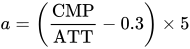
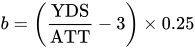
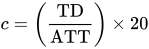
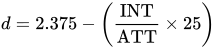
where
- ATT = Number of passing attempts
- CMP = Number of completions
- YDS = Passing yards
- TD = Touchdown passes
- INT = Interceptions
If the result of any calculation is greater than 2.375, it is set to 2.375. If the result is a negative number, it is set to zero.
Then, the above calculations are used to complete the passer rating:

| A perfect passer rating (158.3) requires at least:[1] | A minimum rating (0.0) requires at best: |
|---|---|
|
77.5% completion percentage (31 completions in 40 attempts) |
30.0% completion percentage |
NCAA formula
[edit]The NCAA passing efficiency formula is similar to that of the NFL passer rating, but does not impose limits on the four components. The formula is based on college football data between 1965 and 1978, and when the formula was first created, a 100 passer efficiency indicated an average performance.
The passing efficiency formula is:[6]

where
- ATT = Number of passing attempts
- CMP = Number of completions
- YDS = Passing yards
- TDP = Touchdown passes
- INT = Interceptions
The NCAA passer efficiency has an upper limit of 1,261.6 (every attempt is a 99-yard completion for a touchdown), and a lower limit of −731.6 (every attempt is completed, but results in a 99-yard loss). A passer who throws only interceptions will have a −200 efficiency, as would a passer who only throws completed passes losing an average of 35.714 yards.
Advantages
[edit]In 2011, Sports Illustrated published an article by Kerry Byrne of Cold Hard Football Facts highlighting the importance of passer rating in determining a team's success.[7] "Put most simply," the article states, "you cannot be a smart football analyst and dismiss passer rating. In fact, it's impossible to look at the incredible correlation of victory to passer rating and then dismiss it. You might as well dismiss the score of a game when determining a winner. [...] Few, if any, are more indicative of wins and losses than passer rating. Teams that posted a higher passer rating went 203–53 (.793) in 2010 and an incredible 151–29 (.839) after Week 5." Byrne made an expanded defense of the passer rating and its importance for the Pro Football Researchers Association in 2012.[8] The study showed that all of the eight teams since 1940 that led the league in both offensive passer rating and defensive passer rating won championships.[9]
Flaws
[edit]The passer rating equation does not take into account sacks, fumbles, or a quarterback's rushing production, although by definition it only measures passing statistics.[10]
Due to rule changes and improvement in quarterback play, the league-wide passer rating has increased by an average of 0.63 points per season since its introduction in 1973, from 61.7 that year to 93.6 in 2020, which makes passer rating a poor statistic for comparing quarterbacks from different seasons or eras.[11]
Other measurements
[edit]Total quarterback rating
[edit]ESPN's total quarterback rating is a proprietary statistic that was introduced in 2011 and is designed to measure the total effectiveness and performance of a quarterback. The metric takes into account all of a quarterback's contribution to a game, including passing, rushing, sacks, penalties, touchdowns, and turnovers.[12] Moreover, each play is weighted based on its "difficulty", the context of the game, and the strength of the opposing defense. This means that statistics in garbage time of a blowout game hold less merit than statistics in a close game. Also, a quarterback who throws for four touchdowns and 300 yards against a strong defense will have a higher QBR than a quarterback who has the same stat line against the worst defense in the NFL.[12]
QBR functions on a 0–100 scale, where an average NFL quarterback typically has around a 50 QBR, while a Pro Bowl caliber quarterback will have approximately a 75. This scale also represents a percentile of overall quarterback performances since 2006. This means that if a quarterback has a QBR of 90 their performance in that game is, on average, better than 90% of other quarterback performances.[13]
It is also very common for there to be significant differences between QBR and passer rating leaders due to the additional variables and situational play context that contribute to the calculation of QBR. For example, in 2019, Lamar Jackson had a league leading QBR of 83.0 and earned MVP honors. However, in terms of passer rating, Jackson (113.3) finished behind Ryan Tannehill (117.5) and Drew Brees (116.3), who finished ninth and third in QBR, respectively.
PFF Player Grades
[edit]Pro Football Focus (PFF) is a football website that conducts in-depth analysis on NFL and NCAA games and players. Part of this analysis involves assigning each player in the NFL, as well as the Power Four at the collegiate level, a grade that indicates their performance.[14]
According to PFF, the group's algorithm analyzes every play for each individual player and measures the impact that said player has while on the field. A player's impact is then given a grade between −2 and +2 in 0.5 increments.[14] Each position has a scale with a unique algorithm and rules. The scale also takes into account game context, so a strong play in the fourth quarter of a close matchup will be graded higher than one in the 2nd quarter of a blowout game.
A 0 player grade on any given play represents any position player performing at an expected level and in a manner that neither positively nor negatively impacts their team. An example of this is a running back taking a carry through the correct hole and picking up three to four yards in a 1st and ten situation. Meanwhile, a +2 represents an incredible performance on a play that shifts the dynamic of a game in favor of the player's team. Philadelphia Eagles defensive end Brandon Graham's strip sack on Tom Brady in Super Bowl LII would have easily been a +2 rating.[14] On the other hand, a −2 is a play that catastrophically hinders a team's chance of winning, such as a quarterback throwing a pick-six in the fourth quarter of a close game. Ambiguous plays where the outcome is unclear on how a player impacted their team are typically given a 0.
The sum of these plus-minuses are then converted on a 0–100 scale and produce a grade for a single game. However, a player's season grade is not the average of the 17 grades a player receives each game. Instead, PFF credits a player's entire body of work and longevity throughout the season. It is, therefore, possible for a player to have a higher season grade than any individual grade that a player received in any game he played in.[14]
Records
[edit]NFL
[edit]- Highest passer rating, career (minimum 1,500 attempts): 103.6, Aaron Rodgers, 2005–2023[15]
- Highest passer rating, season (minimum 200 attempts): 122.5, Aaron Rodgers, 2011[16]
Wide receiver Antwaan Randle El, with a passer rating of 157.5 from 21 completed passes of a possible 26, has the highest career rating of any non-QB with more than twenty attempts.[17] Lamar Jackson, Ben Roethlisberger, and Peyton Manning are tied for the record for the most games with a perfect passer rating (4). As of 2025, 82 NFL quarterbacks have completed a game with a perfect passer rating of 158.3, and seven have done so multiple times. Phil Simms holds the record for the highest passer rating in a Super Bowl, at 150.92 in Super Bowl XXI.
All-time NFL passer rating leaders
[edit]NCAA (Division I FBS)
[edit]- Highest passing efficiency, career (minimum 325 completions): 199.4, Tua Tagovailoa, Alabama, 2017–2019[18]
- Highest passing efficiency, season (minimum 15 attempts per game): 208.0 – Jayden Daniels, LSU Tigers, 2023[19]
See also
[edit]References
[edit]- ^ a b "NFL.com – NFL Quarterback Rating Formula". NFL.com. Archived from the original on August 14, 2011. Retrieved August 6, 2011.
- ^ a b "NFL's Passer Rating". Pro Football Hall of Fame Official Site. NFL. January 1, 2005. Archived from the original on October 3, 2015. Retrieved December 27, 2016.
- ^ a b "QB Rating story / GQ magazine / by Don Steinberg". bluedonut.com. Archived from the original on September 18, 2013. Retrieved April 29, 2018.
- ^ SteelersFan, Tim (July 23, 2009). "Did NFL Passer Ratings Spike in 2004 Or Have They Risen Steadily?". bleacher report. Bleacher Report, Inc. Archived from the original on December 28, 2016. Retrieved December 27, 2016.
- ^ "2020 NFL Standings & Team Stats". Pro-Football-Reference.com.
- ^ "NCAA and NFL Passing Efficiency computation". Football.stassen.com. Archived from the original on November 10, 2011. Retrieved November 15, 2011.
- ^ "Kerry J. Byrne: In defense of passer rating". si.com. August 3, 2011. Archived from the original on December 11, 2017. Retrieved April 29, 2018.
- ^ Cold Hard Football Facts: 40 and Fabulous: in praise of passer rating Archived August 17, 2012, at the Wayback Machine
- ^ 1941 Bears, 1943 Bears, 1949 Eagles, 1955 Browns, 1958 Colts, 1959 Colts, 1966 Packers, and 1996 Packers
- ^ Paine, Neil (January 4, 2019). "Kirk Cousins Is Not Better Than Joe Montana. So Let's Fix Passer Rating". FiveThirtyEight. Retrieved November 12, 2020.
- ^ "NFL Season By Season Passing". ProFootballReference. Retrieved September 2, 2021.
- ^ a b "ESPN Introduces The Total Quarterback Rating". ESPN Press Room U.S. August 2, 2011. Retrieved November 12, 2020.
- ^ "How is Total QBR calculated? We explain our quarterback rating". ESPN.com. September 8, 2016. Retrieved November 12, 2020.
- ^ a b c d "PFF Player Grades". PFF. Retrieved November 12, 2020.
- ^ "NFL Passer Rating Career Stats". Pro Football Reference. Retrieved October 3, 2020.
- ^ "Player Game Finder Query Results". Pro Football Reference. Retrieved November 27, 2018.
- ^ King, Peter (November 15, 2010). "Patriots? Jets? Giants? There are no super NFL teams this season". Sports Illustrated. Archived from the original on December 7, 2010. Retrieved January 6, 2011.
- ^ "Tua Tagovailoa College Stats". College Football at Sports-Reference.com. Retrieved January 27, 2020.
- ^ Alexander, Wilson (December 9, 2023). "Jayden Daniels claims the Heisman Trophy, becoming 3rd winner in LSU history". NOLA.com. The Times-Picayune/The New Orleans Advocate. Archived from the original on May 13, 2024. Retrieved May 13, 2024.
External links
[edit]- NFL.com QB Rating Page
- Online passer rating calculator for NFL/CFL, NCAA and AFL formulas
- A look at and breakdown of the NFL Passer Rating
- NFL Career Passer Rating Leaders
- QB Rating Calculator
- Adjustable NFL passer rating calculator and database. Stats from 1932 – present.
- New York Times – The N.F.L.'s Passer Rating, Arcane and Misunderstood – January 14, 2004
Passer rating
View on GrokipediaBackground and History
Origins and Development
The passer rating system was developed in the early 1970s by a special committee commissioned by NFL Commissioner Pete Rozelle and headed by Don R. Smith, an executive at the Pro Football Hall of Fame.[7][2] Smith, a statistician, collaborated with Seymour Siwoff of the Elias Sports Bureau and Don Weiss of the NFL to create the metric.[2] The system was officially adopted by the NFL in 1973 as its standard for evaluating quarterback performance.[2][7] The primary purpose of the passer rating was to provide a single numerical summary of a quarterback's efficiency, allowing for consistent comparisons across seasons and careers.[2][7] It addressed the shortcomings of relying on isolated statistics, such as completion percentage or yards per attempt, which failed to capture overall passing effectiveness by not balancing factors like touchdowns and interceptions.[7] Prior to 1973, from 1962 to 1972, the NFL used an inverse ranking method based on those individual stats, which often produced inequitable results due to its relative nature rather than absolute standards.[7] Development involved extensive statistical testing and adjustments using historical performance data from all qualified pro football passers dating back to 1960.[2] Smith and Siwoff analyzed seasons through 1970 (and into 1971 in some refinements) to establish performance benchmarks, ensuring the formula normalized key passing metrics on a fixed scale.[2][7] This data-driven approach allowed the rating to remain stable over time, independent of yearly fluctuations in league-wide passing trends.[2]Adoption Across Leagues
The National Football League officially adopted the passer rating as its standard measure of quarterback performance in 1973, replacing earlier, simpler metrics such as completion percentage and passing yards that had been used to determine passing leaders.[4][2] This adoption followed a two-year standardization process to address inconsistencies in evaluating passing efficiency across the league.[4] The Canadian Football League extended use of the identical NFL passer rating formula in 1996, integrating it as the official Pass Efficiency Rating (PER) for quarterback evaluation despite differences in gameplay like the larger field and 12-player rosters.[8] Prior to this, the CFL relied on basic passing statistics without a composite efficiency metric.[8] In college football, the National Collegiate Athletic Association developed a modified passer rating formula in 1979, calibrated to data from 1965–1978 and adjusted for variations in game style, including shorter quarters and different defensive alignments compared to professional levels.[9] This version emphasizes completion percentage more heavily to reflect the distinct dynamics of NCAA play.[9] By the 1980s, passer rating had become a staple in official league statistics for both the NFL and NCAA, with annual leaders tracked and published systematically.[10] It also gained prominence in media broadcasts, where announcers routinely referenced ratings during games to contextualize quarterback performances.[2] As of 2025, the core formulas remain unchanged in the NFL, CFL, and NCAA, even as advanced analytics like expected points added have emerged alongside them.[4][9]Formula and Calculation
NFL and CFL Formula
The NFL passer rating, also known as the passer rating or quarterback rating, is calculated using a specific formula that evaluates a quarterback's performance based on four key statistics: completion percentage, yards per attempt, touchdowns per attempt, and interceptions per attempt. The formula, developed in 1973 by a special committee chaired by Don Smith of the Pro Football Hall of Fame, along with Seymour Siwoff of the Elias Sports Bureau and Don Weiss of the NFL, is expressed as: where: The result is capped at a minimum of 0 and a maximum of 158.3 to normalize the scale across varying performance levels. Each component is weighted to contribute equally to the overall rating when a quarterback achieves "elite" performance benchmarks, ensuring no single statistic dominates the evaluation. For component , which measures completion efficiency, the ideal value of 77.5% completions (Comp/Att = 0.775) yields the maximum score of 2.375, as it exceeds the baseline of 30% by 47.5 percentage points multiplied by the factor of 5. Component rewards average yards per attempt; an elite benchmark of 12.5 yards per attempt (Yards/Att = 12.5) also caps at 2.375, reflecting a 9.5-yard excess over the 3-yard baseline scaled by 0.25. For , the touchdown rate, a perfect score of 2.375 is reached at 11.875% touchdowns per attempt (TD/Att = 0.11875), emphasizing scoring efficiency. Finally, penalizes interceptions; the maximum of 2.375 occurs with zero interceptions (Int/Att = 0), while the minimum of 0 is hit at a 9.5% interception rate, balancing risk in decision-making. These benchmarks were calibrated in 1973 to represent exceptional professional-level play, with the average NFL performance yielding a rating around 66. The same formula is used in the Canadian Football League (CFL), adopted due to the similarities in professional play styles between the two leagues, including comparable field dimensions, rules on passing, and emphasis on aerial attacks, despite the CFL's larger field and three-down system. This uniformity allows for direct comparisons of quarterback performance across North American professional football. The 1973 refinement addressed limitations in earlier metrics by equalizing the impact of each component—each ideally contributing up to 2.375 points before averaging and scaling—to create a balanced composite score that better reflects overall passing proficiency without overemphasizing volume statistics like total yards or touchdowns.NCAA Formula
The NCAA passer rating, commonly known as passing efficiency in college football, employs a linear formula designed to evaluate quarterback performance based on aggregate statistics rather than normalized components like those in professional leagues. The formula is: [11] This approach yields scores typically ranging from around 100 for average performers to over 200 for elite ones, with no upper or lower caps, allowing it to capture the full spectrum of outcomes in college games where statistical variance is higher due to factors like younger players and varied offensive schemes.[9] The constants—8.4 for yards, 330 for touchdowns, 100 for completions, and -200 for interceptions—were specifically chosen in 1979 so that a quarterback with league-average stats (about 50% completions, 7 yards per attempt, 4% touchdown rate, and 5% interception rate) would score exactly 100, providing a benchmark tailored to college-level play.[9] The NCAA officially adopted this formula that year for Division I statistics and continues to use it as of 2025, as evidenced in official records and leaderboards.[11] Unlike the capped NFL version, the NCAA's uncapped design better accommodates the college game's characteristics, including shorter seasons (usually 12 games versus 17 in the NFL), smaller rosters with less depth, and passing styles that often involve higher incompletion rates (due to developing receivers) and interception risks from more physical, turnover-focused defenses.[9][12] This structure shares conceptual origins with the NFL passer rating developed in the early 1970s but prioritizes simplicity and scalability for the amateur level.[9]Step-by-Step Calculation Process
To compute the passer rating in the NFL and CFL, begin by gathering the necessary statistics for a quarterback over a given period, such as a game or season: completions (CMP), passing attempts (ATT), passing yards (YDS), touchdown passes (TD), and interceptions (INT).[1] If ATT equals zero, the passer rating is defined as 0.[1] Otherwise, calculate four intermediate components, each normalized to a scale where ideal performance approaches 2.375 and poor performance is floored at 0:- Component a (completion percentage factor): \left( \frac{\text{CMP}}{\text{[ATT](/page/AT&T)}} - 0.3 \right) \times 5
- Component b (yards per attempt factor): \left( \frac{\text{YDS}}{\text{[ATT](/page/AT&T)}} - 3 \right) \times 0.25
- Component c (touchdown percentage factor): \frac{\text{[TD](/page/Touchdown)}}{\text{[ATT](/page/AT&T)}} \times 20
- Component d (interception percentage factor): 2.375 - \left( \frac{\text{[INT](/page/Interception)}}{\text{[ATT](/page/AT&T)}} \times 25 \right)
- a = (no cap needed)
- b = (no cap needed)
- c = (no cap needed)
- d = (no cap needed)
Strengths and Weaknesses
Advantages
The passer rating serves as a balanced, single-number summary of quarterback performance by integrating key metrics such as completion percentage, yards per attempt, touchdown percentage, and interception percentage into a composite score.[2] This approach provides a holistic view of passing efficiency without overemphasizing volume statistics like total yards or attempts, making it particularly valuable for assessing a quarterback's effectiveness in a single, interpretable value.[14] By design, the passer rating normalizes performance against a fixed standard derived from historical data of qualified NFL passers since 1960, which facilitates fair comparisons across eras, rule changes, and playing conditions.[2] For instance, a rating above 100 typically signifies elite-level play, as it exceeds the league average (historically around 66 but rising with modern passing trends) and reflects exceptional efficiency in all components.[2] Its simplicity as an official NFL statistic enhances accessibility for fans, media, and analysts, who frequently reference it in broadcasts, rankings, and discussions of quarterback quality.[2] This widespread adoption extends to influencing awards like Most Valuable Player voting, where high passer ratings often correlate with candidacy due to their role in highlighting standout passing contributions.[15] Empirical studies demonstrate a positive correlation between passer rating and team success, with a coefficient of 0.56 linking higher ratings to improved winning percentages in passing-oriented offenses.[16] This relationship underscores its utility in evaluating how efficient passing drives overall offensive and team performance.[17]Limitations and Criticisms
The passer rating metric has been widely criticized for failing to incorporate key situational factors that influence quarterback performance, such as dropped passes by receivers, defensive pressure from the line, and game script dynamics like garbage time plays that can inflate statistics without reflecting true skill.[18] For instance, the formula treats all completions equally regardless of whether a pass was dropped or thrown under duress, leading to distorted evaluations where offensive line protection or receiver reliability overly impacts the score.[19] Similarly, in blowout games, late meaningless completions can boost a quarterback's rating without accounting for the lack of competitive context.[19] The metric is also considered outdated in the modern NFL, particularly following rule changes implemented in 2004 that emphasized penalties for illegal contact and pass interference, which dramatically favored passing attacks by reducing physicality on receivers and increasing completion percentages.[20] League-wide passer ratings jumped from 78.3 in 2003 to 82.8 in 2004, a 5.8% increase, and have continued to rise steadily due to these protections and evolving offensive schemes, rendering historical comparisons unreliable without era adjustments.[21] This shift has made the unadjusted formula less relevant for evaluating contemporary play, as it overvalues short completions in a pass-friendly environment while underweighting the complexities of modern defenses.[22] Analysts like Aaron Schatz of Football Outsiders have highlighted the lack of contextual adjustments in passer rating, such as the quality of the opposing defense faced or the use of play-action passes, arguing that it provides an incomplete picture even within a single season.[23] As of 2025, the official NFL formula remains unchanged and unadapted to advanced analytics like defense-adjusted metrics, perpetuating these gaps despite the rise of more nuanced evaluations.[24] Examples of misleadingly high ratings often involve quarterbacks with limited attempts achieving "perfect" scores of 158.3, such as in low-volume games where a handful of short completions and a touchdown yield an inflated result without demonstrating sustained excellence.[22] A notable case is the disparity in career ratings between players like Kirk Cousins (around 95.0 through 2018) and historical greats like Joe Montana (92.3), where unadjusted modern advantages create false equivalences.[22] These limitations have spurred the development of alternative metrics to better capture quarterback contributions.[23]Alternative Metrics
Total Quarterback Rating (QBR)
Total Quarterback Rating (QBR), developed by ESPN and introduced in 2011, represents an advanced metric designed to evaluate quarterback performance more holistically than traditional passer rating.[5] It evolved from earlier expected points added (EPA) methodologies, which quantify a play's impact on scoring probability, to create a comprehensive tool that isolates a quarterback's contributions to team success.[25] Unlike the passer rating, which emphasizes only passing efficiency, Total QBR addresses key limitations by incorporating all quarterback-involved plays.[19] The metric operates on a scale from 0 to 100, where higher values indicate greater overall impact, and it credits the quarterback for expected points added per play across passes, rushes, and other actions.[26] It adjusts for situational factors such as down, distance, field position, game clock, score, and opponent defensive strength, using proprietary EPA models to estimate play outcomes.[25] Key differences include its handling of scrambles and fumbles—treating designed runs and improvisational rushes as positive contributions when they add EPA, while penalizing turnovers and penalties based on their expected point loss—thus providing a fuller picture of dual-threat quarterbacks.[19] ESPN employs Total QBR extensively in its quarterback rankings, weekly performance analyses, and season-long leaderboards, making it a staple for evaluating player value in both NFL and college football contexts.[26] As of the 2025 NFL season, it continues to serve as a primary advanced statistic, with official leaderboards tracking adjusted QBR values to account for varying defensive quality.[26]PFF Player Grades
Pro Football Focus (PFF) introduced its player grading system in 2007, relying on detailed film study to evaluate every player on every play in NFL games.[27] The core of the system assigns plus/minus grades ranging from -2.0 (exceptionally poor performance) to +2.0 (elite execution), in 0.5 increments, where 0.0 represents the expected or average outcome for that play based on context.[28] These individual play grades are aggregated and normalized to a 0-100 scale for game and season summaries, allowing for cross-position comparisons while emphasizing relative performance.[28] For quarterbacks, PFF's passer-specific grades incorporate nuanced factors such as accuracy under pressure, decision-making quality, and fit within offensive schemes, going beyond basic completion percentages.[29] These evaluations break down throws by situational context, including performance from a clean pocket versus when blitzed or facing varied defensive pressures, to highlight a quarterback's adaptability and precision in diverse scenarios.[30] This approach rewards throws that exceed expectations—such as threading tight windows or making smart progressions—while penalizing errors like poor reads or forced attempts. Unlike the passer rating, which relies solely on objective raw statistics like completions and yards, PFF grades emphasize subjective human analysis derived from film review to capture the qualitative aspects of play execution.[28] To ensure reliability, PFF employs structured guidelines and multiple analyst reviews for consistency across evaluations, though the process remains rooted in expert judgment rather than automated computation.[31] This complements metrics like passer rating by providing deeper context on individual contributions.[28] PFF grades have become integral to NFL scouting and personnel decisions, with all 32 teams subscribing to the service for player assessments.[32] In free agency and contract negotiations, the grades inform rankings and projections, helping teams evaluate a player's value based on sustained performance trends and scheme compatibility.[33]Other Related Statistics
Adjusted Net Yards per Attempt (ANY/A) refines traditional yards per attempt by accounting for the negative impact of sacks and adjusting for the value of touchdowns and interceptions, providing a more comprehensive measure of passing efficiency.[34] The formula is calculated as (passing yards - sack yards lost + 20 × passing touchdowns - 45 × interceptions) divided by (pass attempts + sacks), which penalizes sack yardage similarly to interceptions while rewarding big plays.[35] This metric correlates strongly with team success, outperforming raw passer rating in predictive value for wins.[36] Completion Percentage Over Expected (CPOE) evaluates a quarterback's accuracy relative to the difficulty of their throws, using a model that factors in elements like throw distance, target depth, and defender proximity.[24] Derived from NFL Next Gen Stats' completion probability, CPOE is the difference between a quarterback's actual completion rate and the expected rate based on situational data, with positive values indicating above-average performance against defenses.[37] Expected Completion Percentage Added (cpoe), a related variant, quantifies the cumulative impact of these overperformances or underperformances across a season, often integrated into broader efficiency rankings.[24] Since the introduction of NFL Next Gen Stats in 2016, tracking data has enabled passer rating variants like air yards per attempt, which measures the average distance the ball travels forward from the line of scrimmage on each pass, highlighting a quarterback's aggressiveness and downfield focus. Big-time throw rate, another tracking-derived metric, tracks the percentage of passes with elite placement and timing—typically thrown into tight windows or beyond 20 yards—capturing high-risk, high-reward decision-making that traditional ratings overlook.[38] In 2025, these metrics have seen increased integration with AI-driven analytics, where machine learning models process Next Gen Stats data alongside historical trends to generate predictive insights for fantasy football projections and sports betting odds.[39] For instance, AI tools now simulate quarterback outcomes by weighting CPOE and air yards against real-time factors like weather and defensive schemes, enhancing accuracy in player valuations for drafts and wagers.[40] This evolution builds on passer rating's foundational efficiency focus by incorporating granular, data-rich evaluations.[41]Records and Achievements
NFL Single-Season Records
The NFL maintains single-season passer rating records for quarterbacks with a minimum of 224 pass attempts, a threshold established to ensure statistical significance across a full season. These records highlight peak performances that often coincide with exceptional efficiency in completion percentage, yards per attempt, touchdown rate, and low interception rates. The all-time leader is Aaron Rodgers, who achieved a 122.5 rating in 2011 with the Green Bay Packers, completing 68.3% of his 502 attempts for 4,643 yards, 45 touchdowns, and just six interceptions.[42] Subsequent top marks reflect similar dominance under high-volume passing. Rodgers again topped the list in 2020 with a 121.5 rating on 526 attempts, while Peyton Manning posted 121.1 in 2004. More recently, Lamar Jackson reached 119.6 in 2024, and Nick Foles hit 119.2 in 2013 during a 13-game stint that included a Super Bowl MVP performance. The following table summarizes the top five single-season records:| Rank | Quarterback | Year | Team | Rating | Attempts | Completions | Yards | TDs | INTs |
|---|---|---|---|---|---|---|---|---|---|
| 1 | Aaron Rodgers | 2011 | GB | 122.5 | 502 | 343 | 4,643 | 45 | 6 |
| 2 | Aaron Rodgers | 2020 | GB | 121.5 | 526 | 372 | 4,299 | 48 | 5 |
| 3 | Peyton Manning | 2004 | IND | 121.1 | 497 | 336 | 4,557 | 49 | 10 |
| 4 | Lamar Jackson | 2024 | BAL | 119.6 | 524 | 392 | 4,146 | 41 | 6 |
| 5 | Nick Foles | 2013 | PHI | 119.2 | 351 | 257 | 2,891 | 27 | 2 |
All-Time NFL Leaders
The all-time NFL career passer rating leaders are determined for quarterbacks with a minimum of 1,500 passing attempts, a threshold established to ensure statistical significance and focus on substantial careers.[6] This qualification excludes short-career standouts and emphasizes longevity and consistency. Due to incomplete play-by-play data before 1978, particularly for earlier eras with less passing volume and different rules, the leaderboard is dominated by post-1970 merger quarterbacks, though ratings are retroactively calculated where possible.[6] As of November 2025, the top career leaders reflect the modern era's emphasis on efficient, high-volume passing, with active players occupying the upper ranks. Lamar Jackson holds the all-time lead at 102.8, achieved through his dual-threat style that boosts completion and yardage efficiency since entering the league in 2018.[6] Aaron Rodgers ranks second at 102.5 over 20 seasons (2005–2025), maintaining elite accuracy despite injury setbacks and a team switch to the Pittsburgh Steelers in 2025, where his early-season performance has stabilized his mark.[6] Patrick Mahomes, third at 101.6 since 2017, exemplifies rapid ascent, with his rating climbing amid multiple Super Bowl wins and consistent 100+ seasons, positioning him as a likely future leader given his youth and volume.[6]| Rank | Quarterback | Rating | Years Active | Attempts |
|---|---|---|---|---|
| 1 | Lamar Jackson | 102.8 | 2018–2025 | 3,050 |
| 2 | Aaron Rodgers | 102.5 | 2005–2025 | 6,800 |
| 3 | Patrick Mahomes | 101.6 | 2017–2025 | 4,800 |
| 4 | Joe Burrow | 101.0 | 2020–2025 | 2,400 |
| 5 | Russell Wilson | 99.3 | 2012–2025 | 6,000 |
NCAA Division I FBS Records
The passing efficiency rating in NCAA Division I Football Bowl Subdivision (FBS) measures quarterback performance using a formula that weights completion percentage, yards per attempt, touchdown percentage, and interception percentage differently from the NFL version, without upper or lower limits on individual components to prevent extreme outliers from low-volume games. This approach, established by the NCAA, results in potentially higher maximum ratings—often exceeding 200 in elite seasons—compared to the NFL's capped system, reflecting the unique dynamics of college football such as shorter seasons (typically 12-13 games) and evolving offensive schemes. Official records require a minimum of 15 pass attempts per team game played for single-season leaders, equivalent to roughly 100-150 total attempts, while career records mandate at least 325 completions (about 400-500 attempts).[47][9] Single-season records highlight exceptional efficiency in high-volume passing attacks. The all-time leader is Jayden Daniels of LSU with a 208.0 rating in 2023, achieved on 404 completions in 555 attempts for 3,812 yards, 40 touchdowns, and just 4 interceptions. Other modern standouts include Grayson McCall of Coastal Carolina (207.6 in 2021 on 176 attempts), Mac Jones of Alabama (203.1 in 2020 on 354/517 attempts for 4,500 yards, 41 touchdowns, 4 interceptions), Joe Burrow of LSU (202.0 in 2019 on 477/657 attempts for 5,671 yards, 60 touchdowns, 6 interceptions), and Tua Tagovailoa of Alabama (199.4 in 2018 on 84/138 attempts for 1,561 yards, 14 touchdowns, 0 interceptions). Earlier benchmarks include Case Keenum of Houston (186.4 in 2008, adjusted) and Kliff Kingsbury of Texas Tech (171.1 in 2002 on 712 attempts for 5,017 yards, 45 touchdowns, and 13 interceptions), both setting era-specific highs amid the rise of air-raid systems.[48][49]| Rank | Player (School, Year) | Rating | Completions/Attempts | Yards | TD | INT |
|---|---|---|---|---|---|---|
| 1 | Jayden Daniels (LSU, 2023) | 208.0 | 404/555 | 3,812 | 40 | 4 |
| 2 | Grayson McCall (Coastal Carolina, 2021) | 207.6 | 176/241 | 2,873 | 27 | 3 |
| 3 | Mac Jones (Alabama, 2020) | 203.1 | 354/517 | 4,500 | 41 | 4 |
| 4 | Joe Burrow (LSU, 2019) | 202.0 | 477/657 | 5,671 | 60 | 6 |
| 5 | Tua Tagovailoa (Alabama, 2018) | 199.4 | 84/138 | 1,561 | 14 | 0 |
| Rank | Player (Schools, Years) | Rating | Completions/Attempts | Yards | TD | INT |
|---|---|---|---|---|---|---|
| 1 | Tua Tagovailoa (Alabama, 2017-19) | 199.4 | 303/410 | 4,507 | 47 | 7 |
| 2 | C.J. Stroud (Ohio State, 2020-22) | 182.4 | 497/707 | 7,071 | 71 | 11 |
| 3 | Kyler Murray (Oklahoma/Texas A&M, 2015-18) | 181.3 | 324/470 | 6,023 | 51 | 11 |
| 4 | Justin Fields (Ohio State/Georgia, 2018-20) | 178.8 | 519/715 | 7,104 | 72 | 16 |
| 5 | Dillon Gabriel (multiple, 2019-24) | 174.3 | approx 1,000/1,500 | 12,000+ | 100+ | 20+ |