Hubbry Logo
Patum de BergaPatum de BergaMain
Open search
Patum de Berga
Community hub
Patum de Berga
logo
8 pages, 0 posts
0 subscribers
Be the first to start a discussion here.
Patum de Berga
Patum de Berga
from Wikipedia
Patum of Berga
DateCorpus Christi
FrequencyAnnual
LocationsBerga, Catalonia, Spain
Patum of Berga
CountrySpain
Reference00156
RegionEurope and North America
Inscription history
Inscription2008 (3th session)
ListRepresentative

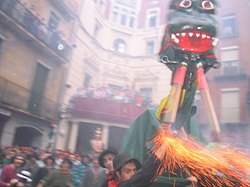
The Patum de Berga (Catalan pronunciation: [pəˈtum ˈβeɾɣə]), or simply La Patum, is a popular and traditional festival that is celebrated each year in the Catalan city of Berga (Barcelona) during Corpus Christi. It consists of a series of "dances" (in Catalan, balls) by townspeople dressed as mystical and symbolic figures, and accompanied either by the rhythm of a drum—the tabal, whose sound gives the festival its name—or band music. The balls are marked by their solemnity and their ample use of fire and pyrotechnics.

It was declared a Traditional Festival of National Interest by the Generalitat de Catalunya in 1983. In 2005, UNESCO declared it one of the Masterpieces of the Oral and Intangible Heritage of Humanity and, in 2008, inscribed it on its Representative List.[1]

Balls

[edit]
  • Els Plens. Documented since 1628.[2]
  • Els Turcs i Cavallets (Turks and Little Knights). Documented since 1828.
  • Les Maces. Documented since 1628.
  • Les Guites (Folkloric "mules"). Documented since 1626 (Guita Grossa), 1890 (Guita boja).
  • L'Àliga (The Eagle). Documented since 1756.
  • Els Nans Vells (The Old Dwarfs). Documented since 1853.
  • Els Gegants (The Giants). Documented since 1695.[3]
  • Els Nans Nous (The New Dwarfs). Documented since 1890.

Origins and significance

[edit]

"La Patum" has its origins in pre-Christian celebrations of the Summer solstice, which were recycled and given new symbolism by the Catholic Church as part of its Corpus celebrations. In Berga, the earliest conserved reference to a Corpus procession is May 20, 1454[1]. The festival evolved and incorporated more elements popular and religious theater in the Middle Ages, leading to a unique combination of giants, devils, angels, moors, and other bizarre-looking characters.

Despite the religious significance of Corpus Christi, and the Patum's descent from "eucharistic performances," in its present form it is rather a show of popular theater. It is unique in Catalonia. Anthropologists and specialists in folklore have been interested in La Patum.

Bruce Springsteen song

[edit]

In 2016, to celebrate the 150th anniversary of the "old giants" (Gegants vells) and the 125th anniversary of the "new giants" (Gegants nous), the Bruce Springsteen song If I should fall behind, arranged by Sergi Cuenca, was danced by both couples of giants.[4][5]

[edit]

See also

[edit]

Bibliography

[edit]

References

[edit]
[edit]
Revisions and contributorsEdit on WikipediaRead on Wikipedia
from Grokipedia
The Patum of is a traditional festival celebrated annually in the town of Berga, , , during the week of Corpus Christi from late May to late June, featuring theatrical parades and brief street dances known as balls performed by local participants portraying effigies and symbolic figures including fire demons, giant-headed dwarves, mule dragons, and giants, all set to the rhythmic beating of the tabal drum and incorporating , , and fire rituals. Originating from medieval parades and interludes accompanying the Catholic feast of Corpus Christi, the festival's documented roots extend to the , preserving a distinctive fusion of religious solemnity and profane entertainment through structured performances by organized groups called comparses. Key events distinguish daytime solemn parades from nighttime festive climaxes, such as the Salt de Plens where hordes of plens—devils brandishing fire-spitting maces—execute synchronized dances in the central square, culminating in the Tirabol, a collective performance uniting all characters to the accompaniment of 19th-century compositions by Joaquim Serra. For its rich embodiment of medieval urban theatre, ritual pyrotechnics, and communal participation, the Patum was proclaimed a of the Oral and Intangible Heritage of Humanity by in 2005 and formally inscribed on the Representative List of the of Humanity in 2008.

History

Medieval Origins

The Patum de Berga originated as a series of processions and theatrical interludes integrated into the Corpus Christi celebrations in Berga during the late medieval period. Archival records indicate that the earliest documented reference to such a procession in the town occurred on May 20, 1454, when participants included a giant effigy of Saint Christopher carried through the streets alongside the Eucharistic host. These events, initially termed the "Bulla" or "Bullícia del Santíssim Sagrament," emerged in the context of 14th-century religious feasts, with preliminary roots traceable to the first third of that century (circa 1320–1333), though firm documentation begins later. The processions served didactic purposes, employing visual and performative elements to convey biblical teachings to an largely illiterate population during the annual feast honoring the transubstantiation. Core components of the Patum, such as giant figures (gegants), first appear in records from 1472, representing adaptations of widespread medieval European traditions where oversized effigies symbolized biblical or allegorical themes in street parades. These elements drew from entremesos—short, lively interludes inserted between the more formal segments of the procession—to inject popular appeal, featuring dances, mock combats, and communal participation that blurred sacred and profane boundaries. While specific guild involvement in Berga remains less explicitly attested in surviving archives compared to larger Catalan cities, the organizational structure mirrored confraternal and artisanal groups common in 15th-century Catalonia, which funded and staged such representations to affirm social cohesion and piety. The played a pivotal role in authorizing these parades as extensions of the solemn Corpus Christi liturgy, viewing them as orthodox complements that reinforced doctrinal observance through accessible spectacle rather than deviation. Ecclesiastical oversight ensured alignment with feast-day protocols, as evidenced by the 1454 procession's integration of effigies with the monstrance-bearing rite, though later strictures from the (1563) began curtailing excesses. This sanctioning reflected pragmatic causal dynamics: medieval clergy leveraged vernacular performances to counter potential heterodox influences in rural peripheries like , prioritizing empirical engagement over rigid solemnity in fostering communal adherence to Eucharistic veneration.

Evolution in the Early Modern Period

During the 16th and 17th centuries, under Habsburg rule in , the Patum de Berga expanded beyond its medieval processional core to incorporate more dynamic and hazardous elements, reflecting broader European trends in festival introduced via Ottoman and Italian influences. Rudimentary and fire-bearing performers began appearing, enhancing the sensory intensity of the dances without altering the fundamental rhythm set by the tabal , which remained central until mid-century additions like additional percussion. The most notable innovation was the Plens, or fire devils—diabolical figures "plens de foc" (full of )—first documented in 1621, where participants wielded maces loaded with petards that exploded during choreographed falls, simulating defeat. By the , records indicate at least two such diablos performing, marking a shift toward intensified rituals that demanded greater coordination among groups like the Maces and emerging fire specialists. This evolution paralleled the emphasis on spectacle in Catholic festivals across the , though local adaptations prioritized communal participation over centralized royal patronage. Municipal oversight strengthened in the late 17th and 18th centuries, with town charters and roles formalizing participant duties to manage risks and maintain order amid Bourbon administrative reforms post-1714. Economic growth in the Berguedà region, supported by extractive industries including early operations, provided resources for enhancements and pyrotechnic supplies, enabling sustained elaboration despite periodic fiscal strains from wars and plagues. These developments institutionalized the Patum as a structured civic event, distinct from ad hoc medieval enactments.

19th and 20th Century Developments

During the , the Patum underwent a process of partial , with its chaotic elements increasingly structured into formalized performances that aligned with emerging municipal oversight and the town's economic expansion. , benefiting from a boom that employed thousands in and mills by mid-century, saw festival participation draw from a growing working-class population, enabling refinements to pyrotechnic sequences such as the coordinated throws of fireballs in the plens de foc. These adaptations preserved the ritual's intensity while adapting to urban growth, as reflected in contemporary accounts of the event's annual execution tied to Corpus Christi observances. Entering the , the Patum maintained continuity through periods of authoritarian rule, including the dictatorship of (1923–1930) and (1939–1975), where it functioned as a sanctioned religious tradition amid restrictions on secular Catalan expressions. Repression of regional languages and dances under Primo de Rivera targeted broader cultural autonomy, yet the festival's ties to allowed its persistence as a contained public spectacle. Under Franco, official media documented vibrant celebrations, such as the 1966 No-Do depicting crowds in ecstatic participation, indicating regime tolerance for folk rituals that reinforced national unity without overt political challenge. Scholarly examinations, including Dorothy Noyes' analysis, frame this endurance as a regulated channel for communal energy rather than outright endorsement of the political order. Economic fluctuations influenced scale and attendance but did not halt the event, with post-Civil War resumptions aligning with industrial recovery in Berguedà's sector by the 1950s. The festival's adaptability ensured its role as a staple of local identity, documented in periodicals and municipal programming that emphasized its medieval roots over modern ideological conflicts.

Post-Franco Revival and Continuity

Following the on November 20, 1975, La Patum de Berga experienced a marked resurgence amid Spain's , evolving from a site of subtle resistance under the regime—where it drew visitors from across as a for larger protests—into a broader emblem of civic mobilization and cultural continuity. Participation intensified, with crowds swelling to over 10,000 in a town of approximately 14,000 residents, straining the central plaça and fostering a participatory that blurred distinctions between performers and spectators. This growth reflected wider societal shifts, incorporating previously marginalized groups such as immigrants, women, and upper-class participants, while peer-group succession ensured generational transmission without relying on invented post-dictatorship narratives. The festival's integration into Catalan identity movements during this period was evident in politicized acts, such as the Guita Xica's symbolic attacks on Spanish flags before 1979 and adoption of Catalan ones thereafter, alongside a 1978 strike by the Guita Grossa demanding better resources amid a miners' context. Campaigns like "Salvem la Patum!" (1978–1979), publicized in outlets such as Avui, emphasized preservation against overcrowding and external dilutions, countering urbanization pressures through shortened procession routes by 1984 and increased repetitions of core elements like the Plens salt—from 12 per performance in the to 60–90 by the , with expanding to about 70 participants. Yet, this revival did not constitute a nationalist reinvention; its pyrotechnic and danced combats retained pre-Franco roots in Corpus Christi entremesos, prioritizing local Berguedan order—symbolized by the Aliga —over abstract Catalanism, as ethnographic underscores tensions between and self-imposed limits to maintain ambient intensity. By the mid-1980s, peak elements like 30 tirabols per night highlighted sustained vigor, though incidents such as the 1989 tear-gassing during a Plens salt over access disputes revealed factional strains from rapid expansion. Post-1975 documentation efforts, including ethnographic monographs and school integrations of Patum practices across , preserved its vernacular forms against modernization, affirming continuity rather than rupture. While some narratives overemphasize its role in independence rhetoric—drawing on its anti-regime —causal examination reveals the festival's endurance as a product of endogenous community dynamics, resilient to both Francoist suppression and subsequent politicization.

Festival Components

Processions and Dances

The Patum de Berga features a structured sequence of processions and choreographed dances centered in the town's main square, Sant Pere, performed by local participants embodying traditional figures to the rhythm of a large known as the tabal. These elements form the core of the festival's daily progression during Corpus Christi week, typically spanning five days from the Tuesday before the feast to the following Sunday, as in 2025 when celebrations ran from June 17 to 22. Processions begin with parades of symbolic characters, escalating from introductory displays to full Patum Completa sequences on key days like Thursday (Corpus Christi) and Sunday. Early days emphasize guild-organized dances and parades of larger figures, such as the gegants (giants) and nans vells (old dwarves), who perform circular balls (dances) with acrobatic steps and coordinated movements around the square. The ball de gegants involves pairs of towering figures—representing historical or mythical personas—dancing in formation, followed by the ball de nans vells, where performers in oversized heads execute leaps and spins, maintaining balance through practiced synchronization. These evolve into processions of nans nous (new dwarves), smaller figures symbolizing youth, who join in lighter, more agile routines, highlighting the festival's multi-generational participation. Central to the dances are the distinctions between plens (full dances) and salts (jumps), with plens comprising extended choreographies of figures like the eagle, Turks, and encircling the square in ritual patterns, while salts denote intense, repetitive leaping sequences that demand endurance and precision. A complete cycle includes multiple salts de plens, where performers execute up to two full rounds of jumps amid the crowd, requiring years of physical within or lineages to master the timing and stamina. Thursday's Patum de lluïment offers a daytime previewing these elements in a measured pace, building to evening climaxes distinct from pyrotechnic displays. This chronological escalation ensures progressive engagement, with Sunday repeating the Patum Completa for communal reinforcement.

Pyrotechnic Elements and Fire Rituals

The pyrotechnic elements of the Patum de Berga culminate in the Salt de Plens, a high-intensity ritual performed in Plaça Sant Pere during the festival's climax. In this event, known as the "Jump of the Full Ones," over 100 plens—fire devils equipped with maces and pyrotechnic devices—execute acrobatic leaps while igniting and hurling directly into the dense crowd of spectators. These performances occur at midnight and in the early hours, with all ambient lights extinguished to heighten the dramatic effect of the explosions and fire trails. The core mechanics involve hand-held fireworks, including compact fireballs launched via short fuses connected to charges, which produce bursts of flame and sparks upon impact or detonation. These trace their integration into the to 16th-century European influences on Catalan theatrical traditions, where gunpowder-based devices were adapted for symbolic representations of infernal chaos within religious processions. Designated colles, or performance groups, specialize in variants such as mulasses—devices emitting sustained streams of fire—and caragols, which generate spiraling trajectories of ignited projectiles, adding layers of visual and auditory intensity to the ritual. Technical standardization emerged in the , as festival organizers refined munition designs for reliable ignition and consistent output, reflecting broader advancements in pyrotechnic while preserving artisanal preparation methods. This evolution ensured the rituals' mechanical precision, with fuses calibrated for sequential detonations synchronized to drum rhythms, enabling performers to maintain formation amid the enveloping smoke and heat.

Costumes, Music, and Performers

The costumes of the devils in the Patum feature specialized attire designed for handling maces and igniting fireworks during performances, emphasizing mobility and protection amid pyrotechnic displays. These outfits, part of the Ball de Diables documented since , incorporate traditional elements that allow for dynamic, acrobatic movements while symbolizing infernal figures in the festival's medieval-derived street theater. The giants, known as gegants, include pairs such as the Gegants Vells, first incorporated into the Patum in 1866 and marking their 150th anniversary in ; these figures, dressed as Saracens, reach heights of up to approximately 5 meters and are constructed primarily from wood, fabric, and lightweight materials to facilitate processional dances. Other costumed elements, like the guites (mule-like dragons) and nans (dwarves with oversized heads), employ and fabric for exaggerated, symbolic forms that enhance the visual spectacle. Music in the Patum relies on percussive and wind instruments, including the tabal—a large drum whose rhythmic "pa-tum" beat defines the festival's name and drives the tempos of all dances—and gralles, folk oboes that provide melodic accompaniment alongside smaller percussion like the taba . These unaltered rhythms, rooted in medieval precedents, synchronize the performers' steps and maintain the event's chaotic yet structured energy without modern adaptations. Performers operate through comparses—organized groups responsible for specific figures—who transmit skills via generational within families or local associations, prioritizing mastery of , timing, and instrument playing over broad participation. This guild-like structure ensures fidelity to historical techniques, with roles such as tabalers and grallers requiring years of practice to execute the precise, physically demanding routines.

Cultural and Religious Significance

Ties to Corpus Christi and Medieval Traditions

The Patum de Berga accompanies the Catholic , instituted by in 1264 through the Transiturus de hoc mundo to commemorate the real presence of Christ in the via public processions and veneration. In , the festival's dances and performances unfold during the week encompassing the Thursday observance, serving as ritual extensions of the Eucharistic rite where participants enact symbolic battles between order and chaos, mirroring theological themes of divine victory. This integration positions the Patum's energetic, bodily expressions as a profane complement to the solemn sacramental focus, a pattern observed in medieval Catalan processions where folk interludes (entremesos) dramatized scriptural events to catechize illiterate audiences. Historical traces link the Patum's core elements—such as devil figures and rhythmic drumming—to 15th-century entremeses documented in regional records, including references to St. Michael and devils in 1451 processional contexts, approved by local as didactic tools within Corpus frameworks. These were not mere secular additions but sanctioned adjuncts to foster communal devotion in the Berguedà , where piety centered on Eucharistic exposition amid agrarian cycles. Unlike speculative pagan derivations, primary attestations tie the practices to post-13th-century liturgical expansions, with church oversight ensuring alignment to orthodoxy rather than autonomous folk survivals. The festival's schedule embeds religious discipline, commencing after the vigils and processions that punctuate fasting periods leading to Corpus, culminating in shared repasts that mark the feast's joyful release. This temporal embedding reflects medieval Catholic causality, where profane exuberance channels piety into collective affirmation of sacramental truths, distinct from solstice rites elsewhere in despite superficial fire motifs.

Symbolic Interpretations of Chaos and Order

The Patum de Berga juxtaposes motifs of infernal chaos, embodied by fire-wielding devils (diables), against the restorative order of communal dances and processions, a duality rooted in medieval Corpus Christi traditions where ritual evokes hellish temptation and purgatorial purification. In performances like the Salts de Plens, devils hurl benzeros—explosive —into dense crowds, creating a sensory assault of smoke, noise, and sparks that simulates demonic frenzy and the soul's trials by , as interpreted in Catalan folk theater where devils personify evil forces subdued by divine order. This chaos is ritually contained by the disciplined choreography of accompanying elements, such as the Ball de Gegants (dance of giants), where oversized effigies move in synchronized steps symbolizing hierarchical stability and the triumph of faith over , a balance observable in the festival's structure since at least the . From a causal perspective on dynamics, the controlled disorder of dances functions as a behavioral mechanism for tension release, channeling collective energies into bounded risk-taking that reinforces social cohesion without escalating to genuine ; participants, often numbering in the thousands, adhere to implicit rules amid pyrotechnic hazards, yielding historically low rates of severe communal disruption despite annual intensity, as the festival's continuity attests. Dorothy describes this as a "primitive" yet adaptive expression where bodily immersion in rituals fosters shared , prioritizing empirical patterns of group synchronization over speculative individual psychologies. Empirical observation reveals that the dances' rhythmic precision—demanding physical coordination and mutual trust—serves to reimpose order post-chaos, evident in the transition from frenzied Guites to orderly Balls, which empirically correlates with heightened participant bonding and minimal post-ritual conflicts. Contemporary analyses risk over-psychologizing these motifs by imposing modern Freudian or Jungian frameworks, attributing chaos to subconscious eruptions rather than verifiable adaptations for crowd regulation; such interpretations, often from academic traditions prone to symbolic overreach, neglect causal evidence from behavioral sequences where fire's peril heightens vigilance and reciprocity, as seen in the devils' choreographed proximity to spectators without proportional injury spikes. Instead, first-principles scrutiny favors observable outcomes: the Patum's dual structure empirically sustains community resilience, with chaos motifs yielding to order not through abstract symbolism alone but through practiced rituals that calibrate risk and restraint, maintaining social equilibrium across centuries.

Community and Social Functions

The Patum de Berga fosters local social cohesion through the colles, voluntary associations responsible for organizing and performing the festival's dances, processions, and pyrotechnic elements, which transmit traditions across generations within families and communities. These groups cultivate a strong emotional attachment among members, contributing to personal and collective identity formation tied to Berga's cultural practices. Participation in the Patum thus reinforces intergenerational bonds, as roles in the colles—such as performers of gegants or devils—are often passed down, embedding the festival in the social fabric of the town. In a of approximately 17,000 residents, the annual event draws thousands of visitors during its five-day span around Corpus Christi, generating a temporary surge in tourism-related economic activity for local businesses, accommodations, and services. This influx provides seasonal revenue but remains limited to the period, with no sustained year-round impact documented, reflecting the event's localized scale amid Berga's rural-industrial . The Patum also functions as a communal expression of Berga's identity, mapping and temporarily bridging social divisions through collective performance, while asserting regional distinctiveness in the Catalan context amid historical and ongoing tensions with central Spanish governance. This role has persisted through political shifts, including post-Franco , where the festival's revival emphasized community solidarity without altering its core structure of controlled chaos.

Recognition and Preservation

UNESCO Designation

In 2005, UNESCO proclaimed the Patum of Berga a Masterpiece of the Oral and Intangible Heritage of Humanity, recognizing its exceptional value as a living tradition blending religious solemnity with exuberant, participatory chaos. This initial designation under the Masterpieces program—preceding the 2003 Convention—emphasized criteria such as outstanding cultural significance, viability through intergenerational transmission, and community-driven safeguarding, applied to elements demonstrating irreplaceable intangible expressions. For the Patum, specifically noted its mix of sacred Corpus Christi processions and profane elements like devil figures hurling into crowds, with choreographies and rhythms preserved via oral and performative knowledge rather than notation, enabling adaptive continuity over centuries. The proclamation process involved nomination by , evaluation by experts assessing empirical distinctiveness against global comparators, and confirmation of the festival's role in fostering social cohesion amid its high-risk —a feature empirically rare in documented European festivals due to the direct, unbarriered interaction between performers and spectators. While 's representativity criterion prioritizes over strict uniqueness, the Patum's designation underscores verifiable traits like its medieval-derived "entremeses" evolving into synchronized , distinguishing it from more static processional traditions elsewhere. In 2008, following the transition to the 2003 Convention framework, the Patum was inscribed on the Representative List of the of Humanity at the third session of the Intergovernmental Committee in . This full listing reinforced commitments to periodic reporting and international cooperation, yielding implications such as enhanced visibility for heritage funding from bodies like the Spanish Ministry of Culture and increased , as the global spotlight has drawn visitors seeking authentic experiential heritage beyond sanitized spectacles.

Efforts in Documentation and Transmission

Documentation of the Patum de Berga has included film recordings since at least the mid-20th century, with the 1962 documentary La Patum de Berga by Nogués capturing processions, dances, and pyrotechnic displays during Corpus Christi celebrations. Archival projects have also focused on musical elements, such as the 2024 revival of forgotten for three festival dances from the collection of local Ramon Miquel i Vergés, preserving scores dating to earlier performances. Post-2005 UNESCO designation, digital efforts have expanded through online repositories and exhibits, including the Museu de la Patum in Berga, which catalogs costumes, , and ritual artifacts to support verifiable historical continuity. Transmission occurs primarily through the comparses—specialized performing groups or guilds responsible for specific elements like devils (diables), mules (guites), and full-bodied figures (plens)—where skills are passed via hands-on apprenticeships emphasizing repetitive annual practice over formal instruction. These guilds measure success by sustained participation rates, with the festival's uninterrupted execution since the 15th century indicating effective intergenerational handover, as core roles require physical mastery of dances and fire-handling techniques acquired through observation and mentorship within family or group lineages. The Patronat de la Patum, founded in the early 1990s by festival participants and city officials, coordinates these efforts by nominating comparsa leaders to oversee training and enforce participation criteria favoring long-term locals to bolster continuity. Preservation strategies emphasize resistance to modifications that could erode authenticity, particularly in pyrotechnic rituals where traditional ignition and combustion methods for pleins and fire devils are upheld against proposed safety alterations, as altering artifacts would disrupt the ritual's chaotic essence central to its medieval origins. The Patronat has pursued trademarks on distinctive elements and UNESCO recognition in 2005 to counter dilution from tourism or imitations, suppressing unauthorized neighborhood variants and limiting access to preserve the controlled disorder of official performances. These measures prioritize empirical fidelity to documented practices over external impositions, ensuring the festival's causal structure—linking fire, movement, and community ritual—remains intact despite urban pressures.

Modern Challenges to Authenticity

The promotion of La Patum as a by the festival's governing body, the Patronat, has sparked since the , with critics arguing that intensified marketing dilutes the event's communal authenticity in favor of spectator-oriented . This shift has led to debates over branding strategies that emphasize the festival's "explosive" appeal to draw external visitors, potentially eroding the ritual's original emphasis on local participation and symbolic intensity. European Union directives on pyrotechnics, such as requirements for minimum spectator distances of 15 meters from high-risk , pose ongoing threats to the Patum's core fire rituals, which rely on close-quarters immersion to evoke chaos and . Although has historically resisted full enforcement of these rules to preserve traditional fiestas, mounting pressures could necessitate adaptations like reduced explosive proximity or scaled-back displays, softening the unyielding physicality that defines elements such as the diables dances. In 2025, organizers implemented what was described as the festival's most inclusive edition to date, involving 60 participants with disabilities in the opening through facility adaptations and wheelchair-accessible groupings, aiming to broaden participation beyond able-bodied locals. Such modifications, while expanding access, have raised concerns among purists that altering spatial dynamics and ritual flows—traditionally unaccommodating to maintain symbolic disorder—compromises the event's unaltered transmission as a medieval-derived ordeal of fire and fervor. Debates persist over declining generational involvement, with some observers citing broader Catalan disengagement from physical traditions amid , yet evidence indicates sustained mass participation, as the Patum has evolved into a of intensified bodily engagement rather than contraction. Local data underscores robust roles in performative groups, countering erosion narratives and affirming resilience against demographic shifts.

Reception and Impact

Domestic and International Popularity

The Patum de Berga draws thousands of visitors each year to , a town of roughly 16,600 residents, swelling local crowds during its five-day Corpus Christi run and providing a measurable economic uplift through heightened and related spending. Key performances, such as the salt de plens, can concentrate up to 6,000 spectators in the central Plaça de Sant Joan, underscoring its capacity to mobilize regional audiences despite the town's modest size. Domestic media in and routinely feature the event, with outlets like El Periódico and portraying it as a cornerstone of local identity and communal vitality, evidenced by annual analyses of attendance and socioeconomic indicators conducted by Berga authorities. Internationally, the festival's profile elevated after proclaimed it a of the Oral and Intangible Heritage of Humanity in 2005 and inscribed it on the Representative List in , prompting features in global media that highlight its explosive rituals and historical depth. Publications such as (2016), , and have covered its spectacles, drawing parallels to broader Catalan traditions while noting increased foreign attendance in the years following the designation. This exposure has sustained rather than inflated interest, as evidenced by consistent programming budgets—reaching 476,000 euros for 2025—to maintain quality amid steady visitor inflows. The event's longevity—documented from 1525 with roots in late-14th-century processions—serves as a metric of genuine endurance, preserving core elements like danced combats and fire displays across six centuries without dilution by ephemeral fads. evaluators have affirmed its intergenerational appeal, uniting participants and spectators from children to elders in a manner that transcends hype, as local troupes and community involvement remain volunteer-driven and tradition-bound. This contrasts with short-lived spectacles, reflecting causal continuity in its appeal tied to authentic transmission rather than marketed novelty.

Influences in Media and Culture

In 2016, for the 150th anniversary of Berga's giants, musician granted permission for his song "If I Should Fall Behind" (from the 1992 album ) to be adapted and performed during the giants' dance, arranged by composer Sergi Cuenca. This one-time integration of into the traditional ball de gegants underscored a deliberate cultural crossover, with the giants—representing historical figures like King James I and Queen Violant—dancing to the track's rhythm amid the festival's medieval pageantry. The Patum has featured in various documentaries highlighting Catalan intangible heritage, such as the 1970s La Patum de Berga, which captures the festival's Corpus Christi processions and symbolic figures against Berga's urban backdrop. Later productions, including Deutsche Welle's 2019 segment on the event's pyrotechnic and rhythmic elements, have broadcast footage internationally, emphasizing its endurance as a communal ritual without broader interpretive overlays. These media portrayals, often produced by public broadcasters or heritage archives, serve primarily to document performative traditions like the salt de plens rather than exert narrative influence. In musical literature, motifs from the Patum appear in Manuel de Falla's works; a prominent linked to Berga's festival informed elements of his El amor brujo (1913), reflecting early 20th-century Catalan folk integrations into classical composition. Scholarly texts on regional reference the Patum's drum-driven dances as exemplars of pre-modern European ritual theater, though such citations prioritize ethnographic description over symbolic extrapolation.

Safety Considerations and Incidents

The Patum de Berga involves intensive pyrotechnic displays, including fireballs (plens) thrown by participants known as devils directly into crowds, creating inherent risks of burns from explosions, embers, and close-contact impacts. These elements expose both performers and spectators to thermal injuries, with historical data indicating that first- and second-degree burns are among the most frequent occurrences during the festival's fire-heavy sequences. Despite the proximity of ignited materials to unprotected participants in traditional attire, fatality rates remain low, with no verified deaths directly attributable to pyrotechnic malfunctions or impacts across documented festival history. Modern safety protocols mitigate these risks without substantially altering core traditions, including 24-hour armed guardianship of pyrotechnic stockpiles in secure, refrigerated facilities to prevent unauthorized access or spontaneous ignition, followed by controlled transport to performance sites. Up to 100 police officers deploy annually to manage crowd dynamics, while on-site medical stations address contusions, burns, and alcohol-related issues, which have declined in incidence over time due to heightened participant awareness and local expertise honed through generational involvement. Protective gear for performers is minimal to preserve authenticity, relying instead on practiced timing and crowd familiarity to avert severe outcomes, though traditional costumes show evidence of burn repairs from past exposures. Major incidents directly tied to pyrotechnics are absent from recent records, contrasting with isolated non-pyrotechnic events like a 2023 fairground or a 2005 off-site during ancillary festivities, underscoring that risks are managed effectively through experiential proficiency rather than external impositions that could dilute the festival's chaotic essence. This track record supports the view that empirical dangers, while real, are proportionate to the controlled intensity of displays, with injuries typically minor and self-limiting among acclimated locals.

References

Add your contribution
Related Hubs
User Avatar
No comments yet.