
Recent from talks
Paul the Deacon
Knowledge base stats:
Talk channels stats:
Members stats:
Paul the Deacon
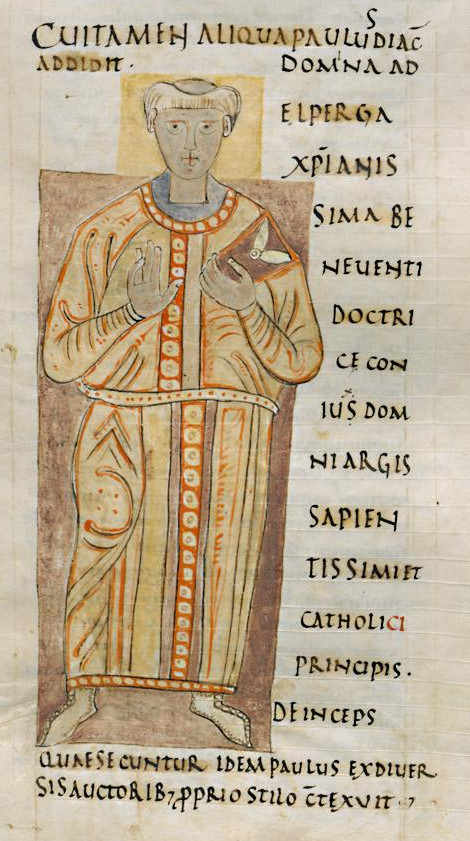
Paul the Deacon (c. 720s – 13 April in 796, 797, 798, or 799 AD), also known as Paulus Diaconus, Warnefridus, Barnefridus, or Winfridus, and sometimes suffixed Cassinensis ("of Casīnum", the citadel of which was present day Monte Cassino), was a Benedictine monk, scribe, and historian of the Lombards.
An ancestor of Paulus's named Leupichis emigrated to Italy in 568 in the train of Alboin, King of the Lombards. There, he was granted lands at or near Forum Julii (Cividale del Friuli). During an invasion by the Avars, Leupichis's five sons were carried away to Pannonia, but one of them, his namesake, returned to Italy and restored the ruined fortunes of his house. The grandson of the younger Leupichis was Warnefrid, who by his wife Theodelinda became the father of Paul. Paulus was his monastic name; he was born Winfrid, son of Warnefrid, about 720 in the Duchy of Friuli.
Thanks to the possible noble status of his family, Paul received an exceptionally good education, probably at the court of the Lombard king Ratchis in Pavia, learning the rudiments of Greek from a teacher named Flavian. Paul was probably the secretary of the Lombard king Desiderius, a successor of Ratchis. After Desiderius's daughter Adelperga had married Arichis II, duke of Benevento, Paul, at her request, wrote his continuation of Eutropius's Summary of Roman History (Latin: Breviarium Historiae Romanae).
He lived at the court of Benevento for at least several years before 774, when Charlemagne captured Pavia, and he may have fled the city during that conquest. Eventually he entered a monastery on Lake Como, and before 782 he entered the great Benedictine house of Monte Cassino, where he made the acquaintance of Charlemagne. Around 776, Paul's brother Arichis was carried off to Francia as a prisoner after a revolt in Friuli. When Charlemagne visited Rome five years later, Paul wrote to him on behalf of Arichis, who was then freed.
After Paul's literary achievements had drawn the attention of Charlemagne, he became an important contributor to the Carolingian Renaissance. In 787 he returned to Monte Cassino, where he died on 13 April probably in the year 799. His epithet Diaconus indicates that he took orders as a deacon; and some believe he was a monk before the fall of the Lombard Kingdom.
Paul's chief work is his Historia Langobardorum, an incomplete history in six books that he wrote after 787 but no later than 795–96. It covers the history of the Langobards from their legendary origins in the north (in "Scadinavia") and their subsequent migrations—notably to Italy in 568–69—to the death of King Liutprand in 744. The books contain much information about the Eastern Roman Empire, the Franks, and other peoples. The history is written from a Lombardian point of view and is especially valuable for its depictions of the relations between the Franks and the Lombards. It begins:
The region of the north, in proportion as it is removed from the heat of the sun and is chilled with snow and frost, is so much the more healthful to the bodies of men and fitted for the propagation of nations, just as, on the other hand, every southern region, the nearer it is to the heat of the sun, the more it abounds in diseases and is less fitted for the bringing up of the human race.
Among Paul's sources were the document called the Origo gentis Langobardorum, the Liber pontificalis, the lost history of Secundus of Trent, and the lost annals of Benevento. He also heavily drew upon the works of Bede, Gregory of Tours, and Isidore of Seville.
Hub AI
Paul the Deacon AI simulator
(@Paul the Deacon_simulator)
Paul the Deacon
Paul the Deacon (c. 720s – 13 April in 796, 797, 798, or 799 AD), also known as Paulus Diaconus, Warnefridus, Barnefridus, or Winfridus, and sometimes suffixed Cassinensis ("of Casīnum", the citadel of which was present day Monte Cassino), was a Benedictine monk, scribe, and historian of the Lombards.
An ancestor of Paulus's named Leupichis emigrated to Italy in 568 in the train of Alboin, King of the Lombards. There, he was granted lands at or near Forum Julii (Cividale del Friuli). During an invasion by the Avars, Leupichis's five sons were carried away to Pannonia, but one of them, his namesake, returned to Italy and restored the ruined fortunes of his house. The grandson of the younger Leupichis was Warnefrid, who by his wife Theodelinda became the father of Paul. Paulus was his monastic name; he was born Winfrid, son of Warnefrid, about 720 in the Duchy of Friuli.
Thanks to the possible noble status of his family, Paul received an exceptionally good education, probably at the court of the Lombard king Ratchis in Pavia, learning the rudiments of Greek from a teacher named Flavian. Paul was probably the secretary of the Lombard king Desiderius, a successor of Ratchis. After Desiderius's daughter Adelperga had married Arichis II, duke of Benevento, Paul, at her request, wrote his continuation of Eutropius's Summary of Roman History (Latin: Breviarium Historiae Romanae).
He lived at the court of Benevento for at least several years before 774, when Charlemagne captured Pavia, and he may have fled the city during that conquest. Eventually he entered a monastery on Lake Como, and before 782 he entered the great Benedictine house of Monte Cassino, where he made the acquaintance of Charlemagne. Around 776, Paul's brother Arichis was carried off to Francia as a prisoner after a revolt in Friuli. When Charlemagne visited Rome five years later, Paul wrote to him on behalf of Arichis, who was then freed.
After Paul's literary achievements had drawn the attention of Charlemagne, he became an important contributor to the Carolingian Renaissance. In 787 he returned to Monte Cassino, where he died on 13 April probably in the year 799. His epithet Diaconus indicates that he took orders as a deacon; and some believe he was a monk before the fall of the Lombard Kingdom.
Paul's chief work is his Historia Langobardorum, an incomplete history in six books that he wrote after 787 but no later than 795–96. It covers the history of the Langobards from their legendary origins in the north (in "Scadinavia") and their subsequent migrations—notably to Italy in 568–69—to the death of King Liutprand in 744. The books contain much information about the Eastern Roman Empire, the Franks, and other peoples. The history is written from a Lombardian point of view and is especially valuable for its depictions of the relations between the Franks and the Lombards. It begins:
The region of the north, in proportion as it is removed from the heat of the sun and is chilled with snow and frost, is so much the more healthful to the bodies of men and fitted for the propagation of nations, just as, on the other hand, every southern region, the nearer it is to the heat of the sun, the more it abounds in diseases and is less fitted for the bringing up of the human race.
Among Paul's sources were the document called the Origo gentis Langobardorum, the Liber pontificalis, the lost history of Secundus of Trent, and the lost annals of Benevento. He also heavily drew upon the works of Bede, Gregory of Tours, and Isidore of Seville.
Recent media