


Community hub
Recent from talks
Contribute something
Nothing was collected or created yet.
Pentax Auto 110
View on Wikipedia | This article needs additional citations for verification. (June 2010) |

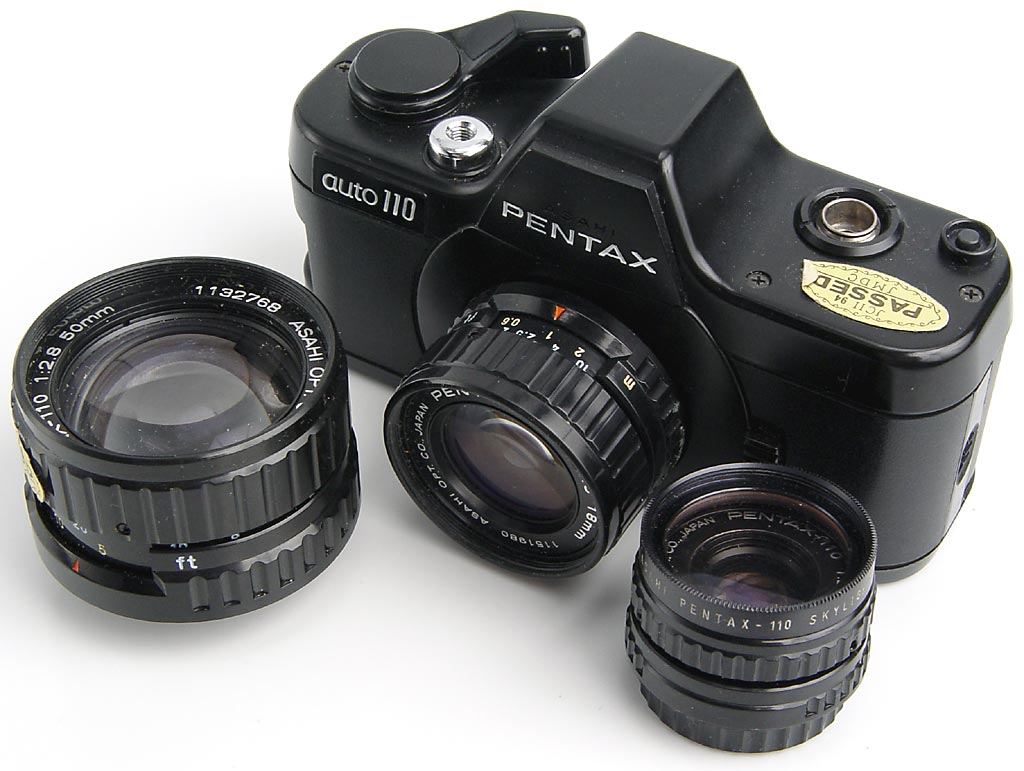
The Pentax Auto 110 and Pentax Auto 110 Super were fully automatic single-lens reflex cameras manufactured by Asahi Pentax for use with Kodak 110 film cartridges.[1] The Auto 110 was introduced with three interchangeable, fixed focal length lenses in 1978. A further three lenses (including one zoom lens) were added in 1981 to coincide with the release of the Auto 110 Super the following year. The camera system was sold until 1985. The complete system is sometimes known as the Pentax System 10, apparently for its official Pentax name, although most Pentax advertising only uses the camera name or Pentax-110. This model represented the only complete ultraminiature SLR system manufactured for the 110 film format, although several fixed-lens 110 SLRs were sold. The camera system also claims to be the smallest interchangeable-lens SLR system ever created.
Auto 110
[edit]
The Pentax Auto 110 features fully automatic exposure, with no user-settable exposure compensation or adjustments. Metering is TTL (through-the-lens) and center-weighted. Unlike 35 mm SLRs, the system's lenses do not have a built-in iris to control the aperture. Instead, an iris is mounted inside the camera body, and functions as both an aperture control and a shutter. This mechanism is capable of programmed exposures between 1/750 s at f/13.5; and 1 s at f/2.8. To ensure that light travelling past the diaphragm blades could not get through to the film over time, the camera's mirror system also functions as a light-tight seal when in the viewing and focusing position. Since the iris is part of the camera, all of the system's lenses had to be constructed with an f/2.8 aperture. The lens' designs, based upon the film dimensions, result in the 24 mm lens being the 'normal' focal length (i.e. equivalent angle of view to a 50 mm lens on a 135 format camera), while lenses of wider angles or longer focal lengths were larger.
Film speed detection
[edit]The camera detects the film speed by the presence or absence of a ridge on the cartridge, as specified in the Kodak 110 film standard. Since there is no official specification of what the film speeds should actually be—they were just "low" and "high"—film and camera manufacturers had to decide for themselves the meaning. Pentax chose ISO 80 and 320 as their settings, but commercially available films at ISO 100 and 400 are close enough to work in practice. A film with an ISO 200 speed would result in either under- or over-exposure. The exposure latitude of color print films is about 2 f/stops (meaning that a photographer could expose either 2 f/stops under or 2 f/stops over the exposure set by the camera). Unfortunately, some recently produced 110 film is rated at ISO 400, but is packaged with the ridge indicating "low". If this is the case, the ridge must be removed (by filing or cutting with a sharp blade) for the camera to expose correctly. Since only a few 110 cameras ever supported the ISO auto-selection, this does not affect the majority of cameras using the format but does affect the Pentax Auto 110. In 2012/2013 ISO 100 film has been produced and marketed under the Lomography label, and gives excellent results, without the need to modify the cartridge casing.
The camera was offered in a special edition "Safari" model, identical to the Auto 110 except for the brown-and-tan color scheme.
Auto 110 Super
[edit]

Introduced in late 1982, the Super is nearly identical in basic shape and size to the previous model and accepts the same lenses. Many improvements and changes were included to make this model arguably a better camera than the previous Auto 110. Film winding is improved with a single-stroke film advance lever that advances the film and cocks the shutter in one winding (the Auto 110 takes two strokes to advance the film). A switch around the shutter release button enables a new ten-second self-timer mode and a shutter lock; the self-timer activates a red light on the pentaprism housing, which flashes during the 10-second shutter release count-down. A button on the front on the user's left hand side gives a +1.5 EV (exposure value) backlit scene exposure compensation.
The optional winder offers an improved battery cover, a well-known weak component in the Auto 110. The shutter button is protected from accidental tripping by an altered casing around the button. The flash synchronization socket cover on the Super is permanently attached to the camera in an attempt to prevent loss, though many still get lost when the plastic tether breaks.
The viewfinder screen has a split image rangefinder center, surrounded by a microprism collar, whereas the Auto 110 has the split image rangefinder center only. The low light warning activates at 1/45 s (the Auto 110 activates at 1/30 s).
Lenses
[edit]The line of lenses consisted of these three at launch:
- 18 mm f/2.8 wide-angle lens (equivalent angle of view to a 35 mm lens on a 135 format camera), (Filter diameter: 30.5 mm).
- 24 mm f/2.8 normal lens (equiv. 50 mm). The optical design meant that this was the smallest lens on the system. (Filter diameter: 25.5 mm)
- 50 mm f/2.8 telephoto lens (equiv. 100 mm), (Filter diameter: 37.5 mm)
In 1981, three more lenses were included:
- 18 mm "Pan Focus" lens was a compact lens of fixed focus set to the hyperfocal distance; the short focal length and wide aperture meant that its depth of field stretched from 1.75 m (5.7 ft) to infinity. The camera aperture needed to be set at f/6.3 for this lens to work as intended,(Filter diameter: 30.5 mm)
- 70 mm f/2.8 telephoto lens (equiv. 140 mm),(Filter diameter: 49 mm)
- 20–40 mm f/2.8 zoom lens (equiv. 40–80 mm). This lens extended for wider focal lengths and shortened towards the telephoto end, (Filter diameter: 49 mm)
The three later lenses are much rarer.
Soligor also made a 1.7x teleconverter.
Lens hoods were available for all of the lenses, and Pentax sold add-on close-up lenses for macro photography and a range of filters.
The 110 lenses have found a new life with the Pentax Q system, which will accept them with an adapter, albeit with a 5.6x crop factor (effective increase in focal length).[2] The lenses can also be mounted on Panasonic/Olympus Micro Four Thirds cameras with an adapter, and the crop factor is only 2x, the same as on the original Pentax 110 body. Wherever adapted, the lenses still require manual focusing.
The 110 lenses can be adapted to APS-C mirrorless cameras, with little vignetting on 24mm, less on 18mm, and no vignetting on 50mm.
-
 Pentax-110 f/2.8 18 mm
 -
 Pentax-110 f/2.8 24 mm
 -
 Pentax-110 f/2.8 20~40 mm Zoom
 -
 Pentax-110 f/2.8 50 mm
 -
 Pentax-110 f/2.8 70 mm


Winders
[edit]
Two models of motor winder were produced. The original 110 Winder took 2 AA batteries and could wind through 100 cartridges of 110 film with one set of batteries. It works only in single-shot mode. It takes about 1.5 s to wind a frame. The 110 Winder II, introduced in 1982, adds a continuous shooting mode and improves the battery cover door, which was fragile on the original.
Flash
[edit]A custom electronic flash unit, the AF130P, was part of the original Auto 110 system, and was produced until the camera ceased being manufactured. Pentax responded to criticism that this electronic flash unit was too large by introducing the smaller AF100P electronic flash unit in 1980. This unit, however, was never part of the Pentax camera kits and became rare.
Other accessories
[edit]Pentax produced a range of various camera-carrying cases and also a belt-clip for the cameras.
See also
[edit]References
[edit]- ^ Pentax ME Super Book of Photography. London: Hamlyn. 1982. p. 46. ISBN 0600356337.
- ^ "Adapted lenses tested on the Q : the reference thread - PentaxForums.com". www.pentaxforums.com. Retrieved 3 June 2018.
External links
[edit]- Pentax110.co.uk, a very complete but unofficial reference to these cameras, archived here
- Pentax 110 SLR at CameraQuest.
- Comprehensive Info and Images
Pentax Auto 110
View on GrokipediaOverview
Design and format
The Pentax Auto 110 is widely regarded as the smallest interchangeable-lens single-lens reflex (SLR) camera ever produced for its 110 film format, with body dimensions of 99 × 56 × 32 mm and a weight of 159 grams without a lens. The camera features a lightweight plastic body construction, paired with a precise 110 bayonet lens mount for compatibility with the system's interchangeable lenses. This minimalist design prioritizes compactness, allowing the entire camera to fit easily into a pocket while retaining the core SLR functionality of through-the-lens viewing and focusing. Central to the Pentax Auto 110's design is its use of the 110 film cartridge system, introduced by Kodak in 1972 as a convenient alternative to larger film formats for consumer photography. The 110 format utilizes 16 mm wide film stock within a drop-in cartridge, producing negatives measuring 13 × 17 mm—the full frame size for this system—and yielding up to 24 exposures per cartridge. By leveraging this small-format cartridge, which eliminates the need for manual film loading and includes pre-set ISO indexing, the Auto 110 achieves a truly pocketable form factor without compromising the optical precision of an SLR. The 110 format quickly gained popularity in the 1970s for enabling compact point-and-shoot cameras, and the Pentax Auto 110 extended this trend to SLR systems by shrinking the reflex mirror, viewfinder, and shutter mechanisms to match the film's scale. Compared to bulkier 35 mm SLRs of the era, such as the Olympus OM-1 or Pentax Spotmatic, the Auto 110 offers dramatically improved portability—often half the size and weight—while preserving the eye-level reflex viewfinder for accurate composition and focus confirmation in a handheld, everyday device.Core features
The Pentax Auto 110 system employs a fully programmed automatic exposure mechanism that selects both shutter speed and aperture based on through-the-lens (TTL) metering, with no provision for manual override or exposure compensation. Shutter speeds range from 1 second at wide apertures to 1/750 second at smaller apertures, while the aperture range spans f/2.8 to f/13.5, depending on the mounted lens. This electronic programmed mode ensures simplicity for users, prioritizing ease of operation in a compact format.[5][6] Metering is conducted via TTL center-weighted measurement using a silicon photodiode (SPD) cell located near the pentaprism, which reads light at full aperture before stopping down to the programmed setting at the moment of exposure. The system operates in EV 3 to 17 (at ISO 100), providing full automation without manual modes, and includes LED indicators in the viewfinder—a green light for shutter speeds above 1/30 second and an amber light for slower speeds to warn of potential camera shake. Film speed is automatically detected from the cartridge's notched tab, automatically detecting ASA 100 or 400.[5][6] The viewfinder utilizes a pentaprism design offering 0.75× magnification and 87% field of view coverage, equipped with a split-image rangefinder patch surrounded by a ground glass focusing screen for precise manual focusing. Viewfinder information includes the exposure LEDs and a battery check function activated by half-pressing the shutter release.[5][6] Power for the metering, electronic shutter, and viewfinder LEDs is supplied by two 1.5V LR44 or SR44 batteries housed in a compartment adjacent to the film chamber, with an estimated life of approximately one year under normal usage or sufficient for several rolls of film. A battery check LED confirms functionality when the shutter button is partially depressed.[5][6] Film loading involves inserting a standard 110 cartridge into the dedicated chamber at the base of the camera body, closing the back cover to engage the automatic transport, and advancing the film via the lever until the first frame marker appears in the viewfinder. The mechanical exposure counter, visible through a window on the back cover, resets to 'S' (start) upon loading and advances with each full lever stroke, typically requiring two strokes for the original model to prevent multiple exposures via an interlock mechanism that blocks the shutter until the film is fully advanced. This design ensures reliable operation with 110 film's 13×17 mm negative format, yielding up to 24 exposures per cartridge.[5][6]History
Development background
In the early 1970s, Kodak's introduction of the Instamatic 110 film cartridge in 1972 sparked widespread adoption of the compact format, prompting camera manufacturers to explore subminiature systems that could rival the convenience of 35mm SLRs while fitting in a pocket.[3] Asahi Optical Co., Ltd., known for its Pentax line of precision cameras, recognized the potential in this burgeoning market and sought to develop the world's smallest interchangeable-lens SLR for 110 film, aiming to elevate the format beyond basic snapshot devices.[2] This motivation was driven by the need to capture consumer interest in portable photography, as 110 film sales surged but lacked advanced SLR options.[7] The conceptual origins of the Pentax Auto 110 trace back to a 1977 prototype from Sugaya Optical, a small Japanese firm led by former Nikon engineer Mr. Sugaya, who designed an early 110-format SLR but could not bring it to production.[2] Asahi acquired the design rights and refined it through their R&D team under engineer M. Suzuki, transforming it into a viable system camera branded as "System 10."[2] Key engineering challenges included miniaturizing the pentaprism viewfinder to maintain a bright, eye-level SLR experience in a body measuring just 99mm tall, while incorporating extensive plastic construction via injection molding to reduce weight to 155 grams without sacrificing durability—unlike traditional metal bodies.[8] A novel behind-the-lens leaf shutter, integrated with aperture blades, further addressed size constraints by eliminating the need for complex in-lens mechanisms, allowing lenses to focus solely on optics.[8] Positioned against fixed-lens 110 cameras from competitors like Kodak's Instamatic series, Minox's rangefinder models, and Agfa's compact automatics, the Auto 110 differentiated itself as a premium, versatile SLR system with interchangeable optics, appealing to enthusiasts seeking professional-grade control in a subminiature package.[2] Asahi emphasized automation, including programmed exposure and TTL metering, to broaden its consumer appeal amid a market shifting toward point-and-shoot simplicity.[7] The system was announced in October 1978, debuting with three prime lenses and accessories to underscore its comprehensive nature.[7]Production and models
The Pentax Auto 110 was launched in late 1978 in Japan and in 1979 internationally, with initial kits typically including the standard 24mm f/2.8 lens.[2][9] The camera system, known as Pentax System 10, marked Asahi Pentax's entry into the subminiature SLR market amid the peak popularity of 110 film.[4] In 1980, the original Auto 110 gained notable recognition when it was mounted on a NASA rocket for constellation observation, demonstrating its reliability in extreme conditions.[4] In 1982, Pentax introduced the Auto 110 Super as an updated version of the original body, retaining the existing lens lineup without introducing new optics.[10] Production of the Auto 110 series continued until 1985, encompassing both models.[11] Early production units featured "Asahi" branding alongside the Pentax name, reflecting the company's full designation at the time, while later variants shifted to "Pentax" only; color options included chrome-trimmed bodies as standard, with black and brown finishes available in limited releases.[12] The relatively low production volume—estimated to be under 100,000 units total—has contributed to the system's rarity on the collector's market today.[2] The end of production in 1985 was driven by the declining popularity of 110 film, which faced competition from more versatile 35mm compact cameras, leading to reduced demand for dedicated systems like the Auto 110.[3] Further challenges arose in 2009 when Kodak discontinued 110 film production, effectively halting mainstream use until Lomography revived the format in 2011 with new stocks and compatible cameras.[13][14]Camera bodies
Original Auto 110
The Pentax Auto 110, introduced in 1978, was the inaugural camera body in the Auto 110 system, designed as a compact fully automatic SLR for 110 film cartridges. It featured a streamlined operation with no manual exposure controls, relying on programmed automatic exposure via TTL metering to simplify use for casual photographers. The body measured approximately 98 x 60 x 32 mm and weighed 120 grams without a lens, emphasizing portability while incorporating a fixed pentaprism viewfinder with 0.5x magnification and 93% frame coverage.[15] Film speed detection in the original Auto 110 was fully automatic, determined by the physical ridge or tab on the 110 film cartridge: cartridges with low-speed film (rated 25-140 ASA) triggered the camera to set ISO 100, while high-speed 400 ASA cartridges activated the corresponding ISO 400 setting, with no provision for manual override. This mechanism ensured seamless loading without user intervention, though it limited flexibility for films outside these ranges. Film advance required a dual-stroke operation of the side-mounted lever to transport one frame and cock the shutter, incorporating a mechanical interlock to prevent accidental double exposures or skipped frames. The lever's design provided tactile feedback, but the two-stroke process could feel cumbersome compared to single-stroke alternatives in later models.[15][2] Controls on the Auto 110 were minimalistic, centered around a single on/off power switch located on the front grip, which activated the electronic shutter and metering system powered by two 1.5V silver-oxide (SR44) or alkaline-manganese (LR44) batteries. There was no self-timer, and user feedback relied on basic red LED indicators in the viewfinder: one for low battery warning and another signaling the end of the film roll after 20 exposures. These indicators promoted straightforward operation but offered limited diagnostic capabilities.[15] Over time, operational quirks have emerged with surviving units, including degradation of the original foam light seals around the film door and back, which can lead to light leaks if not replaced with modern alternatives like cloth or tape. Additionally, the film advance mechanism is prone to jamming in cold weather below freezing, due to the lubricant stiffening in the gear train, requiring careful storage or warming before use. Kit configurations typically included the camera body paired with the standard Pentax-110 24mm f/2.8 lens, while optional kits substituted the ultra-wide Pentax-110 18mm f/2.8 or the short telephoto Pentax-110 50mm f/2.8 for specialized applications.[15][2]Auto 110 Super
The Pentax Auto 110 Super introduced several usability enhancements to the camera body, including a built-in self-timer with a 10-second delay and a front-facing LED indicator that flickers, accelerating in the final two seconds to signal the impending exposure.[6] This feature could be interrupted by switching the mode selector to automatic, providing flexibility for group portraits or delayed shots.[16] Additionally, it added exposure compensation capability, allowing a +1.5 EV adjustment via a front button to handle backlit scenes or high-contrast subjects by increasing exposure threefold in aperture terms.[16] Key upgrades focused on operational efficiency and focusing precision, such as a single-stroke film advance lever requiring a 144-degree sweep—reduced from the original model's multi-stroke design—for quicker frame advancement.[6] The viewfinder incorporated a central split-image rangefinder surrounded by a microprism collar within the matte focusing screen, enabling sharper manual focus confirmation by aligning the split halves or observing the microprisms clear to uniformity, with 0.75x magnification and 87% field coverage.[16] An in-viewfinder display used green and yellow LEDs to indicate shutter speeds: green for 1/45 second or faster (suitable for handholding), and yellow for slower speeds recommending a tripod or flash.[6] Metering saw refinements for greater sensitivity and reliability, particularly in low light, with the center-weighted TTL system using a silicon photo diode (SPD) cell achieving an exposure value (EV) range of 3 to 17 at ISO 100, extending usability in dim conditions compared to prior models.[16] The yellow LED threshold shifted to 1/45 second from 1/30 second, offering earlier warnings for potential camera shake while maintaining programmed automatic exposure from 1 second at f/2.8 to 1/400 second at f/18.[6] The camera's controls included a three-position sliding switch encircling the film advance lever: "L" for lock (preventing accidental exposures and battery drain), "A" for automatic metering and shooting, and "S" for self-timer activation.[16] Film speed detection remained automatic via the 110 cartridge's DX-like coding, supporting ASA 25-400 without manual intervention, identical to earlier versions.[6] The Auto 110 Super maintained full backward compatibility with all existing Auto 110 system lenses and accessories via the bayonet mount, including the six available optics and units like the AF100P and AF130P flashes or 110 Winder II, without introducing any new body variants.[16]Lenses
Prime lenses
The Pentax Auto 110 system featured a series of compact prime lenses, all with a maximum aperture of f/2.8 to match the camera's programmed exposure system, which varied effective apertures from f/2.8 to f/13.5 via the in-body two-bladed shutter mechanism. These lenses were designed specifically for the 13 × 17 mm image frame of 110 film, providing equivalent fields of view roughly double that of 35 mm format lenses. The initial lineup, released in 1978 alongside the original Auto 110 body, included wide-angle, normal, and short telephoto options for versatile shooting. In 1981, a telephoto lens was added to expand the system's capabilities for portrait and distant subject work, along with a fixed-focus wide-angle pancake lens.[17][18] The lenses employed manual focus rings with smooth helical mechanisms, allowing precise adjustment from minimum focus distances ranging from 0.25 m for the wide-angle to 1.5 m for the telephoto (the Pan Focus lens being fixed). Construction emphasized compactness and durability, using multi-coated glass elements to reduce flare and enhance contrast in the small format. Filter threads varied by focal length to accommodate the lens barrel diameters, supporting standard 30.5 mm to 49 mm accessories. All lenses mounted via the proprietary Pentax 110 bayonet, integrating seamlessly with the body's TTL metering for automatic exposure control.[18][19]| Lens | Focal Length & Type | Optical Construction | Angle of View (Diagonal) | Filter Thread | Minimum Focus | Weight | Dimensions (Diameter × Length) |
|---|---|---|---|---|---|---|---|
| 18 mm f/2.8 | Wide-angle | 6 elements / 6 groups | 61.5° | 30.5 mm | 0.25 m | 28 g | 34 × 21 mm |
| 18 mm f/2.8 Pan Focus | Wide-angle (fixed-focus pancake) | 6 elements / 6 groups | 61.5° | 30.5 mm | Fixed (~1.75 m to ∞) | 29 g | 34 × 21 mm |
| 24 mm f/2.8 | Normal | 6 elements / 5 groups | 47° | 25.5 mm | 0.35 m | 13 g | 29.6 × 12.8 mm |
| 50 mm f/2.8 | Short telephoto | 5 elements / 5 groups | 24° | 37.5 mm | 0.9 m | 53 g | 43 × 27.2 mm |
| 70 mm f/2.8 | Telephoto | 6 elements / 5 groups | 17.4° | 49 mm | 1.5 m | 160 g | 51 × 50.5 mm |
Zoom lens
The Pentax Auto 110 system includes only one zoom lens, the Pentax-110 20-40mm f/2.8, introduced in 1981 as an expansion to the original lineup.[18] This lens provides a versatile focal length range equivalent to approximately 40-80mm on 35mm full-frame format, making it suitable for a variety of everyday shooting scenarios within the compact 110 film format.[27] Optically, the lens consists of 8 elements in 8 groups, delivering an angle of view from 58° at 20mm to 30° at 40mm.[28] Its design incorporates a push-pull zoom mechanism for quick adjustments in a compact barrel measuring about 54mm in diameter and 45-65mm in length, weighing 174g.[27] The lens accepts 49mm screw-in filters and focuses as close as 0.7m, with the front element rotating during focusing.[18] Like other Auto 110 lenses, it lacks an aperture ring, as exposure is controlled by the camera body's programmed twin-bladed shutter mechanism, which sets apertures from f/2.8 to f/13.5.[28] In terms of performance, the lens exhibits strong center sharpness across its range, particularly from 20-30mm, but shows noticeable edge softness at the wide end and some barrel distortion at 20mm.[27] The maximum aperture is nominally f/2.8 but varies slightly, becoming about one stop slower at the telephoto end, which necessitates exposure adjustments when zooming in automatic mode.[27] Vignetting is evident at 20mm but reduces at longer focal lengths.[29] This zoom lens excels in travel and general photography, allowing users to cover wide-angle landscapes to normal portraits without changing optics, though its size and weight make it bulkier than the system's prime lenses.[27] It is fully compatible with both the original Auto 110 and Auto 110 Super bodies.[18]Accessories
Winders
The Pentax 110 Winder, introduced in 1978 as part of the original Auto 110 system, is a battery-powered motorized accessory designed to automate single-frame film advance. It attaches directly to the camera's baseplate via the tripod socket, replacing the manual advance lever and providing added grip comfort for handheld shooting. Powered by two 1.5V AA batteries, the winder operates at all shutter speeds and advances film at approximately 1 frame per second after each shutter release.[30][31][1] The winder includes a reverse rewind function, activated by a dedicated switch, allowing users to unload film mid-roll without manual cranking. With a set of alkaline AA batteries, it supports approximately 100 rolls of 36-exposure film before replacement, though actual runtime varies with temperature and usage. Its compact design measures about 99 mm × 48 mm × 34 mm and weighs 112 g with batteries, maintaining the system's portability.[31][32] In 1982, Pentax released the updated 110 Winder II, addressing the original's prone-to-failure battery door while introducing continuous advance capability. This model supports both single-frame and continuous modes up to 1.5 frames per second, enabling short bursts for dynamic subjects. It retains the same two AA battery power source and mounting system, delivering similar runtime of around 100 rolls.[33][2][34] Both winders are fully compatible with the original Auto 110 and the later Auto 110 Super, integrating seamlessly with the Super's single-stroke film transport for quieter and more efficient operation. The Winder II measures 99 mm × 52 mm × 34 mm and weighs 150 g with batteries, slightly bulkier due to enhanced internals but still ergonomic as a vertical grip.[25][2]Flash units
The Pentax Auto 110 system included dedicated electronic flash units optimized for its subminiature format, providing compact illumination options with automatic exposure integration via the camera's proprietary hot-shoe connector. These flashes utilized thyristor-based auto modes to match the camera's programmed exposure, ensuring proper synchronization without manual adjustments. The AF100P, introduced in 1978 as a lightweight and compact unit weighing 100 grams without batteries, featured a guide number of 10 (ISO 100, meters) and operated in auto thyristor mode for straightforward close-range photography. It mounted directly onto the camera's hot shoe, delivering an effective range of approximately 0.8 to 3.5 meters, with a recycle time of about 7 seconds using alkaline batteries. Powered by two AAA cells, the AF100P was ideal for everyday low-light scenarios, complementing the system's portability.[35][36] The AF130P, the larger model introduced in 1978, provided greater power with a guide number of 13 (ISO 100, meters), making it suitable for telephoto lenses where additional reach was needed. It supported two auto modes and a manual option, along with a tiltable bounce head for directing light, and had recycle times of 5 to 10 seconds depending on output and battery freshness. Powered by two AA batteries, yielding around 200 flashes per set, the AF130P expanded creative possibilities in varied lighting conditions.[37][38] The leaf shutter integrated into the Auto 110 lenses enabled full flash synchronization across the entire shutter speed range, up to 1/750 second, eliminating the typical restrictions of focal-plane shutters. In practice, the camera's TTL metering and programmed exposure automatically selected 1/30 second at apertures such as f/2.8 or f/5.6 during flash use in dim light, with adjustments based on the detected film speed (ISO 100 or 400 via cartridge sensing). This ensured consistent results without user intervention.[26][3] The AF100P is powered by two AAA batteries, while the AF130P uses two AA batteries, with optional dedicated battery cases available to extend shooting sessions and protect against compartment corrosion in prolonged use.[38]Other accessories
The Pentax Auto 110 system offered a selection of filters with a 30.5mm screw thread, compatible with the prime lenses to enhance image quality and protect optics. UV filters (part numbers 35802 and 35804) blocked ultraviolet light to reduce haze and safeguarded the lens from dust and scratches, while skylight filters (part numbers 35801 and 35803) similarly provided protection and warmed color tones slightly by absorbing blue light.[39][40] Close-up attachments consisted of screw-on diopter lenses in +1, +2, and +4 strengths, such as the W21 (+1 diopter for the 18mm f/2.8 lens, enabling focus from 16-26 cm at 1:5.7-1:11.3 magnification), S31 (+2 diopter for the 24mm f/2.8, 20-36 cm at 1:6.1-1:12.7), S16 (+4 diopter for the 24mm, 15-20 cm at 1:4.1-1:6.4), T26 (+1 diopter for the 50mm f/2.8, 48.5-91.9 cm at 1:8.0-1:17.1), and T43 (+2 diopter for the 50mm, 34.4-48.9 cm at 1:5.4-1:8.6).[40][39] These could be stacked for greater magnification, supporting macro photography up to approximately 1:4 reproduction ratios. Extension tubes were also available to further extend the lens-to-sensor distance, facilitating detailed close-up work beyond the diopters' capabilities.[40] Dedicated lens hoods minimized lens flare and stray light, with screw-in designs specific to each prime lens: model 34521 for the 18mm f/2.8, 34501 for the 24mm f/2.8, and 34511 for the 50mm f/2.8.[39] Protective cases included hard leather and leatherette options in black or brown for body-and-lens kits, as well as ever-ready pouches for quick access during shooting; neck straps were standard in system sets for comfortable carrying.[41][12] Among miscellaneous items, the tripod adapter (a spacer screwed into the camera's 1/4-20 tripod socket) allowed stable mounting on tripods when using the 50mm, 70mm lenses, or 20-40mm zoom, or with an attached winder, by providing clearance and a secondary socket.[42][43] A standard cable release with threaded socket connected to the shutter button for remote triggering, though options were limited compared to larger format systems.[44] A Soligor 1.7x teleconverter mounted between the lens and body to extend focal lengths, such as converting the 70mm f/2.8 lens to approximately 119mm (equivalent to 238mm in 35mm format).[45] A metal belt clip attached to the camera body for hands-free carrying on a belt, enhancing portability.[46]References
- https://camera-wiki.org/wiki/Pentax_Auto_110