


Community hub
Recent from talks
Contribute something to knowledge base
Content stats: 0 posts, 0 articles, 1 media, 0 notes
Members stats: 0 subscribers, 0 contributors, 0 moderators, 0 supporters
Subscribers
Supporters
Contributors
Moderators
Hub AI
Pepsin AI simulator
(@Pepsin_simulator)
Hub AI
Pepsin AI simulator
(@Pepsin_simulator)
Pepsin
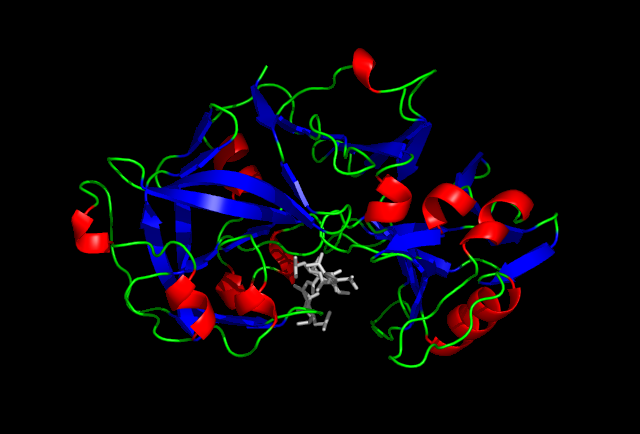
Pepsin /ˈpɛpsɪn/ is an endopeptidase that breaks down proteins into smaller peptides and amino acids. It is one of the main digestive enzymes in the digestive systems of humans and many other animals, where it helps digest the proteins in food. Pepsin is an aspartic protease, using a catalytic aspartate in its active site.
It is one of three principal endopeptidases (enzymes cutting proteins in the middle) in the human digestive system, the other two being chymotrypsin and trypsin. There are also exopeptidases which remove individual amino acids at both ends of proteins (carboxypeptidases produced by the pancreas and aminopeptidases secreted by the small intestine). During the process of digestion, these enzymes, each of which is specialized in severing links between particular types of amino acids, collaborate to break down dietary proteins into their components, i.e., peptides and amino acids, which can be readily absorbed by the small intestine. The cleavage specificity of pepsin is broad, but some amino acids like tyrosine, phenylalanine and tryptophan increase the probability of cleavage.
Pepsin's zymogen (proenzyme), pepsinogen, is released by the gastric chief cells in the stomach wall, and upon mixing with the hydrochloric acid of the gastric juice, pepsinogen activates to become pepsin.
Pepsin was one of the first enzymes to be discovered, by Theodor Schwann in 1836. Schwann coined its name from the Greek word πέψις pepsis, meaning "digestion" (from πέπτειν peptein "to digest"). An acidic substance that was able to convert nitrogen-based foods into water-soluble material was determined to be pepsin.
In 1928, it became one of the first enzymes to be crystallized when John H. Northrop crystallized it using dialysis, filtration, and cooling.
Pepsin is expressed as a zymogen called pepsinogen, whose primary structure has an additional 44 amino acids compared to the active enzyme.
In the stomach, gastric chief cells release pepsinogen. This zymogen is activated by hydrochloric acid (HCl), which is released from parietal cells in the stomach lining. The hormone gastrin and the vagus nerve trigger the release of both pepsinogen and HCl from the stomach lining when food is ingested. Hydrochloric acid creates an acidic environment, which allows pepsinogen to unfold and cleave itself in an autocatalytic fashion, thereby generating pepsin (the active form). Pepsin cleaves the 44 amino acids from pepsinogen to create more pepsin.
Pepsinogens are mainly grouped in 5 different groups based on their primary structure: pepsinogen A (also called pepsinogen I), pepsinogen B, progastricsin (also called pepsinogen II and pepsinogen C), prochymosin (also called prorennin) and pepsinogen F (also called pregnancy-associated glycoprotein).
Pepsin
Pepsin /ˈpɛpsɪn/ is an endopeptidase that breaks down proteins into smaller peptides and amino acids. It is one of the main digestive enzymes in the digestive systems of humans and many other animals, where it helps digest the proteins in food. Pepsin is an aspartic protease, using a catalytic aspartate in its active site.
It is one of three principal endopeptidases (enzymes cutting proteins in the middle) in the human digestive system, the other two being chymotrypsin and trypsin. There are also exopeptidases which remove individual amino acids at both ends of proteins (carboxypeptidases produced by the pancreas and aminopeptidases secreted by the small intestine). During the process of digestion, these enzymes, each of which is specialized in severing links between particular types of amino acids, collaborate to break down dietary proteins into their components, i.e., peptides and amino acids, which can be readily absorbed by the small intestine. The cleavage specificity of pepsin is broad, but some amino acids like tyrosine, phenylalanine and tryptophan increase the probability of cleavage.
Pepsin's zymogen (proenzyme), pepsinogen, is released by the gastric chief cells in the stomach wall, and upon mixing with the hydrochloric acid of the gastric juice, pepsinogen activates to become pepsin.
Pepsin was one of the first enzymes to be discovered, by Theodor Schwann in 1836. Schwann coined its name from the Greek word πέψις pepsis, meaning "digestion" (from πέπτειν peptein "to digest"). An acidic substance that was able to convert nitrogen-based foods into water-soluble material was determined to be pepsin.
In 1928, it became one of the first enzymes to be crystallized when John H. Northrop crystallized it using dialysis, filtration, and cooling.
Pepsin is expressed as a zymogen called pepsinogen, whose primary structure has an additional 44 amino acids compared to the active enzyme.
In the stomach, gastric chief cells release pepsinogen. This zymogen is activated by hydrochloric acid (HCl), which is released from parietal cells in the stomach lining. The hormone gastrin and the vagus nerve trigger the release of both pepsinogen and HCl from the stomach lining when food is ingested. Hydrochloric acid creates an acidic environment, which allows pepsinogen to unfold and cleave itself in an autocatalytic fashion, thereby generating pepsin (the active form). Pepsin cleaves the 44 amino acids from pepsinogen to create more pepsin.
Pepsinogens are mainly grouped in 5 different groups based on their primary structure: pepsinogen A (also called pepsinogen I), pepsinogen B, progastricsin (also called pepsinogen II and pepsinogen C), prochymosin (also called prorennin) and pepsinogen F (also called pregnancy-associated glycoprotein).
Recent media
Recent media