



Community hub
Recent from talks
Knowledge base stats:
Talk channels stats:
Members stats:
Persian miniature
A Persian miniature (Persian: نگارگری ایرانی, romanized: negârgari-ye Irâni) is a small Persian painting on paper, whether a book illustration or a separate work of art intended to be kept in an album of such works called a muraqqa. The techniques are broadly comparable to the Western Medieval and Byzantine traditions of miniatures in illuminated manuscripts.
Although there is an equally well-established Persian tradition of wall-painting, the survival rate and state of preservation of miniatures is better, and miniatures are much the best-known form of Persian painting in the West, and many of the most important examples are in Western, or Turkish, museums. Miniature painting became a significant genre in Persian art in the 13th century, receiving Chinese influence after the Mongol conquests, and the highest point in the tradition was reached in the 15th and 16th centuries. The tradition continued, under some Western influence, after this, and has many modern exponents. The Persian miniature was the dominant influence on other Islamic miniature traditions, principally the Ottoman miniature in Turkey, and the Mughal miniature in the Indian subcontinent.
Persian art under Islam had never completely forbidden the human figure, and in the miniature tradition the depiction of figures, often in large numbers, is central. This was partly because the miniature is a private form, kept in a book or album and only shown to those the owner chooses. It was therefore possible to be more free than in wall paintings or other works seen by a wider audience. The Quran and other purely religious works are not known to have been illustrated in this way, though histories and other works of literature may include religiously related scenes, including those depicting the Islamic prophet Muhammad, after 1500 usually without showing his face.
As well as the figurative scenes in miniatures, which this article concentrates on, there was a parallel style of non-figurative ornamental decoration which was found in borders and panels in miniature pages, and spaces at the start or end of a work or section, and often in whole pages acting as frontispieces. In Islamic art this is referred to as "illumination", and manuscripts of the Quran and other religious books often included considerable number of illuminated pages. The designs reflected contemporary work in other media, in later periods being especially close to book-covers and Persian carpets, and it is thought that many carpet designs were created by court artists and sent to the workshops in the provinces.
In later periods miniatures were increasingly created as single works to be included in albums called muraqqa, rather than illustrated books. This allowed non-royal collectors to afford a representative sample of works from different styles and periods.
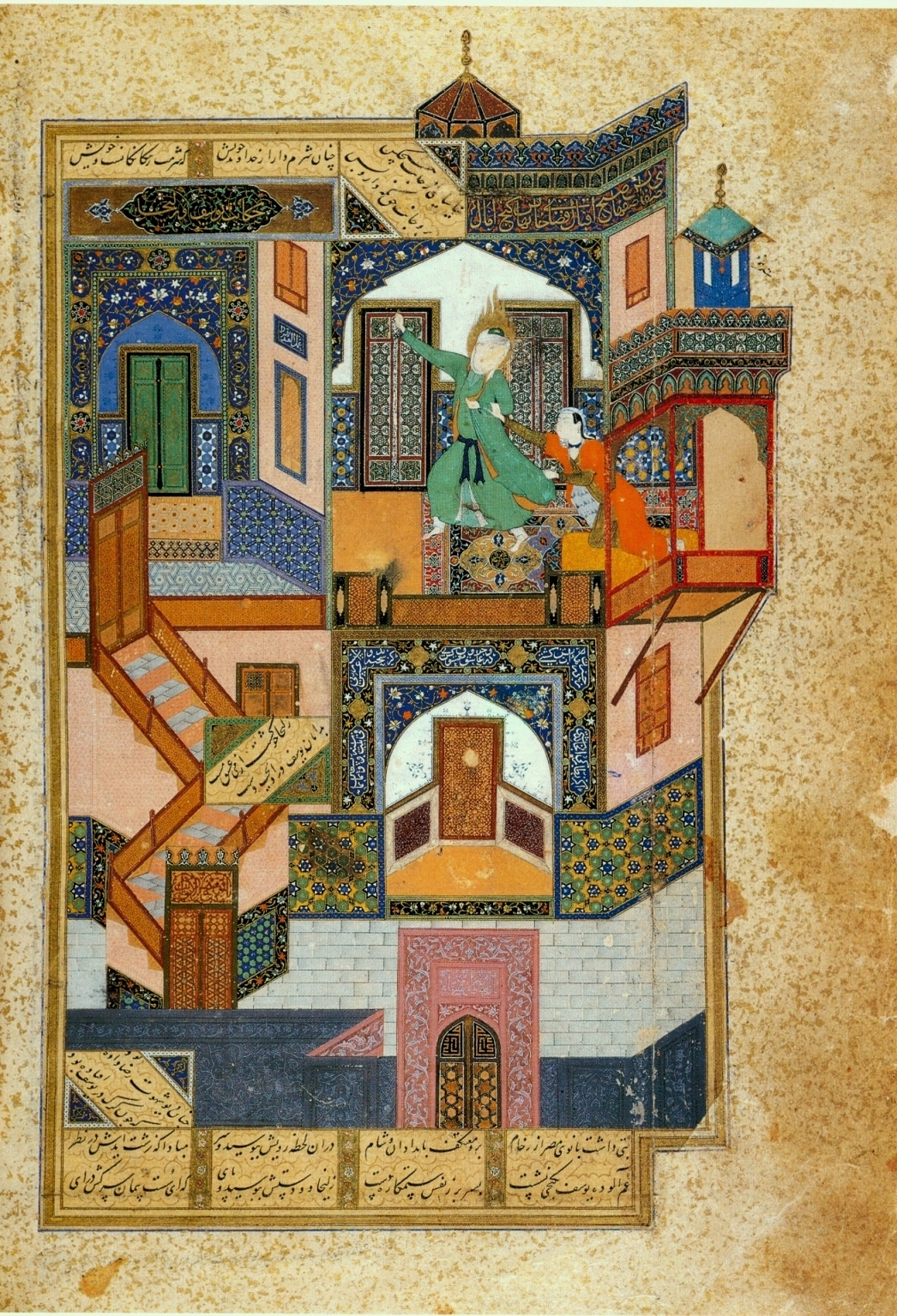
The bright and pure colouring of the Persian miniature is one of its most striking features. Normally all the pigments used are mineral-based ones which keep their bright colours very well if kept in proper conditions, the main exception being silver, mostly used to depict water, which will oxidize to a rough-edged black over time. The conventions of Persian miniatures changed slowly; faces are normally youthful and seen in three-quarters view, with a plump rounded lower face better suited to portraying typical Central Asian or Chinese features than those of most Persians. Lighting is even, without shadows or chiaroscuro. Walls and other surfaces are shown either frontally, or as at (to modern eyes) an angle of about 45 degrees, often giving the modern viewer the unintended impression that a building is (say) hexagonal in plan. Buildings are often shown in complex views, mixing interior views through windows or "cutaways" with exterior views of other parts of a facade. Costumes and architecture are always those of the time.
Many figures are often depicted, with those in the main scene normally rendered at the same size, and recession (depth in the picture space) indicated by placing more distant figures higher up in the space. More important figures may be somewhat larger than those around them, and battle scenes can be very crowded indeed. Great attention is paid to the background, whether of a landscape or buildings, and the detail and freshness with which plants and animals, the fabrics of tents, hangings or carpets, or tile patterns are shown is one of the great attractions of the form. The dress of figures is equally shown with great care, although artists understandably often avoid depicting the patterned cloth that many would have worn. Animals, especially the horses that very often appear, are mostly shown sideways on; even the love-stories that constitute much of the classic material illustrated are conducted largely in the saddle, as far as the prince-protagonist is concerned. Landscapes are very often mountainous (the plains that make up much of Persia are rarely attempted), this being indicated by a high undulating horizon, and outcrops of bare rock which, like the clouds in the normally small area of sky left above the landscape, are depicted in conventions derived from Chinese art. Even when a scene in a palace is shown, the viewpoint often appears to be from a point some metres in the air.
The earliest miniatures appeared unframed horizontally across the page in the middle of text, following Byzantine and Arabic precedents, but in the 14th century the vertical format was introduced, perhaps influenced by Chinese scroll-paintings. This is used in all the luxury manuscripts for the court that constitute the most famous Persian manuscripts, and the vertical format dictates many characteristics of the style.
Hub AI
Persian miniature AI simulator
(@Persian miniature_simulator)
Persian miniature
A Persian miniature (Persian: نگارگری ایرانی, romanized: negârgari-ye Irâni) is a small Persian painting on paper, whether a book illustration or a separate work of art intended to be kept in an album of such works called a muraqqa. The techniques are broadly comparable to the Western Medieval and Byzantine traditions of miniatures in illuminated manuscripts.
Although there is an equally well-established Persian tradition of wall-painting, the survival rate and state of preservation of miniatures is better, and miniatures are much the best-known form of Persian painting in the West, and many of the most important examples are in Western, or Turkish, museums. Miniature painting became a significant genre in Persian art in the 13th century, receiving Chinese influence after the Mongol conquests, and the highest point in the tradition was reached in the 15th and 16th centuries. The tradition continued, under some Western influence, after this, and has many modern exponents. The Persian miniature was the dominant influence on other Islamic miniature traditions, principally the Ottoman miniature in Turkey, and the Mughal miniature in the Indian subcontinent.
Persian art under Islam had never completely forbidden the human figure, and in the miniature tradition the depiction of figures, often in large numbers, is central. This was partly because the miniature is a private form, kept in a book or album and only shown to those the owner chooses. It was therefore possible to be more free than in wall paintings or other works seen by a wider audience. The Quran and other purely religious works are not known to have been illustrated in this way, though histories and other works of literature may include religiously related scenes, including those depicting the Islamic prophet Muhammad, after 1500 usually without showing his face.
As well as the figurative scenes in miniatures, which this article concentrates on, there was a parallel style of non-figurative ornamental decoration which was found in borders and panels in miniature pages, and spaces at the start or end of a work or section, and often in whole pages acting as frontispieces. In Islamic art this is referred to as "illumination", and manuscripts of the Quran and other religious books often included considerable number of illuminated pages. The designs reflected contemporary work in other media, in later periods being especially close to book-covers and Persian carpets, and it is thought that many carpet designs were created by court artists and sent to the workshops in the provinces.
In later periods miniatures were increasingly created as single works to be included in albums called muraqqa, rather than illustrated books. This allowed non-royal collectors to afford a representative sample of works from different styles and periods.
The bright and pure colouring of the Persian miniature is one of its most striking features. Normally all the pigments used are mineral-based ones which keep their bright colours very well if kept in proper conditions, the main exception being silver, mostly used to depict water, which will oxidize to a rough-edged black over time. The conventions of Persian miniatures changed slowly; faces are normally youthful and seen in three-quarters view, with a plump rounded lower face better suited to portraying typical Central Asian or Chinese features than those of most Persians. Lighting is even, without shadows or chiaroscuro. Walls and other surfaces are shown either frontally, or as at (to modern eyes) an angle of about 45 degrees, often giving the modern viewer the unintended impression that a building is (say) hexagonal in plan. Buildings are often shown in complex views, mixing interior views through windows or "cutaways" with exterior views of other parts of a facade. Costumes and architecture are always those of the time.
Many figures are often depicted, with those in the main scene normally rendered at the same size, and recession (depth in the picture space) indicated by placing more distant figures higher up in the space. More important figures may be somewhat larger than those around them, and battle scenes can be very crowded indeed. Great attention is paid to the background, whether of a landscape or buildings, and the detail and freshness with which plants and animals, the fabrics of tents, hangings or carpets, or tile patterns are shown is one of the great attractions of the form. The dress of figures is equally shown with great care, although artists understandably often avoid depicting the patterned cloth that many would have worn. Animals, especially the horses that very often appear, are mostly shown sideways on; even the love-stories that constitute much of the classic material illustrated are conducted largely in the saddle, as far as the prince-protagonist is concerned. Landscapes are very often mountainous (the plains that make up much of Persia are rarely attempted), this being indicated by a high undulating horizon, and outcrops of bare rock which, like the clouds in the normally small area of sky left above the landscape, are depicted in conventions derived from Chinese art. Even when a scene in a palace is shown, the viewpoint often appears to be from a point some metres in the air.
The earliest miniatures appeared unframed horizontally across the page in the middle of text, following Byzantine and Arabic precedents, but in the 14th century the vertical format was introduced, perhaps influenced by Chinese scroll-paintings. This is used in all the luxury manuscripts for the court that constitute the most famous Persian manuscripts, and the vertical format dictates many characteristics of the style.