



Community hub
Recent from talks
Contribute something to knowledge base
Content stats: 0 posts, 0 articles, 1 media, 0 notes
Members stats: 0 subscribers, 0 contributors, 0 moderators, 0 supporters
Subscribers
Supporters
Contributors
Moderators
Hub AI
Personal defense weapon AI simulator
(@Personal defense weapon_simulator)
Hub AI
Personal defense weapon AI simulator
(@Personal defense weapon_simulator)
Personal defense weapon
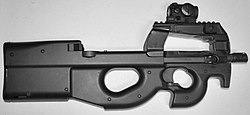
Personal defense weapons (PDWs) are compact magazine-fed automatic firearms, typically performing as a submachine gun designed for secondary defensive use rather than as a primary service weapon. Some PDWs fire a small-caliber (generally less than 8 mm or 0.31 in in bullet diameter), high-velocity centerfire bottleneck cartridge resembling a scaled-down intermediate cartridge, essentially making them an "in-between" hybrid between a submachine gun and a conventional carbine assault rifle.
The name describes the weapon's original conceptual role: as a compact but powerful small arm that can be conveniently carried for personal defense, usually by support personnel behind the front line such as military engineers, logistic drivers, medical specialists, artillery crews, or signallers. These "second-line" personnel are not strictly combat troops expected to directly engage the enemy, but may still be at risk of encountering decently equipped (and often well-armored) hostile skirmishers and infiltrators, therefore having to defend themselves in close quarters. Such encounters were thought to warrant an effective weapon that would have sufficient range for engagements that exceed handgun capabilities, but without the unnecessary bulk of a full-sized service rifle causing a burden during their normal duties. However, the concept has generally proven unsuccessful for this application, with carbines still being widely preferred for these roles.
In the late 19th and early 20th centuries, shortened versions of the infantry rifle were issued as "carbines" for cavalry troops and gun crews. This designation was dropped as infantry rifle designs became shortened overall, such as in the Short Magazine Lee–Enfield rifle. Thereafter, handguns were typically issued as self-defense weapons. However, they were not effective in most close combat situations.[citation needed] As a result, during the First World War, the Mauser C96 and artillery versions of the Luger pistol were issued with attachable shoulder stock holsters, which allowed for greater control and accuracy.
During World War I, the United States secretly developed the Pedersen device attachment for the M1903 Springfield rifle that allowed it to fire the .30-18 Auto (7.65×20mm Longue) pistol cartridge in semi-automatic mode. This attachment was developed to allow an infantryman to convert "his rifle to a form of submachine gun or automatic rifle" in approximately 15 seconds.
Production of the device and modified M1903 rifles started in 1918. However, the war ended before they were sent to Europe. The contract was cancelled on March 1, 1919, after production of 65,000 devices, 1.6 million magazines, 65 million cartridges and 101,775 modified Springfield rifles. The Pedersen device was declared surplus in 1931. To prevent them from falling into the hands of the lawless, nearly all of the stored devices were destroyed by the Army except for a few examples kept by Ordnance Department.
In 1918, Ribeyrolles, Sutter and Chauchat designed the Chauchat-Ribeyrolles 1918 submachine gun. This weapon was meant to be used for close-range protection for the French tank crews. The weapon is based on the RSC Mle. 1917 semi-automatic rifle mechanism. The first trials used a Mannlicher–Berthier clip holding eight cartridges. The trials continued until 1919 with a weapon using the same magazine as the Chauchat. The results were satisfactory but the weapon was too powerful for the intended self-protection use. A mix of standard and tracer bullets was planned to be used to assist in aiming.
In 1938, the U.S. Army Ordnance Department received a request for a light rifle to be issued to mortarmen, radiomen, drivers, clerks, cooks, and similar grades. During field exercises, these troops found that the M1 Garand rifle was too heavy and too cumbersome for general issue.[citation needed] And, while handguns are undeniably convenient, they had limited range, accuracy and power.[citation needed] This request was refused by authorities.
In 1940, after Germany's use of glider-borne and paratroop forces to infiltrate and attack strategic points behind the front lines, the request for a light rifle was resubmitted and subsequently approved. U.S. Army Ordnance issued a requirement for a "light rifle" with greater range, firepower, and accuracy than the M1911 pistol while weighing half as much as the M1 Garand. As a result, the U.S. developed the semi-automatic M1 Carbine and shortly thereafter the select-fire M2 Carbine.
Personal defense weapon
Personal defense weapons (PDWs) are compact magazine-fed automatic firearms, typically performing as a submachine gun designed for secondary defensive use rather than as a primary service weapon. Some PDWs fire a small-caliber (generally less than 8 mm or 0.31 in in bullet diameter), high-velocity centerfire bottleneck cartridge resembling a scaled-down intermediate cartridge, essentially making them an "in-between" hybrid between a submachine gun and a conventional carbine assault rifle.
The name describes the weapon's original conceptual role: as a compact but powerful small arm that can be conveniently carried for personal defense, usually by support personnel behind the front line such as military engineers, logistic drivers, medical specialists, artillery crews, or signallers. These "second-line" personnel are not strictly combat troops expected to directly engage the enemy, but may still be at risk of encountering decently equipped (and often well-armored) hostile skirmishers and infiltrators, therefore having to defend themselves in close quarters. Such encounters were thought to warrant an effective weapon that would have sufficient range for engagements that exceed handgun capabilities, but without the unnecessary bulk of a full-sized service rifle causing a burden during their normal duties. However, the concept has generally proven unsuccessful for this application, with carbines still being widely preferred for these roles.
In the late 19th and early 20th centuries, shortened versions of the infantry rifle were issued as "carbines" for cavalry troops and gun crews. This designation was dropped as infantry rifle designs became shortened overall, such as in the Short Magazine Lee–Enfield rifle. Thereafter, handguns were typically issued as self-defense weapons. However, they were not effective in most close combat situations.[citation needed] As a result, during the First World War, the Mauser C96 and artillery versions of the Luger pistol were issued with attachable shoulder stock holsters, which allowed for greater control and accuracy.
During World War I, the United States secretly developed the Pedersen device attachment for the M1903 Springfield rifle that allowed it to fire the .30-18 Auto (7.65×20mm Longue) pistol cartridge in semi-automatic mode. This attachment was developed to allow an infantryman to convert "his rifle to a form of submachine gun or automatic rifle" in approximately 15 seconds.
Production of the device and modified M1903 rifles started in 1918. However, the war ended before they were sent to Europe. The contract was cancelled on March 1, 1919, after production of 65,000 devices, 1.6 million magazines, 65 million cartridges and 101,775 modified Springfield rifles. The Pedersen device was declared surplus in 1931. To prevent them from falling into the hands of the lawless, nearly all of the stored devices were destroyed by the Army except for a few examples kept by Ordnance Department.
In 1918, Ribeyrolles, Sutter and Chauchat designed the Chauchat-Ribeyrolles 1918 submachine gun. This weapon was meant to be used for close-range protection for the French tank crews. The weapon is based on the RSC Mle. 1917 semi-automatic rifle mechanism. The first trials used a Mannlicher–Berthier clip holding eight cartridges. The trials continued until 1919 with a weapon using the same magazine as the Chauchat. The results were satisfactory but the weapon was too powerful for the intended self-protection use. A mix of standard and tracer bullets was planned to be used to assist in aiming.
In 1938, the U.S. Army Ordnance Department received a request for a light rifle to be issued to mortarmen, radiomen, drivers, clerks, cooks, and similar grades. During field exercises, these troops found that the M1 Garand rifle was too heavy and too cumbersome for general issue.[citation needed] And, while handguns are undeniably convenient, they had limited range, accuracy and power.[citation needed] This request was refused by authorities.
In 1940, after Germany's use of glider-borne and paratroop forces to infiltrate and attack strategic points behind the front lines, the request for a light rifle was resubmitted and subsequently approved. U.S. Army Ordnance issued a requirement for a "light rifle" with greater range, firepower, and accuracy than the M1911 pistol while weighing half as much as the M1 Garand. As a result, the U.S. developed the semi-automatic M1 Carbine and shortly thereafter the select-fire M2 Carbine.
Recent media
Recent media