Hubbry Logo
Peter DemensPeter DemensMain
Open search
Peter Demens
Community hub
Peter Demens
logo
8 pages, 0 posts
0 subscribers
Be the first to start a discussion here.
Peter Demens
Peter Demens
from Wikipedia

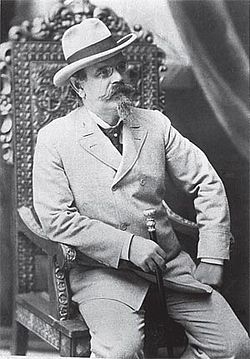
Peter Demens (May 13 [O.S. May 1] 1850 – January 21, 1919),[1] born Pyotr Alekseyevich Dementyev (Russian: Пётр Алексеевич Дементьев), was a Russian nobleman who migrated in 1881 to the United States and became a railway owner and one of the founders of St. Petersburg, Florida, United States.

Key Information

Early life

[edit]

Demens was born in May 1850 as Pyotr Alexeyevitch Dementyev to a wealthy family in Vesyegonsky Uyezd, Tver Governorate, in the Russian Empire. Demens was a liberally minded, well-educated aristocrat, a first cousin of Prince Petroff and a captain in the Russian Imperial Guard. His father died when he was an infant, leaving him two estates, one near the czar's capital of Saint Petersburg and another close to Moscow.[2] His mother died when he was 4.[2] He reportedly grew up in a stone house with servants and became master of his family estate at 17.[2] He received training as a forester managing his large family estates, which would serve him well in the future.

Demens was raised by his maternal uncle Anastassy Alexandrovich Kaliteevsky, marshal of the Vesyegonsk district nobility, who became the boy's tutor and guardian of his land estates.[3] When he was 10, Demens was sent to Saint Petersburg to study at Gymnasium No. 3.[3] Demens did well enough to transfer to the First Technical School in Saint Petersburg.[3]

In 1867, he became a lieutenant in the czar's infantry guard.[2] He rose through the ranks to command sentries at the czar's Winter Palace and the home of Crown Prince Alexander III.[2] Four years later, he resigned his commission and became a squire.[2] He married Raisa Borisenko, who was also an orphan brought up by relatives.[2] He was elected as county marshal of nobility, and became an outspoken writer and active in his rural government.[2] It is reported that Demens sympathized with populist leaders and never adopted Marxist or radical notions.[2]

Some sources state that Demens became outspoken about the czarist regime and left Russia following the assassination of Czar Alexander II in 1881.[2] Other sources note that he left Russia as a political exile in 1880.[4] He emigrated to the United States and anglicized his name to Peter Demens.

In the United States

[edit]

In May 1881, "leaving his family behind, [Demens] sailed for New York, hoping for American promise of mobility and opportunity".[2][need quotation to verify] He reportedly "spent his sea voyage studying an English language textbook".[2] "Arriving in New York with $3,000 ($100,086 in 2025) to start a new life, Demens embarked for Florida" ("spending one day in New York before boarding a train bound for his cousin's Jacksonville orange grove").[2] Because land in Jacksonville was expensive for him at the time, Demens took "a steamer to the back country, where he expected to get more for his money".[citation needed]

He decided to enter the lumber business ("investing in a sawmill and a construction company in Longwood, Fla."[5]), and in 1885 Demens was supplying railroad ties to the narrow-gauge Orange Belt Railway. When the railroad could not pay its debts, Demens took over its charter. As owner of the railroad, Demens "[extended] its lines to link Kissimmee with Jacksonville and Tampa Bay"[2] (with the help of Hamilton Disston).[6] Among potential investors, he successfully invited and entertained Philip D. Armour in Florida,[1] and named a train depot in his honor. Demens went into great debt to get the line completed, and sold it in 1889; the railroad eventually was bought by Henry B. Plant, owner of the Plant System of railroads.

Demens co-founded St. Petersburg, Florida, with John Constantine Williams Sr. On June 8, 1888, the first train pulled into the terminus in southern Pinellas County (the end of the line) with one passenger. The area had no official name and no real streets or sidewalks. After a drawing of straws, Demens won and named the location of his terminus St. Petersburg, Florida, after Saint Petersburg, Russia, where he had spent half his youth. Williams would have named it Detroit, which name was given to the first hotel.

Death and legacy

[edit]
The Demens-Tolstoy Estate on Hillside and Archibald

Demens eventually retired to Alta Loma, California, to the family ranch that later became known as the Demens-Tolstoy Estate. He died there in January 1919; he was survived by his wife, three sons, and two daughters.[4]

Reportedly, "the descendants of Peter Demens now live in California and British Columbia, [including] a grandson, Peter Demens Tolstoy ("writer Leo Tolstoy, who wrote Anna Karenina and The Death of Ivan Ilych, is his great-grand uncle"[7]), a great-grandson, Greg Demens, and a great-great-grandson, Greg Demens."[5] Demens Landing in St. Petersburg, Florida is named in his honor.[8]

In 1979, a historical marker honoring Demens was erected in St. Petersburg, Florida, by the Congress of Russian Americans.[9]

See also

[edit]

Sources

[edit]
  • Gene Burnett. "Florida's Past: People and Events That Shaped the State". Pineapple Press. August 1998. History – 280 pages. ISBN 1-56164-115-4.
  • Grismer, Karl H. "The Story of St. Petersburg". St. Petersburg, FL: P. K. Smith, 1948.
  • Peter Demens. "My Life in America".
  • Mohoff, George & Jack Valov. "A Stroll Through Russiantown" 1996. Chapter 13, pp. 83–88, "Captain Peter A. Demens".

References

[edit]
[edit]
Revisions and contributorsEdit on WikipediaRead on Wikipedia
from Grokipedia
Peter Demens (May 1, 1850 – January 21, 1919) was a Russian-born American entrepreneur, railroad pioneer, and civic leader renowned for founding the city of , in 1888 by extending the Orange Belt Railway to the Gulf Coast and naming the settlement after his Russian hometown. Born Pyotr Alexeyevich Dementyev into in Province, he rose to manage family estates, served as a officer, and left around 1880, possibly due to political activities, financial difficulties, or involvement in a corruption scandal. Immigrating to the in 1881 with his family and limited funds, Demens adapted his aristocratic background to American capitalism, establishing businesses in lumber, construction, and transportation that shaped early Florida development. Upon arriving in Florida, Demens settled in Longwood, where he purchased an orange grove and invested in a by 1883, quickly expanding into railroad infrastructure by constructing station houses for the South Florida Railroad and buildings for the newly established in 1885. His most transformative project was acquiring and extending the Orange Belt Railway from 1886 to 1889, overcoming financial hurdles to connect to the ; on June 8, 1888, the first arrived at the new terminus, prompting him to the townsite, build its inaugural (the Detroit), and promote it as a resort destination. After selling the railroad in 1889 amid economic pressures, he relocated to , founding the P. A. Demens Woodworking Company and introducing progressive labor practices like a nine-hour workday, while contributing to local architecture such as the Romanesque Revival Statesville City Hall. In his later years, Demens moved to around 1892, where he managed an orange plantation in Alta Loma and supported Russian immigrant communities, including the Molokans, by aiding their settlement from 1904 onward. A prolific writer, he authored works like Sketches of the North-American (1895) comparing Russian and American societies, translated Russian poetry, and lectured on , blending his dual cultural identities. His legacy endures through St. Petersburg's growth as a key city, commemorated by plaques in and , and recognition from descendants and historical societies for bridging Russian heritage with American innovation.

Early Life in Russia

Family and Childhood

Pyotr Alexeyevich Dementyev, who later anglicized his name to Peter Demens, was born on May 1, 1850 (Old Style), in Vesyegonsky Uyezd, , , into a wealthy aristocratic that owned extensive landholdings. His noble origins provided him with significant privileges from birth, including access to family estates that shaped his early worldview. Demens became an at the age of four following the deaths of both parents, with his father passing away during his infancy and his mother shortly thereafter. He was subsequently raised by his maternal , Anastassy Alexandrovich Kaliteevsky, a prominent nobleman and of the local , who took charge of his upbringing on the family's rural . This arrangement ensured continuity in his privileged lifestyle, surrounded by a full staff of servants and immersed in the management of agricultural lands. Through his uncle's guidance, Demens inherited two substantial estates—one near and another near St. Petersburg—which introduced him to practices during his childhood. These experiences fostered an early understanding of estate oversight and , laying the foundation for his later entrepreneurial pursuits, though formal responsibilities began in his adolescence.

Education and Military Service

Demens received his early formal education in Saint Petersburg, where he attended Gymnasium No. 3 during his adolescence, a prestigious institution known for its rigorous classical curriculum. Performing exceptionally, he transferred to the First Technical School in the same city, gaining technical knowledge that would later inform his engineering pursuits. At age 17, in 1867, Demens enlisted as a lieutenant in the elite Russian Imperial Guard under Tsar Alexander II, beginning a distinguished military career centered in Saint Petersburg. Over the next four years, he rose to the rank of captain through meritorious service, fulfilling duties that included ceremonial protection of the imperial family and maintaining order in the capital. He retired from active duty in 1871, having completed his obligatory term with honors. Following his military retirement, Demens returned to civilian life as a overseeing the family's inherited estates in Tver Province, where he managed extensive timber operations and agricultural resources. This role involved directing logging activities, sustainable forest preservation, and estate administration, drawing on his technical education to optimize productivity amid Russia's vast woodland holdings.

Immigration and Early Career in the United States

Arrival and Initial Settlement

In 1881, Peter Demens departed amid political unrest following the of Alexander II in March of that year, compounded by his personal disillusionment stemming from exile due to liberal anti-tsarist views. He set sail from in May 1881 and arrived in later that month, carrying $3,000 in savings to fund his new life in America. During the transatlantic voyage, Demens began learning English from a , a practical step toward overcoming the language barriers he would face as a Russian immigrant in an English-speaking society. Upon arrival, Demens encountered the typical hardships of late-19th-century immigrants, including cultural adjustment and financial caution in a foreign land where opportunities were unevenly distributed. He briefly considered settling in , but found land prices there too high for his ambitions. His military background from earlier service in instilled a sense of discipline that aided his adaptation to these uncertainties. Seeking affordable prospects in a burgeoning area, Demens relocated southward to shortly after his arrival, settling in the small town of Longwood in late 1881. This move positioned him in a region ripe for development, where he could invest his capital in and emerging industries amid the state's post-Civil War expansion.

Lumber Business and Local Politics

Upon arriving in , in 1881, Peter Demens invested in the local economy by purchasing an 80-acre tract for an orange grove and acquiring a one-third interest in an existing . He soon expanded this venture into P.A. Demens & Company, establishing a prominent operation in the early 1880s that functioned primarily as a , , and blind factory. The mill, located between Warren Avenue and Bay Avenue, became Longwood's chief industry by the mid-1880s, employing local labor to process timber into building materials and supplying contracts for structures such as those at in nearby Winter Park. Through this enterprise, Demens engaged in regional trade, providing lumber products that supported Florida's growing construction needs during the 1882–1885 period. Demens's business success facilitated his involvement in local politics, reflecting his commitment to civic improvement in the community. He was elected mayor of Longwood, where he advocated for development initiatives aligned with the town's economic expansion. In 1884, he ran unsuccessfully for a seat in the Florida State Senate, demonstrating his broader aspirations for despite the defeat. These efforts underscored his integration into American civic life, as he leveraged his entrepreneurial standing to influence local governance. Demens married Raisa Borisenko in 1881, and the couple raised five children together after immigrating to the . Their family adapted to life in Longwood, with at least one child, Eugene Peter Demens, born there in 1883, marking their establishment in the American South. This personal milestone complemented Demens's professional endeavors, as his household contributed to the multicultural fabric of the growing settlement.

Railroad Ventures and St. Petersburg

Orange Belt Railway Acquisition

In 1885, Peter Demens, a Russian immigrant and owner in , acquired the charter for the Orange Belt Railway after the original investors defaulted on $9,400 owed for railroad ties his company had supplied. The line, initially a short narrow-gauge track serving central Florida's and regions, had been envisioned as a connector between inland agricultural areas and potential markets, but construction had stalled due to financial shortfalls. Demens's prior experience in the lumber business, which involved producing ties and managing for rail projects, positioned him to assume control and reorganize the venture under the newly formed Orange Belt Investment Company, in partnership with a small group of associates. Demens acquired control of the railway when the original investors defaulted on $9,400 owed for railroad ties supplied by his . He reorganized the venture under the Orange Belt Investment Company with a small group of associates, securing additional funding through loans from friends and three new investors—a Canadian, a New Yorker, and a Virginian—to fund initial operations and extensions. Construction challenges persisted, including unreliable backers and mounting creditor pressures, which strained resources as crews worked to lay track across rugged terrain with limited equipment. Despite these hurdles, Demens directed the effort with hands-on oversight of labor, materials, and finances, drawing on his military background for disciplined management. Demens's vision centered on expanding the railway to bridge central Florida's interior with Gulf Coast ports, fostering through improved transport for produce, timber, and passengers. This ambition aimed to stimulate growth in underdeveloped areas by creating vital links that would attract settlers and commerce, transforming the Orange Belt from a modest line into a regional . By , these plans had advanced the route toward coastal connections, though ongoing funding issues tested the project's viability.

Railway Extension and City Founding

Following the acquisition of the Orange Belt Railway, Peter Demens oversaw the extension of its tracks from Sanford southward across to the Pinellas Peninsula, a project that spanned from 1886 to 1888 despite financial and logistical challenges. The completed 3 ft (914 mm) narrow-gauge line spanned about 67 miles, traversing swamps and rural terrain, reaching the Gulf Coast terminus on June 8, 1888, when the Mattie arrived with empty freight cars and a single passenger, a shoe salesman from New York. This completion marked the railway's vital link to , enabling efficient transport of goods and passengers to the undeveloped waterfront area previously known as the hamlet of Wardsville. Demens named the new settlement at the line's end St. Petersburg, after his childhood home in the Russian imperial capital; according to local legend, this was decided by a coin flip with landowner John C. Williams, who had acquired around 2,500 acres in the area starting in 1875, though in reality the name was secured through a petition by Demens's associate Joseph Henschen. To support the nascent community, Demens constructed the first depot at First Avenue South, featuring Russian architectural influences, and initiated basic infrastructure, including a 3,000-foot railroad pier extending into the bay for deeper-water vessel access. Williams, in turn, built the Hotel at Central Avenue and Second Street North—named for his origins—to accommodate early visitors and workers. As co-founders, Demens and Williams facilitated the city's establishment by transferring portions of Williams's land to the railway company, enabling track placement and lot sales to attract settlers. Demens promoted St. Petersburg as an idyllic resort destination, emphasizing its balmy climate, pristine bayfront, and accessibility via rail, which drew initial investors and tourists seeking Florida's natural allure. These efforts laid the groundwork for the area's transformation from isolated outpost to burgeoning coastal town, with land auctions and promotional campaigns highlighting opportunities for residential and development.

Later Life and Legacy

Financial Difficulties and Relocation

Following the completion of the Orange Belt Railway extension to St. Petersburg in , Peter Demens encountered severe financial strain due to the project's high costs and insufficient revenues, exacerbated by unreliable investors and aggressive creditors who seized locomotives to demand payment. Labor disputes intensified the crisis, with unpaid workers threatening violence against him. By mid-1889, overextension forced Demens to sell his interests in the railway to settle mounting debts. The line Demens had developed entered in 1893 amid the broader economic , which deepened financial woes for many railroad ventures through bond defaults and market contraction. After the sale, Demens briefly pursued contracting and lumber-related opportunities tied to his prior holdings in , including properties acquired during the St. Petersburg development, but these proved unviable amid the downturn. Seeking recovery, Demens relocated his family to , in 1889, where he established the P. A. Demens Woodworking Company for and construction work, though he sold it in 1892 after modest success. His health, weakened by years of intense labor and stress, prompted a further move westward to , , in 1892 for fresher air and new prospects. In , Demens stabilized his finances through smaller-scale enterprises, including a profitable steam laundry business and investments in citrus groves near Alta Loma, where he later served as president of the Cucamonga Citrus Fruit Growers Association. He also provided ongoing support to Russian immigrant families, drawing on his own experiences to assist their settlement in the region.

Death, Writings, and Honors

Peter Demens died on January 21, 1919, in Alta Loma, , at the age of 68. He was survived by his wife, Raisa Semionovna Demens (1850–1922), and seven children—with descendants later settling in and . In his later years after relocating to , Demens turned to writing, becoming a prolific contributor to Russian and American newspapers and journals. His notable works included a series of articles titled Ten Years in America: From My Personal Memories, published in Viestnik Evropy from January to May 1893, which detailed his experiences as a Russian immigrant in the United States. Under the pseudonym P. A. Tverskoĭ, he also wrote extensively on topics such as American politics, the annexation of , Cuban affairs, the immigration of Dukhobors to , the treatment of in , the , Molokans, , and the , with many pieces preserved in scrapbooks of clippings from 1881 and 1907–1919. Demens received posthumous recognition for his role in founding St. Petersburg, Florida. In 1977, the city renamed a waterfront park as Demens Landing to honor the site of the first railroad pier he constructed in 1889. Two years later, in 1979, a historical marker and monument were dedicated at the park by the Congress of Russian Americans, commemorating Demens as the city's founder. Annual events, including anniversary observances of his birth and death, continue to celebrate his legacy in St. Petersburg. In 2025, the 175th anniversary of his birth was commemorated by the Congress of Russian Americans and other historical groups.

References

Add your contribution
Related Hubs
User Avatar
No comments yet.