
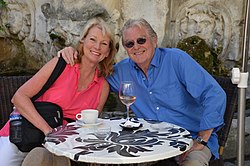


Community hub
Recent from talks
Contribute something
Nothing was collected or created yet.
Peter Mayle
View on Wikipedia
Peter Mayle (/meɪl/ "mail"; 14 June 1939 – 18 January 2018) was a British businessman turned author who moved to France in the 1980s. He wrote a series of bestselling memoirs of his life there, beginning with A Year in Provence (1989).
Key Information


Early life
[edit]Born in Brighton, Sussex, the youngest of three children, Mayle and his parents moved to Barbados in the aftermath of World War II, where his father was transferred as a Colonial Office employee. Mayle returned to England after leaving school at 16 in Barbados.
Advertising career
[edit]His first job in 1957 was as a trainee at Shell Oil, based in its London office. It was there that he discovered that he was more interested in advertising than oil and he wrote to David Ogilvy, the head of the advertising agency that had the Shell account at that time, asking for a job. Ogilvy offered him a job as a junior account executive, but Mayle's interest was more on the creative side of the business and he subsequently became a copywriter in 1961 based in its New York City office.
In due course another agency, Papert Koenig, Lois, poached him from Ogilvy and sent him back to London to head up the creative team in its UK office, where one of his colleagues was Alan Parker. When the US parent hit trouble in the mid-1960s, he and a colleague bought the London operation. They developed the business with accounts that included Watneys, Olivetti, and Sony and after five years, it was bought by BBDO, one of the top American agencies. He then commuted between the U.S. and the UK as its creative director.
A 1972 advertising slogan written by Mayle for Wonderloaf Bread was used as a football chant by supporters of Tottenham Hotspur, and became the basis of the song "Nice One Cyril".
By 1974, Mayle had had enough of advertising and transatlantic commuting, and quit the business to write full-time.
Author
[edit]Mayle started off by writing educational books, including a series on sex education for children and young people. He also penned, in collaboration with illustrator Gray Jolliffe, a series of humorous books about the character Wicked Willie, based upon a personification of the penis. He relocated from Devon to the Luberon, southern France, in the late 80s but his plans to write a novel were overtaken by an account of life in his new environment. This resulted in his 1989 book A Year in Provence which became an international bestseller, chronicling his first year as a British expatriate in Ménerbes, a village in the southern département Vaucluse.
Several more books followed, which have been translated in more than twenty languages. He also wrote for magazines and newspapers. A Year in Provence was subsequently produced as a TV series starring John Thaw and screened in 1993. The novel A Good Year was the basis for the 2006 film of the same name directed by Ridley Scott and starring actors Russell Crowe and Marion Cotillard.
Mayle relocated to Amagansett on Long Island, New York, to get away from fans and sightseers at his home in Provence.[2] He subsequently returned to France and at the time of his death in 2018 resided in Vaugines, also situated in the Luberon, in Provence. He died at the hospital near his home in January 2018.[3]. The last six years of his life were made difficult by a bad fall that injured his left hand, making it difficult for the left-handed Mayle to write his final books.[4]
Awards
[edit]British Book Awards named A Year in Provence Best Travel Book of the Year (1989)[1] and him Author of the Year (1992).[5] The French government made him a Chevalier de la Légion d'honneur (Knight of the Legion of Honor) in 2002, for coopération et francophonie.[6]
Bibliography
[edit]Source:[1]
- Where Did I Come From? The Facts of Life Without Any Nonsense and with Illustrations, illustrated by Arthur Robins and Paul Walter, Carol Publishing Group (Secaucus, NJ), 1973.
- What's Happening to Me? The Answers to Some of the World's Most Embarrassing Questions, illustrated by Arthur Robins and Paul Walter, Carol Publishing Group (Secaucus, NJ), 1975.
- Will I Go to Heaven?, Corwin, 1976.
- "Will I Like It?": Your First Sexual Experience, What to Expect, What to Avoid, and How Both of You Can Get the Most Out of It, photographs by John Thornton, Corwin, 1977.
- How to Be a Pregnant Father: An Illustrated Survival Guide for the First-time Father, illustrated by Arthur Robins, Lyle Stuart, Inc. (Secaucus, NJ), 1977.
- Baby Taming, illustrated by Arthur Robins, Crown (New York), 1978.
- Divorce Can Happen to the Nicest People, illustrated by Arthur Robins, Macmillan (New York), 1979, revised edition published as Why Are We Getting a Divorce?, Crown (New York), 1988.
- (With Paul Rice) As Dead as a Dodo, illustrated by Shawn Rice, David Godine (Boston, MA), 1981.
- (With Arthur Robins) Congratulations! You're Not Pregnant: An Illustrated Guide to Birth Control, Macmillan Publishers (New York), 1981.
- (With Arthur Robins) Grown-ups and Other Problems: Help for Small People in a Big World, Macmillan (New York), 1982.
- The Honeymoon Book, illustrated by Gray Jolliffe, Ballantine Books (New York), 1983.
- Chilly Billy, illustrated by Arthur Robins, Crown (New York), 1980.
- Man's Best Friend: Introducing Wicked Willie in the Title Role, illustrated by Gray Jolliffe, Crown (New York), 1984.
- Anything but Rover—the Art and Science of Naming Your Dog: A Breed by Breed Guide, Including Mongrels, illustrated by Arthur Robins, A. Barker, 1985.
- Sweet Dreams and Monsters: A Beginner's Guide to Dreams and Nightmares and Things That Go Bump under the Bed, illustrated by Arthur Robins, Crown (New York), 1986.
- Wicked Willie's Guide to Women: A Worm's-Eye View of the Fair Sex, illustrated by Gray Jolliffe, Pan Books (London), 1986, Crown (New York), 1987.
- Wicked Willie's Low-Down on Men, illustrated by Gray Jolliffe, Pan Books (London), 1987.
- Wicked Willie's Guide to Women: The Further Adventures of Man's Best Friend, illustrated by Gray Jolliffe, Crown (New York), 1988.
- A Year in Provence, Hamish Hamilton (London, England), 1989, published with illustrations by Judith Clancy, Alfred A. Knopf (New York), 1990.
- (With Raffaella Fletcher) Dangerous Candy: A True Drug Story by Someone Who Did Them and Kicked Them, Sinclair-Stevenson (London, England), 1990, published as Dangerous Candy: A True Story about Drug Addiction, Trafalgar Square Publishing (Pomfret, Vermont), 1991.
- Toujours Provence, Knopf (New York), 1991.
- Acquired Tastes: A Beginner's Guide to Serious Pleasures, Bantam Books (New York), 1992.
- Up the Agency: The Funny Business of Advertising, St. Martin's Press (New York), 1993.
- Hotel Pastis: A Novel of Provence, Knopf (New York), 1993.
- Provence, photographs by Jason Hawkes, Random House (New York), 1994.
- A Dog's Life, with Ed Koren, Knopf (New York), 1995.
- Anything Considered, Knopf (New York), 1996.
- Chasing Cézanne, Knopf (New York), 1997.
- Where Did I Come From? The Facts of Life Without Any Nonsense and with Illustrations, illustrated by Arthur Robins and Paul Walter; African-American edition published with illustrations adapted by Zina Saunders, Carol Publishing Group (Secaucus, NJ), 1999.
- Encore Provence: New Adventures in the South of France, Knopf (New York), 1999.
- French Lessons: Adventures with Knife, Fork, and Corkscrew, Knopf (New York), 2001.
- A Good Year (novel), Knopf (New York), 2004.
- (With Gerard Auzet) Confessions of a French Baker: Breadmaking Secrets, Tips, and Recipes, Knopf (New York), 2005.
- Provence A–Z, Knopf (New York), 2006.
- The Vintage Caper, Knopf (New York), 2009
- The Marseille Caper, Knopf (New York) 2012
- The Corsican Caper, Knopf (New York), 2014
- The Diamond Caper, Knopf (New York), 2015
- Provence in Ten Easy Lessons, Random House, 2014 – adapted from Provence A–Z: A Francophile's Essential Handbook
- My Twenty-Five Years in Provence: Reflections on Then and Now, Knopf (New York), 2018
- Contributions
- (Author of introduction, with Ridley Scott) A Good Year: Portrait of the Film Based on the Novel by Peter Mayle, Newmarket Press (New York), 2007.
- (with Gray Jolliffe), screenplay Wicked Willie
- Contributor of articles to periodicals, including
- contributor to Adventures in Wine, edited by Thom Elkjer, Travelers' Tales (San Francisco, CA), 2002.
- column, "Expensive Habits", Gentleman's Quarterly
- Media adaptations:
- A Year in Provence was adapted for audio cassette, Books on Tape, 1992, and for television by the British Broadcasting Corporation
- French Lessons: Adventures with Knife, Fork, and Corkscrew was adapted for audio cassette
- A Good Year was adapted to film
- What's Happening to Me? adapted as animated video
- Where Did I Come From? adapted as animated video
References and notes
[edit]- ^ a b c "Peter Mayle". Contemporary Authors Online, Gale, 2009. Reproduced in Biography Resource Center. Farmington Hills, Michigan: Gale, 2009. http://galenet.galegroup.com/servlet/BioRC Entry updated: 02/21/2008. Fee. Accessed 2009-04-07 via Fairfax County Public Library. Document Number: H1000111948
- ^ "Adieu, Provence". The Baltimore Sun. 25 June 1996. Retrieved 8 April 2015.
- ^ Genzlinger, Neil (18 January 2018). "Peter Mayle, Who Wrote of "A Year in Provence", Is Dead at 78". The New York Times. Retrieved 18 January 2018.
- ^ "How Have I Not Read This? Discussion of A YEAR IN PROVENCE" (video). youtube.com. 14 July 2021.
- ^ "Living the Good Life: About Peter Mayle". 30 November 2011.
- ^ "Décret du 29 mars 2002 portant élévation, promotion et nomination". Le Journal officiel de la République française (Official Journal of the French Republic) (in French). Government of France. 31 March 2002. p. 5716. Retrieved 8 April 2009.
Coopération et francophonie Etranger en France Au grade de chevalier M. Mayle (Peter) (Grande-Bretagne), écrivain ; 43 ans d'activités professionnelles et culturelles.
External links
[edit]- Peter Mayle.com (unofficial)
- A Year in Provence at IMDb
- A Good Year at IMDb
- Peter Mayle at IMDb

Peter Mayle
View on GrokipediaEarly life and education
Family background
Peter Mayle was born on 14 June 1939 in Brighton, England, as the youngest of three children to a family shaped by his father's career in public service.[1][3] His father worked as a colonial officer in the British Colonial Office, which involved overseas postings that defined much of Mayle's early years.[4] Following World War II, the family relocated to Barbados, where his father was assigned, exposing young Mayle to a tropical environment that fostered a lifelong appreciation for warm climates and diverse settings.[5] Mayle's mother worked as a beautician, contributing to the household in a practical capacity that supported the family's mobile lifestyle amid the father's professional demands.[1] This parental dynamic created a somewhat peripatetic childhood for Mayle, marked by separation when he was sent to boarding school in England at age seven while his family remained abroad. He rejoined them in the Caribbean at 15.[1][4]Schooling
Peter Mayle's formal education was shaped by his family's frequent relocations due to international postings, beginning with boarding at Brighton College in England from the age of seven. Later, following a move to the Caribbean, he attended Harrison College in Barbados.[4][6] His family's international background, tied to his father's role in the Colonial Office, led to these disruptions in his schooling.[1] Mayle's time at Brighton College was marked by an unhappy boarding experience, reflecting a broader disinterest in the structured academic environment. He left school at age 16 without completing formal qualifications.[1][7] This early departure highlighted his preference for self-directed pursuits, where he cultivated writing skills independently through personal correspondence and wide reading.[1] The conclusion of his formal education at 16 paved the way for an immediate transition into the workforce; upon returning to England, Mayle took on entry-level jobs, including roles as a waiter and laundry van driver, before securing a trainee position at Shell Oil the following year.[7][6]Advertising career
Early roles
Peter Mayle entered the advertising industry shortly after leaving school at the age of 16, lacking formal higher education but relying on practical experience to build his skills. In 1957, he began as a trainee in the public relations department of Shell Oil's London office, where he was essentially an office boy handling routine tasks.[1][8] His interest in the creative aspects of advertising was sparked by exposure to Shell's campaigns, particularly those managed by agencies in the United States, leading to a quick internal promotion within a few months to the company's advertising department as a copy trainee.[9] There, Mayle started learning the craft of copywriting through hands-on involvement in promotional materials, honing his ability to craft concise and persuasive messages for oil industry clients like Shell. This period marked his transition from novice administrative roles to initial creative responsibilities, demonstrating his rapid aptitude despite no prior training.[1] By 1961, at age 22, Mayle had advanced sufficiently to secure a position as a copywriter at the prestigious Ogilvy & Mather agency in New York, after impressing founder David Ogilvy with a speculative letter and passing a rigorous copywriting test originally intended for an account executive role.[1][8] In this early professional capacity, he focused on writing slogans and developing ad copy for various client accounts, including the Hathaway shirts campaign, further solidifying his progression to a skilled practitioner in the competitive New York advertising scene. His work during this stint emphasized brevity and wit, skills that would define his later career.[1]Major campaigns and publications
During his time in the advertising industry, Peter Mayle contributed to several key campaigns that helped establish major brands. One of his notable successes was the "Nice one, Cyril" slogan for Wonderloaf bread in 1972, which became a popular football chant among Tottenham Hotspur supporters.[10] These efforts showcased his talent for crafting memorable, persuasive messaging that resonated with consumers.[11] In the mid-1960s, Mayle returned to London as head of creative for Papert, Koenig & Lois, where he managed international accounts and contributed to global brand strategies for multinational clients. This period allowed him to apply his creative skills to broader, cross-border advertising initiatives, influencing how brands positioned themselves worldwide. He later bought out the agency with a partner and sold it to BBDO four years later, becoming creative director.[11] Mayle's experiences in the industry inspired his early non-fiction writing, beginning with Up the Agency (1965), a satirical guide that humorously dissected the eccentricities, hierarchies, and daily rituals of advertising life. The book offered an insider's witty critique of the profession's blend of creativity and commerce.[12] He followed this with Moved and Shaken: The Truth About Life Amongst the Top Advertising Agencies (1975), a more reflective work drawing directly from his personal encounters in leading agencies, highlighting the glamour, pressures, and absurdities of high-stakes advertising.[13] By the late 1970s, Mayle's growing dissatisfaction with the industry's relentless pace and corporate demands prompted a career shift, leading him to leave advertising at age 36 to pursue writing full-time. This transition marked the end of his executive roles and the beginning of his focus on authorship.[14]Writing career
Initial forays into writing
In the mid-1970s, Peter Mayle grew disillusioned with the advertising industry, leaving his executive role in 1974 after fourteen years to pursue writing full-time, citing frustration with its internal politics.[1][15] This shift marked his initial forays into independent authorship, drawing on his copywriting background to create accessible, engaging content for younger audiences. His advertising experience, particularly in crafting concise and persuasive narratives, directly informed the lively storytelling style he employed in these early works.[1] Mayle's first published books were educational titles aimed at children, focusing on sensitive topics like human development. In 1973, he released Where Did I Come From?, an illustrated guide explaining reproduction and sexuality in straightforward terms, followed by What's Happening to Me? in 1975, which addressed puberty and physical changes.[16] He later created the Wicked Willie series starting in 1984, using humor and illustrations to explain puberty and reproduction to young readers.[1] These books, published by Lyle Stuart, became enduring resources for parents and educators, selling millions of copies worldwide due to their honest yet gentle approach.[15] He expanded into freelance writing during this period, collaborating frequently with illustrator Arthur Robins on a series of children's picture books through publishers like Hamish Hamilton. Notable examples include The Amazing Adventures of Chilly Billy (1980), a whimsical tale of a young boy's chilly escapades, and Footprints in the Butter (1987), which followed the mischievous antics of a tiny intruder in a household.[17][18] These partnerships allowed Mayle to blend text and visuals effectively, producing lighthearted stories that emphasized curiosity and humor for early readers.[19] By the 1980s, Mayle had solidified his role as a full-time author, continuing to produce children's literature while experimenting with longer-form fiction. This phase built on his freelance foundation, refining his ability to sustain reader interest beyond the brevity of advertising or short books.[15]Provence memoirs
In 1987, Peter Mayle and his wife Jennie relocated from Devon, England, to a 200-year-old farmhouse in the village of Ménerbes in the Luberon region of Provence, France, initially intending to focus on writing a novel while renovating the property.[1][20] The move, prompted by a desire for a change from British weather, instead inspired Mayle to document their experiences in a series of humorous non-fiction memoirs that captured the quirks of expatriate life in southern France.[21] Mayle's first memoir in this vein, A Year in Provence (1989), chronicles the couple's inaugural year through a series of episodic vignettes, detailing the challenges of farmhouse renovations, encounters with eccentric local characters like truffle hunters and hunters, and immersion in Provençal customs such as lengthy lunches and seasonal festivals.[22] The book highlights the joys of regional cuisine—featuring dishes like daube and bouillabaisse—and the frustrations of French bureaucracy, including endless paperwork for building permits and tax inspections, all rendered with witty, affectionate observations that emphasize a sense of joie de vivre.[23] It became an international bestseller, selling over five million copies worldwide.[4] The success of A Year in Provence led to a trilogy of sequels that expanded on Mayle's Provençal adventures. Toujours Provence (1991) continued the lighthearted explorations of daily life, including more tales of gastronomic excesses and interactions with neighbors, while Encore Provence (1999) reflected on changes in the region over the ensuing decade, such as evolving local markets and expatriate communities.[24] A final volume, My Twenty-Five Years in Provence (2018), was published posthumously, compiling selections from Mayle's columns in The Daily Telegraph and The Spectator to offer retrospective reflections on cultural shifts, enduring traditions, and personal growth amid the Provençal landscape.[25] Central to these memoirs are themes of cultural immersion, where Mayle contrasts British efficiency with Provençal insouciance, and the bureaucratic absurdities that test expatriate patience, such as protracted dealings with officials over minor regulations.[26] Yet, the works celebrate the region's unhurried rhythm and sensory pleasures, fostering reader reflections on simpler lifestyles and the allure of relocating for personal renewal.[27] Collectively, the Provence memoirs have been translated into more than 20 languages, amplifying their global reach. They significantly boosted tourism in Provence, particularly in the Luberon, by drawing visitors inspired to experience the idyllic settings and customs Mayle described, contributing to a surge in international interest in the area during the 1990s and beyond.[28][20]Fiction and other works
Following the success of his Provence memoirs, Peter Mayle turned to fiction, producing seven novels that often featured light-hearted mysteries set against the backdrop of southern France, infused with his signature blend of humor, vivid depictions of local customs, and culinary details.[29] Mayle's debut novel, Hotel Pastis (1993), follows Simon Shaw, a jaded London advertising executive who abandons his career to renovate an old police station into a luxury hotel in the Luberon region of Provence, navigating eccentric locals, romantic entanglements, and bureaucratic hurdles along the way.[30] The book exemplifies his relaxed, witty prose style, which celebrates the sensual pleasures of Provençal life while poking gentle fun at cultural clashes.[31] Among his standalone novels, Chasing Cézanne (1997) centers on freelance photographer André Kelly, who stumbles upon an art forgery scandal involving a purported Cézanne painting, leading to a chase through the French Riviera and international art circles filled with shady dealers and lavish parties.[32] A Good Year (2004) tracks London financier Max Skinner, who inherits his uncle's rundown vineyard in Provence after losing his job, only to face a contest over the estate from a possible illegitimate heir, blending inheritance intrigue with reflections on rural simplicity versus urban ambition.[33] The Vintage Caper (2009) introduces Los Angeles entertainment lawyer Sam Levitt, who investigates a high-profile wine theft from a Hollywood celebrity's cellar, tracing the crime back to Bordeaux and uncovering a scheme tied to rare vintages.[34] Levitt returns in a Provence-based series of caper novels, including The Marseille Caper (2012), where he thwarts a corrupt developer's plan to urbanize a pristine coastal site near Marseille through clever deception and local alliances; The Corsican Caper (2014), in which Levitt exposes a yacht-buying scam on the island of Corsica amid sumptuous meals and island intrigue; and The Diamond Caper (2015), pitting him against jewel thieves targeting a historic Provençal villa during a high-society event.[35] These works highlight Mayle's talent for light mystery plotting, where gourmet food and wine often serve as both comic relief and narrative drivers.[36] Beyond novels, Mayle penned non-memoir non-fiction that extended his explorations of French culture. French Lessons: Adventures with Knife, Fork, and Corkscrew (2001) recounts his travels across France to sample iconic dishes and wines, from truffle hunts in Périgord to champagne tastings in Reims, emphasizing the joys of gastronomic tradition.[37] Provence A-Z (2006) offers an alphabetical guide to the region's quirks, covering topics from absinthe to zinc roofs, with anecdotal insights into architecture, expatriate life, and lavender fields.[38]Personal life
Marriages and family
Peter Mayle was married three times. His first marriage was to Pamela in 1960, when he was 21 years old; the couple had three sons—Simon, Nicholas, and Christopher—before divorcing.[8][1] His second marriage was to Nicola, with whom he had two daughters—Jane and Joanna; this marriage also ended in divorce.[8][39] Mayle's third marriage was to Jennie Armstrong in 1974; the couple met in London while both worked in the advertising industry, with Jennie running her own company producing television commercials.[40][41] This marriage lasted until his death, with no children from the union.[1][42] Mayle's experiences as a father informed his early writing career, particularly in a series of humorous non-fiction books for children that explored domestic and family themes, such as puberty in What's Happening to Me? (1975) and divorce in Why Are We Getting a Divorce? (1988).[24][43] Public information about the professions or current lives of Mayle's five children remains limited, in keeping with the family's preference for privacy.[1]Residences
Peter Mayle's early residences were shaped by his father's career in the Foreign Office, beginning with his birth in Brighton, England, in 1939, where he attended boarding school from the age of seven.[1] Following World War II, the family relocated to Barbados due to his father's posting there, exposing young Mayle to a tropical environment that contrasted with his English schooling.[8] These childhood moves instilled an early adaptability that later influenced his peripatetic professional life.[4] During his advertising career in the 1950s and 1960s, Mayle lived in London, starting as a trainee at Shell before transitioning to copywriting roles.[1] By his early twenties, he moved to New York, where he worked for agencies like Ogilvy & Mather, contributing to high-profile campaigns amid the vibrant creative scene of Madison Avenue.[39] These urban bases honed his skills in persuasive writing but also fueled a desire for a quieter existence, prompting his departure from the industry around 1974. After leaving advertising, Mayle settled briefly in Devon, England, where he began freelancing and authoring children's books, seeking respite from the intensity of city life.[20] This rural interlude in the 1970s and early 1980s allowed him to develop his narrative voice away from commercial pressures.[44] In 1987, Mayle made a permanent move to a 200-year-old farmhouse in Ménerbes, in the Luberon region of Provence, France, purchasing and extensively renovating the property over several years.[1] This relocation profoundly shaped his writing, as the slow-paced rural routines—marked by local market visits, seasonal harvests, and interactions with Provençal craftsmen and neighbors—became central themes in his memoirs, transforming his personal experiences into bestselling accounts of expatriate life.[45] The farmhouse's restoration challenges and the region's sensory pleasures, from truffle hunts to village festivals, not only integrated Mayle into the community but also provided the authentic backdrop for works like A Year in Provence.[4] The success of his books brought unwanted attention, leading to a temporary relocation in the mid-1990s to Amagansett on Long Island, New York, where he sought privacy from tourists flocking to his Provençal home.[46] After about four years, Mayle returned to Provence, settling in the nearby village of Lourmarin, reaffirming his enduring attachment to the region's landscapes and lifestyle that had defined his later career.[47]Death and legacy
Final years and death
In late 2017, Peter Mayle began experiencing a decline in health due to an unspecified illness that eventually required hospitalization.[48] He passed away on 18 January 2018 at the age of 78 in a hospital near his home in Vaugines, Provence, following a short illness.[49][50] His publisher, Alfred A. Knopf, announced the death via a statement on Twitter, describing Mayle as a "beloved writer" whose works captured the joys of life in Provence.[49] A private funeral was held, in keeping with his preference for a low-key send-off that included plans for a celebratory lunch among close friends rather than a traditional ceremony.[50] Following his death, Knopf published My Twenty-Five Years in Provence: Reflections on Then and Now in 2019, a posthumous collection compiled from Mayle's columns originally written for The Sunday Times magazine, offering insights into his enduring affection for Provençal life.[25] Mayle had often reflected on his contented existence in France, once stating in a 2001 interview, "I’m very lucky. I really couldn’t be happier with my life."[1]Cultural influence and adaptations
Peter Mayle's A Year in Provence significantly boosted tourism in the Luberon region of Provence, drawing thousands of British visitors to the area shortly after its 1989 publication and placing the previously quiet countryside on the global travel map.[51] This influx overwhelmed local communities, leading to complaints about overcrowding, bread shortages, and disrupted daily life, with some residents and expats blaming Mayle for the sudden popularity.[51] The author himself relocated from Ménerbes to New York in 1993 due to the "hordes" of tourists, including groups like a coachload of Japanese fans, though he later returned to France.[52] Mayle's work popularized the humorous expatriate memoir within the travel writing genre, shifting it toward accessible, aspirational accounts of rural relocation and cultural immersion rather than elite explorations.[51] A Year in Provence inspired a wave of imitators, including Chris Stewart's Driving Over Lemons and Frances Mayes's writings on Tuscany, spawning a subgenre of lighthearted memoirs about life abroad that publishers actively sought in the 1990s.[51] By blending wit with vivid depictions of local customs, Mayle made expatriate experiences relatable and entertaining, influencing countless authors to chronicle their own overseas adventures.[52] The cultural reach of Mayle's books extended to media adaptations, beginning with the 1993 BBC miniseries A Year in Provence, which starred John Thaw as Peter Mayle and Lindsay Duncan as his wife Annie, capturing the memoir's episodic charm over 12 episodes.[52] This was followed by the 2006 film A Good Year, directed by Ridley Scott and starring Russell Crowe as a banker inheriting a Provençal vineyard, based on Mayle's 2004 novel and highlighting themes of rediscovering simplicity in French countryside life.[52] Mayle's affectionate portrayals of French culture earned him lasting recognition, including the Chevalier de la Légion d'Honneur awarded by the French government in 2002 for his contributions to promoting Francophone heritage and lifestyle.[49] French officials praised his works for fostering international appreciation of Provence's traditions, food, and landscapes, cementing his legacy as a bridge between British and French sensibilities.Awards and honors
Literary prizes
Peter Mayle's memoir A Year in Provence (1989) received the British Book Awards' Best Travel Book of the Year in 1990, highlighting its vivid portrayal of expatriate life in southern France.[53] In recognition of his broader contributions to literature, particularly through the Provence series, Mayle was named Author of the Year by the British Book Awards in 1992.[54] These accolades fueled the commercial success of his works, with A Year in Provence maintaining a position on the New York Times bestseller list for three years and inspiring similar honors within travel writing circles for the series' enduring appeal.[55]Official distinctions
In 2002, the French government bestowed upon Peter Mayle the title of Chevalier de la Légion d'honneur, the highest decoration in France, in recognition of his contributions to promoting French culture and fostering international appreciation for the francophone world.[49][56] This honor specifically acknowledged the role of his Provence-based writings in enhancing France's cultural image abroad and stimulating tourism to the region.[41] The success of Mayle's Provence memoirs, which chronicled the region's lifestyle and landscapes, led to a notable economic impact by drawing increased visitors and boosting local tourism, a factor cited in his official recognition.[57] Regional bodies, such as the Provence-Alpes-Côte d'Azur tourism authority, have highlighted Mayle as a key ambassador for the area, crediting his works with elevating its global profile and supporting economic vitality through sustained interest in Provençal heritage and hospitality.[58] Mayle's distinctions extended to frequent mentions and invitations in French cultural circles, where his portrayals of Provence were celebrated in media and events for bridging Anglo-French cultural exchanges.[51] These acknowledgments underscored his broader influence in formal institutional contexts beyond literary accolades.Bibliography
Non-fiction
Peter Mayle's non-fiction output primarily explores themes of lifestyle, culture, and personal experiences, transitioning from his early career in advertising to immersive accounts of life in Provence. His initial non-fiction books focused on the advertising sector. Up the Agency (1965), published by Paul Hamlyn, offers a satirical examination of the advertising business's eccentricities, based on Mayle's own experiences as a creative executive in London and New York.[59] Mayle's later non-fiction centered on his adopted home in southern France, blending memoir and cultural commentary. A Year in Provence (1989), published by Alfred A. Knopf, chronicles the author's first year renovating a home and adapting to Provençal customs. This was followed by Toujours Provence (1991), also from Knopf, which extends reflections on everyday life, food, and festivals in the region.[60] Encore Provence: New Adventures in the South of France (1999), again by Knopf, revisits Provence after a period away, highlighting changes in local traditions and landscapes. Acquired Tastes (1991), published by Bantam Books, delves into the pleasures of fine living, including wine, dining, and luxury pursuits across Europe. Additional works further illuminate French culture and Provençal specifics. French Lessons: Adventures with Knife, Fork, and Corkscrew (2001), from Knopf, serves as a gastronomic guide to French cuisine, markets, and wines through anecdotal explorations.[37] Provence A-Z (2006), published by Knopf, functions as an alphabetical handbook to Provençal elements like architecture, cuisine, and wildlife, drawing from decades of residence.[38] A Dog's Life (1995), published by Knopf, is a memoir recounting the adventures of Mayle's Jack Russell terrier. Confessions of a French Baker (2005), co-authored with Gerard Mulot and published by Knopf, explores traditional French baking through personal stories. Mayle's final non-fiction title, My Twenty-Five Years in Provence: Reflections on Then and Now (2018), issued posthumously by Knopf, reflects on evolving aspects of life in the Luberon over a quarter-century.[25] Other notable early non-fiction includes How to Be a Pregnant Father (1977), an illustrated guide for expectant fathers published by Lyle Stuart.[61]Novels
Peter Mayle's novels, numbering nine in total, are light-hearted works of adult fiction typically featuring intrigue, romance, and satire centered on expatriate life and French locales, drawing inspiration from the Provençal settings explored in his memoirs.[24][62] His first novel, Expensive Habits, was published in 1991.[63] This was followed by Hotel Pastis in 1993. Anything Considered appeared in 1996. Chasing Cézanne came out in 1997. A Good Year was released in 2004. Beginning in 2009, Mayle launched the Sam Levitt series, a quartet of caper novels featuring the Los Angeles lawyer and his partner Elena as they navigate art thefts and scams in the South of France:- The Vintage Caper (2009)
- The Marseille Caper (2012)
- The Corsican Caper (2014)
- The Diamond Caper (2015)
Children's books
Peter Mayle produced a body of work for young readers in the 1970s and 1980s, consisting of educational books on sensitive topics like puberty and sexuality, alongside whimsical illustrated picture books. These were created in the years immediately following his departure from a 15-year advertising career in 1975, and they emphasize straightforward, engaging explanations suitable for children aged 8-12 or younger.[15][24] Mayle's children's books, listed in order of publication, are:- What's Happening to Me? (1975)
- Will I Go to Heaven? (1976)
- Where Did I Come From? (1973)
- Will I Like It? (1977)
- The Amazing Adventures of Chilly Billy (1980)
- As Dead as a Dodo (with Paul Rice, 1981)[64]
- Footprints in the Butter (1988)
- Wicked Willie (1984)
- Twinkle Twinkle (1985)
- Wicked Willie's Guide to Women (1986)
- Wicked Willie's Low-Down on Men (1987)
- The World According to Wicked Willie (1988)
- Willie's Away! (1988)
- Dear Willie (1989)
- Wicked Willie Stand-Up Comic (1990)
- Willie's Leg-Over Handbook (1991)