


Community hub
Recent from talks
Contribute something
Nothing was collected or created yet.
Pig Destroyer
View on Wikipedia | This article needs additional citations for verification. (February 2025) |
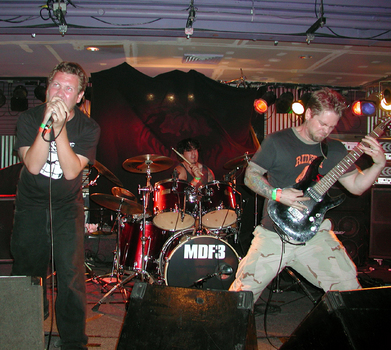
Pig Destroyer is an American grindcore band formed in 1997 in Alexandria, Virginia. The band was formed by vocalist J. R. Hayes, guitarist Scott Hull and drummer John Evans. Pig Destroyer is one of the most well-known grindcore bands due to Hayes' poetic lyrics,[1] Hull's incorporation of thrash metal, doom metal and punk influences in songwriting, and Evans' technical drum work.
Key Information


History
[edit]The band formed in 1997 after the break-up of a short-lived political hardcore band, Treblinka, with 2 former members of said band, vocalist J. R. Hayes (Enemy Soil), guitarist Scott Hull (Agoraphobic Nosebleed, Japanese Torture Comedy Hour, ex-Anal Cunt), and drummer John Evans, who left the band for an unspecified school not long after the band's formation. After the departure of Evans, he was soon replaced by Brian Harvey.[2]
In an interview, Scott Hull claims that they picked the band name on the criteria that it was insulting, yet somewhat more creative than the name of his last band, Anal Cunt. Deciding that "Cop Killer" or "Cop Destroyer" would be tactless, they eventually settled on "Pig Destroyer" ("pig" being a pejorative American slang term for the police). Derived from a non-musical source as extreme as the band's sound, Pig Destroyer's easily identifiable logo was created using a graphic from ANSWER Me! magazine as a template. Relapse Records signed the band and issued a split 7-inch with Isis on the label's Singles Series. 38 Counts of Battery was a complete discography of Pig Destroyer releases up to the year 2000, which included split records with Gnob and influential screamo act Orchid, as well as their debut album, Explosions in Ward 6, and the demo that secured their record deal.
Prowler in the Yard, released in 2001, was the first of the band's records to really break through to what could contextually be considered the "mainstream". Garnering rave reviews from popular press such as Kerrang! and Terrorizer, the record earned Pig Destroyer headlining slots at the 2002 New England Metal and Hardcore Festival and the 2002 Relapse Records CMJ Showcase, as well as a high placing at 2003's Relapse Contamination Fest alongside scene legends High on Fire and The Dillinger Escape Plan (documented on the Relapse Contamination Fest DVD).
2004's Terrifyer boasted a much clearer sound than Prowler in the Yard or 38 Counts of Battery, as well as lyrics and prose from Hayes. The record came with an accompanying DVD soundscape entitled "Natasha", which was intended to be listened to in surround sound (although a more recent Japanese edition of the album has "Natasha" as an ordinary CD with four bonus tracks). Session guitarist Matthew Kevin Mills, Hull's former guitar teacher, recorded the lead guitar parts in the song "Towering Flesh".
A compilation of tracks from the split EPs with Gnob and Benümb is also available, entitled Painter of Dead Girls. The album features alternative versions of older songs from the 38 Counts era (such as "Dark Satellites"), a series of new songs (such as "Rejection Fetish" and "Forgotten Child"), and covers of bands who could be considered an influence (such as The Stooges and Helmet).
2007 saw the release of album Phantom Limb via Relapse Records, complete with album artwork designed by John Baizley (Baroness, Torche).
In 2011, Harvey was replaced by Misery Index drummer Adam Jarvis.[3]
Book Burner was released on October 22, 2012.[4] Pig Destroyer headlined the Terrorizer stage at the Damnation Festival in Leeds in November 2012, which marked their first United Kingdom show in eight years.[5]
In March 2013, Pig Destroyer released an EP titled Mass & Volume via Bandcamp. Recorded at the end of the Phantom Limb sessions, this EP was released as part of a charity effort to benefit the family of recently deceased Relapse Records employee Pat Egen.[6] In September 2013, Adult Swim released the song "The Octagonal Stairway" as part of the 2013 Adult Swim Singles Series.[7]
In October 2013, Adam Jarvis's cousin John Jarvis joined Pig Destroyer as the band's first bass player.[8] In 2014, "The Diplomat" was featured prominently in the season finale of Comedy Central's TV show Workaholics.[9] In 2015, Relapse announced a deluxe reissue of the band's 2001 album Prowler In The Yard, which featured a remixed & remastered version of the album in various limited formats.[10]
At least seven official promotional videos have been made of Pig Destroyer songs: "Piss Angel", from Prowler in the Yard; "Gravedancer", from Terrifyer; "Loathsome", from Phantom Limb; "The Diplomat", from Book Burner; "Army of Cops", "The Torture Fields", and "Mt. Skull" from Head Cage. The first three have aired on MTV2's Headbangers Ball, with each video seeing more airplay than the one that was released before it. The video for "Piss Angel" debuted on the show on August 14, 2004, and was directed by Kenneth Thibault and Nathaniel Baruch.[11] The video for "Gravedancer" was directed by Vladimir Lik and released in 2007. The video for "Loathsome" was directed by David Brodsky and debuted in late 2007. The video for "The Diplomat" was directed by Phil Mucci and released on October 26, 2012.[12] The video for "Army of Cops" was released on July 10, 2018. David Brodsky returned to direct the video.[13] It was followed by the releases of "The Torture Fields" directed by Frank Huang, and "Mt. Skull".[14][15]
In early 2019 John Jarvis was dismissed from the band and replaced with Lody Kong guitarist Travis Stone.
In August 2020, Pig Destroyer released The Octagonal Stairway.[16] Pornographers of Sound was released in June 2021.
In 2022, sound designer Blake Harrison left the band and was replaced by Alex Cha in 2023.
On March 10, 2024, Harrison died from sudden pneumonia and heart attack due to complications of his battle with melanoma.
Influences
[edit]Scott Hull has mentioned artist Matthew Barney, author Dennis Cooper, and noise musicians Whitehouse as influencing his music.[17] Pig Destroyer is inspired by thrash metal such as Dark Angel and Slayer, the sludge metal of The Melvins, and American grindcore as practiced by Brutal Truth.[17] Some releases are influenced by the metalcore subgenre, specifically Prowler in the Yard[citation needed] and Head Cage.[18]
Members
[edit]
Current[edit]
|
Former[edit]
Live musicians[edit]
|
Timeline
[edit]
Discography
[edit]Studio albums
[edit]- Explosions in Ward 6 (1998)
- 38 Counts of Battery (2000)
- Prowler in the Yard (2001)
- Terrifyer (2004)
- Phantom Limb (2007)
- Book Burner (2012)
- Head Cage (2018)
Split albums
[edit]- Orchid / Pig Destroyer (1997)
- Pig Destroyer / Gnob (1999)
- Isis / Pig Destroyer (2000)
- Benümb / Pig Destroyer (2002)
- Pig Destroyer / Coldworker / Antigama (2007)
Extended plays
[edit]- Demo (1997)
- 7" Picture Disc (2000)
- Natasha (2008)
- Blind, Deaf, and Bleeding (2012)
- Mass & Volume (2013)
- The Octagonal Stairway (2020)
References
[edit]- ^ "Pig Destroyer's Lyrical Genius J. R. Hayes Is Inspired by Death and Loves Fugazi – Noisey". Noisey.Vice.com. June 9, 2015. Retrieved December 4, 2018.
- ^ "Face It, You're a Metal Band – Washington City Paper". WashingtonCityPaper.com. January 12, 2001.
- ^ "Pig Destroyer Confirm New Drummer". Theprp.com – Metal And Hardcore News Plus Reviews And More. July 7, 2011. Retrieved October 12, 2014.
- ^ "dB Exclusive: Studio Footage From Upcoming Pig Destroyer Album Book Burner – Decibel Magazine". Decibelmagazine.com. August 8, 2012. Retrieved October 12, 2014.
- ^ "Damnation Festival – Official Website". Damnationfestival.co.uk. Archived from the original on October 9, 2014. Retrieved October 12, 2014.
- ^ "Pig Destroyer Releases 'Mass & Volume' Ep – Blabbermouth.net". BLABBERMOUTH.NET. Retrieved October 12, 2014.
- ^ "Pig Destroyer". Exclaim.ca. Archived from the original on October 24, 2013. Retrieved October 12, 2014.
- ^ "Pig Destroyer Adds Bassist – Blabbermouth.net". BLABBERMOUTH.NET. October 23, 2013. Retrieved October 12, 2014.
- ^ "PIG DESTROYER Was Featured On WORKAHOLICS & It's The Best Three Minutes Of Television Ever – MetalInjection.net". METALINJECTION.NET. April 17, 2014. Retrieved July 23, 2015.
- ^ "Pig Destroyer's Neo-Classic Prowler in the Yard Gets Remixed and Remastered – MetalSucks.net". METALSUCKS.NET. Archived from the original on September 21, 2015. Retrieved July 23, 2015.
- ^ "Pig Destroyer: 'Piss Angel' Video To Premiere On 'Headbanger's Ball' – Blabbermouth.net". BLABBERMOUTH.NET. Archived from the original on August 22, 2004. Retrieved October 12, 2014.
- ^ "Pig Destroyer – PIG DESTROYER Premiere New Video for "The Diplomat" on Noisey, New Album Book Burner Available Now on Relapse Records – Relapse Records : Death Metal, Grindcore, Extreme Metal CDs, DVDs, Vinyl, T-Shirts, Hoodies and merchandise". Relapse.com. Archived from the original on October 18, 2014. Retrieved October 12, 2014.
- ^ "PIG DESTROYER: Premiere "Army of Cops" Music Video; Share Full Head Cage Pre-Order & Details – Label.Relapse.com". Label.Relapse.com. Archived from the original on July 24, 2018. Retrieved July 10, 2018.
- ^ "The Torture Fields". YouTube. August 8, 2018. Archived from the original on December 22, 2021. Retrieved September 1, 2018.
- ^ "Exclusive: Pig Destroyer Take the Piss Out of a Funeral in Their New Video for Mt. Skull". August 29, 2018. Retrieved August 30, 2018.
- ^ "The Octagonal Stairway, by Pig Destroyer". Pigdestroyer.bandcamp.com. Retrieved October 10, 2020.
- ^ a b "Decibel Magazine". Archived from the original on February 9, 2008.
- ^ "Pig Destroyer : Head Cage". September 11, 2018.
External links
[edit]- Pig Destroyer at Relapse Records
- Pig Destroyer at AllMusic
- Pig Destroyer discography at Discogs
- Live Photos of Pig Destroyer at Blackened Music Series Event 2009 Archived August 23, 2009, at the Wayback Machine
- Pig Destroyer at IMDb

| International | |
|---|---|
| National | |
| Artists | |
Pig Destroyer
View on GrokipediaHistory
Formation and early releases (1997–2001)
Pig Destroyer formed in 1997 in the Virginia suburbs of Washington, D.C., initially comprising vocalist J.R. Hayes, guitarist Scott Hull, and drummer Brian Harvey. The trio drew from the local grindcore underground, prioritizing self-recorded material in informal settings like basements to maintain a visceral, unpolished aesthetic reflective of the DIY punk and extreme metal ethos prevalent in the regional scene.[5][6][7] The band's inaugural output was a 1997 demo tape featuring three tracks—"Dark Satellites," "Seven and Thirteen," and an untitled piece—characterized by durations under two minutes each and emphasizing rapid, abrasive compositions.[8] This self-released effort, now out of print, laid the groundwork for their recording approach, with Hull overseeing engineering from the outset to preserve the intended ferocity.[7] In 1998, Pig Destroyer released Explosions in Ward 6 via Reservoir Records (catalog RSVR023), their debut full-length comprising 28 songs averaging 45 seconds in length, captured through rudimentary multi-tracking to amplify the chaotic interplay of elements.[9][10] A vinyl pressing followed in 1999, expanding accessibility within tape-trading and independent distribution circuits.[11] By 2000, the band contributed to a split EP with Benümb, featuring seven tracks of heightened intensity that underscored their ties to the East Coast grind community, again produced by Hull to retain the raw edge of prior efforts.[12][13]Rise and experimentation (2002–2010)
Following the release of Prowler in the Yard on July 24, 2001, Pig Destroyer garnered increased attention within the grindcore underground, with the album's dense, riff-driven compositions and guitarist Scott Hull's clarified production helping to distinguish the band from peers.[14][15] The record's 34 tracks, averaging under two minutes each, emphasized relentless intensity while incorporating subtle structural expansions beyond Napalm Death-style blasts, solidifying their technical prowess and contributing to a growing cult following through Relapse Records' distribution.[16][17] In 2004, the band released Terrifyer on October 12 via Relapse, a 21-track effort clocking in at 32 minutes augmented by the 37-minute doom-laden centerpiece "Natasha," which experimented with extended atmospheric builds and surround-sound mixing on the accompanying DVD audio.[18][19] This double-disc format pushed grindcore conventions by integrating narrative horror elements and guest bass contributions, such as from Hull on select tracks, while Hull's engineering emphasized sonic clarity amid the chaos, earning praise for bridging raw aggression with compositional ambition.[20][21] By 2007, Pig Destroyer issued the full-length Phantom Limb on June 12, introducing sampler Blake Harrison as a fourth member to layer noise and atmospheric samples, marking a shift toward more industrialized textures without diluting core grind ferocity across its 15 tracks.[22][23] Hull's production refinements further honed the band's sound, balancing hyper-speed riffs with eerie interludes, as evidenced in pieces like "Deathtripper," which propelled their reputation for innovative extremity.[24] Throughout the late 2000s, intensive touring reinforced their underground stature, with performances showcasing evolving setlists that highlighted these experimental expansions.[25]Lineup shifts and recent output (2011–present)
In 2011, Pig Destroyer replaced departing drummer Brian Harvey with Adam Jarvis, formerly of Misery Index, marking a significant lineup stabilization that enabled sustained recording and touring amid the band's history of personnel flux.[26] This change coincided with the addition of bass elements in live and studio contexts, enhancing the group's sonic density without altering its core trio-plus-noise structure. Sampler Blake Harrison, a full-time member since 2006 who contributed to atmospheric and textural layers, departed in 2022 after contributing to recent releases; his death from heart failure on March 9, 2024, at age 48 prompted a band statement acknowledging his irreplaceable role in their experimental edge, though the group continued operations without immediate replacement.[27][28] In 2023, the band incorporated Alex Cha on bass for select performances, further adapting to grindcore's demands for live intensity.[29] The period yielded intermittent but potent output, beginning with the full-length Book Burner on October 22, 2012, via Relapse Records, which refined the band's blast-driven aggression through 19 tracks averaging under three minutes.[30] This was followed by a six-year gap before Head Cage on September 7, 2018, incorporating live bass for the first time—courtesy of touring player John Jarvis—yielding their most structurally varied album at 30:59 across 12 songs, blending grind bursts with elongated riffs.[31][32] The 2020 EP The Octagonal Stairway, released August 28, extended this trajectory with six tracks fusing grindcore, noise, and industrial elements, including reworks of prior singles and B-side experiments that underscored the band's refusal to stagnate despite extended creative pauses.[33] Activity persisted into 2025 with tours emphasizing DIY ethos, including a September run across Australia (supported by Wormrot) hitting Perth's Amplifier Bar on the 2nd, Adelaide's Lion Arts Factory on the 4th, and others, plus New Zealand dates like Wellington's San Fran on the 14th—their first in the region since 2008.[34] U.S. engagements followed, such as Los Angeles' Hollywood Palladium on an unspecified late-2025 date, alongside North American outings with unitcode:machine and Curse Mackey, demonstrating resilience through niche venues and merch via platforms like Bandcamp despite grindcore's niche volatility and Harrison's loss.[35][36]Musical style
Grindcore foundations and innovations
Pig Destroyer's core sound adheres closely to grindcore's foundational principles of extreme brevity and unrelenting intensity, with songs typically averaging 1 to 2 minutes in length to maximize ferocity and minimize respite.[37] For instance, their 2001 album Prowler in the Yard compiles 38 tracks that collectively emphasize rapid-fire assaults, many clocking in under one minute to evoke a sense of overwhelming auditory bombardment.[14] This approach mirrors grindcore pioneers by prioritizing quantity—often dozens of tracks per release—over extended compositions, fostering a primal, visceral response through sheer volume and pace rather than structural development.[38] Instrumentally, the band employs hallmark grindcore elements such as relentless blast beats from drummers including Brian Harvey, which drive the percussive pummeling central to the genre's chaotic propulsion.[39] Guitarist Scott Hull delivers riff-heavy barrages without a dedicated bass player, creating a stripped-down, razor-sharp texture that amplifies dissonance and aggression, while vocalist J.R. Hayes delivers screamed vocals infused with poetic phrasing and raw emotional urgency.[5] This configuration rejects conventional metal's harmonic resolution, focusing instead on immediate, gut-level impact through unadorned extremity.[40] Innovations arise in the band's integration of sampling by Blake Harrison, who layers industrial noise and atmospheric dissonance to expand grindcore's palette beyond the purity of acts like Napalm Death, introducing textural chaos that heightens unease without compromising core aggression.[41] This eschews melody or technical virtuosity in favor of emotional rawness, as Hayes has described harnessing personal anger and vulnerability to fuel performances that prioritize cathartic release over polished proficiency.[42] Such elements distinguish Pig Destroyer by critiquing the sanitized production trends in broader metal, insisting on unfiltered ferocity to provoke unmediated listener confrontation.[43]Production techniques and sound evolution
Scott Hull has engineered and produced Pig Destroyer's recordings since the band's inception, utilizing his home studio, Visceral Sound Studios in Alexandria, Virginia, to maintain control over the sound without external commercial pressures.[44] This approach emphasizes raw capture of performances with minimal overdubs in early works, evolving toward denser layering of guitars and noise elements while retaining uncompressed dynamics for aggressive drum tones and distorted riff clarity.[25] Hull's techniques often incorporate drum machines for initial demos and sound manipulation, such as processed vocals and electronic accents, to heighten the chaotic density without smoothing edges for broader appeal.[45] Early 1990s demos and releases like the 1997 self-titled demo and 1998's Explosions in Ward 6 featured lo-fi aesthetics with hasty, organic recordings that prioritized speed and mess over polish, reflecting the band's initial grindcore roots in unrefined aggression.[25] By Terrifyer in 2004, Hull's multi-tracked guitar layers and noise integrations created a wall of unrelenting entropy, yet preserved riff coherence through precise riff-writing amid the barrage, countering perceptions of unstructured noise by emphasizing melodic anchors in the distortion.[1] This era's production amplified the genre's anti-aesthetic, using home-captured tones to embed structural riffs within apparent disorder. Subsequent albums marked a subtle shift toward enhanced definition, as seen in Head Cage (2018), where digital refinements added punch to low-end frequencies and groove elements without diluting intensity, integrating bass lines more prominently via pre-production demos.[45] Hull's evolution balanced raw fury with clearer articulation of compositions, reducing blast beats in favor of mid-tempo heft while upholding the band's refusal to chase mainstream clarity, as evidenced by the album's focus on diverse influences like noise-rock over polished extreme metal norms.[46] These choices underscore a deliberate progression: from primal lo-fi entropy to controlled chaos, where production techniques reveal underlying riff logic without compromising grindcore's visceral core.[14]Influences
Genre precursors and external inspirations
Pig Destroyer's sound draws from early grindcore pioneers, particularly Napalm Death's relentless speed and brevity, as evidenced by the structural influence of their 1987 album Scum on subsequent American grind acts seeking to condense extremity into micro-songs.[47] Carcass contributed gore-infused aesthetics and medical pathology themes, shaping the band's visceral horror elements, though Pig Destroyer diverged by emphasizing personal psychological dread over clinical dissection.[48] Differentiation emerged through U.S. powerviolence bands like Infest, whose chaotic, crossover punk aggression informed Pig Destroyer's raw, unpolished delivery and rejection of European crust's overt political messaging in favor of apolitical sonic violence tied to the Virginia DIY scene's urban alienation.[49] Guitarist Scott Hull's stint with Anal Cunt further instilled irreverent, noise-punk humor and minimalism, evident in Pig Destroyer's stripped-down trio format and avoidance of traditional bass lines.[43][40] Vocalist J.R. Hayes cited Fugazi as a key influence for introspective lyricism, adapting post-hardcore's emotional depth to grindcore's brevity without adopting its straight-edge moralism.[50] The band explicitly rejected black metal's occult mysticism, prioritizing individualized horror over supernatural tropes.[51] External inspirations include horror literature, with Lovecraftian cosmic dread reflected in tracks like "Call Girl of Cthulhu" from Terrifyer (2004), evoking existential insignificance amid urban decay rather than fantastical entities.[52] This aligns with the Virginia hardcore ethos of self-reliant production and local scene grit, eschewing imported ideological crust influences for firsthand environmental desolation.[41]Lyrics and themes
Core motifs of horror and introspection
The lyrics of Pig Destroyer, primarily authored by vocalist J.R. Hayes, center on psychological horror manifested through motifs of tormenting obsession and the inexorable decay of the self, eschewing fantastical gore in favor of visceral emotional disintegration. Recurring themes include personal failure as an inescapable cycle, as articulated in tracks like "Patterns of Failure," where unrequited desire spirals into self-inflicted ruin without resolution or external blame.[53] Bodily and mental erosion appears as a causal endpoint of unchecked impulses, with Hayes drawing from real-world inspirations like mortality to underscore human limits, rendering introspection as a confrontation with innate frailty rather than therapeutic catharsis.[50] Feminine archetypes frequently embody these tormentors, not as politicized symbols but as catalysts for the protagonist's descent into predatory fixation, exemplified in the Prowler in the Yard liner notes' depiction of nocturnal surveillance: "I am parked at the elementary school across from her house, listening to the rain pound against the roof of the car."[54] This narrative privileges the raw mechanics of agency-driven despair—obsession begetting isolation—over narratives that sanitize suffering into victimhood or redemption, aligning with Hayes' stated nihilistic undercurrents that reject imposed meaning in favor of existential void.[55] Hayes' style employs dense, allusive phrasing to evoke betrayal's sting and self-sabotage, as in Book Burner's imagery of fiery dissolution, where interpersonal treachery mirrors internal combustion without moral uplift.[56] Such motifs maintain an apolitical focus, prioritizing causal realism in human interactions—failure as endogenous outcome—over cultural tropes that externalize culpability, fostering a lyrical realism that demands accountability amid dread.Members
Current members
J.R. Hayes has served as the band's lead vocalist since its formation in 1997, delivering high-intensity screamed and shouted lyrics that form the narrative core of Pig Destroyer's sound.[58] His contributions emphasize thematic depth through visceral, horror-infused delivery, maintained consistently across studio recordings and live performances into 2025.[25] Scott Hull, a founding member, handles guitar duties and production responsibilities since 1997, shaping the band's riff-based structures and electronic-infused grindcore aesthetic.[59] Hull's role extends to engineering most albums, incorporating dense layering and noise elements without a dedicated bassist, relying on guitar tones for low-end aggression.[45] He occasionally performs live, supporting the core trio format as of recent tours in 2024–2025. Adam Jarvis joined as drummer in 2012, providing the blast-beat precision and dynamic shifts essential to the band's high-speed execution.[60] Jarvis, also active in Misery Index and other projects, has handled live drumming for albums like Book Burner onward, including rehearsals for new material reported in early 2025. His tenure aligns with the band's post-Harvey era, enabling sustained touring such as the 2025 Southwest dates.[61]Former members
Brian Harvey served as Pig Destroyer's drummer from 1998 to July 2011, succeeding founding member John Evans and providing the blast beat precision that shaped the band's early grindcore intensity across albums like Explosions in Ward 6 (1998) and Prowler in the Yard (2001).[39] His departure prompted the recruitment of Adam Jarvis as replacement.[62] Blake Harrison contributed samples, noise, and sound design starting in 2004, achieving full-time status before the release of Phantom Limb in 2007 and continuing until 2022; he appeared on subsequent records including Book Burner (2012) and Head Cage (2018), incorporating electronic dissonance to enhance the band's chaotic aesthetic.[28] Harrison died on March 9, 2024, from heart failure amid ongoing health challenges including cancer.[28] The band acknowledged his over two decades of creative input in a public statement.[28] Earlier short-term participants included John Evans on drums for the band's formation in 1997 through 1998, and live additions Donna Parker and Jessica Rylan on keyboards and electronics during a 2006 three-day tour run supporting Whitehouse.[63][60]Lineup timeline
Pig Destroyer formed in 1997 in Alexandria, Virginia, initially consisting of vocalist J.R. Hayes and guitarist Scott Hull, with drummer Brian Harvey joining shortly thereafter to solidify the core recording lineup by 1998.[1][6] This trio remained stable through the band's early releases, including the 1998 album Explosions in Ward 6 and the 2001 full-length Prowler in the Yard.[64] In late 2006, Blake Harrison joined as the official sampler and noise operator, contributing to albums like Terrifyer (2004, with pre-join credits) and subsequent works, while also providing live backing vocals.[65][66] Harvey departed around 2011, leading to a rotation of live drummers, with Adam Jarvis emerging as a primary collaborator for recordings such as Book Burner (2012) and ongoing tours.[64][67] Harrison exited the band in December 2022, diminishing the live sampler role, which has since been handled through pre-recorded elements or ad-hoc support during performances.[68] Harrison's death on March 10, 2024, at age 48 prompted tributes from the band and label Relapse Records, but did not lead to dissolution; Pig Destroyer continued touring in 2024 and announced 2025 dates, including European festivals and East Coast U.S. shows, with Jarvis on drums.[65][69][70]Discography
Studio albums
Pig Destroyer's debut studio album, Prowler in the Yard, was released on July 24, 2001, through Relapse Records.[16] The album comprises 48 tracks, structured as a series of vignettes evoking horror themes through fragmented, high-intensity bursts of grindcore aggression and atmospheric tension.[71] The band's second studio album, Terrifyer, followed on October 12, 2004, also via Relapse Records.[18] Featuring 86 tracks, it expands into experimental sprawl with disjointed song structures, incorporating noise elements, doom-laden interludes, and rapid-fire riffs that prioritize disorientation over linear progression.[72] Book Burner, released October 22, 2012, on Relapse Records, marks a shift toward more refined compositions while retaining core intensity.[73] With approximately 20 tracks averaging longer durations, it develops conceptual arcs around societal critique and personal decay, blending grind precision with melodic undertones.[30] The most recent studio album, Head Cage, appeared on September 7, 2018, through Relapse Records.[31] Comprising 12 tracks, it further matures the band's sound with structured songcraft, emphasizing rhythmic complexity and thematic depth in explorations of entrapment and resistance, averaging around 25 minutes total runtime.[74]Extended plays and splits
Pig Destroyer's extended plays and splits have served as vital conduits for their unrelenting grindcore output, often issued in compact formats that align with the genre's emphasis on brevity and ferocity, allowing rapid experimentation and cross-pollination with peers.[12] Early efforts included the July 2000 split with Isis on Relapse Records, a 3-inch CD featuring Pig Destroyer's raw, hastily composed track "Pig Destroyer," which captured the band's nascent sonic violence in under two minutes.[75] The 2002 split with Benümb, released February 19 on Robotic Empire as a 3-inch CD, highlighted Pig Destroyer's side with seven tracks recorded in a single day in early 2000, emphasizing themes of depravity through tracks like "Hymn" and "The American Life," totaling just over six minutes of pummeling riffs and blasts. This release underscored their underground alliances, pairing their DC-area extremity with Benümb's West Coast grind. In 2007, a three-way split vinyl with Coldworker and Antigama extended this collaborative vein, with Pig Destroyer's contributions delivering unrelenting short-form assaults amid the shared 7-inch format.[76] Later EPs maintained this velocity post-personnel flux, incorporating electronic percussion after drummer Brian Harvey's 2006 exit to sustain the barrage. The 2008 Natasha EP, a four-track digital and vinyl outing, distilled visceral horror into sub-five-minute runtime, with opener "Natasha" exemplifying jagged guitar dissonance and vocal ferocity.[6] Culminating in the 2020 The Octagonal Stairway EP on Relapse Records, released August 28 with six tracks blending grind blasts, noise walls, and industrial undertones—such as the title track's 10-minute noise sprawl—the release affirmed their adaptability, clocking 20 minutes while preserving core excess.[33][77] These formats perpetuated Pig Destroyer's role in grind's iterative ecosystem, prioritizing quantity and mutation over polished longevity.Reception
Critical responses and achievements
Pig Destroyer's 2001 album Prowler in the Yard was inducted into Decibel Magazine's Hall of Fame in June 2013, recognizing its status as a landmark in grindcore for its raw aggression and structural innovation within the genre's constraints.[78] The album's inclusion highlighted the band's ability to blend brevity with thematic depth, earning praise from grindcore enthusiasts for maintaining the form's punk-rooted intensity without unnecessary extension.[79] This accolade underscored Pig Destroyer's role in elevating grindcore beyond mere speed, with critics noting its influence on subsequent acts prioritizing concision as a core virtue.[80] The 2018 release Head Cage received acclaim for its atmospheric terror-building and experimental edges, with Pitchfork describing it as a refinement of the band's grindcore foundation through layered dread and sonic unease.[81] Decibel Magazine featured the band on its September 2018 cover in promotion of the album, affirming its critical weight in extreme metal circles despite deviations toward more progressive structures that some purists contrasted with traditional grind brevity.[82] Reviews emphasized the album's 30-minute runtime as a deliberate embrace of grindcore's minimalist ethos, countering perceptions of dilution by delivering unyielding blasts amid horror-infused narratives.[83] Bands like Full of Hell have cited Pig Destroyer as a foundational influence, incorporating similar grindcore bludgeoning and chaotic riffing into their sound, as evidenced by collaborative elements and shared touring history that positioned Pig Destroyer as a blueprint for modern iterations.[84] The band's longevity with Relapse Records, spanning over two decades and multiple full-lengths since Explosions in Ward 6 in 2000, reflects sustained underground endurance rather than mainstream crossover.[85] By 2009, Pig Destroyer had sold nearly 100,000 albums, generating approximately $20,000 annually from sales and merchandise, metrics indicative of a dedicated cult following in niche extreme music scenes without reliance on broader commercial appeal.[86]Criticisms within metal communities
Within grindcore forums, Pig Destroyer is frequently described as a genre outlier, with detractors arguing that its erratic song structures echo the attention-deficit-disorder (ADD)-like tendencies of guitarist Scott Hull's earlier project Anal Cunt, prioritizing disjointed noise bursts over the riff-driven hooks or punk-rooted consistency found in bands like Napalm Death or Nasum.[87] This view posits the band's early output, such as the 2001 album Prowler in the Yard, as favoring chaotic, formless aggression that borders on unstructured noise rather than delivering memorable, hook-laden grindcore anthems.[88] Critics in metal communities have also targeted later releases for a perceived softening of the band's feral intensity, attributing it to lineup maturation—vocalist J.R. Hayes, born in 1972, and Hull, born in 1971, entered their 40s and 50s by the 2010s—and production shifts toward groove and noise-rock elements over relentless blast beats.[45] For instance, 2018's Head Cage drew complaints of "chronic fatigue" and boredom from reviewers, who noted reduced speed and aggression compared to the raw DIY ethos of 1990s demos like 38 Counts of Battery, where tracks devolved into violent, near-indiscernible noise.[89] Such evolutions are seen by skeptics as diluting grindcore's core ferocity, with empirical comparisons highlighting Hayes' vocal texture evolving from guttural shrieks to more restrained delivery over two decades.[90] While some defend Pig Destroyer's underlying riff coherence as rebutting formlessness charges, community debates persist on whether its noise-prioritizing approach truly advances grindcore or merely amplifies gimmickry at the expense of genre-defining brutality.[91] These critiques, drawn from fan discussions rather than mainstream outlets, underscore a divide where purists favor unpolished extremity over the band's experimental outliers.[87]Live performances
Touring history and stage dynamics
Pig Destroyer began their touring career in the late 1990s, focusing on the underground grindcore scene along the United States East Coast, with performances at small venues in areas like Virginia and Maryland.[92] By the mid-2000s, the band expanded internationally, including a Japanese tour in May 2008 supporting their album Terrifyer.[93] European appearances followed in subsequent years, such as festival dates in the early 2010s, building on domestic momentum from U.S. bills with acts like Napalm Death.[94] Throughout the 2010s, touring slowed due to lineup changes and periods of inactivity, including a notable hiatus after 2013, punctuated by sporadic U.S. shows like a 2016 co-headline with The Black Dahlia Murder.[95] This pattern broke in 2025 with their first Australian and New Zealand tour since 2008, spanning September 2 to 14 across cities including Perth, Sydney, and Wellington, joined by Wormrot on Australian dates.[96][97] The run featured high-intensity sets drawing on recent material, marking a return to international endurance in extreme metal circuits.[98] On stage, Pig Destroyer employs minimal setups—typically guitar, drums, vocals, and electronics—eschewing elaborate visuals to amplify raw chaos and sonic assault.[99] Performances emphasize physical ferocity, with frequent stage diving and crowd interaction fostering aggressive mosh pits centered on direct, unfiltered energy rather than theatrical production.[66] Fan and reviewer accounts highlight this dynamic's role in sustaining grindcore's visceral appeal, as seen in live footage from venues like Maryland Deathfest and Electric Brixton, where the band's precision amid disorder elicits immediate, bodily responses from audiences.[100][101]Legacy
Impact on grindcore and extreme music
Pig Destroyer's integration of grindcore with doom-laden atmospheres and thrash-infused riffs, as evident in albums like Terrifyer (2004), expanded the genre's structural possibilities, moving beyond rigid blast-beat minimalism toward dynamic, song-based extremity that prioritized sonic unpredictability over formulaic brevity.[21][102] This approach influenced hybrid scenes in the 2010s, where bands blended grind's aggression with death metal's mid-tempo sludginess and noise's dissonance, fostering evolutions traceable in acts citing their non-linear compositions as a departure from Napalm Death-era uniformity.[45] Vocalist J.R. Hayes' lyrics, rooted in motifs of mortality and psychological fragmentation rather than overt sociopolitical sloganeering, elevated grindcore's thematic rawness toward individual introspection, countering the genre's historical emphasis on collective anthems with personal, unflinching explorations of despair and isolation.[50][42] Hayes has attributed this style to inspirations from death's finality, yielding dense, philosophical content that bands like Pyrrhon have emulated for injecting interior monologues into extreme metal's bombast.[103] This shift reinforced grindcore's resistance to sanitized narratives, prioritizing unfiltered psyche over performative activism and impacting successors in crafting lyrics that probe existential dread amid auditory chaos.[41] Guitarist Scott Hull's production ethos, emphasizing stripped-down, high-fidelity captures of analog extremity without digital gloss, modeled a DIY blueprint for grind acts seeking visceral clarity over polished aggression, as seen in his parallel work with Agoraphobic Nosebleed and influencing the raw sonics of 2010s bands prioritizing hardware immediacy.[25] Collaborations, such as Full of Hell's Dylan Walker guesting on Head Cage (2018), underscore reciprocal influence, with Pig Destroyer's template of poetic intensity amid grind's brevity echoed in Full of Hell's fusion of hardcore breakdowns and lyrical abstraction.[31][104] Overall, their causal role manifests in grindcore's post-2000s diversification, where extremity derives from personal sonic experiments rather than rote emulation, verifiable through cited evolutions in peer acts' structures and themes.[48]References
- https://www.[popmatters](/page/PopMatters).com/everything-is-permitted-2496236086.html