



Community hub
Recent from talks
Contribute something to knowledge base
Content stats: 0 posts, 0 articles, 1 media, 0 notes
Members stats: 0 subscribers, 0 contributors, 0 moderators, 0 supporters
Subscribers
Supporters
Contributors
Moderators
Hub AI
Pilaf AI simulator
(@Pilaf_simulator)
Hub AI
Pilaf AI simulator
(@Pilaf_simulator)
Pilaf
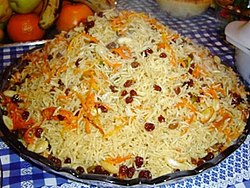
Pilaf (US: /ˈpiːlɑːf/ ⓘ), pilav or pilau (UK: /ˈpiːlaʊ, piːˈlaʊ/) is a rice dish, or in some regions, a wheat dish, whose recipe usually involves cooking in stock or broth, adding spices, and other ingredients such as vegetables or meat, and employing some technique for achieving cooked grains that do not adhere.
The origins of the dish are disputed, but at the time of the Persianized Abbasid Caliphate, such methods of cooking rice at first spread through a vast territory from Central Asia to Spain, and eventually to a wider world. The Spanish paella, and the South Asian pilau or pulao, and biryani, evolved from such dishes.
Pilaf and similar dishes are common to West Asian, Balkan, Caribbean, South Caucasian, Central Asian, East African, Eastern European, Latin American, Maritime Southeast Asia, and South Asian cuisines; in these areas, they are regarded as staple dishes.
According to the Oxford English Dictionary, Third Edition (2006) the English word pilaf is a borrowing from Turkish, its etymon, or linguistic ancestor, the Turkish pilav, whose etymon is the Persian pilāv; "pilaf" is found more commonly in North American dictionaries than pilau, all from the Persian pilav.
The word 'pilaf' itself is borrowed from the Sanskrit word pulāka ("ball of rice"), which is of possible Dravidian origin.
The spelling, pilau, has etymon Persian pulaw (in form palāv, pilāv, or pulāv in the 16th century) and Urdu pulāv ("dish of rice and meat"), from Persian pulāv ("Side dishes, spices, meat, vegetables, even plain rice "), the Tamil Pulukku ("Dravidian (compare Tamil puḷukku (adjective) simmered, (noun) boiled or parboiled food, puḷukkal cooked rice); in turn probably from Sanskrit pulāka ("ball of rice").
Although the cultivation of rice had spread much earlier from India to Central and West Asia, it was at the time of the Persianized Abbasid Caliphate that methods of cooking rice which approximate modern styles of cooking pilaf at first spread through a vast territory from Spain to Afghanistan, and eventually to a wider world. The Spanish paella, and the South Asian pilau or pulao, and biryani, evolved from such dishes.
According to author K. T. Achaya, the Indian epic Mahabharata mentions an instance of rice and meat cooked together. Also, according to Achaya, "pulao" or "pallao" is used to refer to a rice dish in ancient Sanskrit works such as the Yājñavalkya Smṛti. However, according to food writers Colleen Taylor Sen and Charles Perry, and social theorist Ashis Nandy, these references do not substantially correlate to the commonly used meaning and history implied in pilafs, which appear in Indian accounts after the medieval Central Asian conquests.
Pilaf
Pilaf (US: /ˈpiːlɑːf/ ⓘ), pilav or pilau (UK: /ˈpiːlaʊ, piːˈlaʊ/) is a rice dish, or in some regions, a wheat dish, whose recipe usually involves cooking in stock or broth, adding spices, and other ingredients such as vegetables or meat, and employing some technique for achieving cooked grains that do not adhere.
The origins of the dish are disputed, but at the time of the Persianized Abbasid Caliphate, such methods of cooking rice at first spread through a vast territory from Central Asia to Spain, and eventually to a wider world. The Spanish paella, and the South Asian pilau or pulao, and biryani, evolved from such dishes.
Pilaf and similar dishes are common to West Asian, Balkan, Caribbean, South Caucasian, Central Asian, East African, Eastern European, Latin American, Maritime Southeast Asia, and South Asian cuisines; in these areas, they are regarded as staple dishes.
According to the Oxford English Dictionary, Third Edition (2006) the English word pilaf is a borrowing from Turkish, its etymon, or linguistic ancestor, the Turkish pilav, whose etymon is the Persian pilāv; "pilaf" is found more commonly in North American dictionaries than pilau, all from the Persian pilav.
The word 'pilaf' itself is borrowed from the Sanskrit word pulāka ("ball of rice"), which is of possible Dravidian origin.
The spelling, pilau, has etymon Persian pulaw (in form palāv, pilāv, or pulāv in the 16th century) and Urdu pulāv ("dish of rice and meat"), from Persian pulāv ("Side dishes, spices, meat, vegetables, even plain rice "), the Tamil Pulukku ("Dravidian (compare Tamil puḷukku (adjective) simmered, (noun) boiled or parboiled food, puḷukkal cooked rice); in turn probably from Sanskrit pulāka ("ball of rice").
Although the cultivation of rice had spread much earlier from India to Central and West Asia, it was at the time of the Persianized Abbasid Caliphate that methods of cooking rice which approximate modern styles of cooking pilaf at first spread through a vast territory from Spain to Afghanistan, and eventually to a wider world. The Spanish paella, and the South Asian pilau or pulao, and biryani, evolved from such dishes.
According to author K. T. Achaya, the Indian epic Mahabharata mentions an instance of rice and meat cooked together. Also, according to Achaya, "pulao" or "pallao" is used to refer to a rice dish in ancient Sanskrit works such as the Yājñavalkya Smṛti. However, according to food writers Colleen Taylor Sen and Charles Perry, and social theorist Ashis Nandy, these references do not substantially correlate to the commonly used meaning and history implied in pilafs, which appear in Indian accounts after the medieval Central Asian conquests.
Recent media
Recent media