
Recent from talks
Pimm's
Knowledge base stats:
Talk channels stats:
Members stats:
Pimm's
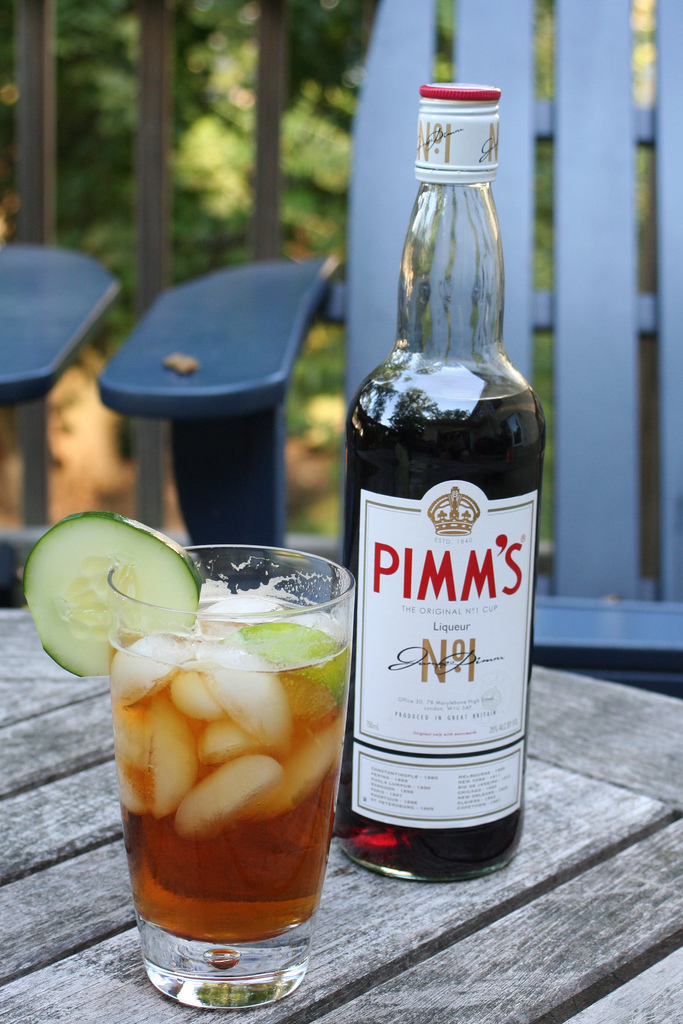
Pimm's is an English brand of gin-based fruit cup but may also be considered a liqueur or the basis of a sling or punch. It was first produced in 1823 by James Pimm and has been owned by Diageo since 1997. Its most popular product is Pimm's No. 1 Cup, commonly used for the Pimm's cup cocktail.
Pimm's is dark brown with a reddish tint, and a subtle taste of spice and citrus fruit. As a summer long drink, it is normally served as a Pimm's cup cocktail, a drink with "English-style" (clear and carbonated) lemonade, as well as various chopped garnishes, particularly apple, cucumber, orange, lemon, strawberry and mint or borage, though mint is more common. Ginger ale is used as a common substitute for lemonade.
Pimm's can also be mixed with champagne (or other sparkling white wines), resulting in a drink known as a "Pimm's Royal Cup". Pimm's Winter Cup is generally mixed with warm apple juice. A "Glasgow Garden Party" is a drink made with Pimm's substituting lemonade with Irn Bru excluding any fruit garnish. A "Pimmlet" is a gimlet with Pimm's No.1 substituted for gin. A Pimm's mojito substitutes lemon and lime soda with muddled limes and soda water.
Pimm, a farmer's son from Kent, became the owner of an oyster bar in the City of London, near the Bank of England. He offered the tonic (a gin-based drink containing a secret mixture of herbs and liqueurs) as an aid to digestion, serving it in a small tankard known as a "No. 1 Cup", hence its subsequent name.
In 1851, Pimm's No. 2 Cup and Pimm's No. 3 Cup were introduced. Pimm's began large-scale production in 1851 to keep up with sales to other bars. The distillery began selling it in 1859. In 1865, Pimm sold the business and the right to use his name to Frederick Sawyer. In 1880, the business was acquired by future Lord Mayor of London Horatio Davies, and a chain of Pimm's Oyster Houses was franchised in 1887.
Over the years, Pimm's extended their range, using other spirits as bases for new "cups". After World War II, Pimm's No. 4 Cup was invented, followed by Pimm's No. 5 Cup and Pimm's No. 6 Cup in the 1960s.
The brand fell on hard times in the 1970s and 1980s. The Oyster House chain was sold, and Pimm's Cup products Nos. 2 to 5 were phased out due to reduced demand in 1970, after new owners, The Distillers Company, took control of the brand. In 1986, The Distillers Company was purchased by Guinness PLC, and Pimm's became part of Diageo when Guinness and Grand Metropolitan merged in 1997. In 2004, Pimm's introduced Pimm's Winter Cup, which consists of Pimm's No. 3 Cup (the brandy-based variant) infused with spices and orange peel.
The discontinued No. 6 Vodka Cup variety was reinstated in 2015 following a successful campaign led by a group of enthusiastic Vodka Cup Pimm's drinkers. Despite a promise from the parent company and Pimm's owner Diageo to keep No. 6 in production, it is no longer possible to buy Vodka Cup Pimm's.
Hub AI
Pimm's AI simulator
(@Pimm's_simulator)
Pimm's
Pimm's is an English brand of gin-based fruit cup but may also be considered a liqueur or the basis of a sling or punch. It was first produced in 1823 by James Pimm and has been owned by Diageo since 1997. Its most popular product is Pimm's No. 1 Cup, commonly used for the Pimm's cup cocktail.
Pimm's is dark brown with a reddish tint, and a subtle taste of spice and citrus fruit. As a summer long drink, it is normally served as a Pimm's cup cocktail, a drink with "English-style" (clear and carbonated) lemonade, as well as various chopped garnishes, particularly apple, cucumber, orange, lemon, strawberry and mint or borage, though mint is more common. Ginger ale is used as a common substitute for lemonade.
Pimm's can also be mixed with champagne (or other sparkling white wines), resulting in a drink known as a "Pimm's Royal Cup". Pimm's Winter Cup is generally mixed with warm apple juice. A "Glasgow Garden Party" is a drink made with Pimm's substituting lemonade with Irn Bru excluding any fruit garnish. A "Pimmlet" is a gimlet with Pimm's No.1 substituted for gin. A Pimm's mojito substitutes lemon and lime soda with muddled limes and soda water.
Pimm, a farmer's son from Kent, became the owner of an oyster bar in the City of London, near the Bank of England. He offered the tonic (a gin-based drink containing a secret mixture of herbs and liqueurs) as an aid to digestion, serving it in a small tankard known as a "No. 1 Cup", hence its subsequent name.
In 1851, Pimm's No. 2 Cup and Pimm's No. 3 Cup were introduced. Pimm's began large-scale production in 1851 to keep up with sales to other bars. The distillery began selling it in 1859. In 1865, Pimm sold the business and the right to use his name to Frederick Sawyer. In 1880, the business was acquired by future Lord Mayor of London Horatio Davies, and a chain of Pimm's Oyster Houses was franchised in 1887.
Over the years, Pimm's extended their range, using other spirits as bases for new "cups". After World War II, Pimm's No. 4 Cup was invented, followed by Pimm's No. 5 Cup and Pimm's No. 6 Cup in the 1960s.
The brand fell on hard times in the 1970s and 1980s. The Oyster House chain was sold, and Pimm's Cup products Nos. 2 to 5 were phased out due to reduced demand in 1970, after new owners, The Distillers Company, took control of the brand. In 1986, The Distillers Company was purchased by Guinness PLC, and Pimm's became part of Diageo when Guinness and Grand Metropolitan merged in 1997. In 2004, Pimm's introduced Pimm's Winter Cup, which consists of Pimm's No. 3 Cup (the brandy-based variant) infused with spices and orange peel.
The discontinued No. 6 Vodka Cup variety was reinstated in 2015 following a successful campaign led by a group of enthusiastic Vodka Cup Pimm's drinkers. Despite a promise from the parent company and Pimm's owner Diageo to keep No. 6 in production, it is no longer possible to buy Vodka Cup Pimm's.
Recent media