



Community hub
Recent from talks
Knowledge base stats:
Talk channels stats:
Members stats:
Piracy in the Strait of Malacca
Piracy in the Strait of Malacca has long been a threat to ship owners and the mariners who ply the 900 km-long (550 miles) sea lane. In recent years, coordinated patrols by Indonesia, Malaysia, Thailand, and Singapore along with increased security on vessels have caused a sharp downturn in piracy.
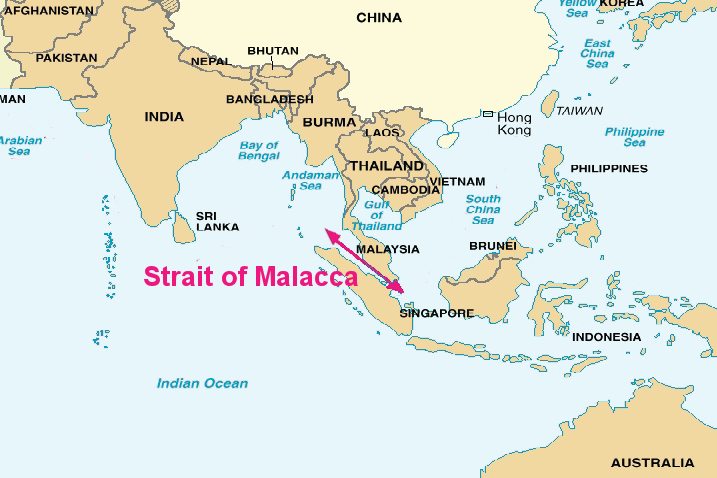
The Strait of Malacca's geography makes the region very susceptible to piracy. It was and still is an important passageway between China and India, used heavily for commercial trade. The strait is on the route between Europe, the Suez Canal, the oil-exporting countries of the Persian Gulf, and the busy ports of East Asia. It is narrow, contains thousands of islets, and is an outlet for many rivers, making it ideal for pirates to evade capture.
Piracy in the Strait of Malacca was not only a lucrative way of life but also an important political tool. Rulers relied on the region's pirates to maintain control. For example, it was through the loyalty of Orang Laut pirate crews that the 14th-century Palembang prince Parameswara survived expansion attempts by neighbouring rulers and eventually went on to found the Sultanate of Malacca.
Piracy in the region was mentioned in Chinese texts; for example, the 14th century traveller Wang Dayuan described pirates from Long Ya Men (in present-day Singapore) and Lambri (in Northern Sumatra) in his work Daoyi Zhilüe. The pirates of Long Ya Men were said to leave Chinese junks going west through the strait undisturbed, but waited until the Chinese junks were on their way back to China laden with goods before they attacked with two to three hundred boats.
Between the 15th and 19th centuries, Malaysian waters played a key role in political power struggles throughout Southeast Asia. Aside from local powers, antagonists also included such colonial powers as the Portuguese, Dutch and British. A record of foreign presence, particularly in the South China Sea and the Strait of Malacca, is found today in the watery graves of sailing vessels lost to storms, piracy, battles, and poor ship handling.
In the 1830s, the controlling colonial powers in the region, the British East India Company and the Dutch Empire, agreed to curb the rampant piracy. This decision, embodied in the Anglo-Dutch Treaty of 1824 led to the creation of the British Straits Settlements of Malacca, Dinding, Penang, and Singapore, seats of British administration aimed at controlling piracy and enabling maritime trade. The British and Dutch empires effectively drew a demarcation line along the strait, agreeing to fight against piracy on their own side of the line. This line of demarcation would eventually become the modern-day border between Malaysia and Indonesia. Increased patrolling and superior seafaring technology on the part of the European powers, as well as improved political stability and economic conditions in the region, eventually allowed the European powers to greatly curb piracy in the region by the 1870s.
Following the 1869 opening of the Suez Canal and changing shipping routes, the British and Dutch signed the Anglo-Dutch Treaties of 1870–1871 which ended British territorial claims to Sumatra, allowing the Dutch a free hand within their sphere of influence in Maritime Southeast Asia while handing them the responsibility to check piracy. The treaty eventually led to the Aceh War.
The International Maritime Bureau (IMB) reports worldwide pirate attacks fell for the third year in a row in 2006. Attacks on ships at sea in 2006 fell to 239 vessels, down from 276 in 2005. That same trend echoed in the Strait of Malacca where attacks dropped from 79 in 2005 to 50 in 2006. Nonetheless, in 2004, the region accounted for 40% of piracy worldwide. The IMB reported in October 2007 that Indonesia continued to be the world's most pirate-struck region with 37 attacks since January 2007, though that was an improvement from the same nine-month period in 2006.
Hub AI
Piracy in the Strait of Malacca AI simulator
(@Piracy in the Strait of Malacca_simulator)
Piracy in the Strait of Malacca
Piracy in the Strait of Malacca has long been a threat to ship owners and the mariners who ply the 900 km-long (550 miles) sea lane. In recent years, coordinated patrols by Indonesia, Malaysia, Thailand, and Singapore along with increased security on vessels have caused a sharp downturn in piracy.
The Strait of Malacca's geography makes the region very susceptible to piracy. It was and still is an important passageway between China and India, used heavily for commercial trade. The strait is on the route between Europe, the Suez Canal, the oil-exporting countries of the Persian Gulf, and the busy ports of East Asia. It is narrow, contains thousands of islets, and is an outlet for many rivers, making it ideal for pirates to evade capture.
Piracy in the Strait of Malacca was not only a lucrative way of life but also an important political tool. Rulers relied on the region's pirates to maintain control. For example, it was through the loyalty of Orang Laut pirate crews that the 14th-century Palembang prince Parameswara survived expansion attempts by neighbouring rulers and eventually went on to found the Sultanate of Malacca.
Piracy in the region was mentioned in Chinese texts; for example, the 14th century traveller Wang Dayuan described pirates from Long Ya Men (in present-day Singapore) and Lambri (in Northern Sumatra) in his work Daoyi Zhilüe. The pirates of Long Ya Men were said to leave Chinese junks going west through the strait undisturbed, but waited until the Chinese junks were on their way back to China laden with goods before they attacked with two to three hundred boats.
Between the 15th and 19th centuries, Malaysian waters played a key role in political power struggles throughout Southeast Asia. Aside from local powers, antagonists also included such colonial powers as the Portuguese, Dutch and British. A record of foreign presence, particularly in the South China Sea and the Strait of Malacca, is found today in the watery graves of sailing vessels lost to storms, piracy, battles, and poor ship handling.
In the 1830s, the controlling colonial powers in the region, the British East India Company and the Dutch Empire, agreed to curb the rampant piracy. This decision, embodied in the Anglo-Dutch Treaty of 1824 led to the creation of the British Straits Settlements of Malacca, Dinding, Penang, and Singapore, seats of British administration aimed at controlling piracy and enabling maritime trade. The British and Dutch empires effectively drew a demarcation line along the strait, agreeing to fight against piracy on their own side of the line. This line of demarcation would eventually become the modern-day border between Malaysia and Indonesia. Increased patrolling and superior seafaring technology on the part of the European powers, as well as improved political stability and economic conditions in the region, eventually allowed the European powers to greatly curb piracy in the region by the 1870s.
Following the 1869 opening of the Suez Canal and changing shipping routes, the British and Dutch signed the Anglo-Dutch Treaties of 1870–1871 which ended British territorial claims to Sumatra, allowing the Dutch a free hand within their sphere of influence in Maritime Southeast Asia while handing them the responsibility to check piracy. The treaty eventually led to the Aceh War.
The International Maritime Bureau (IMB) reports worldwide pirate attacks fell for the third year in a row in 2006. Attacks on ships at sea in 2006 fell to 239 vessels, down from 276 in 2005. That same trend echoed in the Strait of Malacca where attacks dropped from 79 in 2005 to 50 in 2006. Nonetheless, in 2004, the region accounted for 40% of piracy worldwide. The IMB reported in October 2007 that Indonesia continued to be the world's most pirate-struck region with 37 attacks since January 2007, though that was an improvement from the same nine-month period in 2006.