



Community hub
Recent from talks
Knowledge base stats:
Talk channels stats:
Members stats:
Pit (nuclear weapon)
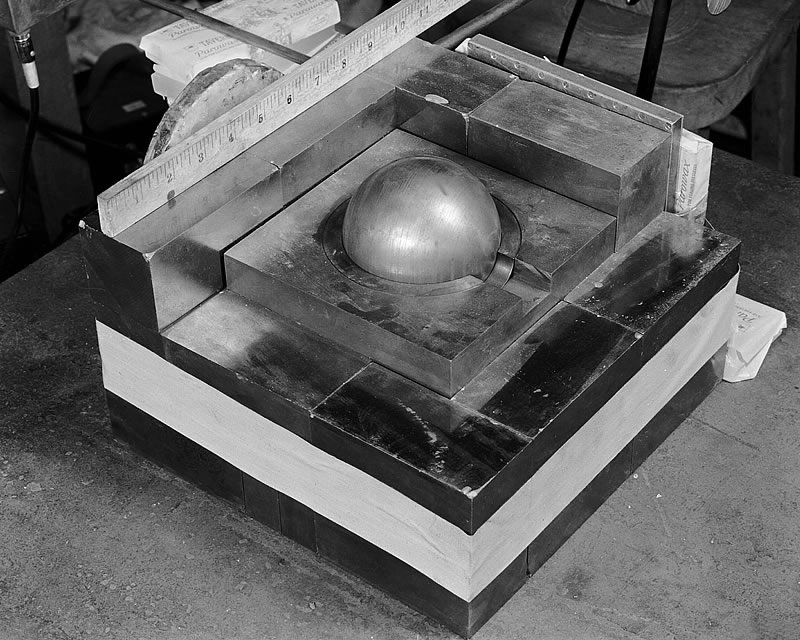
In nuclear weapon design, the pit is the core of an implosion nuclear weapon, consisting of fissile material and any neutron reflector or tamper bonded to it. Early pits were spherical, while most modern pits are prolate spheroidal. Some weapons tested during the 1950s used pits made with uranium-235 alone, or as a composite with plutonium. All-plutonium pits are the smallest in diameter and have been the standard since the early 1960s. The pit is named after the hard core found in stonefruit such as peaches and apricots.
The pits of the first nuclear weapons were solid, with an urchin neutron initiator in their center. The Gadget and Fat Man used pits made of 6.2 kg of solid hot pressed plutonium-gallium alloy (at 400 °C and 200 MPa in steel dies – 750 °F and 29,000 psi) half-spheres of 9.2 cm (3.6 in) diameter, with a 2.5 cm (1 in) internal cavity for the initiator. The Gadget's pit was electroplated with 0.13 mm of silver because of plutonium's susceptibility to corrosion in air. This layer, however, developed blisters, which had to be ground off. These gaps were then patched with gold leaf before the test. The Fat Man pit, and those of subsequent models, were all plated with nickel. A hollow pit was considered and known to be more efficient but ultimately rejected due to higher requirements for implosion accuracy.[citation needed]
Later designs used TOM initiators of similar design but with diameters of only about 1 cm (3⁄8 in). The internal neutron initiators were later phased out and replaced with pulsed neutron sources, and with boosted fission weapons.[citation needed]
The solid-cores were known as the "Christy" design, after Robert Christy who made the solid pit design a reality after it was initially proposed by Edward Teller. Along with the pit, the whole physics package was also informally nicknamed "Christy['s] Gadget".
Efficiency of the implosion can be increased by leaving an empty space between the tamper and the pit, causing a rapid acceleration of the shock wave before it impacts the pit. This method is known as levitated-pit implosion. Levitated pits were tested in 1948 with Fat Man style bombs (Mark IV). The early weapons with a levitated pit had a removable pit, called an open pit. It was stored separately, in a special capsule called a birdcage.
During implosion of a hollow pit, the plutonium layer accelerates inwards, colliding in the middle and forming a supercritical highly dense sphere. Due to the added momentum, the plutonium itself plays part of the role of the tamper, requiring a smaller amount of uranium in the tamper layer, reducing the warhead weight and size. Hollow pits are more efficient than solid ones but require more accurate implosion; solid "Christy" pits were therefore favored for the first weapon designs. Following the war's end in August 1945, the laboratory focused on the problem of the hollow pit again, and for the rest of the year they were headed by Hans Bethe, Christy's group leader and successor to the theoretical division, with the hollow composite core being of greatest interest, due to the cost of plutonium and trouble ramping up the Hanford reactors.
The efficiency of the hollow pits can be further increased by injecting a 50%/50% mixture of deuterium and tritium into the cavity immediately before the implosion, so called "fusion boosting"; this also lowers the minimum amount of plutonium for achieving a successful explosion. The higher degree of control of the initiation, both by the amount of deuterium-tritium mixture injection and by timing and intensity of the neutron pulse from the external generator, facilitated the design of variable yield weapons.[citation needed]
In the early period of nuclear weapons development, the plutonium-239 supply was scarce. To lower its amount needed for a pit, a composite core was developed, where a hollow shell of plutonium was surrounded with an outer shell of then more plentiful highly enriched uranium. The composite cores were available for Mark 3 nuclear bombs by the end of 1947. For example, a composite core for a US Mark 4 bomb, the 49-LCC-C core was made of 2.5 kg of plutonium and 5 kg of uranium. Its explosion releases only 35% of energy of the plutonium and 25% of the uranium, so it is not highly efficient, but the weight saving of plutonium is significant.
Hub AI
Pit (nuclear weapon) AI simulator
(@Pit (nuclear weapon)_simulator)
Pit (nuclear weapon)
In nuclear weapon design, the pit is the core of an implosion nuclear weapon, consisting of fissile material and any neutron reflector or tamper bonded to it. Early pits were spherical, while most modern pits are prolate spheroidal. Some weapons tested during the 1950s used pits made with uranium-235 alone, or as a composite with plutonium. All-plutonium pits are the smallest in diameter and have been the standard since the early 1960s. The pit is named after the hard core found in stonefruit such as peaches and apricots.
The pits of the first nuclear weapons were solid, with an urchin neutron initiator in their center. The Gadget and Fat Man used pits made of 6.2 kg of solid hot pressed plutonium-gallium alloy (at 400 °C and 200 MPa in steel dies – 750 °F and 29,000 psi) half-spheres of 9.2 cm (3.6 in) diameter, with a 2.5 cm (1 in) internal cavity for the initiator. The Gadget's pit was electroplated with 0.13 mm of silver because of plutonium's susceptibility to corrosion in air. This layer, however, developed blisters, which had to be ground off. These gaps were then patched with gold leaf before the test. The Fat Man pit, and those of subsequent models, were all plated with nickel. A hollow pit was considered and known to be more efficient but ultimately rejected due to higher requirements for implosion accuracy.[citation needed]
Later designs used TOM initiators of similar design but with diameters of only about 1 cm (3⁄8 in). The internal neutron initiators were later phased out and replaced with pulsed neutron sources, and with boosted fission weapons.[citation needed]
The solid-cores were known as the "Christy" design, after Robert Christy who made the solid pit design a reality after it was initially proposed by Edward Teller. Along with the pit, the whole physics package was also informally nicknamed "Christy['s] Gadget".
Efficiency of the implosion can be increased by leaving an empty space between the tamper and the pit, causing a rapid acceleration of the shock wave before it impacts the pit. This method is known as levitated-pit implosion. Levitated pits were tested in 1948 with Fat Man style bombs (Mark IV). The early weapons with a levitated pit had a removable pit, called an open pit. It was stored separately, in a special capsule called a birdcage.
During implosion of a hollow pit, the plutonium layer accelerates inwards, colliding in the middle and forming a supercritical highly dense sphere. Due to the added momentum, the plutonium itself plays part of the role of the tamper, requiring a smaller amount of uranium in the tamper layer, reducing the warhead weight and size. Hollow pits are more efficient than solid ones but require more accurate implosion; solid "Christy" pits were therefore favored for the first weapon designs. Following the war's end in August 1945, the laboratory focused on the problem of the hollow pit again, and for the rest of the year they were headed by Hans Bethe, Christy's group leader and successor to the theoretical division, with the hollow composite core being of greatest interest, due to the cost of plutonium and trouble ramping up the Hanford reactors.
The efficiency of the hollow pits can be further increased by injecting a 50%/50% mixture of deuterium and tritium into the cavity immediately before the implosion, so called "fusion boosting"; this also lowers the minimum amount of plutonium for achieving a successful explosion. The higher degree of control of the initiation, both by the amount of deuterium-tritium mixture injection and by timing and intensity of the neutron pulse from the external generator, facilitated the design of variable yield weapons.[citation needed]
In the early period of nuclear weapons development, the plutonium-239 supply was scarce. To lower its amount needed for a pit, a composite core was developed, where a hollow shell of plutonium was surrounded with an outer shell of then more plentiful highly enriched uranium. The composite cores were available for Mark 3 nuclear bombs by the end of 1947. For example, a composite core for a US Mark 4 bomb, the 49-LCC-C core was made of 2.5 kg of plutonium and 5 kg of uranium. Its explosion releases only 35% of energy of the plutonium and 25% of the uranium, so it is not highly efficient, but the weight saving of plutonium is significant.