


Community hub
Recent from talks
Contribute something
Nothing was collected or created yet.
Vampyrellidae
View on Wikipedia | You can help expand this article with text translated from the corresponding article in French. (June 2019) Click [show] for important translation instructions.
|
| Vampyrellidae | |
|---|---|

| |
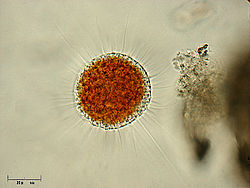
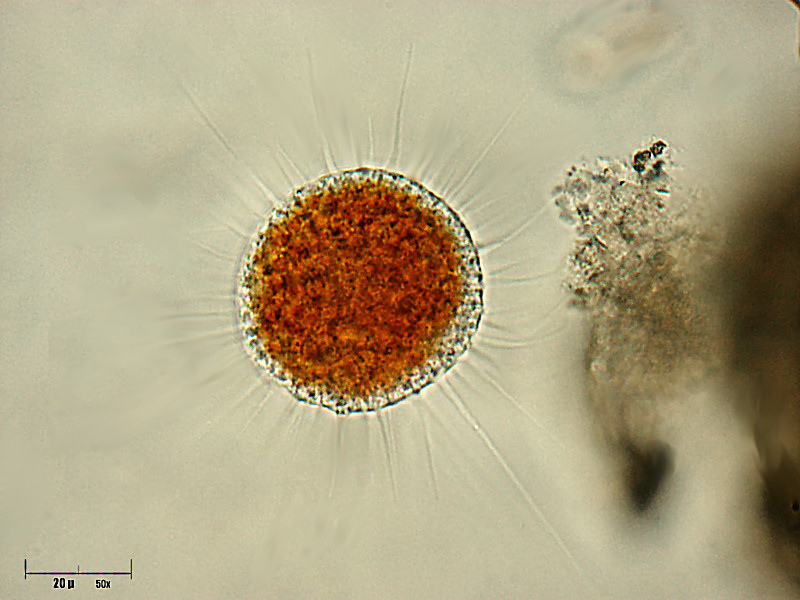
| Vampyrella lateritia | |
Scientific classification 
| |
| Domain: | Eukaryota |
| Clade: | Sar |
| Clade: | Rhizaria |
| Phylum: | Endomyxa |
| Class: | Vampyrellidea |
| Order: | Vampyrellida |
| Family: | Vampyrellidae Zopf, 1885 |
| Genera | |
| Diversity | |
| 19 species | |
The family Vampyrellidae is a subgroup of the order Vampyrellida (or Aconchulinida) within the supergroup Rhizaria.[1][2] Based on molecular sequence data, the family currently comprises the genus Vampyrella, and maybe several other vampyrellid amoebae (e.g. Gobiella).[2] The cells are naked and characterised by radiating, filose pseudopodia (also referred to as filopodia) and an orange colouration of the main cell body.[3][4]
In former times the family Vampyrellidae contained several genera (e.g. Vampyrella, Gobiella, Leptophrys, Platyreta, Theratromyxa) and was identical with the order Vampyrellida, also known under the name "Aconchulinida".[5] However, based on molecular sequence data the family Vampyrellidae was restricted to a subgroup containing only the genus Vampyrella, and a different family Leptophryidae was established for the genera Leptophrys, Platyreta and Theratromyxa.[2]
Characteristics
[edit]_(14596233838).jpg)
When free-floating, the cell is spherical and around 30 μm across, with long radially directed filose pseudopods as well as distinctive shorter club-shaped ones, so that it resembles a heliozoan. Moving, the cell stretches out and takes a more typical amoeboid form, with an obvious distinction between the clear periphery and pseudopods and the greenish interior. In this form it finds its way into algae cells and feeds on their interiors. At least one genus, Theratromyxa, also feeds on soil nematodes.[6] A few other vampyrellids are parasitic on fungi. As such, these vampyrellids can be an important control of parasitic rust fungus of wheat and other crops.
Vampyrellids characteristically have mitochondria with tubular cristae. Together with the nucleariids they include the majority of the naked filose amoebae.[citation needed]
Systematics and phylogeny
[edit]Genera and species
[edit]There are at least 19 credibly described species that are either proved or likely to belong to the family Vampyrellidae, all of them belonging to the genus Vampyrella.[7]
- Vampyrella Cienkowski 1865. 19 species.
- Vampyrella agilis Penard 1890
- Vampyrella atheyae Zyloff 1903
- Vampyrella closterii Poisson & Mangenot 1933
=Gobiella closterii Röpstorf et al. 1994 - Vampyrella euglenae Dangeard 1886
- Vampyrella flabellata Cash 1904
- Vampyrella gomphonematis Haeckel 1870
- Vampyrella helioproteus Engelmann 1882
- Vampyrella incolor de Bruyne 1890
- Vampyrella inermis Klein 1882
- Vampyrella lateritia (Fresenius 1856) Leidy 1879
= Amoeba lateritia Fresenius 1856
= Vampyrella spirogyrae Cienkowski 1865 - Vampyrella mirabilis Dangeard 1935
- Vampyrella multiformis Zopf 1885
- Vampyrella pallida Moebius 1888
= Vampyrina pallida (Moebius 1888) Frenzel 1897 - Vampyrella peritrichophaga Dangeard 1886
- Vampyrella polyblasta Sorokin 1876
- Vampyrella radiosa Penard 1890
- Vampyrella soror Shouteden 1905
- Vampyrella ulothricis Scherffel 1935
- Vampyrella variabilis Klein 1882
Phylogenetic tree
[edit]The following cladogram depicts the relationships between Vampyrellidae and other vampyrellid families. Of the 19 species, only 2 species of Vampyrella have been genetically sequenced, which limits the information on the internal relationships of the genus.[7]
| Vampyrellida |
| ||||||||||||||||||||||||||||||||||||||||||
References
[edit]- ^ "Vampyrellidae". Retrieved 2009-03-08.
- ^ a b c Hess, Sebastian; Sausen, Nicole; Melkonian, Michael (2012-02-15). "Shedding Light on Vampires: The Phylogeny of Vampyrellid Amoebae Revisited". PLOS ONE. 7 (2) e31165. Bibcode:2012PLoSO...731165H. doi:10.1371/journal.pone.0031165. ISSN 1932-6203. PMC 3280292. PMID 22355342.
- ^ Cienkowski, L. (1865-12-01). "Beiträge zur Kenntniss der Monaden". Archiv für Mikroskopische Anatomie (in German). 1 (1): 203–232. doi:10.1007/BF02961414. ISSN 0176-7364. S2CID 84323025.
- ^ Zopf, Wilhelm (1885). Die Pilzthiere oder Schleimpilze. Breslau: Trewendt.
- ^ David Bass; Ema E.-Y. Chao; Sergey Nikolaev; Akinori Yabuki; Ken-ichiro Ishida; Cédric Berney; Ursula Pakzad; Claudia Wylezich & Thomas Cavalier-Smith (2009). "Phylogeny of novel naked filose and reticulose Cercozoa: Granofilosea cl. n. and Proteomyxidea revised". Protist. 160 (1): 75–109. doi:10.1016/j.protis.2008.07.002. PMID 18952499.
- ^ Morphology and fine structure of the trophozoites of Theratromyxa weberi (Protozoa: Vampyrellidae) predacious on soil nematodes
- ^ a b Hess, Sebastian; Suthaus, Andreas (2022). "The Vampyrellid Amoebae (Vampyrellida, Rhizaria)". Protist. 173 (1: 125854) 125854. doi:10.1016/j.protis.2021.125854. PMID 35091168. S2CID 245303468.
External links
[edit]- Röpstorf, Peter; Hülsmann, Norbert; Hausmann, Klaus (1994). "Comparative fine structural investigations of interphase and mitotic nuclei of vampyrellid filose amoebae". Journal of Eukaryotic Microbiology. 41 (1): 18–30. doi:10.1111/j.1550-7408.1994.tb05930.x. S2CID 84357480.
- http://starcentral.mbl.edu/microscope/portal.php?pagetitle=assetfactsheet&imageid=932
- http://tolweb.org/tree?group=The_other_protists&contgroup=Eukaryotes
