Hubbry Logo
PlayStation 3 technical specificationsPlayStation 3 technical specificationsMain
Open search
PlayStation 3 technical specifications
Community hub
PlayStation 3 technical specifications
logo
8 pages, 0 posts
0 subscribers
Be the first to start a discussion here.
PlayStation 3 technical specifications
from Wikipedia

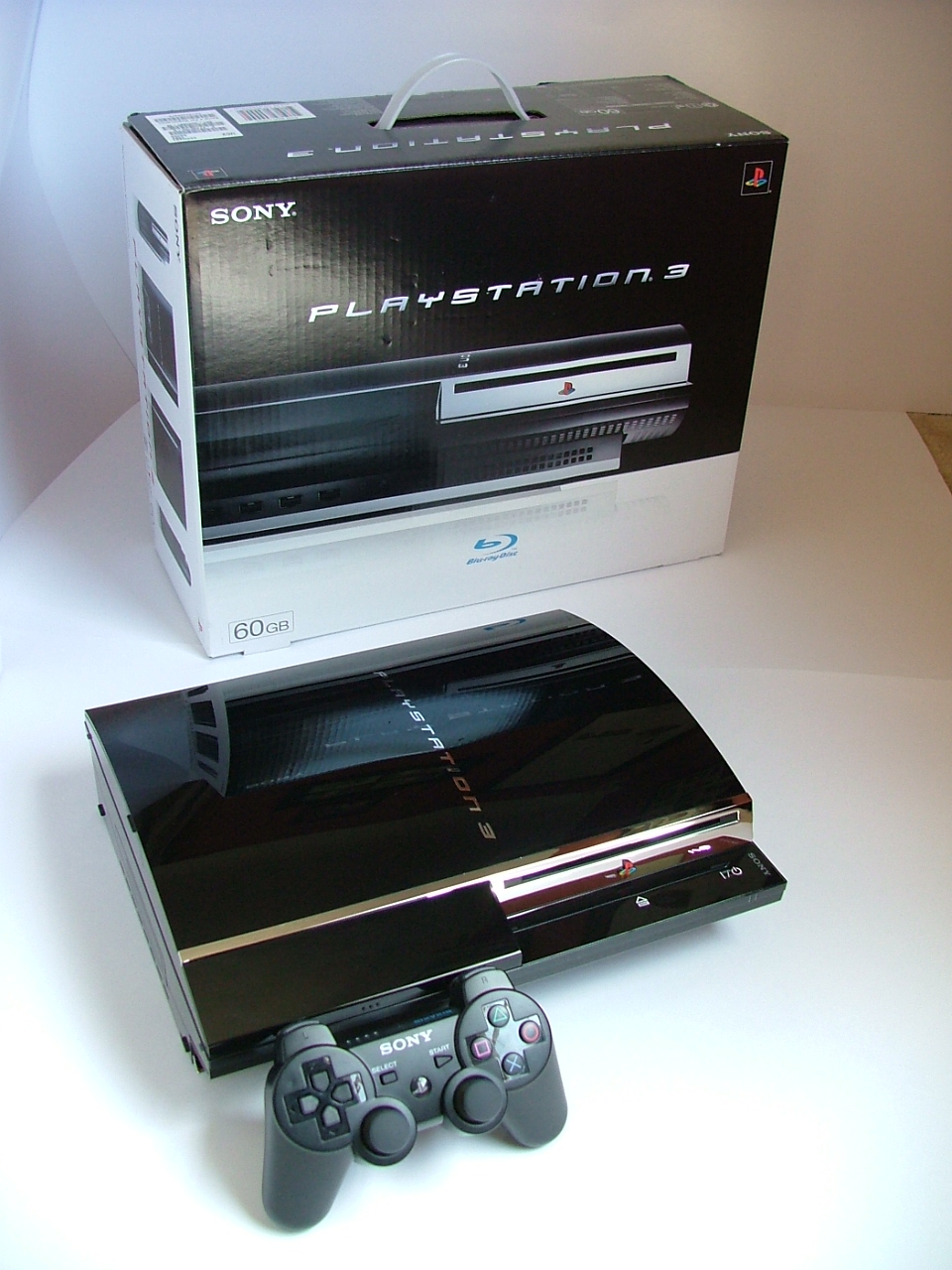
A PlayStation 3 console with a Sixaxis controller

The PlayStation 3 technical specifications describe the various components of the PlayStation 3 (PS3) video game console.

Central processing unit

[edit]
The Cell Broadband Engine on a PlayStation 3 motherboard

The PlayStation 3 is powered by the Cell Broadband Engine, a 64-bit CPU co-developed by Sony, Toshiba and IBM. It includes a 3.2 GHz PowerPC-based Power Processing Element (PPE) and seven Synergistic Processing Elements (SPEs).[1] To improve manufacturing yield, the processor is initially fabricated with eight SPEs. After production, each chip is tested, and if a defect is found in one SPE, it is disabled using laser trimming. This approach minimizes waste by utilizing processors that would otherwise be discarded. Even in chips without defects, one SPE is intentionally disabled to ensure consistency across units.[2][3] Of the seven operational SPEs, six are available for developers to use in games and applications, while the seventh is reserved for the console's operating system.[3]

The Cell processor achieves a theoretical maximum of 204.8 GFLOPS in single precision floating point operations and up to 15 GFLOPS double precision.[4]

The PS3 has 256 MB Rambus XDR DRAM, clocked at CPU die speed.[4][5] The PPE has 64 KB L1 cache and 512 KB L2 cache, while the SPEs have 2 MB local memory (256 KB per SPE),[6] connected by the Element Interconnect Bus (EIB) with up to 307.2 Gbit/s bandwidth.

The Cell processor was initially produced on a 90 nm process.[7] It was shrunk to 65 nm in 2007,[7][8] and to 45 nm in 2009.

Graphics processing unit

[edit]
PS3 GPU-RSX "Reality Synthesizer"

Graphics processing for PlayStation 3 is managed by the RSX Reality Synthesizer, developed by Nvidia and paired with 256 MB of GDDR3 video memory.[5] The RSX graphics processor can output resolutions ranging from standard-definition (480i/576i) up to high-definition (1080p).[9]

The GPU is clocked at 500 MHz and makes use of 256 MB GDDR3 RAM clocked at 650 MHz with an effective transmission rate of 1.3 GHz.[10] The RSX has a floating-point performance of 192 GFLOPS.[11]

The RSX was initially fabricated on a 90 nm process.[12] It received a node shrink to 65 nm in 2008,[13] to 40 nm in 2010,[14] and to 28 nm in 2013.[15]

Configurations

[edit]

The PS3 received several component revisions which served to reduce power consumption. This in turn resulted in production savings, lower heat production, lower cooling requirements and quieter operation. Since launch, the Cell processor shrank from 90 nm to 45 nm. The RSX GPU also saw reduction in size over periodic revisions of the PS3.

Major improvements were introduced with the PS3 Slim. It utilizes a 45 nm Cell which results in a 34% reduction in power consumption over the previous 65 nm Cell model;[16] the last Slim model further decreases power consumption with the move to a 40 nm RSX and later 28 nm on the CECH‑43xx models.[17]

Model numbers

[edit]

On all models of the PS3, the last seven characters of the serial number make up the console's model number. This begins with "CECH", followed by a letter indicating what model the system is. The last two characters of the model number indicate what region the system is from.

Model Capacity Release[19] Regions
00[21] (JP) 01[22] (NA) 02[23] (AU) 03[24] (UK) 04[25] (EMEA) 05[26] (KOR) 06[27] (SEA) 07[28] (TW) 08[29] (RU/IN) 11[30] (SA) 12[31] (HK)
CECHAxx 60 GB November 2006 Yes Yes Yes Yes Yes
CECHBxx 20 GB November 2006 Yes Yes Yes Yes
CECHCxx 60 GB March 2007 Yes Yes Yes Yes
CECHDxx 20 GB Unreleased
CECHExx 80 GB August 2007 Yes Yes Yes Yes Yes
CECHFxx 80 GB Unreleased
CECHGxx 40 GB October 2007 Yes Yes Yes Yes Yes Yes Yes Yes Yes
CECHHxx 40 GB October 2007 Yes Yes Yes Yes Yes Yes Yes Yes Yes
CECHIxx 40 GB Unreleased
CECHJxx 40 GB August 2008 Yes Yes Yes Yes
CECHKxx 80 GB August 2008 Yes Yes Yes Yes Yes Yes Yes Yes Yes Yes
CECHLxx 80 GB October 2008 Yes Yes Yes Yes Yes Yes Yes Yes Yes Yes
CECHMxx 80 GB October 2008 Yes
CECHNxx 80 GB Unreleased
CECHOxx 80 GB Unreleased
CECHPxx 160 GB October 2008 Yes Yes Yes Yes Yes Yes Yes Yes
CECHQxx 160 GB April 2009 Yes
CECH‑20xxA 120 GB September 2009 Yes Yes Yes Yes Yes Yes Yes Yes Yes Yes Yes
CECH‑20xxB 250 GB October 2009 Yes Yes Yes Yes Yes Yes Yes Yes Yes Yes Yes
CECH‑21xxA 120 GB March 2010 Yes Yes Yes Yes Yes Yes Yes
CECH‑21xxB 250 GB March 2010 Yes Yes Yes Yes Yes Yes Yes
CECH‑25xxA 160 GB July 2010 Yes Yes Yes Yes Yes Yes Yes Yes Yes
CECH‑25xxB 320 GB July 2010 Yes Yes Yes Yes Yes Yes Yes Yes Yes Yes
CECH‑30xxA 160 GB July 2011 Yes Yes Yes Yes Yes Yes Yes Yes Yes Yes
CECH‑30xxB 320 GB July 2011 Yes Yes Yes Yes Yes Yes Yes Yes Yes Yes
CECH‑40xxA 12 GB October 2012 Yes Yes Yes Yes Yes Yes Yes Yes Yes
CECH‑40xxB 250 GB September 2012 Yes
CECH‑40xxC 500 GB September 2012 Yes Yes
CECH‑42xxA 12 GB June 2013 Yes Yes Yes Yes Yes Yes Yes Yes
CECH‑42xxB 250 GB June 2013 Yes
CECH‑42xxC 500 GB June 2013 Yes
CECH‑43xxA 12 GB May 2014 Yes Yes Yes Yes Yes Yes Yes Yes
CECH‑43xxB 250 GB May 2014 Yes
CECH‑43xxC 500 GB May 2014 Yes

Connectivity

[edit]
Supported resolutions[32]
Resolution Region Composite S-Video Component D-Terminal HDMI
480i NTSC Yes Yes Yes Yes No
480p NTSC No No Yes Yes Yes
576i PAL Yes Yes Yes Yes No
576p PAL No No Yes Yes Yes
720p NTSC / PAL No No Yes Yes Yes
1080i NTSC / PAL No No Yes Yes Yes
1080p NTSC / PAL No No Yes Yes Yes

In terms of audio, the PS3 supports outputting up to 7.1 digital audio over HDMI in several codecs including AAC, Dolby Digital, Dolby Digital Plus, Dolby TrueHD, DTS, DTS-HD Master Audio and LPCM at 44.1, 48, 88, 96, 176.4 and 192 kHz. The PS3 slim features an upgraded HDMI chip that allows bitstreaming of lossless codecs to an external receiver, earlier versions had to decode the signal internally before outputting it via LPCM.[33]

In the early 60 and 80 GB configurations, flash memory can also be used, either Memory Sticks; CompactFlash cards; or SD/MMC cards. All models support USB memory devices; flash drives and external hard drives are both automatically recognized. However, they must be formatted with the FAT32 file system.[34]

Early systems (20, 60, and NTSC 80 GB configurations) were equipped with four USB 2.0 ports at the front of the console. All other configurations had just two.

For networking, all models provide one Gigabit Ethernet port, Bluetooth 2.0 support, and except for the original 20 GB configuration, built-in 802.11b/g Wi-Fi.

Physical appearance

[edit]
Model Dimensions (when laid flat, width × height × depth) Weight
Original ("Fat") 325 mm × 98 mm × 274 mm (12.8 in × 3.9 in × 10.8 in)[35] 5 kg (11 lb)
Slim 290 mm × 98 mm × 290 mm (11.4 in × 3.9 in × 11.4 in) 3.2 kg (7.1 lb)
Super Slim 290 mm × 60 mm × 230 mm (11.4 in × 2.4 in × 9.1 in)[36] 2.1 kg (4.6 lb)

The PlayStation 3 retained the same basic design across its three major hardware revisions, featuring a black plastic shell with a convex top when placed horizontally, or a convex-left side when oriented vertically.

The original ("Fat") model used glossy piano black plastic and featured a logo inspired by the font used in the 2002 Spider-Man film, also produced by Sony. According to PlayStation designer Teiyu Goto, this logo was one of the first design elements selected by SCEI president Ken Kutaragi and helped shape the console's overall aesthetic, which had a glossy piano-black finish and touch-sensitive power and eject buttons.[37]

The font would be abandoned at the introduction of the "Slim" revision in favor of an updated version of the PS2 logo with more curved edges,[38] which was also quieter and more compact than its predecessor.

The "Super Slim" model weighs approximately 25% less than the "Slim" due in part to the slot-loading Blu-ray drive being replaced with a top-load disc reader similar to the original PlayStation's, but with a sliding cover.[39]

Power supply

[edit]

All models of the PlayStation console series are equipped with a universal power supply capable of operating on AC input voltages ranging from 100 to 240 V at either 50 or 60 Hz. The original models use a standard IEC 60320 C14 inlet, paired with a region-appropriate C13 power cord. Later revisions, including the "Slim" and "Super Slim" models, utilize a smaller C8 inlet and a corresponding C7 power cord.

The initial internal power supply was rated at 380 W (although power draw only ranged from 170 to 200 W during use),[40] but this was gradually reduced in subsequent hardware revisions, reaching a rating of 190 W in the final "Super Slim" model.

Disc drive

[edit]

The PlayStation 3 features an optical disc drive that supports multiple formats, including Blu-ray, DVD, and CD. Region coding is enforced for applicable media types, and support for certain formats vary by hardware revision. Additionally, the console can playback discs with compressed audio files in the MP3, WMA, and ATRAC formats, images in the JPEG format, and videos in the MPEG-4 format.[41]

Blu-ray

[edit]

With Blu-ray discs, the drive has a maximum read speed of 2× (72 Mbit/s or 8.58 MB/s).

Supported formats include:[41]

DVD

[edit]

With DVDs, the drive has a maximum read speed of 8× (86.4 Mbit/s or 10.3 MB/s).

Supported formats include:[41]

CD

[edit]

With CDs, the drive has a maximum read speed of 24× (29.49 Mbit/s or 3.51 MB/s).

Supported formats include:[41]

Official accessories

[edit]

The PlayStation 3 Sixaxis[44] is a controller that is very similar in appearance to that of its predecessors, the DualShock and DualShock 2. The SIXAXIS features finer analog sensitivity;[45] more trigger-like R2 and L2 buttons; a PS ("home") button; and a USB mini-B port for charging the internal battery and for wired play. The PlayStation 3 supports up to 7 simultaneous controllers over Bluetooth.[46] The Sixaxis is named for its ability to detect motion in the full six degrees. The Sixaxis controller which has "Sixaxis" printed on the front of the controller above the charging port, and to the right, does not vibrate.

At its press conference at the 2007 Tokyo Game Show, Sony announced the DualShock 3 (trademarked DUALSHOCK 3), a PlayStation 3 controller with the same function and design as the Sixaxis, but with vibration capability.[47] Hands-on accounts describe the controller as being slightly heavier than the standard Sixaxis controller, and capable of vibration forces comparable to the DualShock 2.[48] It has "DualShock 3" printed on the front right of the controller; in the place where the previous models had "Sixaxis" printed. And "Sixaxis" is now moved to the lower front right of the controller, below the "DualShock 3" printing.

The PlayStation 3 Memory Card Adaptor is a device that allows data to be transferred from PlayStation and PlayStation 2 memory cards to the PlayStation 3's hard disk. The device has a cable that connects to the PS3's USB port on one end, and features a legacy PS2 memory card port on the other end.

Using Bluetooth, the PlayStation 3 BD Remote allows users to control videos and music on Blu-ray Disc and DVD. In Japan, the device was available starting December 7, 2006. The PS3 will accept signals only via its Bluetooth Remote, as the console does not have an infrared receiver; this prevents the use of universal remotes with the system. The Blu-ray Disc movie Talladega Nights: The Ballad of Ricky Bobby was included with the initial 400,000 release copies of the PS3 in North America,[49] while the first 500,000 European PlayStation Network activations after launch received a free copy of the Blu-ray release of Casino Royale.[50]

On April 25, 2007, Sony announced the PlayStation Eye. This is an updated version of the PlayStation 2 peripheral, the EyeToy. The camera is capable of capturing 60 frames per second video at 640×480 resolution and 120 frame/s video at 320×240 resolution. The four-channel microphone on the Eye can block out background noise. The camera supports live video chat and voice chat without a headset, and was launched in the United States on October 23, 2007, for US$39.99,[51] and in Australia on November 8, 2007, for A$79.95.[52] It was also bundled with the card game The Eye of Judgment released in the United States on the same day as the camera itself for US$69.99,[53] and in Japan and Australia on October 25, 2007, for JP¥9,980 and A$159.95, respectively.[54][55]

Official PlayStation 3 HDMI and Component AV cables are also available for retail.[citation needed]

Backward compatibility

[edit]

All PlayStation 3 models feature backwards compatibility with all titles released for the original PlayStation, while original models (up to the 40 GB CECHCxx/80 GB CECHExx models) featured PlayStation 2 playback. The first two models (CECHA and B) featured an integrated Emotion Engine and Graphics Synthesizer within the PlayStation 3's SoC; the CECHC and E models eschewed the Emotion Engine for an emulated version through the Cell chip, but retained the Graphics Synthesizer. Saving games in PlayStation/PlayStation 2 titles require a virtual memory card to be created by the user; a memory card adapter is available so users can copy their old PS/PS2 game saves to a virtual memory card on the PS3's hard drive.[56] On all consoles, including non-backwards compatible models, select PlayStation 2 titles may also be played as "PS2 Classics", which packages an emulated version of the game through the PlayStation Store. Jailbreaking the console allows the user to play titles that were not released on the PlayStation Store through the same emulation method used by Sony for their PS2 Classics.

The PlayStation 3 does not include interfaces for legacy PlayStation peripherals, though IGN.com tested a legacy controller using a PS2-to-USB adapter, finding that it is compatible, though most other devices (such as the Guitar Hero controller) may not be compatible.[57] However, with the release of firmware 1.70 for the PlayStation 3, Sony has added support for previous Guitar Hero controllers with generic PS2-to-USB adapters (although the whammy bar is not functional). Nyko started production on the "Play Adaptor", a PS2-to-USB adapter allowing for guitars and other PlayStation 2 peripherals to be used on the PlayStation 3 and was scheduled for release in Q2/2007, but Nyko stated at the end of March that the production of this device had been postponed due to compatibility problems with the PS3.[58] The PS3 supports both the USB EyeToy camera/webcam and SOCOM Headset for video and voice chat. The PlayStation 3 can also use Memory Sticks to store and save data for PlayStation and PlayStation 2 software.[59]

See also

[edit]

References

[edit]
[edit]
Revisions and contributorsEdit on WikipediaRead on Wikipedia
from Grokipedia
The (PS3) technical specifications refer to the hardware components of Sony's seventh-generation , released in 2006, which features the innovative Cell Broadband Engine (CPU), the RSX "Reality Synthesizer" (GPU), 256 MB of system memory, and 256 MB of GDDR3 video memory, enabling high-definition gaming, playback, and support for the Blu-ray disc format as both a game medium and optical drive standard. The core of the PS3's architecture is the Cell Broadband Engine, a 64-bit co-developed by , , and , consisting of one dual-threaded Power Processing Element (PPE) based on the PowerPC and seven Synergistic Processing Elements (SPEs), all clocked at 3.2 GHz, with the PPE including a VMX vector unit and 512 KB L2 cache, while each SPE has 256 KB of local SRAM and 128 SIMD GPRs for vector operations. The Cell provides a theoretical peak performance of 230 GFLOPS in single-precision floating-point operations, optimized for parallel processing tasks common in gaming and scientific , though one SPE is reserved for system functions in practice. This design emphasized high bandwidth and efficiency, with main memory bandwidth reaching 25.6 GB/s via the interface. Complementing the CPU, the RSX GPU is a custom implementation based on NVIDIA's G70 architecture (similar to the GeForce 7800 GTX), operating at 550 MHz with 24 pixel shader units and 8 vertex shader units, delivering pixel fill rate of 4.4 Gpixels/s and texture fill rate of 13.2 Gtexels/s, paired with its dedicated 256 MB GDDR3 memory at 650 MHz (effective 1.3 GHz) for a bandwidth of 20.8 GB/s. The GPU supports DirectX 9.0-level features including shader model 3.0, hardware transform and lighting, and anti-aliasing, enabling resolutions up to 1080p with dual-channel output for Full HD displays, while also handling video decoding for formats like H.264 and VC-1. The architecture features separate memory pools for CPU (256 MB XDR DRAM) and GPU (256 MB GDDR3), with the GPU able to access system memory via the FlexIO bus for additional flexibility. Storage in the PS3 consists of a user-upgradeable 2.5-inch Serial ATA (HDD) spinning at 5400 RPM, with capacities varying by model from an initial 20 GB to up to 500 GB in later versions, allowing for game saves, downloaded content, and media storage, alongside support for external USB drives. The console's optical drive is a Blu-ray (BD-ROM) mechanism capable of reading single- and dual-layer Blu-ray discs at up to 2x speeds (72 Mbps maximum), with backward compatibility for DVDs and CDs, including playback of BD-ROM, BD-R, BD-RE, DVD-R, DVD-RW, and media. This drive facilitated the PS3's role as a multimedia center, supporting high-definition movie playback and large game installs exceeding 50 GB. Connectivity options include up to four USB 2.0 ports on early models (later models have two; speeds up to 480 Mbps), 2.0 for wireless controllers and peripherals (supporting up to seven devices), for wired networking, and optional 802.11 b/g (added in 60 GB and later models). Video outputs encompass 1.3a (early models) or 1.4 (later models) for uncompressed and multi-channel audio, up to , composite, and , while audio supports advanced formats such as , (via LPCM), 5.1, and DTS 5.1, with seven 48 kHz/16-bit linear PCM channels and optical/coaxial digital outputs. The included wireless controller uses with a , featuring six-axis motion sensing via a three-axis and for tilt-based inputs. The PS3 was released in multiple configurations, starting with the original "fat" model (CECHA/B series) measuring approximately 325 mm (width) × 98 mm (height) × 274 mm (depth) and weighing 5 kg, powered by a 380 W (100-240 V, 50/60 Hz) with a maximum consumption of 200 W. Later "slim" models (CECH-20xx/30xx series, introduced in 2009) reduced dimensions to 290 mm × 65 mm × 290 mm and weight to 3.2-3.5 kg, with a more efficient 250 W and lower noise levels equivalent to the PlayStation 2. A "super slim" variant (CECH-40xx/42xx series, from 2012) further slimmed to 204 mm depth and included flash-based 12 GB models without HDD, though all retained the core Cell and RSX hardware with minor process shrinks (from 90 nm to 40 nm for improved yields and efficiency).

Processor and Graphics

Central Processing Unit

The PlayStation 3's is the Cell Broadband Engine, a heterogeneous jointly developed by , , and to enable high-performance and tasks. Fabricated on a 90 nm SOI-CMOS process with 234 million transistors and a die size of 221 mm², the chip operates at a clock speed of 3.2 GHz, delivering a theoretical peak performance of 230.4 GFLOPS in single-precision floating-point operations. At the heart of the architecture is the Power Processing Element (PPE), a dual-threaded, in-order PowerPC core that serves as the general-purpose controller for the system. The PPE incorporates a VMX () vector unit to support multimedia extensions, enabling efficient scalar and vector processing for operating system tasks and coordination of parallel workloads. Complementing the PPE are eight Synergistic Processing Elements (), specialized co-processors optimized for data-intensive operations; in the implementation, one SPE is disabled to enhance yields, leaving seven available for use. Each SPE employs a 128-bit SIMD architecture with 256 KB of local store memory acting as both instruction and data cache, facilitating high-throughput parallel processing without reliance on traditional caching hierarchies. The Cell's design emphasizes multimedia processing through its synergistic integration of the PPE and , connected via the Element Interconnect Bus (EIB), which provides up to 25.6 GB/s of bandwidth to main and supports over 100 outstanding DMA requests for efficient data movement. This configuration yields a of approximately 200 W for the CPU subsystem, balancing high computational density with power efficiency for console applications.

Graphics Processing Unit

The Graphics Processing Unit (GPU) of the PlayStation 3, known as RSX "Reality Synthesizer," is a custom implementation derived from NVIDIA's G70 architecture, originally featured in the GeForce 7800 GTX series. It operates at a core clock speed of 550 MHz and includes 24 pixel shader units and 8 vertex shader units, also clocked at 550 MHz, enabling unified shader processing for vertex and pixel operations. The RSX supports DirectX 9.0c-level features, including programmable shaders, with additional PS3-specific extensions for optimized rendering in console environments. The GPU is equipped with 256 MB of dedicated GDDR3 clocked at 650 MHz (1.3 GHz effective data rate) across a 128-bit memory bus, providing a theoretical bandwidth of 20.8 GB/s. It features 24 texture mapping units (TMUs) and 8 render output units (ROPs), supporting advanced rendering techniques such as 4x (MSAA) and anisotropic up to 16x for enhanced image quality in games. Theoretical performance metrics include a peak pixel fill rate of 4.4 gigapixels per second and a texel fill rate of 13.2 gigatexels per second, sufficient for handling high-definition at resolutions up to . The RSX integrates with the Cell Broadband Engine processor via NVIDIA's FlexIO interface, offering up to 20 GB/s of bidirectional bandwidth for data transfer between the GPU and system resources. This connection allows the RSX to access portions of the main system —up to 224 MB—for texture caching when local VRAM is insufficient, enabling flexible in resource-intensive applications.

Memory and Storage

System Memory

The PlayStation 3 features 256 MB of as its primary system memory, utilizing Extreme Data Rate technology clocked at 3.2 GHz to deliver a peak bandwidth of 25.6 GB/s. This high-speed serves as the main RAM for runtime operations, accessible by the Cell Broadband Engine processor for executing the operating system, game logic, and general CPU tasks. The configuration employs a 64-bit differential signaling bus, with older models using four 64 MB chips and later models incorporating two 128 MB chips, ensuring efficient data transfer across the system. The memory controller is integrated directly into the Cell processor, facilitating seamless management of data flow between the main memory and the processor's components. This integration supports error-correcting code (ECC) functionality, enhancing data reliability by detecting and correcting single-bit errors during operations critical to gaming and system stability. By embedding the controller within the Cell, the architecture minimizes latency in memory access while maintaining high throughput for demanding workloads. System memory is shared between the operating system and applications, with the OS typically reserving up to 64 MB for its core functions, leaving the remainder available for developers through flexible partitioning schemes. This allocation allows to dynamically utilize the bulk of the 256 MB for logic processing, asset loading, and CPU-driven computations, though updates over time optimized the OS footprint to as low as 50 MB in later versions. Developers could partition memory to balance needs between the Power Processing Element (PPE) and Synergistic Processing Elements (SPEs), promoting efficient resource use in resource-constrained environments. Access patterns to the are optimized to complement the ' local stores, which act as fast to hide the higher latency of main memory fetches—typically around 30 ns. Data is transferred via (DMA) commands, allowing to process workloads asynchronously while minimizing stalls from main memory delays. This design prioritizes burst-oriented transfers suited to the Cell's vector processing paradigm, with bandwidth occasionally shared for hybrid CPU-GPU tasks in unified rendering scenarios.

Hard Disk Drive

The PlayStation 3 incorporates a removable 2.5-inch Serial ATA hard disk drive (HDD) as its main storage component, housing the operating system, installed games, save data, and user media files. Early launch models in 2006 featured 20 GB capacities in the United States and 60 GB in and , while subsequent revisions introduced larger options including 40 GB, 80 GB, 120 GB, 160 GB, 250 GB, 320 GB, and 500 GB to accommodate growing storage demands for digital downloads and media playback. All stock drives operate at 5400 RPM with sequential read and write speeds around 100 MB/s, providing sufficient performance for loading games and streaming content without significant bottlenecks in the era's software ecosystem. The HDD connects via a Serial ATA (SATA I) interface rated at 1.5 Gbit/s (approximately 150 MB/s theoretical maximum), with practical transfer rates for stock drives around 100 MB/s due to rotational speed and encoding overhead. User upgradeability is a key feature, allowing replacement with compatible 2.5-inch SATA drives up to 9.5 mm in height; original "fat" models require tools and partial disassembly for access, whereas Slim and Super Slim variants support tool-less swaps via an accessible side bay for easier maintenance and capacity expansion. To replace the HDD without losing installed games, save data, or other user content, users can utilize the built-in Backup Utility to create a full backup on a compatible USB mass storage device (formatted in FAT32 with sufficient capacity). The process involves connecting the USB drive, navigating to Settings > System Settings > Backup Utility to perform the backup, shutting down the console, replacing the 2.5-inch SATA HDD (using tools for original models or tool-less access for Slim/Super Slim variants), booting the console with the new drive, reinstalling the system software from a USB drive containing the PS3UPDAT.PUP file downloaded from Sony's website, and then restoring the backup to recover all preserved data, including game installations and saves. In models supporting software-based backward compatibility with PlayStation 2 titles, the HDD stores essential emulation data and assets to enable gameplay. Security is enforced through full-disk hardware encryption using AES-128, with keys derived from and tied to the console's unique serial number, preventing unauthorized data access if the drive is removed or the system is compromised. This encryption applies across all PS3 variants, ensuring protected storage for licensed content and user files.

Flash Memory

The PlayStation 3 employs 256 MB of NAND flash memory in its initial fat models (such as CECHA/B/C/E/G series) to store essential system components, including the primary operating system (GameOS), recovery OS for troubleshooting and updates, and cache data like game saves, patches, and temporary files. This non-volatile storage ensures rapid access to critical software without relying on the slower hard disk drive during startup or recovery scenarios. In subsequent slim and super slim models, the NAND is replaced by a 16 MB NOR flash configuration, maintaining compatibility while reducing size for cost efficiency, though the core storage functions remain analogous. The NAND flash operates through two 128 MB chips interleaved via a dedicated bridge chip, presenting a unified storage block to the system; this setup supports the console's security architecture by encrypting partitions to prevent tampering. Wear-leveling algorithms distribute write operations evenly across the flash cells to mitigate degradation over time, while built-in (ECC) detects and repairs bit errors, both managed by the integrated controller in the South Bridge I/O processor. These mechanisms are vital for the flash's endurance, given its frequent use in system operations. In the boot process, the South Bridge initializes by loading the hypervisor and initial bootloader directly from the flash memory, establishing the chain of trust before the Cell processor activates and accesses the HDD for additional resources. This flash-based initial load enables quick recovery modes, such as safe mode, independent of the main storage drive. A supplementary small serial NOR flash chip (typically 64 KB SPI interface) handles low-level BIOS functions and security keys, ensuring secure hardware authentication during power-on. The flash also supports hybrid caching with the HDD, buffering small, high-access data for improved performance.

Optical Disc Drive

Blu-ray Capabilities

The PlayStation 3 features a dedicated Blu-ray Disc read-only drive as a core component, enabling high-definition media playback and game loading with capacities supporting up to 25 GB on single-layer BD-ROM discs and 50 GB on dual-layer variants. The drive employs a blue-violet laser operating at a wavelength of 405 nm, which allows for higher data density compared to DVD's red laser, facilitating the storage of advanced audiovisual content. This hardware is integral to the console's role as an of Blu-ray technology, certified under BD-ROM Profile 1.0 for compatibility with standard Blu-ray specifications. Drive design varies across PS3 models to balance form factor and reliability: the original "fat" models (CECHA/B series) utilize a motorized slot-loading mechanism for seamless disc insertion, while the Slim models (CECH-20xx/30xx series) adopt a motorized slot-loading mechanism for easier maintenance and reduced mechanical failure rates. Super Slim models (CECH-40xx/42xx series) revert to a passive slot-loading design without motorized assistance, requiring manual disc insertion to minimize power consumption and noise. All variants maintain consistent Blu-ray read performance at a maximum of 2× constant angular velocity (CAV), delivering up to 72 Mbit/s (approximately 9 MB/s), sufficient for smooth playback of high-bitrate content without buffering issues in typical use. Content protection is handled through integration with the console's Cell Broadband Engine CPU, where firmware implements AACS decryption keys—updated periodically via system software to counter key revocation—and emulates the BD+ virtual machine for advanced anti-piracy measures. This software-firmware approach ensures ongoing compatibility with evolving Blu-ray standards, including read support for BD-R and BD-RE media, though the drive lacks native write functionality for these formats.

DVD and CD Support

The PlayStation 3 optical disc drive ensures backward compatibility with standard-definition DVD and media by incorporating secondary laser systems alongside its primary Blu-ray functionality, allowing the console to function as a versatile media player for legacy formats. This design enables seamless playback of DVD videos, audio s, and data discs without requiring additional hardware, maintaining support across all PS3 models from launch through later revisions. DVD reading capabilities include support for DVD-ROM, DVD-R, DVD-RW, , DVD+RW, and discs, with a maximum read speed of 8x (approximately 11.08 MB/s). CD support covers , , , audio CDs, Video CDs (VCD), and Super Video CDs (SVCD), achieved at a maximum read speed of 24x (approximately 3.6 MB/s). These speeds apply to the constant linear velocity (CLV) mode, prioritizing reliable data retrieval for gaming, video playback, and music. The drive's laser assembly integrates three distinct diodes into a compact unit: a red laser operating at 650 nm wavelength for DVD reading, an laser at 780 nm for CD reading, and a blue-violet laser at 405 nm for Blu-ray, facilitating multi-format handling within the same mechanical structure. This triple-laser configuration contributes to the drive's efficiency in switching between disc types. While the internal drive is strictly read-only for DVDs and CDs, the PS3 lacks native writing support for these formats; users must rely on external USB-connected optical drives for burning operations.

Input/Output Interfaces

Connectivity Ports

The (PS3) provides a range of physical connectivity ports for attaching peripherals, external media, and display devices, with configurations varying across its hardware revisions to balance functionality and design efficiency. Early "fat" models, such as the 60 GB CECHAxx and CECHBxx variants, featured four USB 2.0 ports on the front panel alongside integrated slots supporting SD (including SDHC in updated ), (standard/Duo/PRO), and (Type I/II) formats for direct transfer from cameras and other devices. Some 80 GB fat models (e.g., CECHE series) also included four USB ports and slots, while later 80 GB and 160 GB fat models had only two front USB 2.0 ports and no card slots—a change carried over to all Slim (CECH-20xx/30xx/40xx series) and Super Slim (CECH-42xx/43xx series) models to streamline the . Slim models have the two USB ports on the right side, while Super Slim models have them on the front. The USB 2.0 ports operate at high-speed rates up to 480 Mbps and support a wide array of peripherals, including DUALSHOCK 3 controllers for wired play and charging, external hard drives for storage expansion, USB keyboards and mice for navigation, and digital cameras for photo/video import via the system's media browser. All models limit simultaneous USB device support to seven, prioritizing power delivery for controllers (up to 500 mA per port) while preventing overload from high-draw devices like multiple external drives. The Super Slim model's ports remain consistent with two front USB 2.0 slots across regions, though some PAL variants omit minor legacy features without impacting core connectivity. On the rear panel, connectivity is uniform across all PS3 models, featuring a single capable of transmitting uncompressed video and multi-channel audio to compatible displays, including support for Deep Color and x.v.Color standards. The AV Multi Out port offers analog video connectivity via composite, , or component (Y Pb Pr) cables, enabling compatibility with older televisions while providing output up to for enhanced picture quality. is handled through an optical () output for surround sound passthrough. A RJ-45 port (10BASE-T/100BASE-TX/1000BASE-T) facilitates stable wired for online gaming and media streaming. The rear also includes a standard AC power inlet and a lock slot for securing the console against theft in shared environments.

Networking Features

The PlayStation 3 incorporates a interface compliant with 10BASE-T, 100BASE-TX, and 1000BASE-T standards, enabling full-duplex wired connectivity for online gaming and media streaming. This port utilizes a Marvell Ethernet controller, such as the 88E6108-LAR1 in early models, which handles data transfer rates up to 1 Gbps while supporting auto-negotiation for optimal link speeds. Wireless networking is provided through built-in IEEE 802.11b/g in all models except the initial 20 GB configuration, operating on the 2.4 GHz band with maximum theoretical speeds of 54 Mbps under 802.11g. These models, including the Slim and Super Slim variants, integrate the module directly, eliminating the need for external adapters in most cases. For enhanced performance, 802.11n compatibility (2.4 GHz, up to 300 Mbps) can be achieved via compatible USB wireless adapters connected to the console's USB ports. Bluetooth connectivity supports + EDR across all models, facilitating wireless pairing with up to seven controllers or peripherals simultaneously for low-latency input and audio transmission. Security features include WPA2-PSK encryption for networks, ensuring protected wireless access, along with compatibility for filtering implemented on the user's router.

Audio and Video Output

Video Specifications

The PlayStation 3 supports video output via up to resolution at 60 Hz, including , , and in regions, or in PAL regions, with full HDCP compliance to enable protected content playback such as Blu-ray discs. Later PS3 models, starting from the CECH-3000 series, require for high-definition Blu-ray video output to adhere to AACS standards via HDCP, though games remain compatible with other outputs. For analog connections, the PS3 uses (YPbPr) to deliver high-definition signals up to resolution for games and non-protected content, or for protected Blu-ray video, alongside and standard-definition or modes, providing progressive and interlaced formats suitable for HDTVs without restrictions. In PAL regions, RGB SCART output is available through the AV Multi connector, offering enhanced color accuracy over composite but limited to lower resolutions compared to or component for HD content. Supported frame rates include 24 fps for cinematic content like Blu-ray films, 30 fps and 60 fps for video, and corresponding interlaced rates of 60i or 50i, all at fixed refresh rates without (VRR) support to maintain compatibility with contemporary displays. The PS3 supports stereoscopic 3D output via for compatible games and Blu-ray content, enabled by system software updates version 3.30 (for games) and 3.50 (for Blu-ray 3D) in 2010. outputs can embed audio signals alongside video for simplified connectivity. The RSX 'Reality Synthesizer' GPU drives video rendering and processing, performing hardware-based upscaling from lower resolutions to , for interlaced sources like DVDs, and 10-bit deep color output over for improved in supported media.

Audio Processing

The PlayStation 3's audio processing is integrated into its Cell Broadband Engine central processing unit, which handles decoding and output tasks without a dedicated audio . This setup supports hardware decoding for standard formats such as 5.1 and DTS 5.1, enabling efficient playback of compressed audio streams from games, Blu-ray discs, and other media. For high-definition lossless formats, the PS3 relies on software decoding implemented through system firmware updates, including support for and up to 7.1 channels. These formats are decoded into Linear (LPCM) for output, preserving audio quality without native bitstream passthrough on early models; later "Slim" models added HDMI bitstream capability for these codecs. The system supports up to 7.1-channel LPCM output, providing immersive for compatible content. Audio outputs include for uncompressed 7.1-channel LPCM or bitstream transmission (up to 7.1 channels on supported models) and optical/coaxial for compressed formats limited to 5.1 channels. Sample rates are configurable at 44.1 kHz or 48 kHz natively, with upsampling options to higher rates like 88.2 kHz or 176.4 kHz for enhanced processing, and bit depths of 16-bit or 24-bit depending on the source material. Audio output synchronizes with video signals via to maintain lip-sync in playback.

Models and Configurations

Hardware Variants

The PlayStation 3 launched in with the original "Fat" models, available in configurations with 20 GB or 60 GB hard disk drives. These launch models incorporated hardware-based for games, achieved through dedicated and Graphics Synthesizer chips integrated into the system. Later fat variants included 80 GB options, which lacked this hardware and instead offered limited software emulation for select PS2 titles. Power consumption during operation typically ranged from 200 to 215 W, reflecting the larger chassis and higher thermal output of the initial for both Cell and RSX processors, with later fat revisions using 65 nm for the RSX. In 2009, Sony introduced the Slim series (CECH-2000 designation), which featured a redesigned, more compact chassis with hard disk drive capacities starting at 120 GB and extending up to 250 GB. The Slim utilized a 45 nm process for the Cell processor, enabling a 34% reduction in power consumption compared to the original models, paired with a 250 W power supply unit. Backward compatibility for PlayStation 2 titles was eliminated in favor of software emulation on select games, and the cooling system was improved with a quieter fan design to address noise complaints from the Fat era. The Super Slim variant, released in 2012 under the CECH-4000 series, further refined the design with options from 12 ( in entry-level models) to 500 , emphasizing cost efficiency and portability. It adopted a 28 nm process for the RSX graphics processor, contributing to lower power draw via a , and switched to a top-loading slot-loading optical drive for reduced thickness and weight—approximately 25% lighter than the Slim at around 2.1 kg. Like the Slim, it lacked hardware support, relying on software methods. Early Fat models were particularly susceptible to the Yellow Light of Death (YLOD), a hardware failure manifested as a blinking red light accompanied by three yellow LEDs, often resulting from overheating that caused solder joint degradation on the . All PS3 variants benefited from ongoing updates for stability and security, with the final major release being version 4.92 in 2025.

Model Identification

The PlayStation 3 consoles are identified primarily through their model numbers, which are printed on a label located on the back of the system near the sticker. These model numbers begin with "CECH" and are followed by letters and numbers that denote the hardware generation, storage capacity, and regional variant. For instance, early "fat" models include CECHA for the 60 GB version released in and , and CECHB for the 20 GB version in those regions. European fat models are designated as CECHC or CECHE, while 80 GB variants use codes like CECHG, CECHL, or CECHP depending on the market. Slim models follow the CECH-20xx series, and Super Slim models use the CECH-40xx and CECH-42xx series. Region codes are embedded in the last two digits of the model number, aligning with Blu-ray region standards: "00" or "01" for Region A ( and ), "05" for Region B (), and "08" or similar for Region C ( and other areas). These codes help determine compatibility with region-locked media and software. Additionally, manufacturing date codes appear on the same label in a format indicating the year and production quarter, such as "6A" for the first quarter of 2006, allowing users to assess the console's age for potential hardware reliability issues. The 11-digit serial number, also on the rear label, serves for warranty verification, support inquiries, and online registration with . The FCC ID, a regulatory identifier for compliance, is printed nearby on the label and varies by model—for example, AK8CECHA1 for early models or XCET12NA28K for Slim variants—useful for repair parts sourcing or legal compliance checks. A notable regional variation is the PS3i subset targeted at the Indian market (e.g., CECHG04I), which omits built-in to lower costs while retaining other 80 GB model features.

Power and Physical Design

Power Supply

The original PlayStation 3 models utilized an internal unit (PSU) rated at 380 for early variants, supporting AC input voltages of 100–240 at 50/60 Hz to accommodate global regions, though actual power draw during normal operation ranged from 170–200 . Later fat models achieved lower consumption of 120–140 under typical loads due to component revisions such as 65 nm Cell and 90 nm RSX process shrinks, while retaining similar PSU ratings around 380 . The PlayStation 3 Slim, introduced in 2009, featured a more compact 250 W PSU with improved efficiency. Sony claimed power consumption reduced to approximately two-thirds of the original 60 GB model, but independent measurements indicate actual maximum draw around 100 W—about half the original's ~200 W—while idle usage is 70–90 W compared to the fat models' 170 W. This redesign contributed to lower operational heat, managed through a single fan system for dissipation. Most models feature universal 100–240 V input, though some early fat variants are 220–240 V only. The Super Slim variant, released in 2012, employed a further refined 190 W PSU (a 24% reduction in rating from the Slim's 250 W) with auto-voltage adjustment across 100–240 V, enabling seamless operation without regional adapters. Actual idle power for Super Slim units typically falls to 40–60 W, enhancing energy efficiency for prolonged use. These progressive optimizations across models prioritized reduced electricity demands and heat output, with cooling via a single fan in Slim and Super Slim (earlier fat models used a more complex fan setup).

Dimensions and Appearance

The PlayStation 3 console was produced in three primary hardware revisions—the original "Fat," "Slim," and "Super Slim" models—each featuring distinct physical dimensions, weights, and exterior designs that evolved to prioritize compactness, heat dissipation, and user ergonomics while maintaining a sleek, modern aesthetic suitable for home entertainment setups. The original "Fat" model, launched in 2006, measures 325 mm in width, 98 mm in height, and 274 mm in depth (WHD), with a weight of approximately 5 kg. This bulky design incorporates glossy piano black plastic construction and curved edges, giving it a premium, curved profile that emphasizes its role as a multimedia powerhouse. Later variants of the Fat model, such as the 40 GB version, were slightly lighter at around 4.4–4.7 kg but retained the same overall dimensions. Introduced in 2009, the "Slim" model significantly reduces the footprint to 290 mm in width, 65 mm in height, and 290 mm in depth (WHD), weighing 3.2 kg for improved portability without compromising functionality. It shifts to a matte black finish to minimize visible fingerprints and scratches, paired with a piano black accent strip along the top for subtle contrast, and supports both horizontal and vertical placement via an optional stand. The "Super Slim" model, released in 2012, further streamlines the design to 290 mm in width, 60 mm in height, and 230 mm in depth (WHD), with a weight of 2.1 kg, making it the lightest and most space-efficient iteration. This version maintains a matte finish but introduces a perforated top panel with ventilation slots for better airflow and a slimmer, more angular profile that integrates seamlessly into modern AV racks. The 12 GB flash-based models omit the HDD but retain similar dimensions and weight. Across all models, LED indicators provide clear status feedback: the power LED illuminates green during normal operation and red in standby mode, the disc eject button glows when active, and USB ports feature individual lights to indicate charging or connected devices. Port placements vary slightly by model, with front-facing USB ports and power/eject buttons for easy access, while rear panels house HDMI, Ethernet, and AV outputs.
ModelDimensions (W x H x D, mm)Weight (kg)Key Appearance Features
Fat325 x 98 x 2745.0Glossy piano black plastic, curved edges
Slim290 x 65 x 2903.2Matte finish, optional stand support
Super Slim290 x 60 x 2302.1Perforated top for ventilation, slimmer profile

Official Accessories

Controllers

The PlayStation 3 utilizes the wireless controller as its initial input device, released in 2006 alongside the console. This controller employs Bluetooth 2.0 with Enhanced Data Rate (EDR) for wireless connectivity, allowing up to seven controllers to pair simultaneously with the system over a range of approximately 10 meters. It integrates a three-axis and three-axis to provide motion sensing, supporting tilt and rotation detection without vibration feedback due to legal constraints from Immersion Corporation's patents. The is powered by a built-in 3.7 V lithium-ion with a capacity of 570 mAh, offering 20 to 30 hours of continuous use depending on activity, and charges via USB Mini-B connection at 5 V and up to 500 mA. In 2007, Sony introduced the DualShock 3 controller as a successor, incorporating all features while adding dual DC vibration motors for haptic feedback, with the left motor heavier for varied intensity effects and the right lighter for higher-frequency responses. Both controllers feature pressure-sensitive analog buttons on the face controls (triangle, circle, cross, square) and triggers (L1, L2, R1, R2), enabling variable input based on press strength. The DualShock 3 maintains the same 2.0 EDR connectivity, motion sensors, and 3.7 V 570–610 mAh , with comparable 20–30 hour runtime and USB charging. It weighs approximately 180 g, heavier than the 's 137 g due to the rumble components, with shared dimensions of 157 mm × 98 mm × 55 mm. Both controllers are compatible across all hardware variants.

Other Peripherals

The camera serves as an official input peripheral for the PS3, enabling motion-based gameplay and through technology. It connects to the console via USB 2.0 and features a capable of capturing video at a maximum resolution of 640 × 480 pixels (VGA) at 60 frames per second, or 320 × 240 pixels at 120 frames per second, supporting applications that require real-time motion tracking such as in games like . The camera includes a built-in four-microphone array with noise cancellation for enhanced audio input, and its adjustable —ranging from 56 to 75 degrees—facilitates precise player positioning and environmental interaction without additional . This peripheral leverages the PS3's USB ports for plug-and-play functionality, prioritizing low-latency performance for interactive experiences. The PlayTV tuner expands the PS3's multimedia capabilities by integrating digital terrestrial television reception and recording features, primarily for regions using standards such as . As a USB 2.0 device, it allows users to watch, pause, and rewind live signals while supporting dual-tuner operation to record one channel and view another simultaneously. Recordings are stored directly to the PS3's internal in high-definition formats up to resolution, with MPEG-4 compression for efficient space utilization, enabling scheduled recordings via an integrated into the console's interface. The tuner receives broadcasts without requiring external power, relying on the PS3's USB bus for operation, and includes time-shifting features that buffer up to two hours of content for seamless playback. Buzz! buzzers provide specialized input for multiplayer quiz games in the Buzz! series, functioning as a set of up to eight USB-connected keypads designed for rapid response interactions. Each buzzer unit features a large central buzzer button for signaling answers and four smaller colored buttons (blue, green, yellow, orange) for multiple-choice selections, with the four-unit receiver plugging directly into a PS3 USB port to emulate a single . Available in wired and variants, the wireless models use 2.4 GHz RF with a USB for connectivity up to 10 meters, supporting up to eight players without additional adapters. These peripherals emphasize tactile feedback through button presses, optimized for the PS3's low-latency USB polling to ensure synchronized multiplayer . PlayStation Move controllers introduce advanced motion-sensing as a core peripheral for immersive input, distinct from standard gamepads by focusing on spatial tracking. The primary incorporates a six-axis sensor system, combining a three-axis for angular rate detection and a three-axis for linear motion, alongside a three-axis for orientation compensation relative to the . It communicates wirelessly via while supporting USB charging through a mini-USB , with an integrated vibration motor providing haptic feedback for enhanced sensory immersion. The controller's visible orb—equipped with RGB LEDs—enables the to track its precise 3D position, achieving millimeter-level accuracy in games requiring fine gesture control, such as . This setup utilizes the PS3's USB ports indirectly for charging and calibration, prioritizing seamless integration with the console's processing for real-time motion data. The PlayStation Move system also includes the Navigation Controller, a secondary device resembling a traditional but focused on and inputs for precise movement and camera control in Move-enabled games. It features a PS , action buttons, a directional pad, and a single , connecting via and powered by two AA batteries or an optional . Additionally, the PlayStation BD provides infrared-based navigation for Blu-ray playback and media apps, with a built-in for voice commands in select titles. The Move allows simultaneous charging of up to two motion controllers via USB.

Backward Compatibility

PS2 Hardware Support

The PlayStation 3's support for native execution of PlayStation 2 software in its early models relied on integrated hardware components derived from the PS2 architecture, specifically the Emotion Engine (EE) CPU and Graphics Synthesizer (GS) GPU. This dedicated hardware enabled direct compatibility without relying on software emulation, allowing PS2 games to run as they would on original PS2 consoles. The EE, a 128-bit R5900-based processor, operated at 299 MHz in these PS3 implementations, while the GS functioned at 147.5 MHz to handle graphics rendering. Accompanying these was 32 MB of Rambus DRAM (RDRAM) shared with the PS3's main memory pool for efficient resource allocation during PS2 mode operation. This PS2 hardware suite was featured in select "fat" PS3 variants: full hardware (EE + GS) in the 20 GB and 60 GB models (identifiers CECHA and CECHB), and partial hardware (GS-only with software-emulated EE) in some 80 GB models (CECHC and CECHE). These configurations were designed to bridge generational compatibility during the PS3's launch phase, but Sony phased out the hardware in subsequent revisions starting with the 40 GB model (CECHG) and all later 80 GB (CECHL, CECHP, CECHQ), Slim, and Super Slim variants to reduce manufacturing costs, size, and energy use. The removal of this hardware shifted PS2 support to software-based emulation for select titles where available. In terms of performance, the integrated PS2 hardware in compatible PS3 models supported nearly all of the PS2 game library, including physical discs and providing full DVD video playback functionality akin to a standalone PS2. However, PS2-specific network features, such as online multiplayer, were not preserved due to the PS3's distinct networking architecture.

PS1 and Software Emulation

The PlayStation 3 provides full backward compatibility with PlayStation 1 games via software emulation powered by the Cell Broadband Engine, enabling seamless playback of original PS1 discs and digital titles across all models. This emulation replicates the original PS1 hardware environment, including the MIPS R3000A-compatible 32-bit RISC CPU running at its native clock speed of 33.8688 MHz to ensure accurate timing and performance without slowdowns. Full compatibility relies on software execution for complete hardware simulation using the Cell processor. The software emulation layer utilizes the Cell's Power Processing Element (PPE) to handle the emulated MIPS CPU instructions and coordinates with multiple () for PS1 GPU tasks, achieving parallel processing of graphics commands. Synchronization between up to four SPE instances occurs via sliTick and sliTock functions over dedicated channels (16-24), with the PPE overseeing timing to mimic the original PS1's geometry transformation engine and rendering pipeline. This approach allows PS1 games to run at full speed with , supporting features like region locking and card creation for saves, though it requires users to select output resolutions manually for optimal display on modern TVs. In models lacking dedicated PS2 hardware, software emulation extends to select PS2 titles using the Cell processor, introduced via firmware updates starting with version 3.00 in August 2009, through the PS2 Classics digital service on the PlayStation Store. This service provided a curated selection of PS2 games (approximately 368 titles out of over 4,000 in the original library, or about 8%, with availability continuing as of 2025) emulated purely in software on the PPE and SPEs. These updates unified emulation handling for both PS1 and compatible PS2 Classics on the Cell, shifting from hybrid methods in earlier models to pure software execution on later revisions. Limitations of the software emulation include the absence of online multiplayer support for emulated PS2 games, as network features from the original PS2 era are not replicated, and occasional visual issues such as texture glitches or rendering artifacts in demanding PS2 titles due to approximations in the emulation core. PS1 emulation, by contrast, experiences fewer such problems owing to the simpler architecture, running reliably at full speed without hardware dependencies. Subsequent firmware iterations, including versions beyond 3.00, refined these capabilities by adding compatibility for additional titles and improving stability for legacy software execution.

References

Add your contribution
Related Hubs
User Avatar
No comments yet.