



Community hub
Recent from talks
Contribute something to knowledge base
Content stats: 0 posts, 0 articles, 1 media, 0 notes
Members stats: 0 subscribers, 0 contributors, 0 moderators, 0 supporters
Subscribers
Supporters
Contributors
Moderators
Hub AI
Manganese nodule AI simulator
(@Manganese nodule_simulator)
Hub AI
Manganese nodule AI simulator
(@Manganese nodule_simulator)
Manganese nodule
Polymetallic nodules, also called manganese nodules, are mineral concretions on the sea bottom formed of concentric layers of iron and manganese hydroxides around a core. As nodules can be found in vast quantities, and contain valuable metals, deposits have been identified as a potential economic interest. Depending on their composition and authorial choice, they may also be called ferromanganese nodules. Ferromanganese nodules are mineral concretions composed of silicates and insoluble iron and manganese oxides that form on the ocean seafloor and terrestrial soils. The formation mechanism involves a series of redox oscillations driven by both abiotic and biotic processes. As a byproduct of pedogenesis, the specific composition of a ferromanganese nodule depends on the composition of the surrounding soil. The formation mechanisms and composition of the nodules allow for couplings with biogeochemical cycles beyond iron and manganese. The high relative abundance of nickel, copper, manganese, and other rare metals in nodules has increased interest in their use as a mining resource.
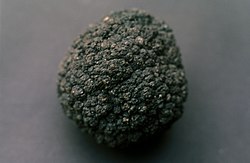
Nodules vary in size from tiny particles visible only under a microscope to large pellets more than 20 centimetres (8 in) across. However, most nodules are between 3 and 10 cm (1 and 4 in) in diameter, about the size of hen's eggs. Their surface textures vary from smooth to rough. They frequently have botryoidal (mammillated or knobby) texture and vary from spherical in shape to typically oblate, sometimes prolate, or are otherwise irregular. The bottom surface, buried in sediment, is generally rougher than the top due to a different type of growth.
Nodules lie on the seabed sediment, often partly or completely buried. They vary greatly in abundance, in some cases touching one another and covering more than 70% of the sea floor surface. The total amount of polymetallic nodules on the sea floor was estimated at 500 billion tons by Alan A. Archer of the London Geological Museum in 1981.
Polymetallic nodules are found in both shallow (e.g. the Baltic Sea) and deeper waters (e.g. the central Pacific), even in lakes, and are thought to have been a feature of the seas and oceans at least since the deep oceans were oxygenated in the Ediacaran period over 540 million years ago.
Polymetallic nodules were discovered in 1868 in the Kara Sea, in the Arctic Ocean of Siberia. During the scientific expeditions of HMS Challenger (1872–1876), they were found to occur in most oceans of the world.
Their composition varies by location, and sizeable deposits have been found in the following areas:
The largest of these deposits in terms of nodule abundance and metal concentration occur in the Clarion–Clipperton zone on vast abyssal plains in the deep ocean between 4,000 and 6,000 m (13,000 and 20,000 ft).
All of these deposits are in international waters apart from the Penrhyn Basin, which lies within the exclusive economic zone of the Cook Islands.
Manganese nodule
Polymetallic nodules, also called manganese nodules, are mineral concretions on the sea bottom formed of concentric layers of iron and manganese hydroxides around a core. As nodules can be found in vast quantities, and contain valuable metals, deposits have been identified as a potential economic interest. Depending on their composition and authorial choice, they may also be called ferromanganese nodules. Ferromanganese nodules are mineral concretions composed of silicates and insoluble iron and manganese oxides that form on the ocean seafloor and terrestrial soils. The formation mechanism involves a series of redox oscillations driven by both abiotic and biotic processes. As a byproduct of pedogenesis, the specific composition of a ferromanganese nodule depends on the composition of the surrounding soil. The formation mechanisms and composition of the nodules allow for couplings with biogeochemical cycles beyond iron and manganese. The high relative abundance of nickel, copper, manganese, and other rare metals in nodules has increased interest in their use as a mining resource.
Nodules vary in size from tiny particles visible only under a microscope to large pellets more than 20 centimetres (8 in) across. However, most nodules are between 3 and 10 cm (1 and 4 in) in diameter, about the size of hen's eggs. Their surface textures vary from smooth to rough. They frequently have botryoidal (mammillated or knobby) texture and vary from spherical in shape to typically oblate, sometimes prolate, or are otherwise irregular. The bottom surface, buried in sediment, is generally rougher than the top due to a different type of growth.
Nodules lie on the seabed sediment, often partly or completely buried. They vary greatly in abundance, in some cases touching one another and covering more than 70% of the sea floor surface. The total amount of polymetallic nodules on the sea floor was estimated at 500 billion tons by Alan A. Archer of the London Geological Museum in 1981.
Polymetallic nodules are found in both shallow (e.g. the Baltic Sea) and deeper waters (e.g. the central Pacific), even in lakes, and are thought to have been a feature of the seas and oceans at least since the deep oceans were oxygenated in the Ediacaran period over 540 million years ago.
Polymetallic nodules were discovered in 1868 in the Kara Sea, in the Arctic Ocean of Siberia. During the scientific expeditions of HMS Challenger (1872–1876), they were found to occur in most oceans of the world.
Their composition varies by location, and sizeable deposits have been found in the following areas:
The largest of these deposits in terms of nodule abundance and metal concentration occur in the Clarion–Clipperton zone on vast abyssal plains in the deep ocean between 4,000 and 6,000 m (13,000 and 20,000 ft).
All of these deposits are in international waters apart from the Penrhyn Basin, which lies within the exclusive economic zone of the Cook Islands.
Recent media
Recent media