Hubbry Logo
Degree of a polynomialDegree of a polynomialMain
Open search
Degree of a polynomial
Community hub
Degree of a polynomial
logo
7 pages, 0 posts
0 subscribers
Be the first to start a discussion here.
Degree of a polynomial
from Wikipedia

In mathematics, the degree of a polynomial is the highest of the degrees of the polynomial's monomials (individual terms) with non-zero coefficients. The degree of a term is the sum of the exponents of the variables that appear in it, and thus is a non-negative integer. For a univariate polynomial, the degree of the polynomial is simply the highest exponent occurring in the polynomial.[1] The term order has been used as a synonym of degree but, nowadays, may refer to several other concepts (see Order of a polynomial (disambiguation)).

For example, the polynomial which can also be written as has three terms. The first term has a degree of 5 (the sum of the powers 2 and 3), the second term has a degree of 1, and the last term has a degree of 0. Therefore, the polynomial has a degree of 5, which is the highest degree of any term.


To determine the degree of a polynomial that is not in standard form, such as , one can put it in standard form by expanding the products (by distributivity) and combining the like terms; for example, is of degree 1, even though each summand has degree 2. However, this is not needed when the polynomial is written as a product of polynomials in standard form, because the degree of a product is the sum of the degrees of the factors.


Names of polynomials by degree

[edit]

The following names are assigned to polynomials according to their degree:[2][3][4]

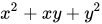
Names for degree above three are based on Latin ordinal numbers, and end in -ic. This should be distinguished from the names used for the number of variables, the arity, which are based on Latin distributive numbers, and end in -ary. For example, a degree two polynomial in two variables, such as , is called a "binary quadratic": binary due to two variables, quadratic due to degree two.[a] There are also names for the number of terms, which are also based on Latin distributive numbers, ending in -nomial; the common ones are monomial, binomial, and (less commonly) trinomial; thus is a "binary quadratic binomial".
Examples

[edit]

The polynomial is a cubic polynomial: after multiplying out and collecting terms of the same degree, it becomes , with highest exponent 3.


The polynomial is a quintic polynomial: upon combining like terms, the two terms of degree 8 cancel, leaving , with highest exponent 5.


Behavior under polynomial operations

[edit]

The degree of the sum, the product or the composition of two polynomials is strongly related to the degree of the input polynomials.[6]

Addition

[edit]

The degree of the sum (or difference) of two polynomials is less than or equal to the greater of their degrees; that is,

and .

For example, the degree of is 2, and 2 ≤ max{3, 3}.

The equality always holds when the degrees of the polynomials are different. For example, the degree of is 3, and 3 = max{3, 2}.

Multiplication

[edit]

The degree of the product of a polynomial by a non-zero scalar is equal to the degree of the polynomial; that is,

.

For example, the degree of is 2, which is equal to the degree of .

Thus, the set of polynomials (with coefficients from a given field F) whose degrees are smaller than or equal to a given number n forms a vector space; for more, see Examples of vector spaces.

More generally, the degree of the product of two polynomials over a field or an integral domain is the sum of their degrees:

.

For example, the degree of is 5 = 3 + 2.

For polynomials over an arbitrary ring, the above rules may not be valid, because of cancellation that can occur when multiplying two nonzero constants. For example, in the ring of integers modulo 4, one has that , but , which is not equal to the sum of the degrees of the factors.


Composition

[edit]

The degree of the composition of two non-constant polynomials and over a field or integral domain is the product of their degrees:

For example, if has degree 3 and has degree 2, then their composition is which has degree 6.

Note that for polynomials over an arbitrary ring, the degree of the composition may be less than the product of the degrees. For example, in the composition of the polynomials and (both of degree 1) is the constant polynomial of degree 0.

Degree of the zero polynomial

[edit]

The degree of the zero polynomial is either left undefined, or is defined to be negative (usually −1 or ).[7]

Like any constant value, the value 0 can be considered as a (constant) polynomial, called the zero polynomial. It has no nonzero terms, and so, strictly speaking, it has no degree either. As such, its degree is usually undefined. The propositions for the degree of sums and products of polynomials in the above section do not apply, if any of the polynomials involved is the zero polynomial.[8]

It is convenient, however, to define the degree of the zero polynomial to be negative infinity, and to introduce the arithmetic rules[9]

and

These examples illustrate how this extension satisfies the behavior rules above:

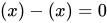
  • The degree of the sum is 3. This satisfies the expected behavior, which is that .
  • The degree of the difference is . This satisfies the expected behavior, which is that .
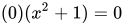
  • The degree of the product is . This satisfies the expected behavior, which is that .

Computed from the function values

[edit]

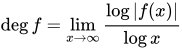
A number of formulae exist which will evaluate the degree of a polynomial function f. One based on asymptotic analysis is

;

this is the exact counterpart of the method of estimating the slope in a log–log plot.

This formula generalizes the concept of degree to some functions that are not polynomials. For example:

  • The degree of the multiplicative inverse, , is −1.
  • The degree of the square root, , is 1/2.
  • The degree of the logarithm, , is 0.
  • The degree of the exponential function, , is

The formula also gives sensible results for many combinations of such functions, e.g., the degree of is .

Another formula to compute the degree of f from its values is

;

this second formula follows from applying L'Hôpital's rule to the first formula. Intuitively though, it is more about exhibiting the degree d as the extra constant factor in the derivative of .

A more fine grained (than a simple numeric degree) description of the asymptotics of a function can be had by using big O notation. In the analysis of algorithms, it is for example often relevant to distinguish between the growth rates of and , which would both come out as having the same degree according to the above formulae.

Extension to polynomials with two or more variables

[edit]

For polynomials in two or more variables, the degree of a term is the sum of the exponents of the variables in the term; the degree (sometimes called the total degree) of the polynomial is again the maximum of the degrees of all terms in the polynomial. For example, the polynomial x2y2 + 3x3 + 4y has degree 4, the same degree as the term x2y2.

However, a polynomial in variables x and y, is a polynomial in x with coefficients which are polynomials in y, and also a polynomial in y with coefficients which are polynomials in x. The polynomial

has degree 3 in x and degree 2 in y.

Degree function in abstract algebra

[edit]

Given a ring R, the polynomial ring R[x] is the set of all polynomials in x that have coefficients in R. In the special case that R is also a field, the polynomial ring R[x] is a principal ideal domain and, more importantly to our discussion here, a Euclidean domain.

It can be shown that the degree of a polynomial over a field satisfies all of the requirements of the norm function in the euclidean domain. That is, given two polynomials f(x) and g(x), the degree of the product f(x)g(x) must be larger than both the degrees of f and g individually. In fact, something stronger holds:

For an example of why the degree function may fail over a ring that is not a field, take the following example. Let R = , the ring of integers modulo 4. This ring is not a field (and is not even an integral domain) because 2 × 2 = 4 ≡ 0 (mod 4). Therefore, let f(x) = g(x) = 2x + 1. Then, f(x)g(x) = 4x2 + 4x + 1 = 1. Thus deg(fg) = 0 which is not greater than the degrees of f and g (which each had degree 1).

Since the norm function is not defined for the zero element of the ring, we consider the degree of the polynomial f(x) = 0 to also be undefined so that it follows the rules of a norm in a Euclidean domain.

See also

[edit]

Notes

[edit]

References

[edit]
Revisions and contributorsEdit on WikipediaRead on Wikipedia
from Grokipedia
In mathematics, the degree of a polynomial is defined as the highest of the degrees of its monomials (terms) with non-zero coefficients. For a univariate (single-variable) polynomial, this is the highest exponent of the variable with a non-zero coefficient after expanding and combining like terms. For example, the polynomial 3x4+2x253x^4 + 2x^2 - 5 has degree 4. The zero polynomial has no non-zero terms and its degree is typically undefined or defined as -\infty. For a non-zero polynomial p(x)=anxn+an1xn1++a1x+a0p(x) = a_n x^n + a_{n-1} x^{n-1} + \cdots + a_1 x + a_0, where an0a_n \neq 0, the degree is nn, and this nn indicates the polynomial's asymptotic growth behavior and bounds the number of its roots (at most n real roots, exactly n complex roots counting multiplicities). Constant non-zero polynomials have degree 0, linear polynomials degree 1, quadratic degree 2, and so on. When a polynomial is expressed in standard form—with terms arranged in descending order of exponents—the degree corresponds to the exponent in the leading term, which is the term with the highest power, and its coefficient is the leading coefficient. This form facilitates identifying the degree quickly; for instance, in p(x)=3x42x2+5p(x) = 3x^4 - 2x^2 + 5, the degree is 4 because the leading term is 3x43x^4. The degree plays a crucial role in operations on polynomials: the degree of a sum or difference is at most the maximum of the individual degrees (and exactly that if the leading coefficients do not cancel), while the degree of a product is precisely the sum of the degrees of the factors. The degree profoundly influences a polynomial's graphical behavior and root structure. For end behavior, as x|x| approaches infinity, the graph is dominated by the leading term: even-degree polynomials with positive leading coefficients rise to positive infinity on both ends, while odd-degree ones rise on the right and fall on the left (and vice versa for negative leading coefficients). Regarding roots, the Fundamental Theorem of Algebra states that every non-constant polynomial of degree nn with complex coefficients has exactly nn roots in the complex numbers, counting multiplicities, implying at most nn real roots. This theorem underscores the degree's centrality in solving polynomial equations and factoring. Beyond , the degree concept extends to multivariate polynomials (total degree as the sum of exponents in the highest-degree term) and informs applications in , where it relates to (reducing degree by 1) and integrals, as well as in fields like for algorithm complexity in polynomial-time computations. Overall, the degree encapsulates essential structural and asymptotic properties that define how polynomials model real-world phenomena, from physics trajectories to economic functions.

Basic Concepts

Definition

In , polynomials in a single indeterminate xx over a field FF (such as the rational numbers Q\mathbb{Q} or real numbers R\mathbb{R}) are defined as formal finite sums p(x)=k=0nakxkp(x) = \sum_{k=0}^n a_k x^k, where each coefficient aka_k belongs to FF. This formal sum representation treats polynomials as algebraic objects independent of their evaluation as functions, emphasizing their structure as elements of the FF. The degree of a p(x)=anxn+an1xn1++a1x+a0p(x) = a_n x^n + a_{n-1} x^{n-1} + \dots + a_1 x + a_0, denoted deg(p)\deg(p), is the highest exponent nn for which the leading coefficient an0a_n \neq 0. Here, the leading term is anxna_n x^n, and ana_n is the leading coefficient, which is nonzero by definition for this nn. This measure captures the "order" or complexity of the based on its highest power.

Notation

The standard representation of a univariate polynomial p(x)p(x) over the real or complex numbers is given by the finite sum p(x)=k=0nakxk,p(x) = \sum_{k=0}^n a_k x^k, where the coefficients aka_k are constants, nn is a non-negative integer, and an0a_n \neq 0. This form highlights the powers of the indeterminate xx, with the highest power nn determining the structure of the polynomial. The degree of such a polynomial pp, denoted degp\deg p or deg(p)\deg(p), is defined as this highest exponent nn with nonzero coefficient. This notation is widely used in algebraic contexts to succinctly refer to the polynomial's order without expanding the full expression. For instance, in polynomial rings, the degree function deg:FN\deg: \mathbb{F} \to \mathbb{N} (where F\mathbb{F} is a field) provides a valuation-like measure. A monic polynomial is a special case where the leading coefficient an=1a_n = 1, simplifying factorization and root analysis; such polynomials are typically identified by the adjective "monic" prefixed to their description, without a unique symbolic notation beyond the standard sum form. The collection of all polynomials with coefficients in a field F\mathbb{F} forms the polynomial ring F\mathbb{F}, which is a vector space over F\mathbb{F} with basis {1,x,x2,}\{1, x, x^2, \dots\}. Conceptually, the degree degp\deg p governs the polynomial's growth rate, as higher-degree terms dominate the behavior of p(x)|p(x)| for large x|x|.

Classification

Names by Degree

Polynomials are traditionally classified by their degree, which is the highest power of the variable with a nonzero , and each low degree has a specific name derived from historical and geometric conventions. These names facilitate concise reference in mathematical discourse, particularly when discussing equations formed by setting the polynomial equal to zero. The following table summarizes the standard names for polynomials by degree:
DegreeName
0constant polynomial
1linear polynomial
2quadratic polynomial
3cubic polynomial
4quartic polynomial
5quintic polynomial
≥6nth-degree polynomial
For degrees greater than 5, there are no universally standardized names, though occasional terms like "sextic" for degree 6 or "septic" for degree 7 appear in specialized literature but are not commonly used. The etymological roots of these names reflect geometric interpretations related to powers. "Quadratic" originates from the Latin quadratus, meaning "square," alluding to the second power as the square of a linear term. Similarly, "cubic" derives from the Latin cubicus, from Greek kybos meaning "cube," referring to the third power. "Quartic" stems from Latin quartus ("fourth"), "quintic" from quintus ("fifth"), while "linear" evokes a straight line (first degree), and "constant" indicates an unchanging value (zero degree). These names extend to the corresponding equations. For instance, a is of the form ax2+bx+c=0ax^2 + bx + c = 0 where a0a \neq 0, a is ax3+bx2+cx+d=0ax^3 + bx^2 + cx + d = 0 with a0a \neq 0, and so forth for quartic and quintic equations, each solvable by radicals up to degree 4 but not generally for degree 5 or higher.

Examples

To illustrate the degree of a univariate , consider specific examples across low degrees, where the degree is determined by the highest power of the variable with a non-zero , known as the leading term. For a constant , such as p(x)=5p(x) = 5, the leading term is the constant 5 itself, which corresponds to x0x^0, so the degree is 0; lower-degree terms are absent and thus do not affect this. Similarly, for a linear , p(x)=3x2p(x) = 3x - 2, the leading term is 3x3x, with power 1, giving degree 1; the constant term -2 has a lower power and does not change the degree. A quadratic polynomial, p(x)=x2+4x+1p(x) = x^2 + 4x + 1, has leading term x2x^2 ( 1), so its degree is 2; the linear and constant terms have lower powers that do not influence the overall degree. For a cubic polynomial, p(x)=2x3xp(x) = 2x^3 - x, the leading term is 2x32x^3, establishing degree 3; the absence of x2x^2 term and the presence of the lower-degree x-x term do not alter this, as only the highest non-zero power matters. These examples, labeled by their standard names (constant for degree 0, linear for degree 1, quadratic for degree 2, and cubic for degree 3), demonstrate how non-zero constants qualify as degree 0 polynomials.

Operations

Addition

When adding two univariate polynomials p(x)p(x) and q(x)q(x), the degree of their sum is at most the maximum of their individual degrees: deg(p+q)max(degp,degq)\deg(p + q) \leq \max(\deg p, \deg q). Equality holds unless the leading coefficients of the polynomials with the highest degree cancel out during . To determine the degree precisely, consider the leading terms. Suppose degp=m\deg p = m and degq=n\deg q = n, with mnm \geq n, so p(x)=amxm+ lower termsp(x) = a_m x^m + \ lower\ terms and q(x)=bnxn+ lower termsq(x) = b_n x^n + \ lower\ terms, where am0a_m \neq 0 and bn0b_n \neq 0. If m>nm > n, the leading term of p+qp + q is amxma_m x^m, so deg(p+q)=m=degp\deg(p + q) = m = \deg p. If m=nm = n, the leading term is (am+bm)xm(a_m + b_m) x^m; the degree remains mm if am+bm0a_m + b_m \neq 0, but drops to the highest power with a nonzero in the resulting if cancellation occurs (am+bm=0a_m + b_m = 0). This can be expressed formally using the δmn\delta_{mn}, which is 1 if m=nm = n and 0 otherwise. The leading coefficient of the sum is then am+bmδmna_m + b_m \delta_{mn}, and the degree is mm if this coefficient is nonzero, or lower otherwise. Subtraction of is a special case of addition, obtained by adding the (i.e., multiplying one by -1, which negates all coefficients including the leading one). Thus, the degree rules apply similarly, with potential cancellation when degrees are equal and leading coefficients differ by the negation.

Multiplication

When multiplying two non-zero univariate polynomials p(x)p(x) and q(x)q(x) over an RR, the degree of their product is the sum of their individual degrees: deg(pq)=degp+degq\deg(p \cdot q) = \deg p + \deg q. This follows from the structure of polynomial multiplication. Let p(x)=amxm+ lower termsp(x) = a_m x^m + \ lower\ terms and q(x)=bnxn+ lower termsq(x) = b_n x^n + \ lower\ terms, where am,bnRa_m, b_n \in R are the non-zero leading coefficients and m=degpm = \deg p, n=degqn = \deg q. The leading term of p(x)q(x)p(x) q(x) is then ambnxm+na_m b_n x^{m+n}. Since RR is an integral domain, it has no zero divisors, so ambn0a_m b_n \neq 0. To see why this is the highest-degree term, note that all other terms in the expansion of p(x)q(x)p(x) q(x) arise from products of terms of degree at most m1m-1 from p(x)p(x) and at most nn from q(x)q(x), or vice versa, yielding degrees strictly less than m+nm+n. Thus, there is no cancellation at degree m+nm+n, confirming deg(pq)=m+n\deg(p \cdot q) = m + n. This rule holds unconditionally over fields, as fields are integral domains. However, in general commutative rings, the product of the leading coefficients may be zero due to zero divisors, potentially resulting in a degree less than the sum.

Composition

The degree of the composition pqp \circ q of two univariate polynomials pp and qq over a field satisfies deg(pq)=deg(p)deg(q)\deg(p \circ q) = \deg(p) \cdot \deg(q) provided that deg(q)1\deg(q) \geq 1. This holds because the composition is itself a polynomial, and its degree follows from the multiplicative behavior under substitution for non-constant inner polynomials. To derive this, let p(y)=amym+ lower termsp(y) = a_m y^m + \ lower\ terms, where am0a_m \neq 0 and m=deg(p)m = \deg(p), and q(x)=bnxn+ lower termsq(x) = b_n x^n + \ lower\ terms, where bn0b_n \neq 0 and n=deg(q)1n = \deg(q) \geq 1. The highest-degree term in p(q(x))p(q(x)) arises from substituting the leading term of q(x)q(x) into the leading term of p(y)p(y), yielding am(bnxn)m=ambnmxnma_m (b_n x^n)^m = a_m b_n^m x^{nm}, whose exponent nmnm is the product of the degrees. Lower-degree terms in q(x)q(x) contribute terms of strictly lower degree in the expansion, preserving the leading term. If deg(q)=0\deg(q) = 0, then q(x)q(x) is a non-zero constant cc, and pq=p(c)p \circ q = p(c), which is also a constant (hence degree 0). If c=[0](/page/0)c = [0](/page/0) and p(0)=0p(0) = 0, the result is the zero polynomial. The zero polynomial has degree conventionally defined as -\infty or left undefined, but the standard rule for composition assumes qq is not the constant zero polynomial to avoid this special case.

Special Cases

Zero Polynomial

The zero polynomial, often denoted simply as 00, consists of all coefficients being zero and thus has no terms with non-zero coefficients. As a result, it possesses no leading term, which complicates the standard definition of degree as the exponent of the highest power with a non-zero coefficient. To address this, mathematical conventions assign a special degree to maintain consistency across polynomial operations and properties. The most widely adopted convention in , particularly in the study of polynomial rings, defines the degree of the zero polynomial as -\infty. This assignment ensures that fundamental rules, such as the subadditivity of degree under addition—deg(p+q)max(degp,degq)\deg(p + q) \leq \max(\deg p, \deg q)—hold universally, including cases where p+q=0p + q = 0, as max(degp,deg(p))=deg(0)=\max(\deg p, \deg(-p)) = \deg(0) = -\infty. Without this, the inequality would fail when polynomials cancel completely, as the degree would otherwise need to be lower than any finite value. This -\infty convention also supports multiplicativity, where deg(p0)=\deg(p \cdot 0) = -\infty for any pp, aligning with the rule deg(pq)=degp+degq\deg(p \cdot q) = \deg p + \deg q in the extended real numbers, since adding -\infty to any finite degree yields -\infty. For composition, 0q=00 \circ q = 0 for any qq, preserving deg(0q)=\deg(0 \circ q) = -\infty, though standard degree formulas for composition typically presuppose non-zero polynomials to avoid indeterminacies. The choice of -\infty further facilitates advanced applications, such as the division algorithm in rings, where it ensures quotients and remainders behave predictably. Alternative conventions appear in some contexts: the degree may be left undefined to strictly reflect the lack of a leading term, or occasionally set to 1-1, positioning it immediately below degree-zero constants. The undefined approach avoids artificial assignments but can complicate proofs requiring degree comparisons, while 1-1 preserves some ordering (e.g., below constants but above nothing) yet fails to fully maintain additivity, as deg(p+(p))=1\deg(p + (-p)) = -1 would not satisfy max(degp,deg(p))\leq \max(\deg p, \deg(-p)) for degp0\deg p \geq 0. In contrast, -\infty excels in preserving all such properties within the extended reals, making it the preferred standard in rigorous algebraic treatments.

Constant Polynomials

A constant polynomial is a polynomial expression of the form p(x)=cp(x) = c, where cc is a non-zero element from the underlying field or ring of . By , the degree of such a is 0, as there are no terms involving the variable xx with positive exponents. This contrasts with higher-degree , where the degree is determined by the highest power of xx with a non-zero . In terms of operations, adding a constant polynomial to a polynomial q(x)q(x) of degree greater than 0 preserves the degree of q(x)q(x), since the constant only affects the constant term without altering the leading coefficient. Similarly, multiplying a polynomial by a non-zero constant polynomial scales all coefficients uniformly but leaves the degree unchanged, as the highest power remains the same. These properties highlight how constant polynomials act as scalar multiples within the , maintaining structural integrity in algebraic manipulations. From a functional perspective, a constant p(x)=cp(x) = c defines a that maps every value in the domain to cc, exhibiting no variation and a horizontal graph in the real or . This functional behavior underscores its role as the simplest non-trivial case of a function, often serving as the base case in inductive arguments about polynomial degrees.

Computation

From Coefficients

The degree of a univariate polynomial given in standard form, expressed as p(x)=k=0nakxkp(x) = \sum_{k=0}^n a_k x^k where the coefficients aka_k are known, is determined by identifying the largest index nn such that an0a_n \neq 0. This process involves scanning the coefficients starting from the highest index and proceeding downward until the first non-zero coefficient is encountered, as all higher coefficients must be zero by definition of the standard representation. In computational contexts, polynomials are often stored as arrays or vectors of coefficients, ordered from lowest to highest degree. To compute the degree, one trims any trailing zeros from the array—effectively ignoring coefficients of zero at the end—and takes the index of the last non-zero entry as the degree (with the zero polynomial assigned degree -\infty or undefined in some conventions). This approach ensures efficient determination, particularly for dense representations where the array length provides an upper bound on the possible degree. For example, in algorithmic implementations, this trimming step is a standard preprocessing operation before further computations. For sparse polynomials, which store only the non-zero terms as pairs of exponents and coefficients to optimize memory usage, the degree is simply the maximum exponent among all terms with non-zero coefficients. This representation is particularly useful for high-degree polynomials with many zero coefficients, allowing direct access to the highest non-zero term without scanning an entire dense . In such cases, the degree reflects the "order" of the in its sparse standard form, emphasizing the sparsity pattern.

From Function Values

One method to determine the degree of a polynomial from its function values involves finite differences, which exploit the property that the forward difference operator reduces the degree of a polynomial by one. The forward difference is defined as Δp(x)=p(x+1)p(x)\Delta p(x) = p(x+1) - p(x), and higher-order differences are computed iteratively, such as Δk+1p(x)=Δkp(x+1)Δkp(x)\Delta^{k+1} p(x) = \Delta^k p(x+1) - \Delta^k p(x). For a polynomial p(x)p(x) of degree nn, the first differences Δp(x)\Delta p(x) form a polynomial of degree n1n-1, and this process continues until the nnth differences are constant (equal to n!ann! a_n, where ana_n is the leading coefficient), while the (n+1)(n+1)th differences are zero. Thus, the degree nn is the smallest integer such that the nnth differences are constant across equally spaced evaluation points. To apply this, evaluate p(x)p(x) at a sequence of equally spaced points, construct a difference table, and identify the level at which the differences become constant. For example, consider evaluations of a quadratic polynomial at points; the first differences will be linear (non-constant), but the second differences will be constant, indicating degree 2. This method assumes exact arithmetic and sufficient evaluation points (at least n+2n+2 to verify the zero higher differences). Another approach uses : a of degree at most nn is uniquely determined by its values at n+1n+1 distinct points, per the fundamental theorem of . To find the degree, compute the interpolating (e.g., via Newton or Lagrange methods) using successively more points; the degree is the minimal nn such that the interpolant of degree at most nn fits all available evaluation points exactly, without needing a higher degree. For instance, if m>n+1m > n+1 points lie on a degree-nn interpolant but require degree nn (not less), the original has degree nn. This requires solving systems for or basis evaluations at the points. An asymptotic method estimates the degree for large x|x|, where the leading term dominates: p(x)anxnp(x) \sim a_n x^n, so logp(x)/logxn\log |p(x)| / \log |x| \approx n. By evaluating at large xx and computing this ratio, the integer nn closest to the limit provides the degree estimate. This works well assuming an0a_n \neq 0 and sufficiently large xx to neglect lower terms. These methods assume exact function values and face limitations in numerical practice, such as rounding errors in finite differences that can mask constancy for high degrees or ill-conditioned interpolation matrices leading to unstable estimates. For noisy data, overestimation of degree may occur due to fitting artifacts, and high-degree cases amplify sensitivity to evaluation precision.

Extensions

Multivariate Polynomials

In the context of polynomials in multiple variables, such as p(x1,x2,,xn)=cαxαp(x_1, x_2, \dots, x_n) = \sum c_\alpha x^\alpha where α=(α1,,αn)\alpha = (\alpha_1, \dots, \alpha_n) is a multi-index and xα=x1α1xnαnx^\alpha = x_1^{\alpha_1} \cdots x_n^{\alpha_n}, the total degree extends the univariate notion by considering the combined exponents across all variables. The total degree of pp, denoted deg(p)\deg(p), is the maximum value of α=α1+α2++αn|\alpha| = \alpha_1 + \alpha_2 + \dots + \alpha_n over all multi-indices α\alpha with nonzero cαc_\alpha. For example, consider p(x,y)=x2y+xy3p(x,y) = x^2 y + x y^3; the monomials have total degrees 3 and 4, respectively, so deg(p)=4\deg(p) = 4. A related concept is the partial degree with respect to a specific variable xix_i, denoted degxi(p)\deg_{x_i}(p), which is the maximum exponent αi\alpha_i over all multi-indices α\alpha with nonzero , treating the other variables as constants. In the example above, degx(p)=2\deg_x(p) = 2 and degy(p)=3\deg_y(p) = 3. The full degree of pp can then be expressed as the multi-degree deg(p)=(degx1(p),,degxn(p))\deg(p) = (\deg_{x_1}(p), \dots, \deg_{x_n}(p)), though the total degree is more commonly used for overall analysis. The behavior of the total degree under polynomial operations mirrors the univariate case in many respects but accounts for potential interactions among variables. For the sum p+qp + q, deg(p+q)max(deg(p),deg(q))\deg(p + q) \leq \max(\deg(p), \deg(q)), with equality holding unless there is cancellation among the highest-degree terms. For the product pqp \cdot q, assuming the coefficient ring has no zero divisors, deg(pq)=deg(p)+deg(q)\deg(p \cdot q) = \deg(p) + \deg(q), as the highest-degree terms multiply to produce a term of that combined degree without cancellation. Composition of multivariate polynomials is more intricate, as it involves substituting polynomials for variables; the resulting total degree is generally at most the product of the degrees involved, but exact computation depends on the specific substitution and may involve lower degrees due to dependencies among variables. Homogeneous polynomials form an important subclass where all monomials have the same total degree dd, meaning p(tx1,tx2,,txn)=tdp(x1,x2,,xn)p(tx_1, tx_2, \dots, tx_n) = t^d p(x_1, x_2, \dots, x_n) for any scalar tt. For instance, x2y+xy2x^2 y + x y^2 is homogeneous of total degree 3. Such polynomials are fundamental in and , as they preserve scaling properties under linear transformations.

Abstract Algebra

In the context of , the RR over a RR with unity consists of formal expressions f(x)=anxn++a0f(x) = a_n x^n + \cdots + a_0 with coefficients in RR, where the degree of a nonzero ff, denoted degf\deg f, is the largest nn such that the leading coefficient an0a_n \neq 0. When RR is an , this definition ensures that the leading coefficient is nonzero and the degree function behaves additively under : for nonzero polynomials p(x),q(x)Rp(x), q(x) \in R, deg(p(x)q(x))=degp(x)+degq(x)\deg(p(x)q(x)) = \deg p(x) + \deg q(x). If RR is a field, then RR forms a , where the degree serves as the Euclidean function or norm: for any a,bRa, b \in R with b0b \neq 0, there exist unique q,rRq, r \in R such that a=qb+ra = qb + r and either r=0r = 0 or degr<degb\deg r < \deg b. This structure underpins the division algorithm and unique factorization in RR, with the additivity of degrees in preserving the Euclidean property. Polynomial rings are naturally graded rings, where R=n=0RxnR = \bigoplus_{n=0}^\infty R x^n and the homogeneous component of degree nn consists of polynomials whose terms are multiples of xnx^n. Hilbert's basis theorem states that if RR is Noetherian, then RR is also Noetherian, implying every ideal in RR has a finite generating set; the proof relies on the degree function to control leading terms and ensure finite generation by considering ideals modulo lower-degree parts. In noncommutative settings, such as Ore extensions R[x;σ,δ]R[x; \sigma, \delta] where σ\sigma is an and δ\delta a σ\sigma-derivation of RR, the degree of a skew polynomial is defined analogously as the highest power of xx with nonzero , preserving many properties like additivity under multiplication when applicable. From a valuation-theoretic perspective, the degree can be viewed as the negative of the valuation at , degf=v(f)\deg f = -v_\infty(f), where vv_\infty measures the order of growth at the point at infinity in the over the .

References

Add your contribution
Related Hubs
User Avatar
No comments yet.