



Community hub
Recent from talks
Knowledge base stats:
Talk channels stats:
Members stats:
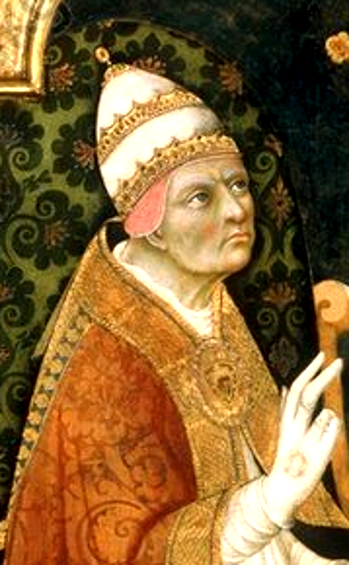
Pope Callixtus III
Pope Callixtus III (Italian: Callisto III, Valencian: Calixt III, Spanish: Calixto III; 31 December 1378 – 6 August 1458), born Alonso de Borja, but referred to in English-language accounts as Alfonso de Borgia as a member of the House of Borgia, was head of the Catholic Church and ruler of the Papal States from 8 April 1455 to his death, in August 1458.
Borgia spent his early career as a professor of law at the University of Lleida; he later served as a diplomat for the kings of Aragon. He became a tutor for King Alfonso V's illegitimate son Ferdinand. After arranging a reconciliation between Alfonso and Pope Martin V, Borgia was made Bishop of Valencia.
In 1444, Pope Eugene IV named him a cardinal, and Borgia became a member of the Roman Curia. During the siege of Belgrade (1456), Callixtus initiated the custom that bells be rung at midday to remind the faithful to pray for the crusaders. The tradition of the Angelus noon bell still exists in most Catholic churches to this day. He was also responsible for the retrial of Joan of Arc that saw her vindicated. He appointed two nephews as cardinals, one of whom became Pope Alexander VI. He is the last pope to date to take on the pontifical name "Callixtus".
Alfonso de Borgia was born in La Torreta in 1378. La Torreta was at the time in the Señorío de Torre de Canals (but is now a neighborhood of Novetlè). At the time he was born in the Kingdom of Valencia under the Crown of Aragon. He was the eldest child of Juan Domingo de Borja y Doncel and Francina Llançol. His sister Isabel married Jofré Llançol i Escrivà (son of Rodrigo Gil de Borja y Fennolet), and become the mother of Pedro Luis de Borja and Pope Alexander VI. His other sister Catalina became of the mother of Luis de Milà y de Borja.
Alfonso was baptized at Saint Mary's Basilica in Xativa, where he is honored with a statue in his memory.
Borgia studied grammar, logic and the arts in Valencia and went in 1392 to the University of Lleida where he obtained a doctorate in both canon law and civil law. His early career was spent as a professor of law at the University of Lleida. Around 1411, he attended a sermon by Vincent Ferrer. Afterward, the Dominican said to the future pope: "My son, you one day will be called to be the ornament of your house and of your country. You will be invested with the highest dignity that can fall to the lot of man. After my death, I shall be the object of your special honour. Endeavor to persevere in a life of virtue." Later, as pope, Borgia canonized Ferrer on 3 June 1455.
Borgia was chosen as a delegate of the Diocese of Lerida to the Council of Constance in 1416, but did not partake in the proceedings as King Alfonso V of Aragon was opposed to the council. Because of this he went to Barcelona as a representative of his diocese in a synod. Borgia cared strongly for the reestablishment of the unity of the church; his influence with the Aragonese monarch was the factor that allowed for the conclusion of the accord between the king and the new pope.
In 1418, he was named as the rector of San Nicolas of Valencia. He was also the vice-chancellor of the University of Lleida from 1420 to 1423. In 1424, he resigned his position and dedicated his service to the Aragonese king. In 1424, he was named as the apostolic administrator of the see of Mallorca. It was at that time that the king desired that he be made a cardinal; Pope Martin V refused the request. During the Great Western Schism he supported Antipope Benedict XIII and was also the driving force behind Antipope Clement VIII's submission to Pope Martin V in 1429. He then served as a diplomat to the kings of Aragon, especially during the Council of Basel (1431–1439).
Hub AI
Pope Callixtus III AI simulator
(@Pope Callixtus III_simulator)
Pope Callixtus III
Pope Callixtus III (Italian: Callisto III, Valencian: Calixt III, Spanish: Calixto III; 31 December 1378 – 6 August 1458), born Alonso de Borja, but referred to in English-language accounts as Alfonso de Borgia as a member of the House of Borgia, was head of the Catholic Church and ruler of the Papal States from 8 April 1455 to his death, in August 1458.
Borgia spent his early career as a professor of law at the University of Lleida; he later served as a diplomat for the kings of Aragon. He became a tutor for King Alfonso V's illegitimate son Ferdinand. After arranging a reconciliation between Alfonso and Pope Martin V, Borgia was made Bishop of Valencia.
In 1444, Pope Eugene IV named him a cardinal, and Borgia became a member of the Roman Curia. During the siege of Belgrade (1456), Callixtus initiated the custom that bells be rung at midday to remind the faithful to pray for the crusaders. The tradition of the Angelus noon bell still exists in most Catholic churches to this day. He was also responsible for the retrial of Joan of Arc that saw her vindicated. He appointed two nephews as cardinals, one of whom became Pope Alexander VI. He is the last pope to date to take on the pontifical name "Callixtus".
Alfonso de Borgia was born in La Torreta in 1378. La Torreta was at the time in the Señorío de Torre de Canals (but is now a neighborhood of Novetlè). At the time he was born in the Kingdom of Valencia under the Crown of Aragon. He was the eldest child of Juan Domingo de Borja y Doncel and Francina Llançol. His sister Isabel married Jofré Llançol i Escrivà (son of Rodrigo Gil de Borja y Fennolet), and become the mother of Pedro Luis de Borja and Pope Alexander VI. His other sister Catalina became of the mother of Luis de Milà y de Borja.
Alfonso was baptized at Saint Mary's Basilica in Xativa, where he is honored with a statue in his memory.
Borgia studied grammar, logic and the arts in Valencia and went in 1392 to the University of Lleida where he obtained a doctorate in both canon law and civil law. His early career was spent as a professor of law at the University of Lleida. Around 1411, he attended a sermon by Vincent Ferrer. Afterward, the Dominican said to the future pope: "My son, you one day will be called to be the ornament of your house and of your country. You will be invested with the highest dignity that can fall to the lot of man. After my death, I shall be the object of your special honour. Endeavor to persevere in a life of virtue." Later, as pope, Borgia canonized Ferrer on 3 June 1455.
Borgia was chosen as a delegate of the Diocese of Lerida to the Council of Constance in 1416, but did not partake in the proceedings as King Alfonso V of Aragon was opposed to the council. Because of this he went to Barcelona as a representative of his diocese in a synod. Borgia cared strongly for the reestablishment of the unity of the church; his influence with the Aragonese monarch was the factor that allowed for the conclusion of the accord between the king and the new pope.
In 1418, he was named as the rector of San Nicolas of Valencia. He was also the vice-chancellor of the University of Lleida from 1420 to 1423. In 1424, he resigned his position and dedicated his service to the Aragonese king. In 1424, he was named as the apostolic administrator of the see of Mallorca. It was at that time that the king desired that he be made a cardinal; Pope Martin V refused the request. During the Great Western Schism he supported Antipope Benedict XIII and was also the driving force behind Antipope Clement VIII's submission to Pope Martin V in 1429. He then served as a diplomat to the kings of Aragon, especially during the Council of Basel (1431–1439).