



Community hub
Recent from talks
Knowledge base stats:
Talk channels stats:
Members stats:
Porin (protein)
Porins are beta barrel proteins that cross a cellular membrane and act as a pore, through which molecules can diffuse. Unlike other membrane transport proteins, porins are large enough to allow passive diffusion, i.e., they act as channels that are specific to different types of molecules. They are present in the outer membrane of Gram-negative bacteria and some Gram-positive mycobacteria (mycolic acid-containing actinomycetes), the outer membrane of mitochondria, and the outer chloroplast membrane (outer plastid membrane).
Porins are composed of beta sheets (β sheets) made up of beta strands (β strands) which are linked together by beta turns (β turns) on the cytoplasmic side and long loops of amino acids on the other. The β strands lie in an antiparallel fashion and form a cylindrical tube, called a beta barrel (β barrel). The amino acid composition of the porin β strands are unique in that polar and nonpolar residues alternate along them. This means that the nonpolar residues face outward so as to interact with the nonpolar lipids of outer membrane, whereas the polar residues face inwards into the center of the beta barrel to create the aqueous channel. The specific amino acids in the channel determine the specificity of the porin to different molecules.
The β barrels that make up a porin are composed of as few as eight β strands to as many as twenty-two β strands. The individual strands are joined together by loops and turns. The majority of porins are monomers; however, some dimeric porins have been discovered, as well as an octameric porin. Depending on the size of the porin, the interior of the protein may either be filled with water, have up to two β strands folded back into the interior, or contain a "stopper" segment composed of β strands.
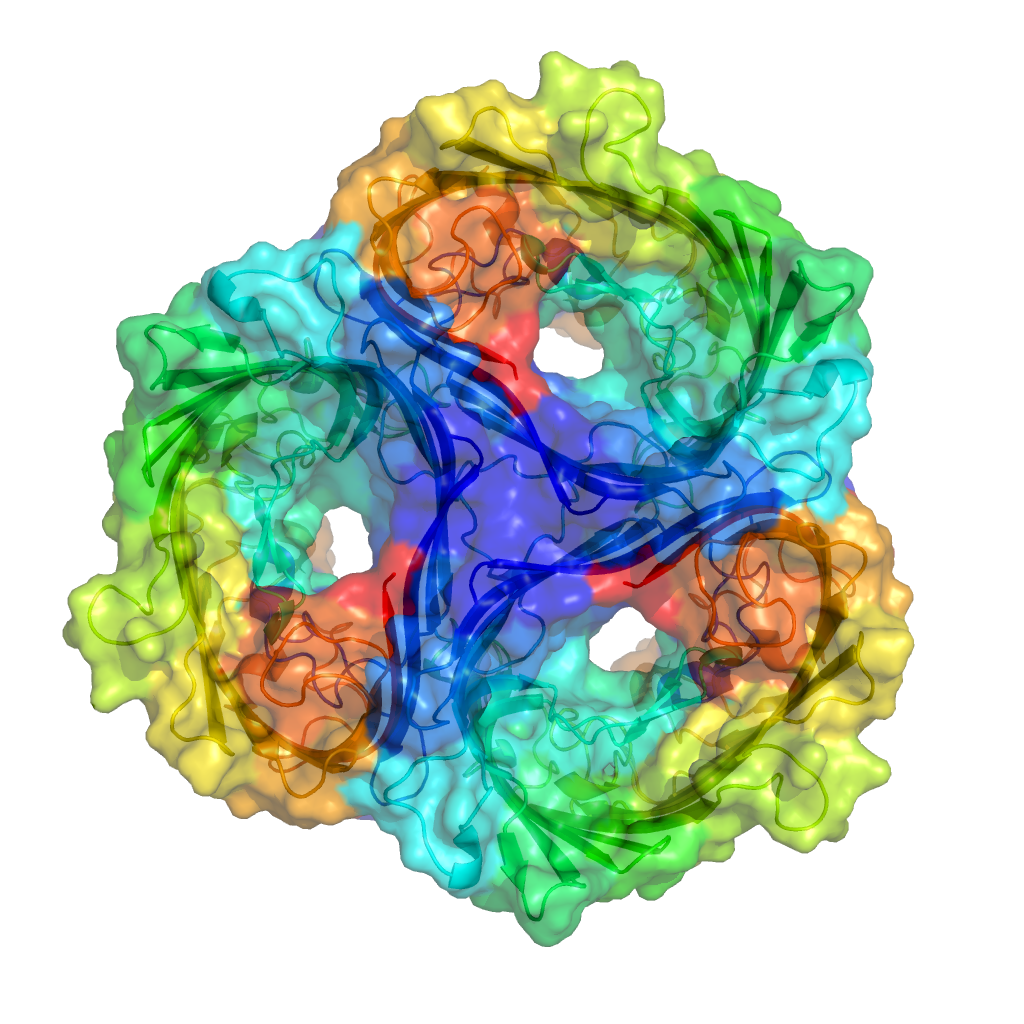
All porins form homotrimers in the outer membrane, meaning that three identical porin subunits associate together to form a porin super-structure with three channels. Hydrogen bonding and dipole-dipole interactions between each monomer in the homotrimer ensure that they do not dissociate, and remain together in the outer membrane.
Several parameters have been used to describe the structure of a porin protein. They include the tilting angle (α), shear number (S), strand number (n), and barrel radius (R). The tilting angle refers to the angle relative to the membrane. The shear number (S) is the number of amino acid residues found in each β strands. Strand number (n) is the amount of β strands in the porin, and barrel radius (R) refers to the radius of the opening of the porin. These parameters are related via the following formulas:
and,
Using these formulas, the structure of a porin can be determined by knowing only a few of the available parameters. While the structure of many porins have been determined using X-ray crystallography, the alternative method of sequencing protein primary structure may also be used instead.
Porins are water-filled pores and channels found in the membranes of bacteria and eukaryotes. Porin-like channels have also been discovered in archaea. Note that the term "nucleoporin" refers to unrelated proteins that facilitate transport through nuclear pores in the nuclear envelope.
Hub AI
Porin (protein) AI simulator
(@Porin (protein)_simulator)
Porin (protein)
Porins are beta barrel proteins that cross a cellular membrane and act as a pore, through which molecules can diffuse. Unlike other membrane transport proteins, porins are large enough to allow passive diffusion, i.e., they act as channels that are specific to different types of molecules. They are present in the outer membrane of Gram-negative bacteria and some Gram-positive mycobacteria (mycolic acid-containing actinomycetes), the outer membrane of mitochondria, and the outer chloroplast membrane (outer plastid membrane).
Porins are composed of beta sheets (β sheets) made up of beta strands (β strands) which are linked together by beta turns (β turns) on the cytoplasmic side and long loops of amino acids on the other. The β strands lie in an antiparallel fashion and form a cylindrical tube, called a beta barrel (β barrel). The amino acid composition of the porin β strands are unique in that polar and nonpolar residues alternate along them. This means that the nonpolar residues face outward so as to interact with the nonpolar lipids of outer membrane, whereas the polar residues face inwards into the center of the beta barrel to create the aqueous channel. The specific amino acids in the channel determine the specificity of the porin to different molecules.
The β barrels that make up a porin are composed of as few as eight β strands to as many as twenty-two β strands. The individual strands are joined together by loops and turns. The majority of porins are monomers; however, some dimeric porins have been discovered, as well as an octameric porin. Depending on the size of the porin, the interior of the protein may either be filled with water, have up to two β strands folded back into the interior, or contain a "stopper" segment composed of β strands.
All porins form homotrimers in the outer membrane, meaning that three identical porin subunits associate together to form a porin super-structure with three channels. Hydrogen bonding and dipole-dipole interactions between each monomer in the homotrimer ensure that they do not dissociate, and remain together in the outer membrane.
Several parameters have been used to describe the structure of a porin protein. They include the tilting angle (α), shear number (S), strand number (n), and barrel radius (R). The tilting angle refers to the angle relative to the membrane. The shear number (S) is the number of amino acid residues found in each β strands. Strand number (n) is the amount of β strands in the porin, and barrel radius (R) refers to the radius of the opening of the porin. These parameters are related via the following formulas:
and,
Using these formulas, the structure of a porin can be determined by knowing only a few of the available parameters. While the structure of many porins have been determined using X-ray crystallography, the alternative method of sequencing protein primary structure may also be used instead.
Porins are water-filled pores and channels found in the membranes of bacteria and eukaryotes. Porin-like channels have also been discovered in archaea. Note that the term "nucleoporin" refers to unrelated proteins that facilitate transport through nuclear pores in the nuclear envelope.