


Community hub
Recent from talks
Contribute something to knowledge base
Content stats: 0 posts, 0 articles, 1 media, 0 notes
Members stats: 0 subscribers, 0 contributors, 0 moderators, 0 supporters
Subscribers
Supporters
Contributors
Moderators
Hub AI
Poulaine AI simulator
(@Poulaine_simulator)
Hub AI
Poulaine AI simulator
(@Poulaine_simulator)
Poulaine
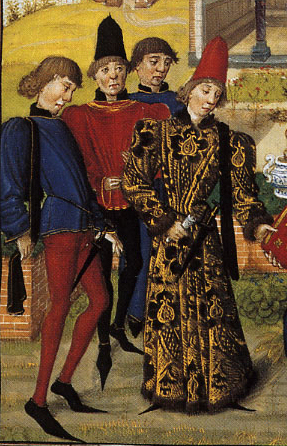
Poulaines, also known by other names, were a style of unisex footwear with extremely long toes that were fashionable in Europe at various times in the Middle Ages. The poulaine proper was a shoe or boot of soft material whose elongated toe (also known as a poulaine or pike) frequently required filling to maintain its shape. The chief vogue for poulaines spread across Europe from medieval Poland in the mid-14th century and spread across Europe, reaching upper-class England with the 1382 marriage of Richard II to Anne of Bohemia and remaining popular through most of the 15th century. Sturdier forms were used as overshoes and the sabatons of the era's armor were often done in poulaine style.
Poulaines were periodically condemned by Christian writers of the time as demonic or vain. Kings of the era variously taxed them as luxuries, restricted their use to the nobility, or outright banned them.
Archaeological evidence indicates that poulaines were a medical liability. Digs at high-status cemeteries have shown that people likely to have worn the shoes quadrupled their risk of bunions and broken bones from falls.
After becoming more common as women's footwear and expanding to awkward lengths, poulaines fell from fashion in the 1480s (see duckbill shoe) and were seldom revived, although they are considered an influence on some later trends such as the 1950s British winklepicker boots.
The usual English name poulaine (/puˈleɪn/) is a borrowing and clipping of earlier Middle French soulers a la poulaine ("shoes in the Polish fashion") from the style's supposed origin in medieval Poland. They have also been known as pikes from the common weapon of the era; as piked, peaked, or copped shoes; as cracows, crakows, and krakows from the former Polish capital; or simply as pointed shoes, pointy shoes, or long toed shoes. Poulaine, pike, crakow, and liripipe can also be used particularly for the elongated toe itself, causing some writers to mistakenly restrict the usage of poulaine to only the toe and to insist on crakow as the name of the footwear itself. Despite appearing in a 2014 Vogue article, however, use of crakow for the shoe is now so uncommon as to be marked obsolete in the Oxford English Dictionary. The elongated toe was also known as a beak, although this was not generally applied to the shoe itself.
Shoes with pointed, curled, and/or elongated toes are documented in the archeological record back to at least 3000 BC and have passed in and out of fashion over time. In classical antiquity, the Etruscan calceus repandus ("turned calceus") was worn by both genders before becoming particularly associated under the Romans with Juno Sospita and related goddesses. In Byzantine fashion, priestly vestments included gilt slippers ending in forward point from at least the 5th century.
Pointed-toed shoes first became a major trend in Western fashion with the late-11th-century pigache. They were ridiculed by poets and historians and censured by the clergy, who compared them to scorpion's tails and ram's horns and repeatedly connected them to effeminacy and homosexuality while simultaneously condemning how most courtiers adopted the fashion to "seek the favors of women with every kind of lewdness". As a returning papal legate, the former professor Robert de Courson banned other faculty of the University of Paris from wearing them in August 1215. The same year, the Fourth Lateran Council also banned embroidered and pointed-toe shoes for clergy. Guibert of Nogent blamed the origin of the pigache on footwear exported from Islamic Cordoba, Orderic Vitalis on the promiscuous Fulk of Anjou's attempts to disguise the deformity of his bunions. The fashion historian Ruth Wilcox offers that it may have been a simple adaptation of the Normans' own sabatons, which they had extended to a point and turned down in the late 11th century to better hold their stirrups during battle. After its initial excesses reaching about 2 inches (5 cm) beyond the foot and a trend of stuffing and styling the ends started by William Rufus's courtier Robert the "Horny" (Robertus Cornardus), the style settled into a more conservative and compact form for a century until the Black Death. It was still necessary, however, to restate the injunctions against clerical use of the shoes in 1281 and 1342.
Poulaines proper spread across Europe in the mid-14th century before falling out of fashion in the 1480s. It spread from the Polish court of Casimir the Great to France and thence to Burgundy, Germany, England, and Scotland.
Poulaine
Poulaines, also known by other names, were a style of unisex footwear with extremely long toes that were fashionable in Europe at various times in the Middle Ages. The poulaine proper was a shoe or boot of soft material whose elongated toe (also known as a poulaine or pike) frequently required filling to maintain its shape. The chief vogue for poulaines spread across Europe from medieval Poland in the mid-14th century and spread across Europe, reaching upper-class England with the 1382 marriage of Richard II to Anne of Bohemia and remaining popular through most of the 15th century. Sturdier forms were used as overshoes and the sabatons of the era's armor were often done in poulaine style.
Poulaines were periodically condemned by Christian writers of the time as demonic or vain. Kings of the era variously taxed them as luxuries, restricted their use to the nobility, or outright banned them.
Archaeological evidence indicates that poulaines were a medical liability. Digs at high-status cemeteries have shown that people likely to have worn the shoes quadrupled their risk of bunions and broken bones from falls.
After becoming more common as women's footwear and expanding to awkward lengths, poulaines fell from fashion in the 1480s (see duckbill shoe) and were seldom revived, although they are considered an influence on some later trends such as the 1950s British winklepicker boots.
The usual English name poulaine (/puˈleɪn/) is a borrowing and clipping of earlier Middle French soulers a la poulaine ("shoes in the Polish fashion") from the style's supposed origin in medieval Poland. They have also been known as pikes from the common weapon of the era; as piked, peaked, or copped shoes; as cracows, crakows, and krakows from the former Polish capital; or simply as pointed shoes, pointy shoes, or long toed shoes. Poulaine, pike, crakow, and liripipe can also be used particularly for the elongated toe itself, causing some writers to mistakenly restrict the usage of poulaine to only the toe and to insist on crakow as the name of the footwear itself. Despite appearing in a 2014 Vogue article, however, use of crakow for the shoe is now so uncommon as to be marked obsolete in the Oxford English Dictionary. The elongated toe was also known as a beak, although this was not generally applied to the shoe itself.
Shoes with pointed, curled, and/or elongated toes are documented in the archeological record back to at least 3000 BC and have passed in and out of fashion over time. In classical antiquity, the Etruscan calceus repandus ("turned calceus") was worn by both genders before becoming particularly associated under the Romans with Juno Sospita and related goddesses. In Byzantine fashion, priestly vestments included gilt slippers ending in forward point from at least the 5th century.
Pointed-toed shoes first became a major trend in Western fashion with the late-11th-century pigache. They were ridiculed by poets and historians and censured by the clergy, who compared them to scorpion's tails and ram's horns and repeatedly connected them to effeminacy and homosexuality while simultaneously condemning how most courtiers adopted the fashion to "seek the favors of women with every kind of lewdness". As a returning papal legate, the former professor Robert de Courson banned other faculty of the University of Paris from wearing them in August 1215. The same year, the Fourth Lateran Council also banned embroidered and pointed-toe shoes for clergy. Guibert of Nogent blamed the origin of the pigache on footwear exported from Islamic Cordoba, Orderic Vitalis on the promiscuous Fulk of Anjou's attempts to disguise the deformity of his bunions. The fashion historian Ruth Wilcox offers that it may have been a simple adaptation of the Normans' own sabatons, which they had extended to a point and turned down in the late 11th century to better hold their stirrups during battle. After its initial excesses reaching about 2 inches (5 cm) beyond the foot and a trend of stuffing and styling the ends started by William Rufus's courtier Robert the "Horny" (Robertus Cornardus), the style settled into a more conservative and compact form for a century until the Black Death. It was still necessary, however, to restate the injunctions against clerical use of the shoes in 1281 and 1342.
Poulaines proper spread across Europe in the mid-14th century before falling out of fashion in the 1480s. It spread from the Polish court of Casimir the Great to France and thence to Burgundy, Germany, England, and Scotland.
Recent media
Recent media