Hubbry Logo
WinklepickerWinklepickerMain
Open search
Winklepicker
Community hub
Winklepicker
logo
8 pages, 0 posts
0 subscribers
Be the first to start a discussion here.
Winklepicker
Winklepicker
from Wikipedia

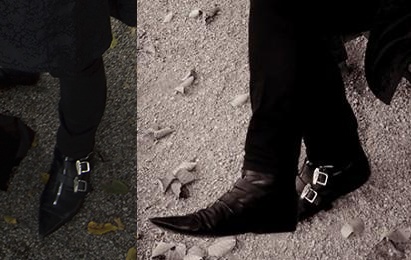
Winklepicker boots, 2009

Winklepickers or winkle pickers are a style of shoe or boot worn from the 1950s onward, especially popular with British rock and roll fans such as Teddy Boys. The feature that gives both the boot and shoe their name is the very sharp and long pointed toe, reminiscent of medieval poulaines and approximately the same as the long pointed toes on some women's high-fashion shoes and boots in the 2000s. They are still popular in the goth, raggare and rockabilly subcultures.

Names

[edit]

The extremely pointed toe was called a winkle picker because, in England, periwinkle snails ("winkles") were a popular seaside snack which is eaten using a pin or other thin pointed object to carefully extract the soft parts out of the coiled shell. The same practice led to the figurative phrase "to winkle something out". Other countries used other names for the same style, usually similarly humorous. In some parts of the United States, they are called "roach stompers" because of their ability to kill a roach in a corner.[citation needed] In Norway and Sweden, they were called "mosquito chasers" (Norwegian: myggjagere; Swedish: myggjagare).

History

[edit]

Origins

[edit]

Winklepickers, inspired by the Polish poulaines worn by the medieval French nobility,[1] were a conspicuous contrast to the brothel creepers worn by Teddy Boys. The male shoes were lace-up Oxford style with a low heel and an exaggerated pointed toe. A Chelsea boot style (elastic-sided with a two-inch—later as much as two-and-one-half-inch—Cuban heels) was notably worn by the Beatles but although it had a pointed toe, was not considered to be a winklepicker. Winklepicker shoes were also worn by Teddy Girls as well as being a fleeting fashion for young women generally.[citation needed]

1960s

[edit]

In the early 1960s, the winklepicker toe was popular with modernists, teddy boys and rockers. In the early 1960s, the point was effectively chopped off (they hung on for longer than that in the UK) and gave rise to the "chisel toe" on the footwear of all genders. However, winklepickers with traditional sharp-point styles made a comeback of sorts in the late 1970s and early 1980s (either as previously unworn old-stock, second-hand originals, or contemporary-production attempted copies) and worn by several subculture groups including mods, rockers, teddy boys, rockabillies, punks, rock'n'roll revivalists, and in the goth scene, where they are known as "pikes".[2]

Winklepickers with stiletto heels for women swept the UK in the late 1950s, and at one stage, the High Street versions were commonly worn by a large part of the adult female populace of the UK. They were often manufactured in Italy, but the handmade versions, notably those from Stan's Shoes of Battersea, were the most extreme, if somewhat bulky-looking at the toe compared with the Italian styles.[3]

The original 1960s winklepicker stilettos were similar to the long, pointed toe that has been fashionable on women's shoes and boots in Europe of late. The long, sharp toe was always teamed with a stiletto heel (or spike heel), which, as today, could be as low as one-and-a-half inches or as high as five inches, though most were in the three- to four-inch range. The stiletto heels on the original 1960s styles were, however, much more curved in at the rear (also sometimes sharply waisted and slightly flared out at the top piece) than most of the recent pointy-toed fashion shoes, which often have straighter, thicker, more set-back heels, rather at odds with the look of the pointed toe. In most cases, too, the modern shoe toes lack the length of the true 1960s winklepicker and bear more resemblance to the less pointed mass-produced versions of the era.[4]

They attained some notoriety, when they first appeared, as a result of being worn in gang fights (sometimes by both sexes), although there is some question as to the accuracy of contemporary newspaper accounts. In fact, although the winklepicker looks lethal, it would be far more likely for damage to be caused to the delicately pointed shoe than to the opponent in any serious kicking incident.[5]

Modern day

[edit]
British historian Guy Walters wearing black winklepicker boots

By the middle of the first decade of the 21st century, winklepickers were worn with 1960s mod blazers, Western shirts, vintage T shirts, and skinny jeans by many indie pop bands and musicians, such as of Kings of Leon, Kaiser Chiefs, the Kills, Jack White, Mod Fun, Neils Children, Blanaid Montague, Klaxons, and Daniel Johns. The shoes are closely related to British garage rock band the Horrors,[6] who even went as far as to have a winklepicker boot with three buckles on their official merchandise t-shirt along with the words "I am a horror." Faris Badwan has personally endorsed Paolo Vandini Veers. They are also worn by English comedians Russell Brand[7] and Noel Fielding and English DJ and TV presenter Alex Zane.

Winklepicker boots are very popular in Germany among the modern Vogue goth and punk subcultures, who refer to the boots as "pikes" or "pickers".[citation needed]

Although slightly pointed toes are often a feature of women's fashion shoes, they are usually nowadays "tamed down" or shortened (often sacrificing comfortable toe space) for mass market appeal.

See also

[edit]

References

[edit]
[edit]
Revisions and contributorsEdit on WikipediaRead on Wikipedia
from Grokipedia
A winklepicker is a style of or characterized by an extremely pointed , designed to resemble the sharp tool used to extract winkles (small edible sea snails) from their shells. The term derives from this resemblance, with the elongated, needle-like shape often making the both distinctive and impractical for everyday wear. Originating from medieval European fashion, winklepickers trace their roots to the 15th-century "crakows" or "poulaines," pointed shoes popularized in Poland and adopted by , where toes could measure up to two feet in length and were sometimes supported by chains or ribbons attached to the to signify status. This extreme style symbolized wealth and extravagance but was later regulated by sumptuary laws due to its ostentation. The modern winklepicker emerged in the mid-20th century, gaining prominence in the 1950s among British youth subcultures, particularly who paired them with drape jackets and drainpipe trousers to evoke a rock 'n' roll aesthetic inspired by American influences. By the early 1960s, the style spread to mods, who favored sleeker versions, and was worn by emerging musicians such as members of and , cementing its association with rebellious teenage fashion and post-war youth culture. Winklepickers experienced revivals in subsequent decades, including the punk and goth scenes of the and , where they were adapted into sturdier boot forms while retaining their sharply pointed toes, and again in the 2000s among bands like The and celebrities such as , highlighting their enduring appeal as a symbol of edgy, countercultural style. Despite their impracticality—often criticized for causing discomfort and hindering mobility—these shoes remain a notable icon in fashion history, influencing contemporary pointed-toe designs in both men's and women's footwear.

Terminology

Etymology

The term "winklepicker" derives from the word "winkle," referring to the periwinkle (Littorina littorea), combined with "picker," denoting a sharp tool used to extract the mollusk from its spiral shell. The name evokes the shoe's distinctive sharply pointed toe, which visually resembles the slender, needle-like implement employed in winkle harvesting. This etymological link highlights the playful, observational common in mid-20th-century British , where everyday objects inspired descriptors. The term was first documented in 1960 in a Spectator article describing the footwear's exaggerated points, coinciding with the style's popularity among teddy boy subcultures in the late . By the late , "winklepicker" had entered wider lexicon as a shorthand for shoes with elongated, pike-like toes extending up to several inches. This modern naming convention represents a 20th-century evolution from earlier European descriptors for pointed footwear, such as the medieval "poulaines," which similarly denoted extreme toe extensions but lacked the shellfish-inspired whimsy of the British term.

Alternative Names

Winklepickers have been known by various regional and stylistic synonyms that reflect their distinctive pointed toe design, often varying by location and subcultural context. In British English, they are commonly referred to as "pointy boots," emphasizing the elongated, sharp toe shape that became iconic in youth fashion during the mid-20th century. A related term, "chisel toes," emerged in the early 1960s as a variant describing shoes with an angular, blade-like toe that moderated the extreme point of traditional winklepickers, offering a slightly less pronounced but still sharp silhouette popular among mod subcultures. In international contexts, particularly within goth subcultures, the style is often called "pikes," a for the aggressively pointed shoes or boots that evoke a dramatic, otherworldly aesthetic and have been adapted with buckles or platforms since the . The evolution of these names in fashion trade publications during the often shifted toward descriptive terms like "pointed-toe shoes" to catalog the style's variations, moving from the foundational "winklepicker" inspired by shellfish extraction tools to broader descriptors accommodating stylistic tweaks.

Design and Construction

Toe and Overall Shape

The defining feature of the winklepicker is its extreme toe elongation, which in original 1950s and 1960s designs extended 2 to 4 inches beyond the foot's natural line, forming a sharp, needle-like point designed to evoke a dramatic, stylized silhouette. Later iterations feature shorter points, typically up to 1 inch. This pointed toe, often described as resembling the pin used to extract winkles from their shells, creates a visually striking extension that prioritizes aesthetic exaggeration over anatomical alignment. The overall shape of the winklepicker adopts a slim, elongated profile, typically constructed on a 1950s-style last that ensures a narrow fit around the foot and ankle. This results in low-cut shoes or ankle boots with a streamlined form, emphasizing verticality and minimal bulk to accentuate the toe's prominence while maintaining a sleek, tapered appearance from heel to tip. Functionally, the winklepicker's design compromises practicality, as the elongated toe restricts natural foot movement and balance during walking, rendering it more a statement of style than a utilitarian footwear option. This impracticality underscores its cultural role in youth fashion, where visual impact superseded everyday comfort.

Materials and Build Variations

The original winklepicker shoes from the 1950s and 1960s were predominantly constructed from polished leather, often in black or patent finishes, which provided a sleek, reflective surface that complemented the era's sharp mod and teddy boy aesthetics. Suede emerged as an alternative material in later revivals, offering a softer texture while retaining the distinctive pointed form. These materials were chosen for their durability and ability to hold the elongated toe shape under daily wear. Construction emphasized robustness to preserve the shoe's signature sharpness, with reinforcements along stress points such as the seam to prevent splitting and maintain structural integrity over time. Optional side buckles, sometimes with silver hardware in teddy boy-inspired designs, added both functional closure and decorative flair. Heel heights varied from flat soles for everyday versatility to 1-2 inches in Cuban-style variants, balancing style with comfort. The 's extreme elongation placed particular stress on these build elements, necessitating such reinforcements. In contemporary iterations, synthetic vegan leather has become a popular alternative in brands targeting ethical consumers, replicating the look of traditional without animal products. Goth-inspired winklepicker boots often incorporate platform soles to enhance height and dramatic effect while using materials like faux or PU for added resilience in alternative subcultures.

Historical Development

Medieval Precursors

The medieval precursors to the winklepicker style are found in the exaggerated pointed footwear of 14th- and 15th-century , particularly the poulaines and crakows, which featured dramatically elongated toes as symbols of elite status. These shoes emerged prominently after the (1347–1351), a that decimated up to 60% of 's population, allowing surviving to flaunt their wealth and leisure through impractical that hindered mobility. Worn by , the toes could extend up to 18 inches (46 cm), often stuffed with material like moss or wool for rigidity and sometimes chained to the knee to maintain the curl, emphasizing opulence over functionality. Sumptuary laws were enacted to regulate this extravagance, particularly to prevent lower classes from imitating noble attire. In , King Edward IV's 1463 statute explicitly restricted pointed shoes, prohibiting anyone below the rank of , , or from wearing toes longer than two inches, aiming to preserve class distinctions and curb perceived moral decay associated with such ostentation. Similar regulations appeared across , reflecting broader efforts to control in the post-plague era. Regional variations highlighted the style's evolution, with Polish crakows—named after the city of —featuring particularly pronounced curled tips that influenced continental court fashions. Originating in mid-14th-century Poland, these shoes spread westward via trade and diplomacy, their spiraling points evoking phallic symbolism or motifs, further elevating their role in displays of power and virility among the upper classes. This extreme toe design later inspired revivals in 20th-century , reinterpreting medieval excess for modern aesthetics.

1950s Emergence

The winklepicker shoe style first gained prominence in early 1950s Britain, particularly among working-class youth in , as an integral element of the emerging Teddy Boy subculture. This pointed-toe footwear drew inspiration from 'n' roll culture, which arrived via films like in 1956 and tours by artists such as , blending with local adaptations of Edwardian fashion to create a flamboyant look that rejected the utilitarian clothing of post-war austerity. The term "Teddy boy" was coined by the British press in September 1953, shortening "Edwardian" in reference to the subculture's revival of 1910s-inspired suits, complete with drainpipe trousers, velvet-collared jackets, and winklepickers as the signature shoe. These shoes symbolized youthful defiance against rationing-era restrictions, which had only fully ended in , allowing for more expressive personal style among teenagers with increasing disposable income. Winklepickers were often tailor-made or custom-fitted, emphasizing their long, exaggerated toe shape that echoed distant medieval precedents like the 15th-century crakows. By the late , production of winklepickers had ramped up in Britain's shoe manufacturing heartland of , where firms like Groocock of Rothwell began mass-producing them to meet demand from and rock 'n' roll enthusiasts. This shift enabled wider accessibility, transforming the style from a niche urban trend into a nationwide phenomenon tied to jiving dances and rebellious youth identity.

1960s Peak

The winklepicker style surged in popularity between 1960 and 1964, achieving peak commercial success amid the vibrant mod and rocker youth subcultures of Britain, where the sharply pointed toes became a hallmark of edgy, tailored looks. Often paired with slim drainpipe trousers and leather jackets, these shoes symbolized rebellion and sharp style for rockers, while early mods embraced them as part of their sleek, Italian-inspired ensembles. Sales boomed as the footwear transitioned from niche teddy boy accessory to mainstream youth fashion staple, driven by the era's economic affluence and cultural explosion in London. This period saw a significant manufacturing expansion, with British shoemakers like Anello & Davide leading production of variants such as the elastic-sided, Cuban-heeled Beatle boots, which featured the signature pointed toes and were custom-made for figures like in 1961. Italian imports and influences added to the diversity, introducing sleek leather designs that appealed to the subcultures' affinity for continental tailoring. Women's winklepickers also proliferated, often with elevated heels for a feminine twist, complementing the rising mini-skirt trend and broadening the style's commercial reach. By 1965, however, winklepickers began to decline in favor as youth fashions pivoted toward chunkier, more comfortable silhouettes amid the emerging hippie movement and broader cultural shifts away from rigid mod aesthetics. Persistent complaints about the discomfort of the elongated toes, which cramped feet during prolonged wear, further eroded their appeal, paving the way for less extreme styles like toes.

Post-1960s Revivals

Following the decline of winklepickers after their peak, the style experienced intermittent revivals in various subcultures, adapting the original pointed-toe silhouette to contemporary aesthetics. In the , the shoe gained traction within goth and scenes, where black leather variants with buckles and details became staples, popularized by bands such as The Damned, , and . These designs echoed the template but incorporated darker, more ornate elements suited to the era's nocturnal fashion. During the and , winklepickers found a niche in indie and circles, with bands like , , and sporting updated versions that expanded color palettes while preserving the classic elongated toe. Brands such as Underground England reintroduced the style through new productions, bridging underground wear and high- editorials, where the shoe symbolized a blend of retro and modern sleaze. This period marked a shift toward more accessible adaptations, appearing in indie shoots and attire. In the and , winklepickers saw renewed interest among nu-goth and communities, with underground brands like Underground England offering archival-inspired models such as the Blitz Winklepicker Zip Boot and Peck Winklepicker Buckle Boot. High-fashion reinterpretations by designers including for , Saint Laurent, and Celine further elevated the style, while mass retailers like Zara and produced affordable variants. Specialized labels, including Goth Pikes, catered to goth enthusiasts with pointed-toe boots emphasizing durability and subcultural heritage, contributing to steady demand in online markets.

Cultural Significance

Youth Subcultures

In the 1950s, winklepickers emerged as integral elements of the ' uniform, often paired with Edwardian-inspired drape suits to signify working-class resistance against middle-class societal norms in post-war Britain. This , primarily composed of young, working-class men from urban areas like , used the sharply pointed shoes to project a defiant, flamboyant identity that challenged the and conformity of the era. The footwear's exaggerated style amplified their collective expression of rebellion, transforming everyday attire into a symbol of class-based empowerment and cultural opposition. By the 1960s, winklepickers were adopted by the , where they contributed to an aggressive, leather-clad aesthetic rooted in enthusiasm and rock 'n' roll defiance. favored the pointed toes alongside drainpipe and biker jackets to embody a rugged, masculinity that clashed with mainstream values. In contrast, the rival Mods favored sleeker footwear such as pointed Chelsea boots, though early mods also wore winklepickers. From the 1980s onward, winklepickers resurfaced within punk and goth subcultures as potent symbols of non-conformity, often customized through DIY modifications to feature exaggerated points, buckles, or dark finishes. integrated them into ensembles of ripped clothing and safety pins, using the shoes to underscore their rejection of consumerist norms and embrace of chaotic self-expression. , drawing from roots, elevated winklepickers with Victorian-inspired drama, pairing them with and velvet to evoke eternal rebellion and otherworldliness. This enduring adoption reflects their role in fostering identity through subversive, handcrafted across alternative scenes.

Fashion and Media Influence

The pointed toe design of winklepickers has exerted a notable influence on high-fashion runways and designer collections, evolving from subcultural staple to a symbol of edgy sophistication. Designers such as , , and have incorporated exaggerated pointed toes reminiscent of winklepickers into their work, reinterpreting the style through glam-punk and androgynous lenses at houses like , Saint Laurent, and Celine. For instance, Christian Louboutin's iconic pumps, such as those in his enduring collections, feature pronounced vamps ending in a "winklepicker point," blending historical sharpness with modern luxury heel structures. This crossover has elevated the beyond niche appeal, appearing in luxury iterations that emphasize defiance and precision. In media representations, winklepickers have symbolized youthful rebellion and stylistic clashes, particularly in depictions of British . The 1979 film , which dramatizes the mod-rocker rivalries, highlights winklepickers as a key element of rocker attire, contrasting sharply with the polished of mods to underscore subcultural tensions. During the 1980s goth era, the style persisted in music visuals associated with bands like , whose dark, aesthetic aligned with pointed-toe shoes as part of broader , evoking a haunting, elongated silhouette in performances and videos. Contemporary winklepickers continue to impact mainstream through revivals and adaptable styling. As of June 2025, their resurgence has been noted in luxury and high-street brands, promoting all-gender wear, as seen in collections from brands like Underground England, which use original lasts for designs paired with fluid silhouettes like sheer blouses or accents.

References

Add your contribution
Related Hubs
User Avatar
No comments yet.