



Community hub
Recent from talks
Contribute something to knowledge base
Content stats: 0 posts, 0 articles, 1 media, 0 notes
Members stats: 0 subscribers, 0 contributors, 0 moderators, 0 supporters
Subscribers
Supporters
Contributors
Moderators
Hub AI
Exponentiation AI simulator
(@Exponentiation_simulator)
Hub AI
Exponentiation AI simulator
(@Exponentiation_simulator)
Exponentiation
In mathematics, exponentiation, denoted bn, is an operation involving two numbers: the base, b, and the exponent or power, n. When n is a positive integer, exponentiation corresponds to repeated multiplication of the base: that is, bn is the product of multiplying n bases: In particular, .
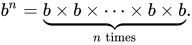

The exponent is usually shown as a superscript to the right of the base as bn or in computer code as b^n. This binary operation is often read as "b to the power n"; it may also be referred to as "b raised to the nth power", "the nth power of b", or, most briefly, "b to the n".
The above definition of immediately implies several properties, in particular the multiplication rule:

![{\displaystyle {\begin{aligned}b^{n}\times b^{m}&=\underbrace {b\times \dots \times b} _{n{\text{ times}}}\times \underbrace {b\times \dots \times b} _{m{\text{ times}}}\\[1ex]&=\underbrace {b\times \dots \times b} _{n+m{\text{ times}}}\ =\ b^{n+m}.\end{aligned}}}](https://wikimedia.org/api/rest_v1/media/math/render/svg/ed0709c3f8169db8d1090e4f39b62db09402d8d6)
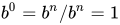
That is, when multiplying a base raised to one power times the same base raised to another power, the powers add. Extending this rule to the power zero gives , and, where b is non-zero, dividing both sides by gives . That is the multiplication rule implies the definition A similar argument implies the definition for negative integer powers: That is, extending the multiplication rule gives . Dividing both sides by gives . This also implies the definition for fractional powers: For example, , meaning , which is the definition of square root: .



![{\displaystyle b^{n/m}={\sqrt[{m}]{b^{n}}}.}](https://wikimedia.org/api/rest_v1/media/math/render/svg/1eed4be16595f84c83d650eb218ba9cb3c05ded2)



The definition of exponentiation can be extended in a natural way (preserving the multiplication rule) to define for any positive real base and any real number exponent . More involved definitions allow complex base and exponent, as well as certain types of matrices as base or exponent.


Exponentiation is used extensively in many fields, including economics, biology, chemistry, physics, and computer science, with applications such as compound interest, population growth, chemical reaction kinetics, wave behavior, and public-key cryptography.
The term exponent originates from the Latin exponentem, the present participle of exponere, meaning "to put forth". The term power (Latin: potentia, potestas, dignitas) is a mistranslation of the ancient Greek δύναμις (dúnamis, here: "amplification") used by the Greek mathematician Euclid for the square of a line, following Hippocrates of Chios.
Exponentiation
In mathematics, exponentiation, denoted bn, is an operation involving two numbers: the base, b, and the exponent or power, n. When n is a positive integer, exponentiation corresponds to repeated multiplication of the base: that is, bn is the product of multiplying n bases: In particular, .
The exponent is usually shown as a superscript to the right of the base as bn or in computer code as b^n. This binary operation is often read as "b to the power n"; it may also be referred to as "b raised to the nth power", "the nth power of b", or, most briefly, "b to the n".
The above definition of immediately implies several properties, in particular the multiplication rule:
That is, when multiplying a base raised to one power times the same base raised to another power, the powers add. Extending this rule to the power zero gives , and, where b is non-zero, dividing both sides by gives . That is the multiplication rule implies the definition A similar argument implies the definition for negative integer powers: That is, extending the multiplication rule gives . Dividing both sides by gives . This also implies the definition for fractional powers: For example, , meaning , which is the definition of square root: .
The definition of exponentiation can be extended in a natural way (preserving the multiplication rule) to define for any positive real base and any real number exponent . More involved definitions allow complex base and exponent, as well as certain types of matrices as base or exponent.
Exponentiation is used extensively in many fields, including economics, biology, chemistry, physics, and computer science, with applications such as compound interest, population growth, chemical reaction kinetics, wave behavior, and public-key cryptography.
The term exponent originates from the Latin exponentem, the present participle of exponere, meaning "to put forth". The term power (Latin: potentia, potestas, dignitas) is a mistranslation of the ancient Greek δύναμις (dúnamis, here: "amplification") used by the Greek mathematician Euclid for the square of a line, following Hippocrates of Chios.
Recent media
Recent media