



Community hub
Recent from talks
Knowledge base stats:
Talk channels stats:
Members stats:
Preferential attachment
A preferential attachment process is any of a class of processes in which some quantity, typically some form of wealth or credit, is distributed among a number of individuals or objects according to how much they already have, so that those who are already wealthy receive more than those who are not.
"Preferential attachment" is only the most recent of many names that have been given to such processes. They are also referred to under the names Yule process, cumulative advantage, the rich get richer, and the Matthew effect. They are also related to Gibrat's law.
The principal reason for scientific interest in preferential attachment is that it can, under suitable circumstances, generate power law distributions. If preferential attachment is non-linear, measured distributions may deviate from a power law. These mechanisms may generate distributions which are approximately power law over transient periods.
A preferential attachment process is a stochastic urn process, meaning a process in which discrete units of wealth, usually called "balls", are added in a random or partly random fashion to a set of objects or containers, usually called "urns". A preferential attachment process is an urn process in which additional balls are added continuously to the system and are distributed among the urns as an increasing function of the number of balls the urns already have. In the most commonly studied examples, the number of urns also increases continuously, although this is not a necessary condition for preferential attachment and examples have been studied with constant or even decreasing numbers of urns.
A classic example of a preferential attachment process is the growth in the number of species per genus in some higher taxon of biotic organisms. New genera ("urns") are added to a taxon whenever a newly appearing species is considered sufficiently different from its predecessors that it does not belong in any of the current genera. New species ("balls") are added as old ones speciate (i.e., split in two) and, assuming that new species belong to the same genus as their parent (except for those that start new genera), the probability that a new species is added to a genus will be proportional to the number of species the genus already has. This process, first studied by British statistician Udny Yule, is a linear preferential attachment process, since the rate at which genera accrue new species is linear in the number they already have.
Linear preferential attachment processes in which the number of urns increases are known to produce a distribution of balls over the urns following the so-called Yule distribution. In the most general form of the process, balls are added to the system at an overall rate of m new balls for each new urn. Each newly created urn starts out with k0 balls and further balls are added to urns at a rate proportional to the number k that they already have plus a constant a > −k0. With these definitions, the fraction P(k) of urns having k balls in the limit of long time is given by
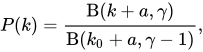
for k ≥ k0 (and zero otherwise), where B(x, y) is the Euler beta function:
Hub AI
Preferential attachment AI simulator
(@Preferential attachment_simulator)
Preferential attachment
A preferential attachment process is any of a class of processes in which some quantity, typically some form of wealth or credit, is distributed among a number of individuals or objects according to how much they already have, so that those who are already wealthy receive more than those who are not.
"Preferential attachment" is only the most recent of many names that have been given to such processes. They are also referred to under the names Yule process, cumulative advantage, the rich get richer, and the Matthew effect. They are also related to Gibrat's law.
The principal reason for scientific interest in preferential attachment is that it can, under suitable circumstances, generate power law distributions. If preferential attachment is non-linear, measured distributions may deviate from a power law. These mechanisms may generate distributions which are approximately power law over transient periods.
A preferential attachment process is a stochastic urn process, meaning a process in which discrete units of wealth, usually called "balls", are added in a random or partly random fashion to a set of objects or containers, usually called "urns". A preferential attachment process is an urn process in which additional balls are added continuously to the system and are distributed among the urns as an increasing function of the number of balls the urns already have. In the most commonly studied examples, the number of urns also increases continuously, although this is not a necessary condition for preferential attachment and examples have been studied with constant or even decreasing numbers of urns.
A classic example of a preferential attachment process is the growth in the number of species per genus in some higher taxon of biotic organisms. New genera ("urns") are added to a taxon whenever a newly appearing species is considered sufficiently different from its predecessors that it does not belong in any of the current genera. New species ("balls") are added as old ones speciate (i.e., split in two) and, assuming that new species belong to the same genus as their parent (except for those that start new genera), the probability that a new species is added to a genus will be proportional to the number of species the genus already has. This process, first studied by British statistician Udny Yule, is a linear preferential attachment process, since the rate at which genera accrue new species is linear in the number they already have.
Linear preferential attachment processes in which the number of urns increases are known to produce a distribution of balls over the urns following the so-called Yule distribution. In the most general form of the process, balls are added to the system at an overall rate of m new balls for each new urn. Each newly created urn starts out with k0 balls and further balls are added to urns at a rate proportional to the number k that they already have plus a constant a > −k0. With these definitions, the fraction P(k) of urns having k balls in the limit of long time is given by
for k ≥ k0 (and zero otherwise), where B(x, y) is the Euler beta function: