


Community hub
Recent from talks
Contribute something
Nothing was collected or created yet.
Prince of Waterloo
View on Wikipedia
Prince of Waterloo (Dutch: Prins van Waterloo, French: Prince de Waterloo) is a title in the Dutch and Belgian nobility, held by the Duke of Wellington. The title was created by King William I of the Netherlands for Field Marshal Arthur Wellesley, 1st Duke of Wellington as a victory title in recognition of defeating Napoleon at the Battle of Waterloo in 1815. The Duke of Wellington and all his descendants along the male line belong to Dutch and Belgian nobility, in which all the descendant dukes carry the title of "Prince of Waterloo" with the style "Serene Highness" (Dutch: Doorluchtigheid). The rest of his family retain the Dutch honorific Jonkheer or Jonkvrouw.
Key Information


Estate of the prince
[edit]In addition to this title, the Dutch king also granted Wellington 1,050 hectares (2,600 acres) of land and a yearly endowment of 20,000 guilders. To this day the Dukes of Wellington retain the title Prince of Waterloo,[1] and enjoy an annual income of around £100,000 from the longstanding tenants occupying the land.
Owing to the establishment of the separate Kingdom of Belgium in 1831, the title (being Dutch) and the land (located in Belgium) became separated.[vague] After the Belgian independence the endowment was by the Treaty of London included in the public debt to be assumed by the new Kingdom of Belgium.
The land held by the Prince of Waterloo came under pressure from retired Belgian senator Jean-Emile Humblet in 2001.[2] In 1817, the government in what is now Belgium struck a deal to pay the duke £1,600 a year in return for the proceeds of sales of timber which the duke wanted to clear from the forested land. Until 1988, successive dukes enjoyed this annual payment, but the then Prince of Waterloo, Valerian Wellesley, 8th Duke of Wellington, agreed to forgo the payment in exchange for outright ownership of 24 ha (60 acres) of the 1,050 ha (2,600 acres) to which he has rights. But some Belgian taxpayers, led by Humblet, claimed the deal did not reflect the value of the land and drew attention to the wider issues surrounding the original agreement, contending that Belgium was effectively coerced into accepting the terms of the original agreement, because it could not afford to offend Britain.[3][4]
In 2009 a Member of Parliament from Vlaams Belang questioned the Minister of Finance, Didier Reynders about the grant. Reynders replied that this grant is part of the international obligations of Belgium under the Treaty of London and that he had no intention of reneging on the obligation, as all the Dukes have faithfully fulfilled their obligations.[5]
List of princes of Waterloo (1815–present)
[edit]- Arthur Wellesley, 1st Prince of Waterloo (1769–1852) from 1815
- Arthur Wellesley, 2nd Prince of Waterloo (1807–1884) from 1852
- Henry Wellesley, 3rd Prince of Waterloo (1846–1900) from 1884
- Arthur Wellesley, 4th Prince of Waterloo (1849–1934) from 1900
- Arthur (Charlie) Wellesley, 5th Prince of Waterloo (1876–1941) from 1934
- Henry (Morney) Wellesley, 6th Prince of Waterloo (1912–1943) from 1941
- Gerald (Gerry) Wellesley, 7th Prince of Waterloo (1885–1972) from 1943
- Arthur Valerian Wellesley, 8th Prince of Waterloo (1915–2014) from 1972
- Arthur Charles Wellesley, 9th Prince of Waterloo (b. 1945) from 2014
The heir apparent is the present holder's son Jonkheer Arthur Gerald Wellesley (b. 1978).
Family tree
[edit]| Wellesley family tree: Dukes of Wellington, Victoria, and Ciudad Rodrigo, and Princes of Waterloo | |||||||||||||||||||||||||||||||||||||||||||||||||||||||||||||||||||||||||||||||||||||||||||||||||||||||||||||||||||||||||||||||||||||||||||||||||||||||||||||||||||||||||||||||||||||||||||||||||||||||||||||||||||||||||||||||||||||||||||||||||||||||||||||||||||||||||||||||||||||||||||||||||||||||||||||||||||||||||||||||||||||||||||||||||||||||||||||||||||||||||||||||||||||||||||||||||||||||||||||||||||||||||||||||||||||||||||||||||||||||||||||||||||||||||||||||||||||||||||||||||||||||||||||||||||||||||||||||||||||||||||||||||||||||||||||||||||||||||||||||||||||||||||||||||||||||||||||||
|---|---|---|---|---|---|---|---|---|---|---|---|---|---|---|---|---|---|---|---|---|---|---|---|---|---|---|---|---|---|---|---|---|---|---|---|---|---|---|---|---|---|---|---|---|---|---|---|---|---|---|---|---|---|---|---|---|---|---|---|---|---|---|---|---|---|---|---|---|---|---|---|---|---|---|---|---|---|---|---|---|---|---|---|---|---|---|---|---|---|---|---|---|---|---|---|---|---|---|---|---|---|---|---|---|---|---|---|---|---|---|---|---|---|---|---|---|---|---|---|---|---|---|---|---|---|---|---|---|---|---|---|---|---|---|---|---|---|---|---|---|---|---|---|---|---|---|---|---|---|---|---|---|---|---|---|---|---|---|---|---|---|---|---|---|---|---|---|---|---|---|---|---|---|---|---|---|---|---|---|---|---|---|---|---|---|---|---|---|---|---|---|---|---|---|---|---|---|---|---|---|---|---|---|---|---|---|---|---|---|---|---|---|---|---|---|---|---|---|---|---|---|---|---|---|---|---|---|---|---|---|---|---|---|---|---|---|---|---|---|---|---|---|---|---|---|---|---|---|---|---|---|---|---|---|---|---|---|---|---|---|---|---|---|---|---|---|---|---|---|---|---|---|---|---|---|---|---|---|---|---|---|---|---|---|---|---|---|---|---|---|---|---|---|---|---|---|---|---|---|---|---|---|---|---|---|---|---|---|---|---|---|---|---|---|---|---|---|---|---|---|---|---|---|---|---|---|---|---|---|---|---|---|---|---|---|---|---|---|---|---|---|---|---|---|---|---|---|---|---|---|---|---|---|---|---|---|---|---|---|---|---|---|---|---|---|---|---|---|---|---|---|---|---|---|---|---|---|---|---|---|---|---|---|---|---|---|---|---|---|---|---|---|---|---|---|---|---|---|---|---|---|---|---|---|---|---|---|---|---|---|---|---|---|---|---|---|---|---|---|---|---|---|---|---|---|---|---|---|---|---|---|---|---|---|---|---|---|---|---|---|---|---|---|---|---|---|---|---|---|---|---|---|---|---|---|---|---|---|---|---|---|---|---|---|---|---|---|---|---|---|---|---|---|---|---|---|---|---|---|---|---|---|---|---|---|---|---|---|---|---|---|---|---|---|---|---|---|---|---|---|---|---|---|---|---|---|---|---|---|---|---|---|---|---|---|---|---|---|---|---|---|---|---|---|---|---|---|---|---|---|---|---|---|---|---|---|---|---|---|---|---|---|---|---|---|---|---|---|---|---|---|---|---|---|---|---|---|---|---|---|---|---|---|---|---|---|---|---|---|---|---|---|---|---|---|---|---|---|---|---|---|---|---|---|---|---|---|---|---|---|---|
| |||||||||||||||||||||||||||||||||||||||||||||||||||||||||||||||||||||||||||||||||||||||||||||||||||||||||||||||||||||||||||||||||||||||||||||||||||||||||||||||||||||||||||||||||||||||||||||||||||||||||||||||||||||||||||||||||||||||||||||||||||||||||||||||||||||||||||||||||||||||||||||||||||||||||||||||||||||||||||||||||||||||||||||||||||||||||||||||||||||||||||||||||||||||||||||||||||||||||||||||||||||||||||||||||||||||||||||||||||||||||||||||||||||||||||||||||||||||||||||||||||||||||||||||||||||||||||||||||||||||||||||||||||||||||||||||||||||||||||||||||||||||||||||||||||||||||||||||
References
[edit]See also
[edit]Prince of Waterloo
View on GrokipediaOrigins and Historical Context
Creation of the Title
The title of Prince of Waterloo was created on 8 July 1815 by King William I of the Netherlands as a victory honor for Field Marshal Arthur Wellesley, 1st Duke of Wellington, commander of the Anglo-Allied army that defeated Napoleon Bonaparte at the Battle of Waterloo on 18 June 1815.[2] This grant occurred amid the formation of the United Kingdom of the Netherlands, established by the Congress of Vienna in 1815, which elevated William from sovereign prince to king and integrated territories including the site of the battle near present-day Belgium.[5] The title recognized Wellington's decisive leadership over multinational forces, including significant Dutch-Belgian contingents under the Prince of Orange (the future William II), whose troops suffered heavy casualties at Quatre Bras and Waterloo.[2] Hereditary by male primogeniture, the title was explicitly transmissible to Wellington's eldest male heirs, distinguishing it from personal honors and embedding it within Dutch nobility alongside British peerages.[2] Accompanied by estates in the Netherlands as an endowment, the creation reflected William I's intent to bind allied commanders to the new kingdom's legitimacy post-Napoleonic upheaval, though Wellington rarely invoked the foreign princely style in Britain, prioritizing his domestic dukedom.[6] The grant's timing—mere weeks after the battle—underscored its role as immediate recompense for military service on soil pivotal to Dutch sovereignty.[5]Significance in Post-Waterloo Europe
The title of Prince of Waterloo was created on 18 July 1815 by King William I of the Netherlands, mere weeks after the Battle of Waterloo on 18 June 1815, as a direct reward to Arthur Wellesley, 1st Duke of Wellington, for his command of allied forces that defeated Napoleon Bonaparte and secured the restoration of monarchical order in Europe.[7] This grant reflected the nascent United Kingdom of the Netherlands' dependence on British military support, as the victory at Waterloo not only ended French domination of the Low Countries but also enabled the Congress of Vienna's territorial rearrangements, including the elevation of the House of Orange to kingship over a enlarged state incorporating modern Belgium.[8] The title, hereditary in the male line with remainder to Wellington's heirs, symbolized enduring Dutch gratitude and intertwined British martial achievement with continental legitimacy, at a time when the Concert of Europe emphasized coalition bonds to suppress revolutionary threats. In the aristocratic landscape of post-Napoleonic Europe, the princely dignity—accompanied by the style "His Serene Highness" (Zijne Doorluchtigheid)—elevated Wellington's status among sovereign houses, aligning him with ranks typically reserved for German or Italian principalities and facilitating diplomatic interactions in a era of restored absolutism.[7] Unlike transient military honors, its heritability embedded the 1815 triumph within transgenerational nobility, granting subsequent Dukes of Wellington precedence in Dutch court protocol and underscoring cross-border elite networks that stabilized the Vienna settlement against liberal upheavals, such as those in 1830. Following Belgian independence in 1830, the title retained validity in both successor states' nobilities, preserving its utility for familial estates and alliances amid the fragmentation of the United Netherlands. This dual recognition exemplified how post-Waterloo honors perpetuated anti-revolutionary solidarity, with the Wellesley line serving as a living emblem of coalition victory in aristocratic Europe. The associated majorate—an entailed domain exceeding 1,000 hectares in Limburg province, initially granted to support the title's prestige—was largely commuted to monetary compensation by Wellington in 1818, prioritizing liquidity over landed obligations while retaining the honorific core.[9] This pragmatic adjustment mirrored broader 19th-century shifts in noble finance but did not diminish the title's role in affirming Anglo-Dutch ties, as evidenced by its invocation in later Wellesley diplomatic endeavors and marriages, which reinforced conservative European networks into the Victorian era. Overall, the Prince of Waterloo embodied the causal link between battlefield success and institutional continuity, privileging empirical alliance outcomes over ideological abstraction in the reconfiguration of post-1815 power structures.Title Characteristics and Privileges
Style, Precedence, and Heraldic Elements
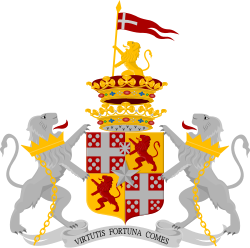
The Prince of Waterloo is formally styled "His Serene Highness" (Dutch: Zijne Doorluchtige Hoogheid), a predicate granted by King William I of the Netherlands upon the title's creation on July 8, 1815, and required to precede the title in official usage.[10] This style distinguishes the holder within Dutch and Belgian nobility, where it is legally protected and enforced, as affirmed in Belgian parliamentary documents from 1984 stipulating its mandatory prefix to avoid penalties.[11] In terms of precedence, the title ranks as a princely dignity (vorstelijke titel) in the Dutch nobility system, placing it among the highest non-royal ranks recognized by the High Council of Nobility (Hoge Raad van Adel). Historically tied to a majorat estate, it conferred feudal privileges until the 19th-century reforms, but today Dutch nobility retains no substantive legal precedence or privileges beyond the right to use recognized titles and heraldic bearings.[12] The heraldic elements associated with the title incorporate the augmented arms of the House of Wellesley, originally those of the Wesley family adapted for Arthur Wellesley, featuring a silver cross on a red field with lions passant guardant, augmented in the chief with a scroll bearing the inscription "Waterloo" in gold letters to commemorate the 1815 battle.[13] These arms, granted via British letters patent in 1814 and used consistently for the Dutch title, include supporters of red lions and a crest with a wyvern, symbolizing the family's martial heritage.[14] The full achievement is employed in both British and Dutch contexts without differencing for the principality.[15]Relation to British and Dutch Nobility
The title of Prince of Waterloo (Dutch: Prins van Waterloo) was conferred on 18 July 1815 by King William I of the Netherlands upon Arthur Wellesley, 1st Duke of Wellington, as a hereditary honor for his decisive victory at the Battle of Waterloo on 18 June 1815.[2] This Dutch creation established a unique linkage between British and Dutch aristocratic lineages, as the title devolves in the same male-line primogeniture as the British Dukedom of Wellington, ensuring its perpetual association with the Wellesley family.[16] In British nobility, the Prince of Waterloo functions as a subsidiary foreign dignity held by the premier Duke of Wellington, who takes precedence among British peers by virtue of the 1814-1815 creations but does not invoke the princely style domestically, adhering instead to the conventions of the Peerage of the United Kingdom. The title's foreign origin precludes its integration into British parliamentary or ceremonial hierarchies, yet it symbolizes the international acclaim bestowed upon Wellington, paralleling other Continental honors like the Spanish Dukedom of Ciudad Rodrigo granted in 1812.[17] Within Dutch and Belgian nobility, the title retains formal recognition as a princely rank in the historic Nobility of Brabant—part of the erstwhile United Kingdom of the Netherlands—elevating the holder to Zijne Doorluchtige Hoogheid (His Serene Highness), a style uncommon in modern Dutch aristocracy. Following Belgian independence in 1830, the title and its accompanying majorat (entailed estate known as the Wellington endowment) were preserved under Belgian law as the sole such inheritance from the Dutch era, though neither Netherlands nor Belgium attaches legal privileges to noble titles today.[2] The Wellesley Duke, as a non-resident foreigner, does not participate in the advisory bodies of Dutch or Belgian nobility, underscoring the title's ceremonial rather than participatory role in Low Countries' aristocratic circles.[18]Hereditary Succession
List of Princes of Waterloo
The title of Prince of Waterloo was created on 8 July 1815 by Royal Decree of King William I of the United Netherlands, granted to Arthur Wellesley, 1st Duke of Wellington, and his heirs male lawfully begotten, in recognition of his victory at the Battle of Waterloo.[19] The succession follows primogeniture in the male line, aligning with the Dukedom of Wellington created in the Peerage of the United Kingdom in 1814.[20]| No. | Name | Lifespan | Tenure as Prince |
|---|---|---|---|
| 1st | Arthur Wellesley | 1769–1852 | 1815–1852 |
| 2nd | Arthur Richard Wellesley | 1807–1884 | 1852–1884 |
| 3rd | Henry Wellesley | 1846–1900 | 1884–1900 |
| 4th | Arthur Charles Wellesley | 1849–1934 | 1900–1934 |
| 5th | Arthur Charles Wellesley | 1876–1941 | 1934–1941 |
| 6th | Henry Valerian George Wellesley | 1912–1943 | 1941–1943 |
| 7th | Gerald Wellesley | 1885–1972 | 1943–1972 |
| 8th | Arthur Valerian Wellesley | 1915–2014 | 1972–2014 |
| 9th | Arthur Charles Valerian Wellesley | b. 1945 | 2014–present |
Current and Heir Apparent
The current Prince of Waterloo is Arthur Charles Valerian Wellesley, 9th Duke of Wellington (born 19 August 1945), who acceded to the title upon the death of his father, Arthur Valerian Wellesley, 8th Duke of Wellington, on 31 December 2014 at Stratfield Saye House.[21] As the hereditary head of the British Wellesley line, he holds the Dutch and Belgian princely title with the style Serene Highness (Zijne Doorluchtige Hoogheid) in those jurisdictions, reflecting its origins in the Kingdom of the United Netherlands.[22] The heir apparent is the Duke's eldest son, Arthur Gerald Wellesley, Marquess of Douro (born 31 January 1978), who married model Jemma Kidd in 2010 and serves as the direct successor to both the British dukedom and the associated foreign titles under male-preference primogeniture.[23] The Marquess maintains the family estates and participates in commemorative events tied to the Battle of Waterloo legacy.[24]Associated Assets and Legacy
Estates and Properties
The title of Prince of Waterloo is attached to a majorat, known as the Wellington Endowment, comprising inalienable lands and revenues established by decree of King William I of the Netherlands on 29 September 1815.[2] This endowment, the only such hereditary estate in Belgium inherited from the United Netherlands period, was formed from confiscated religious properties repurposed to provide stable income to the title holder, following a model inspired by Napoleonic systems of primogeniture-tied assets.[2] Originally encompassing 1,083 hectares of state woodland located between Nivelles and Les Quatre-Bras, south of Brussels, the endowment generated revenue through timber and agricultural leases.[2] By 1988, full ownership was reduced to 25 hectares, with the remainder managed under usufruct rights yielding annual income, such as approximately €125,000 from 83 tenant farms as of recent assessments.[2] The properties' current market value exceeds €120 million, though tied to the title's male-line succession and reverting to the Belgian state upon its extinction.[2] No other estates are directly entailed to the Dutch-Belgian princely title beyond this endowment.[2]Enduring Symbolism and Modern Relevance
The title of Prince of Waterloo symbolizes the decisive Allied coalition victory against Napoleon Bonaparte at the Battle of Waterloo on June 18, 1815, embodying Dutch royal gratitude for Arthur Wellesley, 1st Duke of Wellington's, command of British, Dutch, and other forces that halted French expansion and facilitated the restoration of European stability via the Congress of Vienna. Created on July 8, 1815, by King William I of the Netherlands as a hereditary honor for Wellington and his male heirs, it underscores the pivotal Anglo-Dutch military partnership in defeating revolutionary upheaval, with the "Waterloo" designation directly evoking the battlefield near present-day Belgium where the engagement unfolded. This symbolism persists in heraldic and noble contexts, linking the Wellesley lineage to the campaign's tactical acumen, including Wellington's defensive positioning and coordination with Prussian reinforcements under Gebhard Leberecht von Blücher. In contemporary terms, the title retains legal and cultural pertinence as the only surviving majorat—an entailed inheritance—from the United Kingdom of the Netherlands period under Belgian law, tied to the Wellington endowment that preserves associated patrimonial rights.[2] Held by Charles Wellesley, 9th Duke of Wellington (born August 19, 1945), who styles himself His Serene Highness in Dutch-Belgian nobility, it manifests in his patronage of Waterloo Uncovered, a veteran-led archaeological initiative excavating the battlefield since 2015 to recover musket balls, buttons, and human remains, thereby connecting modern scholarship to the event's empirical realities.[4] The 9th Prince's election to the British House of Lords in September 2015 further integrates the title into ongoing political discourse, where it evokes Wellingtonian legacies of strategic leadership amid debates on defense and European relations.[25]Genealogy
Wellesley Family Lineage
The Wellesley family originated as the Colley family, an Anglo-Irish Protestant landowning dynasty established in Ireland by the late 16th century, with estates centered in Counties Kildare and Meath totaling over 13,700 acres by 1641.[26] The Colleys descended from English settlers, likely from Cheshire or Rutland, who acquired Irish lands during the Tudor plantations and held positions such as High Sheriff of Kildare as early as 1368 under the variant name Wellesley.[27] [28] In 1728, Richard Colley (c. 1690–1758), son of Henry Colley of Castle Carbery, inherited the estates of his cousin Robert Wesley of Dangan, County Meath, and adopted the surname Wesley along with the family's arms, becoming Richard Wesley, 1st Baron Mornington in 1746.[29] [28] His son, Garret Wesley (1735–1781), succeeded as 2nd Baron and was created 1st Earl of Mornington in 1760; Garret married Anne Hill, daughter of Arthur Hill, 1st Viscount Dungannon, in 1759, producing five sons who elevated the family's prominence.[30] The eldest son, Richard Colley Wesley (1760–1842), Governor-General of India from 1797 to 1805, petitioned to revert the surname to Wellesley in 1799 upon his elevation to Marquess Wellesley, reflecting the ancient spelling linked to their Norman-era forebears.[31] The third surviving son, Arthur Wellesley (1769–1852), born Arthur Wesley in Dublin, adopted Wellesley following his brother's change and was granted the Dukedom of Wellington in 1814 for his military victories, including Waterloo; he married Catherine Pakenham in 1806, with their heir Arthur Richard Wellesley (1807–1884) becoming the 2nd Duke.[30] [26] Subsequent Dukes maintained the patrilineal descent: the 2nd Duke's son Henry (1823–1900) as 3rd Duke; Charles (1846–1908) as 4th; Arthur (1849–1934) as 5th; Arthur (1876–1941) as 6th; Gerald (1885–1970) as 7th; Arthur Valerian (1915–2014) as 8th; and Charles Arthur (b. 1945) as 9th Duke, ensuring continuity of the lineage tied to the Prince of Waterloo title granted to the Duke's heirs.[32] The family's Anglo-Irish roots, blending English settler heritage with Irish estates, underscore their role in British imperial administration and military leadership.[33]Interconnections with European Royalty
The title of Prince of Waterloo originated from a grant by William I of the Netherlands to Arthur Wellesley, 1st Duke of Wellington, on 8 July 1815, recognizing his decisive role in the Battle of Waterloo earlier that year; this established a formal, hereditary connection to the House of Orange-Nassau, as the title persists as a subsidiary honor under Dutch law, with incumbents accorded the style His Serene Highness by courtesy of the Dutch monarchy.[2] The linkage underscores the family's ongoing nominal ties to the Dutch royal house, distinct from British peerages, though the title's use remains primarily ceremonial and integrated into the Wellesley succession without direct governance or estate implications in the Netherlands. A more recent marital alliance further intertwined the Wellesley lineage with continental European royalty when Charles Wellesley, Marquess of Douro (later 9th Duke of Wellington), wed Princess Antonia of Prussia on 3 February 1977 at St. Paul's Church, Knightsbridge.[34] [35] Princess Antonia (born 28 April 1955), daughter of Prince Friedrich Georg of Prussia (1911–1966) and Lady Brigid Guinness, traces her paternal descent to the House of Hohenzollern; her grandfather, Prince Heinrich of Prussia (1862–1929), was a younger brother of Kaiser Wilhelm II (1859–1941), embedding Prussian imperial lineage into the family.[34] This union produced five children, including the current Prince of Waterloo, Arthur Gerald Wellesley, Marquess of Douro (born 31 January 1978), who thus inherits Hohenzollern ancestry matrilineally alongside the Dutch-derived princely title patrilineally.[36] No other documented marriages or successions in the direct male line of Princes of Waterloo have linked the family to reigning or former European royal houses beyond these instances.References
- https://en.wikisource.org/wiki/Dictionary_of_National_Biography%2C_1885-1900/Wellesley%2C_Richard_Colley_%281690%253F-1758%29