
Recent from talks
Project Mohole
Knowledge base stats:
Talk channels stats:
Members stats:
Project Mohole
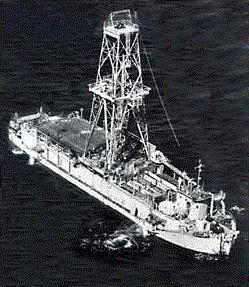
Project Mohole was an attempt in the early 1960s to drill through the Earth's crust to obtain samples of the Mohorovičić discontinuity, or Moho, the boundary between the Earth's crust and mantle. The project was intended to provide an earth science complement to the high-profile Space Race. While such a project was not feasible on land, drilling in the open ocean was more feasible, because the mantle lies much closer to the sea floor.
Led by a group of scientists called the American Miscellaneous Society with funding from the National Science Foundation, the project suffered from political and scientific opposition, mismanagement, and cost overruns. The U.S. House of Representatives defunded it in 1966. By then a program of sediment drilling had branched from Project Mohole to become the Deep Sea Drilling Project of the National Science Foundation.
During discussions at the end of a panel reviewing proposals for Earth Sciences at the National Science Foundation in March 1957, Walter Munk, a professor of geophysics and oceanography at the Scripps Institution of Oceanography, suggested the idea behind the Mohole Project: to drill into the Mohorovicic Discontinuity and obtain a sample of the Earth's mantle. The suggestion, in response to the set of fine, but modest proposals they had just reviewed, was made as a bold new idea and without regard to cost. Harry Hess, a professor of geology at Princeton University, was receptive to the idea.
Hess was one of the principal proponents of sea-floor spreading or plate tectonics at the time, and he saw the Mohole Project as a means to test this theory. The project was to exploit the fact that the mantle was much closer to the ocean's floor (5–10 km) than to the surface of land over continents (ca. 30 km), suggesting that drilling to the mantle from the ocean would be more feasible.
The idea for the project was initially developed by the informal group of scientists known as the American Miscellaneous Society (AMSOC), including Hess, Munk, Gordon Lill, Roger Revelle, Harry Ladd, Joshua Tracey, William Rubey, Maurice Ewing, and Arthur Maxwell. Lill, who headed the Geophysics Branch of the Office of Naval Research, had formed this whimsically-named society to assist in processing a disparate variety of proposals (of a miscellaneous nature) for funds in the earth sciences. Hess had approached Lill with the Mohole idea, and they eventually decided that AMSOC should submit a proposal to the National Science Foundation to develop the project. The name of this organization was often viewed as a joke, however, and it would later prove troublesome to the project's success.
The initial proposal to NSF was rejected because of the informal nature of the originating organization, and it had to be resubmitted as a proposal from the National Academy of Sciences (NAS); several members of AMSOC were also members of NAS. The proposal resulted in a $15,000 grant in June 1958 for a feasibility study of Mohole, and Willard N. Bascom, an ocean engineer, oceanographer, and geologist, became the Executive Secretary of AMSOC.
On October 4, 1957 the Soviet Union launched the Sputnik 1 satellite that initiated the Space Race and a revolution in science and education in the United States. The ever-present competition with the Russians provided a positive political background to the Mohole Project, particularly after rumors that the Russians were attempting a similar drilling program. Other aspects favorable to Mohole were that it was the first big science project in Earth Sciences and that it was a new idea distinct from the many space programs that were underway as a result of the Sputnik crisis; the National Aeronautics and Space Administration (NASA) was established in 1958.
With the new funding, AMSOC formed three panels in 1958: the Drilling Panel, the Site Selection Panel, and the Scientific Objectives and Measurements Panel, and in April 1959 Bascom became the Technical Director for the Mohole Project. The AMSOC Committee, within the National Academy of Sciences, became both advisor and manager for the project. By mid-1959, the NAS Governing Board had given AMSOC authorization to proceed with preliminary studies and Phase 1 of Mohole with a budget of up to $2.5M. Project Mohole was to proceed in three phases: Phase 1, an experimental drilling program; Phase 2, an intermediate vessel and drilling program; and Phase 3, drilling to the Moho.
Hub AI
Project Mohole AI simulator
(@Project Mohole_simulator)
Project Mohole
Project Mohole was an attempt in the early 1960s to drill through the Earth's crust to obtain samples of the Mohorovičić discontinuity, or Moho, the boundary between the Earth's crust and mantle. The project was intended to provide an earth science complement to the high-profile Space Race. While such a project was not feasible on land, drilling in the open ocean was more feasible, because the mantle lies much closer to the sea floor.
Led by a group of scientists called the American Miscellaneous Society with funding from the National Science Foundation, the project suffered from political and scientific opposition, mismanagement, and cost overruns. The U.S. House of Representatives defunded it in 1966. By then a program of sediment drilling had branched from Project Mohole to become the Deep Sea Drilling Project of the National Science Foundation.
During discussions at the end of a panel reviewing proposals for Earth Sciences at the National Science Foundation in March 1957, Walter Munk, a professor of geophysics and oceanography at the Scripps Institution of Oceanography, suggested the idea behind the Mohole Project: to drill into the Mohorovicic Discontinuity and obtain a sample of the Earth's mantle. The suggestion, in response to the set of fine, but modest proposals they had just reviewed, was made as a bold new idea and without regard to cost. Harry Hess, a professor of geology at Princeton University, was receptive to the idea.
Hess was one of the principal proponents of sea-floor spreading or plate tectonics at the time, and he saw the Mohole Project as a means to test this theory. The project was to exploit the fact that the mantle was much closer to the ocean's floor (5–10 km) than to the surface of land over continents (ca. 30 km), suggesting that drilling to the mantle from the ocean would be more feasible.
The idea for the project was initially developed by the informal group of scientists known as the American Miscellaneous Society (AMSOC), including Hess, Munk, Gordon Lill, Roger Revelle, Harry Ladd, Joshua Tracey, William Rubey, Maurice Ewing, and Arthur Maxwell. Lill, who headed the Geophysics Branch of the Office of Naval Research, had formed this whimsically-named society to assist in processing a disparate variety of proposals (of a miscellaneous nature) for funds in the earth sciences. Hess had approached Lill with the Mohole idea, and they eventually decided that AMSOC should submit a proposal to the National Science Foundation to develop the project. The name of this organization was often viewed as a joke, however, and it would later prove troublesome to the project's success.
The initial proposal to NSF was rejected because of the informal nature of the originating organization, and it had to be resubmitted as a proposal from the National Academy of Sciences (NAS); several members of AMSOC were also members of NAS. The proposal resulted in a $15,000 grant in June 1958 for a feasibility study of Mohole, and Willard N. Bascom, an ocean engineer, oceanographer, and geologist, became the Executive Secretary of AMSOC.
On October 4, 1957 the Soviet Union launched the Sputnik 1 satellite that initiated the Space Race and a revolution in science and education in the United States. The ever-present competition with the Russians provided a positive political background to the Mohole Project, particularly after rumors that the Russians were attempting a similar drilling program. Other aspects favorable to Mohole were that it was the first big science project in Earth Sciences and that it was a new idea distinct from the many space programs that were underway as a result of the Sputnik crisis; the National Aeronautics and Space Administration (NASA) was established in 1958.
With the new funding, AMSOC formed three panels in 1958: the Drilling Panel, the Site Selection Panel, and the Scientific Objectives and Measurements Panel, and in April 1959 Bascom became the Technical Director for the Mohole Project. The AMSOC Committee, within the National Academy of Sciences, became both advisor and manager for the project. By mid-1959, the NAS Governing Board had given AMSOC authorization to proceed with preliminary studies and Phase 1 of Mohole with a budget of up to $2.5M. Project Mohole was to proceed in three phases: Phase 1, an experimental drilling program; Phase 2, an intermediate vessel and drilling program; and Phase 3, drilling to the Moho.
Recent media