
Hubbry Logo
Propulsive efficiencyPropulsive efficiencyMain
Open search
Propulsive efficiency
Community hub
Propulsive efficiency
logo
7 pages, 0 posts
0 subscribers
Be the first to start a discussion here.
Propulsive efficiency
from Wikipedia

In aerospace engineering, concerning aircraft, rocket and spacecraft design, overall propulsion system efficiency is the efficiency with which the energy contained in a vehicle's fuel is converted into kinetic energy of the vehicle, to accelerate it, or to replace losses due to aerodynamic drag or gravity. Mathematically, it is represented as ,[1] where is the cycle efficiency and is the propulsive efficiency.

The cycle efficiency is expressed as the percentage of the heat energy in the fuel that is converted to mechanical energy in the engine, and the propulsive efficiency is expressed as the proportion of the mechanical energy actually used to propel the aircraft. The propulsive efficiency is always less than one, because conservation of momentum requires that the exhaust have some of the kinetic energy, and the propulsive mechanism (whether propeller, jet exhaust, or ducted fan) is never perfectly efficient. It is greatly dependent on exhaust expulsion velocity and airspeed.

Cycle efficiency

[edit]

Most aerospace vehicles are propelled by heat engines of some kind, usually an internal combustion engine. The efficiency of a heat engine relates how much useful work is output for a given amount of heat energy input.

From the laws of thermodynamics:

where
is the work extracted from the engine. (It is negative because work is done by the engine.)
is the heat energy taken from the high-temperature system (heat source). (It is negative because heat is extracted from the source, hence is positive.)
is the heat energy delivered to the low-temperature system (heat sink). (It is positive because heat is added to the sink.)


In other words, a heat engine absorbs heat from some heat source, converting part of it to useful work, and delivering the rest to a heat sink at lower temperature. In an engine, efficiency is defined as the ratio of useful work done to energy expended.

The theoretical maximum efficiency of a heat engine, the Carnot efficiency, depends only on its operating temperatures. Mathematically, this is because in reversible processes, the cold reservoir would gain the same amount of entropy as that lost by the hot reservoir (i.e., ), for no change in entropy. Thus:

where is the absolute temperature of the hot source and that of the cold sink, usually measured in kelvins. Note that is positive while is negative; in any reversible work-extracting process, entropy is overall not increased, but rather is moved from a hot (high-entropy) system to a cold (low-entropy one), decreasing the entropy of the heat source and increasing that of the heat sink.

Propulsive efficiency

[edit]

Propulsive efficiency is defined as the ratio of propulsive power (i.e. thrust times velocity of the vehicle) to work done on the fluid. In generic terms, the propulsive power can be calculated as follows:

where represents thrust and , the flight speed.

The thrust can be computed from intake and exhaust massflows ( and ) and velocities ( and ):

The work done by the engine to the flow, on the other hand, is the change in kinetic energy per time. This does not take into account the efficiency of the engine used to generate the power, nor of the propeller, fan or other mechanism used to accelerate air. It merely refers to the work done to the flow, by any means, and can be expressed as the difference between exhausted kinetic energy flux and incoming kinetic energy flux:

The propulsive efficiency can therefore be computed as:

Depending on the type of propulsion used, this equation can be simplified in different ways, demonstrating some of the peculiarities of different engine types. The general equation already shows, however, that propulsive efficiency improves when using large massflows and small velocities compared to small mass-flows and large velocities, since the squared terms in the denominator grow faster than the non-squared terms.

The losses modelled by propulsive efficiency are explained by the fact that any mode of aero propulsion leaves behind a jet moving into the opposite direction of the vehicle. The kinetic energy flux in this jet is for the case that .


Jet engines

[edit]
Dependence of the energy efficiency (η) from the exhaust speed/airplane speed ratio (c/v) for airbreathing jets

The propulsive efficiency formula for air-breathing engines is given below.[2][3] It can be derived by setting in the general equation, and assuming that . This cancels out the mass-flow and leads to:

where is the exhaust expulsion velocity [4] and is both the airspeed at the inlet and the flight velocity.

For pure jet engines, particularly with afterburner, a small amount of accuracy can be gained by not assuming the intake and exhaust massflow to be equal, since the exhaust gas also contains the added mass of the fuel injected. For turbofan engines, the exhaust massflow may be marginally smaller than the intake massflow because the engine supplies "bleed air" from the compressor to the aircraft. In most circumstances, this is not taken into account, as it makes no significant difference to the computed propulsive efficiency.

By computing the exhaust velocity from the equation for thrust (while still assuming ), we can also obtain the propulsive efficiency as a function of specific thrust ():

A corollary of this is that, particularly in air breathing engines, it is more energy efficient to accelerate a large amount of air by a small amount, than it is to accelerate a small amount of air by a large amount, even though the thrust is the same. This is why turbofan engines are more efficient than simple jet engines at subsonic speeds.

Dependence of the propulsive efficiency () upon the vehicle speed/exhaust speed ratio (v_0/v_9) for rocket and jet engines

Rocket engines

[edit]

A rocket engine's is usually high due to the high combustion temperatures and pressures, and the long converging-diverging nozzle used. It varies slightly with altitude due to changing atmospheric pressure, but can be up to 70%. Most of the remainder is lost as heat in the exhaust.

Rocket engines have a slightly different propulsive efficiency () than air-breathing jet engines, as the lack of intake air changes the form of the equation. This also allows rockets to exceed their exhaust's velocity.

[5]

Similarly to jet engines, matching the exhaust speed and the vehicle speed gives optimum efficiency, in theory. However, in practice, this results in a very low specific impulse, causing much greater losses due to the need for exponentially larger masses of propellant. Unlike ducted engines, rockets give thrust even when the two speeds are equal.

In 1903, Konstantin Tsiolkovsky discussed the average propulsive efficiency of a rocket, which he called the utilization (utilizatsiya), the "portion of the total work of the explosive material transferred to the rocket" as opposed to the exhaust gas.[6]

Propeller engines

[edit]
Propulsive efficiency comparison for various gas turbine engine configurations

The calculation is somewhat different for reciprocating and turboprop engines which rely on a propeller for propulsion since their output is typically expressed in terms of power rather than thrust. The equation for heat added per unit time, Q, can be adopted as follows:
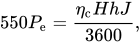
where H = calorific value of the fuel in BTU/lb, h = fuel consumption rate in lb/hr and J = mechanical equivalent of heat = 778.24 ft.lb/BTU, where is engine output in horsepower, converted to foot-pounds/second by multiplication by 550. Given that specific fuel consumption is Cp = h/Pe and H = 20 052 BTU/lb for gasoline, the equation is simplified to:

expressed as a percentage.

Assuming a typical propeller efficiency of 86% (for the optimal airspeed and air density conditions for the given propeller design[citation needed]), maximum overall propulsion efficiency is estimated as:

See also

[edit]

References

[edit]

Notes

[edit]
Revisions and contributorsEdit on WikipediaRead on Wikipedia
from Grokipedia
Propulsive efficiency is a key performance metric in that quantifies the effectiveness of a system in converting the mechanical power input from an engine into useful power for vehicle , while accounting for the losses in the exhaust stream relative to the surrounding atmosphere. For air-breathing engines, such as turbojets and turbofans, it is mathematically expressed as ηp=21+VjV0\eta_p = \frac{2}{1 + \frac{V_j}{V_0}}, where VjV_j is the exhaust jet velocity relative to the vehicle and V0V_0 is the vehicle's forward flight velocity. This efficiency is inherently less than 1 (or 100%) because a portion of the energy is inevitably left as excess in the wake of the exhaust gases. The value of propulsive efficiency depends critically on the ratio of exhaust velocity to flight velocity, with higher efficiencies achieved when this ratio is low, meaning the exhaust is expelled at a speed close to the vehicle's speed to minimize wasted kinetic energy. For instance, propeller-driven systems and high-bypass turbofan engines can attain propulsive efficiencies exceeding 80% at subsonic speeds due to their ability to accelerate large masses of air to relatively low velocities, whereas pure turbojets are less efficient at low speeds because their high exhaust velocities leave more energy in the slipstream. In rocket propulsion, which operates in vacuum without air intake, the formula adjusts to ηp=2(V0Ve)1+(V0Ve)2\eta_p = \frac{2 \left( \frac{V_0}{V_e} \right)}{1 + \left( \frac{V_0}{V_e} \right)^2}, where VeV_e is the effective exhaust velocity, emphasizing that rocket efficiency improves with increasing vehicle speed but remains generally lower than air-breathing systems at equivalent conditions. Overall, optimizing propulsive efficiency is essential for reducing consumption and improving range in and , influencing design choices such as bypass ratios in jet engines or diameters, and it forms one component of the overall efficiency alongside and mechanical efficiencies. Advances in , including variable cycle engines, continue to push these efficiencies higher to meet demands for sustainable .

Basic Concepts

Definition

Propulsive efficiency, denoted as ηp\eta_p, is defined as the of the useful propulsive power— multiplied by the vehicle's forward speed—to the total power supplied to the system, specifically the rate at which is added to the . This metric quantifies how effectively a propulsion device converts input energy into forward momentum for the vehicle, rather than dissipating it as excess in the exhaust wake. The standard expression for propulsive efficiency in jet propulsion is ηp=2vv+ve\eta_p = \frac{2v}{v + v_e}, where vv is the vehicle's speed through the surrounding medium and vev_e is the absolute exhaust velocity. This formula arises from the thrust power FvF \cdot v, where F=m˙(vev)F = \dot{m}(v_e - v) and m˙\dot{m} is the mass flow rate, divided by the kinetic energy addition rate 12m˙(ve2v2)\frac{1}{2} \dot{m} (v_e^2 - v^2). It illustrates that ηp\eta_p approaches 1 as vev_e approaches vv (minimal velocity increment), minimizing waste, but practical systems balance this with other constraints. The concept of propulsive efficiency was first formalized in the early by engineers like William Froude (1810–1879), who introduced it in the context of marine performance as the ratio of output power to energy input rate. Froude's work on ship hydrodynamics laid the groundwork, which was subsequently adapted to aeronautical applications as powered flight advanced, enabling analysis of and later jet systems. High propulsive efficiency is essential for minimizing consumption and maximizing operational range in propelled vehicles, as it directly influences the required to achieve a given level. It complements , which addresses conversion from , to yield the overall system performance.

Relation to Thermal Efficiency

In systems, the overall efficiency ηo\eta_o is typically expressed as the product of ηth\eta_{th}, propulsive efficiency ηp\eta_p, and mechanical or transmission efficiency ηm\eta_m, such that ηo=ηth×ηp×ηm\eta_o = \eta_{th} \times \eta_p \times \eta_m. This decomposition highlights how different stages of conversion contribute to the net performance of the system, with ηm\eta_m accounting for losses in components like gears or shafts. Thermal efficiency ηth\eta_{th} quantifies the conversion of chemical energy in the fuel to the kinetic and thermal energy of the exhaust gases, primarily through thermodynamic cycles like the Brayton cycle in gas turbines. In contrast, propulsive efficiency ηp\eta_p addresses the subsequent process of transferring momentum from the accelerated exhaust to the vehicle, determining how effectively the kinetic energy imparted to the propulsion fluid generates useful thrust. This distinction is crucial because thermal processes occur upstream in the engine core, where heat addition and expansion produce high-energy gases, while propulsive aspects involve the interaction of the exhaust jet with the surrounding fluid, often leading to inefficiencies independent of the initial energy conversion. For instance, in engines operating on an ideal , ηth\eta_{th} sets an upper limit on the available from fuel combustion for , governed by and temperature ratios, but ηp\eta_p governs how much of that translates into effective rather than wasted exhaust . Propulsive losses, which manifest after thermal conversion, primarily arise from the residual in the exhaust wake relative to the ambient fluid, representing that does not contribute to net . This post-thermal inefficiency underscores the need for designs that minimize exhaust excesses to optimize overall system performance.

Theoretical Foundations

Energy Balance in Propulsion

In propulsion systems, the fundamental process involves converting stored in propellants into of the , achieved primarily through the generation of exhaust that propels the forward. This conversion occurs via a controlled reaction, such as , where high-energy propellants release , which is then transformed into directed flow to produce . The of this process hinges on minimizing , with the core mechanism relying on imparting to a stream (air or exhaust gases) to create a reaction . The theoretical foundation for analyzing this energy conversion rests on the conservation laws applied to streams within a surrounding the propulsor. ensures that the into the system equals the out, maintaining continuity in the or stream. equates the () to the rate of change in momentum of the , where TT arises from the velocity difference between incoming and outgoing flows: T=m˙([ve](/page/Velocity)[v](/page/Velocity))T = \dot{m} ([v_e](/page/Velocity) - [v](/page/Velocity)), with m˙\dot{m} as , vev_e as exhaust , and vv as vehicle . balances the input energy against changes in kinetic and internal energies, accounting for the work done on the without viscous or losses in ideal cases. A key idealization for understanding these principles is the actuator disk theory, which models an ideal or as an infinitesimally thin disk that uniformly adds to the passing through it. This disk represents the propulsor without detailing blade or nozzle geometry, simplifying analysis to one-dimensional, steady flow assumptions. The power required by the actuator disk, known as propulsive power, is given by P=TvP = T \cdot v, where the disk imparts just enough to accelerate the flow for the desired . In this model, the flow velocity at the disk is the average of the upstream (vehicle) and downstream (wake or exhaust) velocities, enabling straightforward application of the conservation laws to predict performance limits. The overall balance in captures how input power from the energy source is partitioned: Pinput=Pthrust+Pexhaust loss+PthermalP_{\text{input}} = P_{\text{thrust}} + P_{\text{exhaust loss}} + P_{\text{thermal}}, where Pthrust=TvP_{\text{thrust}} = T \cdot v represents the useful power accelerating the , Pexhaust loss=12m˙(vev)2P_{\text{exhaust loss}} = \frac{1}{2} \dot{m} (v_e - v)^2 quantifies the remaining in the exhaust relative to the ambient atmosphere (wasted through in the wake), and PthermalP_{\text{thermal}} accounts for irreversible losses like incomplete or heat rejection. This balance highlights that ideal seeks to equate input power closely to thrust power by reducing exhaust velocity excess and inefficiencies. Propulsive efficiency emerges as a metric to quantify the minimization of these exhaust kinetic losses relative to the total energy supplied.

Derivation of Propulsive Efficiency

Propulsive efficiency, denoted as ηp\eta_p, quantifies the fraction of the total kinetic energy imparted to the exhaust flow that contributes to the vehicle's forward propulsion. It is derived from fundamental principles of momentum conservation for thrust generation and energy conservation for power assessment in steady-state propulsion systems. The derivation assumes inviscid flow, steady-state conditions, and one-dimensional exhaust, with the mass flow rate of air through the engine approximately equal to the exhaust mass flow rate, neglecting the small contribution from fuel mass. Under these conditions, the thrust TT produced by the propulsion system is given by the change in momentum of the flow: T=m˙(vev)T = \dot{m} (v_e - v), where m˙\dot{m} is the mass flow rate, vev_e is the exhaust velocity relative to the vehicle, and vv is the vehicle velocity relative to the ambient air. The useful propulsive power delivered to the vehicle is the product of thrust and vehicle speed: Puseful=Tv=m˙(vev)vP_{\text{useful}} = T \cdot v = \dot{m} (v_e - v) v. The total power supplied to the flow, however, is the rate of kinetic energy increase of the exhaust relative to the vehicle, which is 12m˙ve2\frac{1}{2} \dot{m} v_e^2 (since the inlet kinetic energy relative to the vehicle is 12m˙v2\frac{1}{2} \dot{m} v^2, but the net increase simplifies to the exhaust term in the relative frame for this approximation). More precisely, the power input is the difference in kinetic energy flux: 12m˙(ve2v2)\frac{1}{2} \dot{m} (v_e^2 - v^2). Propulsive efficiency is thus the ratio of useful power to total power supplied: ηp=Tv12m˙(ve2v2)=m˙(vev)v12m˙(ve2v2).\eta_p = \frac{T v}{\frac{1}{2} \dot{m} (v_e^2 - v^2)} = \frac{\dot{m} (v_e - v) v}{\frac{1}{2} \dot{m} (v_e^2 - v^2)}. Simplifying by canceling m˙\dot{m} and multiplying numerator and denominator by 2 yields: ηp=2v(vev)ve2v2.\eta_p = \frac{2 v (v_e - v)}{v_e^2 - v^2}. The denominator factors as (vev)(ve+v)(v_e - v)(v_e + v), allowing cancellation of (vev)(v_e - v): ηp=2vve+v=21+vev.\eta_p = \frac{2 v}{v_e + v} = \frac{2}{1 + \frac{v_e}{v}}. An equivalent form uses the speed ratio u=vveu = \frac{v}{v_e}, giving ηp=2u(1u)\eta_p = 2 u (1 - u). This derivation aligns with the energy balance in simplified models like the actuator disk, where propulsive efficiency emerges from the momentum-energy interplay. The formula assumes no intake losses and constant mass flow rate, which may require adjustments in real-world scenarios with variable m˙\dot{m} or drag on the intake. These limitations highlight that while ηp\eta_p approaches 1 as vev_e nears vv, practical designs balance this with sufficient thrust via higher m˙\dot{m}.

Applications to Jet Engines

Turbojets

Turbojet engines, which operate without bypass airflow, achieve propulsion through the acceleration of a relatively small mass of air to high exhaust velocities, typically making them ideal for high-speed flight regimes. The propulsive efficiency of a turbojet, defined as the ratio of thrust power to the rate of kinetic energy addition to the exhaust, is given by η_p = 2 / (1 + v_e / v), where v_e is the exhaust velocity relative to the engine and v is the flight velocity; this arises from the fundamental energy balance in jet propulsion, where a large velocity increment (v_e - v) leads to excess kinetic energy in the wake. For turbojets, where v_e greatly exceeds v at typical operating conditions, an approximation emerges as η_p ≈ \frac{2M}{1 + M} with M as the flight Mach number, reflecting the scaling of flight speed relative to the speed of sound and the near-sonic exhaust conditions. Propulsive efficiency in turbojets trends upward with increasing flight speed, reaching peaks in the high subsonic regime (around Mach 0.8–0.9) where the velocity mismatch between exhaust and is moderated, but it drops significantly at low speeds such as takeoff due to the large v_e / v ratio, often resulting in η_p below 50%. This mismatch means that much of the engine's energy output dissipates as unused in the exhaust plume after mixing with ambient air. Historically, early designs, such as Frank Whittle's prototypes from the 1930s, exhibited low propulsive efficiencies, around 50% at typical operating conditions, owing to rudimentary components and high velocity ratios. Subsequent advancements, including improved compressors and turbines, elevated efficiencies to over 50% in operational engines without afterburners, particularly at cruise speeds. A primary contributor to reduced effective propulsive efficiency in turbojets is the formation of shock waves, especially in supersonic inlets or nozzles, which cause total losses of up to 28% at Mach 2 and diminish the available for . Additionally, incomplete mixing of the high- exhaust with the surrounding atmosphere leads to persistent velocity gradients in the wake, further eroding efficiency by leaving residual kinetic energy unrecovered.

Turbofans

Turbofan engines enhance propulsive efficiency over turbojets by incorporating a fan that accelerates a larger mass of air at a lower velocity through a bypass duct, surrounding the core flow. This design splits the incoming air: a portion passes through the core for combustion and high-velocity exhaust, while the majority bypasses the core, providing thrust with reduced exhaust velocity relative to the aircraft speed. The bypass ratio (BPR), defined as the mass flow rate through the fan bypass duct divided by the core mass flow rate, is a key parameter; modern high-BPR turbofans typically operate at BPRs of 5:1 or higher, such as 8-10 in civil aviation engines. The propulsive efficiency ηp\eta_p for a with separate exhaust nozzles for the and core streams is given by ηp=2V(m˙b+m˙c)(m˙bvb+m˙cvc)+V(m˙b+m˙c),\eta_p = \frac{2 V ( \dot{m}_b + \dot{m}_c ) }{ ( \dot{m}_b v_b + \dot{m}_c v_c ) + V ( \dot{m}_b + \dot{m}_c ) }, where VV is the flight , m˙b\dot{m}_b and m˙c\dot{m}_c are the and core flow rates, and vbv_b and vcv_c are the respective exhaust . This can be approximated as a weighted combination: ηpβηp,b+ηp,cβ+1\eta_p \approx \frac{ \beta \eta_{p,b} + \eta_{p,c} }{ \beta + 1 }, where β=m˙b/m˙c\beta = \dot{m}_b / \dot{m}_c is the BPR, and ηp,b\eta_{p,b} and ηp,c\eta_{p,c} are the propulsive efficiencies of the and core streams, respectively; the fan efficiency influences ηp,b\eta_{p,b} through the polytropic efficiency of the compression process. High-BPR configurations (e.g., β>5\beta > 5) achieve ηp>70%\eta_p > 70\% at cruise conditions, as the increased flow lowers the effective exhaust , optimizing the u=V/veu = V / v_e (where vev_e is the effective exhaust ) closer to 1, as ηp=2u/(1+u)\eta_p = 2u / (1 + u) increases with uu, though practical requirements limit how high uu can be. This bypass effect minimizes losses in the exhaust wake by accelerating a greater to a nearer the flight speed, reducing the excess that dissipates as . For instance, in cruise at Mach 0.85 (approximately 250 m/s at altitude), the core exhaust might exceed 500 m/s, but the bypass stream operates closer to 300-400 m/s, yielding an overall ηp\eta_p around 77-80%. The General Electric GE90 engine, powering the with a BPR of about 9:1, exemplifies this, attaining ηp80%\eta_p \approx 80\% at Mach 0.85 cruise through advanced variable geometry in the compressor stages, which maintains optimal fan and core matching across flight regimes. Advancements in design seek even higher ηp\eta_p by pushing BPR extremes, with unducted fans (also known as open rotors) emerging as a hybrid approach that removes the fan duct to reduce weight and drag while achieving BPRs exceeding 20:1. These configurations approach propeller-level propulsive efficiencies (85-95%) by further lowering exhaust velocities and increasing mass flow, potentially improving by 20-30% over conventional high-BPR turbofans at subsonic cruise, though challenges in and blade aerodynamics persist. Ongoing developments, such as geared open rotors, aim to realize these gains for next-generation commercial aircraft. As of 2025, programs like NASA's STARC and CFM's RISE are advancing open rotor technologies, aiming for 20%+ improvements in over current high-BPR turbofans.

Applications to Other Systems

Rockets

In rocket engines, propulsive efficiency (ηp\eta_p) quantifies the fraction of the imparted to the exhaust that contributes to the 's forward , distinct from air-breathing systems due to the absence of air. The for ηp\eta_p in s is given by ηp=2(v/ve)1+(v/ve)2\eta_p = \frac{2 (v / v_e)}{1 + (v / v_e)^2}, where vv is the 's speed and vev_e is the exhaust velocity relative to the ; this expression arises from the balance between power (FvF v) and the rate at which is added to the exhaust stream. At launch in the atmosphere, where v0v \approx 0 and vevv_e \gg v, ηp\eta_p approaches zero, reflecting inefficient transfer as most exhaust dissipates without accelerating the significantly; values remain below 10% during ascent phases for early designs. Propulsive efficiency in rockets is closely linked to (IspI_{sp}), defined as Isp=ve/g0I_{sp} = v_e / g_0 where g0=9.81g_0 = 9.81 m/s² is , serving as a proxy for exhaust velocity and overall utilization. Higher IspI_{sp}, which corresponds to a higher vev_e, reduces ηp\eta_p for a given vehicle speed but enables greater achievable changes (Δv\Delta v) for the mission through improved efficiency, though real-world performance incurs losses from expansion, where over- or under-expansion relative to reduces effective by up to 15%. In vacuum operations, ηp\eta_p improves markedly as vv increases toward orbital speeds, approaching ideal values near unity when vvev \approx v_e, though practical limits constrain this. Unlike atmospheric propulsion, rocket ηp\eta_p is uniquely dominated by exhaust plume divergence, as there is no ambient air to entrain; non-axial flow in the plume leads to 10-20% thrust vector losses, mitigated by contoured bell nozzles that align exhaust streams more effectively than conical designs. Historical examples illustrate evolution: the (1940s), with an IspI_{sp} of 203 s at and 239 s in vacuum, exhibited ηp<10%\eta_p < 10\% during launch due to its moderate ve19902350v_e \approx 1990-2350 m/s and significant plume losses from its simple nozzle. Modern engines like the SpaceX Raptor, employing full-flow staged combustion for near-complete propellant utilization, achieve Isp350I_{sp} \approx 350 s at and 380 s in vacuum, enabling ηp>60%\eta_p > 60\% in space via optimized expansion ratios that minimize divergence losses.

Propellers

Propellers are widely used in fixed-wing aircraft and marine vessels to generate thrust by accelerating a fluid mass, with propulsive efficiency defined as the ratio of thrust power (thrust times advance speed) to shaft power input to the propeller. In ideal actuator disk theory, this efficiency can approach 100% under optimal conditions, but practical limitations reduce it significantly. The fundamental expression for propulsive efficiency η_p in propeller systems is η_p = 2u / (1 + u), where u is the speed ratio (advance speed V divided by the slipstream velocity V_j behind the propeller). This simplifies to approximately 2u for low u (high thrust loading), and in practice, it peaks at 80-90% around u ≈ 0.7, balancing thrust requirements with minimal kinetic energy losses in the wake. Blade element theory provides a foundational method to analyze and predict performance by dividing the blade into discrete elements and integrating local aerodynamic forces along the span. Efficiency is strongly influenced by the J = V / (n D), where V is the vehicle speed, n is the propeller rotational speed in revolutions per second, and D is the diameter; optimal efficiency occurs at specific J values depending on and loading, typically yielding peak η_p in the range of 0.7-0.85 for aircraft propellers. This theory highlights how mismatches in J lead to losses from , , or , particularly in marine applications where affects loading. Historically, the ' 1903 propellers for the first powered flight achieved approximately 66% propulsive efficiency, a remarkable feat given the wooden construction and empirical design process. Advances in materials and have elevated performance; modern composite propellers, with optimized shapes and lightweight structures, routinely exceed 85% efficiency, enabling higher cruise speeds and fuel savings in aircraft. In marine contexts, similar gains apply, though scaled for water's higher . Ducted propeller designs, such as commonly used in , enhance efficiency by 10-15% compared to open propellers, primarily by shrouding the blades to reduce tip vortex losses and improve flow uniformity. This configuration accelerates flow through the duct, increasing for a given power input, especially at low speeds in applications like tugboats or underwater vehicles, while maintaining high η_p across a broader operating range.

References

Add your contribution
Related Hubs
User Avatar
No comments yet.