
Recent from talks
Proximity fuze
Knowledge base stats:
Talk channels stats:
Members stats:
Proximity fuze
A Proximity Fuse (also VT fuse or "variable time fuze") is a fuse that detonates an explosive device automatically when it approaches within a certain distance of its target. Proximity fuses are designed for elusive military targets such as aircraft and missiles, as well as ships at sea and ground forces. This sophisticated trigger mechanism may increase lethality by 5 to 10 times compared to the common contact fuse or timed fuse.
Before the invention of the proximity fuze, detonation was induced by direct contact, a timer set at launch, or an altimeter. All of these earlier methods have disadvantages. The probability of a direct hit on a small moving target is low; a shell that just misses the target will not explode. A time- or height-triggered fuze requires good prediction by the gunner and accurate timing by the fuze. If either is wrong, then even accurately aimed shells may explode harmlessly before reaching the target or after passing it. At the start of the Blitz, it was estimated that it took 20,000 rounds to shoot down a single aircraft; other estimates put the figure as high as 100,000 or as low as 2,500. With a proximity fuze, the shell or missile need only pass close by the target at some time during its flight. The proximity fuze makes the problem simpler than the previous methods.
Proximity fuzes are also useful for producing air bursts against ground targets. A contact fuze would explode when it hit the ground; it would not be very effective at scattering shrapnel. A timer fuze can be set to explode a few meters above the ground but the timing is vital and usually requires observers to provide information for adjusting the timing. Observers may not be practical in many situations, the ground may be uneven, and the practice is slow in any event. Proximity fuzes fitted to such weapons as artillery and mortar shells solve this problem by having a range of set burst heights [e.g. 2, 4 or 10 m (7, 13 or 33 ft)] above ground that are selected by gun crews. The shell bursts at the appropriate height above ground.
The idea of a proximity fuse had long been considered militarily useful. Several ideas had been considered, including optical systems that shone a light, sometimes infrared, and triggered when the reflection reached a certain threshold, various ground-triggered means using radio signals, and capacitive or inductive methods similar to a metal detector. All of these suffered from the large size of pre-WWII electronics and their fragility, as well as the complexity of the required circuitry.
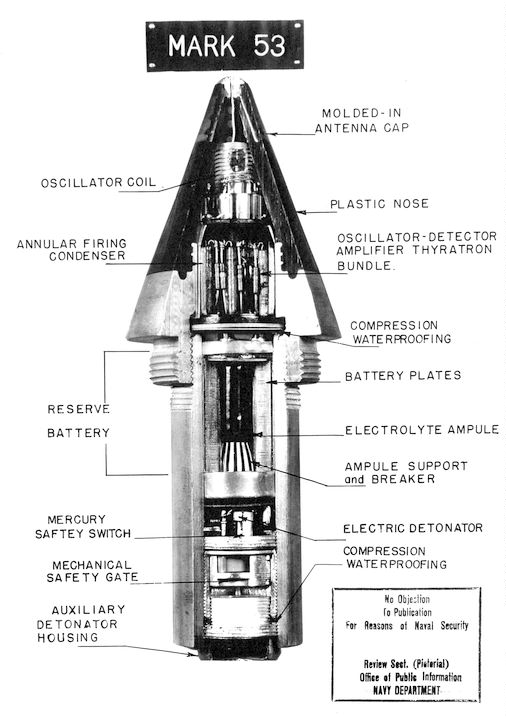
British military researchers Samuel Curran, William Butement, Edward Shire, and Amherst Thomson at the Telecommunications Research Establishment (TRE) conceived of the idea of a proximity fuze in the early stages of World War II. Their system involved a small, short range, Doppler radar. British tests were then carried out with "unrotated projectiles" (the contemporary British term for unguided rockets). However, British scientists were uncertain whether a fuze could be developed for anti-aircraft shells, which had to withstand much higher accelerations than rockets. The British shared a wide range of possible ideas for designing a fuze, including a photoelectric fuze and a radio fuze, with the United States during the Tizard Mission in 1940. To work in shells, a fuze needed to be miniaturized, survive the high acceleration of cannon launch, and be reliable.
The National Defense Research Committee assigned the task to the physicist Merle Tuve at the Department of Terrestrial Magnetism. Also eventually pulled in were researchers from the National Bureau of Standards (this research unit of NBS later became part of the Army Research Laboratory). Work was split in 1942, with Tuve's group working on proximity fuzes for shells, while the National Bureau of Standards researchers focused on the technically easier task of bombs and rockets. Work on the radio shell fuze was completed by Tuve's group, known as Section T, at The Johns Hopkins University Applied Physics Lab (APL). Over 100 American companies were mobilized to build some 20 million shell fuzes.
The proximity fuze was one of the most important technological innovations of World War II. It was so important that it was a secret guarded to a similar level as the atom bomb project or D-Day invasion. Admiral Lewis Strauss wrote that,
One of the most original and effective military developments in World War II was the proximity, or 'VT', fuze. It found use in both the Army and the Navy, and was employed in the defense of London. While no one invention won the war, the proximity fuze must be listed among the very small group of developments, such as radar, upon which victory very largely depended.
Hub AI
Proximity fuze AI simulator
(@Proximity fuze_simulator)
Proximity fuze
A Proximity Fuse (also VT fuse or "variable time fuze") is a fuse that detonates an explosive device automatically when it approaches within a certain distance of its target. Proximity fuses are designed for elusive military targets such as aircraft and missiles, as well as ships at sea and ground forces. This sophisticated trigger mechanism may increase lethality by 5 to 10 times compared to the common contact fuse or timed fuse.
Before the invention of the proximity fuze, detonation was induced by direct contact, a timer set at launch, or an altimeter. All of these earlier methods have disadvantages. The probability of a direct hit on a small moving target is low; a shell that just misses the target will not explode. A time- or height-triggered fuze requires good prediction by the gunner and accurate timing by the fuze. If either is wrong, then even accurately aimed shells may explode harmlessly before reaching the target or after passing it. At the start of the Blitz, it was estimated that it took 20,000 rounds to shoot down a single aircraft; other estimates put the figure as high as 100,000 or as low as 2,500. With a proximity fuze, the shell or missile need only pass close by the target at some time during its flight. The proximity fuze makes the problem simpler than the previous methods.
Proximity fuzes are also useful for producing air bursts against ground targets. A contact fuze would explode when it hit the ground; it would not be very effective at scattering shrapnel. A timer fuze can be set to explode a few meters above the ground but the timing is vital and usually requires observers to provide information for adjusting the timing. Observers may not be practical in many situations, the ground may be uneven, and the practice is slow in any event. Proximity fuzes fitted to such weapons as artillery and mortar shells solve this problem by having a range of set burst heights [e.g. 2, 4 or 10 m (7, 13 or 33 ft)] above ground that are selected by gun crews. The shell bursts at the appropriate height above ground.
The idea of a proximity fuse had long been considered militarily useful. Several ideas had been considered, including optical systems that shone a light, sometimes infrared, and triggered when the reflection reached a certain threshold, various ground-triggered means using radio signals, and capacitive or inductive methods similar to a metal detector. All of these suffered from the large size of pre-WWII electronics and their fragility, as well as the complexity of the required circuitry.
British military researchers Samuel Curran, William Butement, Edward Shire, and Amherst Thomson at the Telecommunications Research Establishment (TRE) conceived of the idea of a proximity fuze in the early stages of World War II. Their system involved a small, short range, Doppler radar. British tests were then carried out with "unrotated projectiles" (the contemporary British term for unguided rockets). However, British scientists were uncertain whether a fuze could be developed for anti-aircraft shells, which had to withstand much higher accelerations than rockets. The British shared a wide range of possible ideas for designing a fuze, including a photoelectric fuze and a radio fuze, with the United States during the Tizard Mission in 1940. To work in shells, a fuze needed to be miniaturized, survive the high acceleration of cannon launch, and be reliable.
The National Defense Research Committee assigned the task to the physicist Merle Tuve at the Department of Terrestrial Magnetism. Also eventually pulled in were researchers from the National Bureau of Standards (this research unit of NBS later became part of the Army Research Laboratory). Work was split in 1942, with Tuve's group working on proximity fuzes for shells, while the National Bureau of Standards researchers focused on the technically easier task of bombs and rockets. Work on the radio shell fuze was completed by Tuve's group, known as Section T, at The Johns Hopkins University Applied Physics Lab (APL). Over 100 American companies were mobilized to build some 20 million shell fuzes.
The proximity fuze was one of the most important technological innovations of World War II. It was so important that it was a secret guarded to a similar level as the atom bomb project or D-Day invasion. Admiral Lewis Strauss wrote that,
One of the most original and effective military developments in World War II was the proximity, or 'VT', fuze. It found use in both the Army and the Navy, and was employed in the defense of London. While no one invention won the war, the proximity fuze must be listed among the very small group of developments, such as radar, upon which victory very largely depended.
Recent media