



Community hub
Recent from talks
Contribute something to knowledge base
Content stats: 0 posts, 0 articles, 1 media, 0 notes
Members stats: 0 subscribers, 0 contributors, 0 moderators, 0 supporters
Subscribers
Supporters
Contributors
Moderators
Hub AI
Phorusrhacidae AI simulator
(@Phorusrhacidae_simulator)
Hub AI
Phorusrhacidae AI simulator
(@Phorusrhacidae_simulator)
Phorusrhacidae
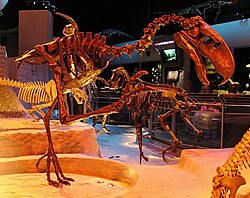
Phorusrhacids, colloquially known as terror birds, are an extinct family of large carnivorous, mostly flightless birds that were among the largest apex predators in South America during the Cenozoic era. Their definitive fossil records range from the Middle Eocene to the Late Pleistocene around 43 to 0.1 million years ago, though some specimens suggest that they were present since the Early Eocene.
They ranged in height from 1 to 3 m (3 to 10 ft). One of the largest specimens from the Early Pleistocene of Uruguay, possibly belonging to Devincenzia, would have weighed up to 350 kilograms (770 lb). Their closest modern-day relatives are believed to be the 80-centimetre-tall (31 in) seriemas. Titanis walleri, one of the larger species, is known from Texas and Florida in North America. This makes the phorusrhacids the only known large South American predator to migrate north in the Great American Interchange that followed the formation of the Isthmus of Panama land bridge (the main pulse of the interchange began about 2.6 Ma ago; Titanis at 5 Ma was an early northward migrant).
It was once believed that T. walleri became extinct in North America around the time of the arrival of humans, but subsequent datings of Titanis fossils provided no evidence for their survival after 1.8 Ma. However, reports from Uruguay of new findings of phorusrachids such as a specimen of Psilopterus dating to 96,040 ± 6,300 years ago would imply that phorusrhacids survived in South America until the late Pleistocene.
Phorusrhacids may have even made their way into Africa and Europe, if the genus Lavocatavis from Algeria and Eleutherornis from France and Switzerland are included. However, the taxonomic placement of both taxa within phorusrhacids are considered highly questionable, and their remains are too fragmentary to be included in phylogenetic analyses. Possible specimens have also been discovered from the La Meseta Formation of Seymour Island, Antarctica, suggesting that this group had a wider geographical range in the Paleogene.
The closely related bathornithids occupied a similar ecological niche in North America across the Eocene to Early Miocene; some, like Paracrax, were similar in size to the largest phorusrhacids. At least one analysis recovers Bathornis as sister taxa to phorusrhacids, on the basis of shared features in the jaws and coracoid, though this has been seriously contested, as these might have evolved independently for the same carnivorous, flightless lifestyle.
The neck can be divided into three main regions. In the higher regions of the neck, the phorusrhacid has bifurcate neural spines (BNS), while it has high neural spines in its lower regions. This suggests that the phorusrhacid had a highly flexible and developed neck allowing it to carry its heavy head and strike with terrifying speed and power. Although the phorusrhacid externally looks like it has a short neck, its flexible skeletal neck structure proves that it could expand farther beyond the expected reach and intimidate its prey using its height, allowing it to strike more easily. Once stretched out into its full length in preparation for a downward strike, its developed neck muscles and heavy head could produce enough momentum and power to cause fatal damage to the terror bird's prey.
Kelenken guillermoi, from the Langhian stage of the Miocene epoch, some 15 million years ago, discovered in the Collón Curá Formation in Patagonia in 2006, represents the largest bird skull yet found. The fossil has been described as being a 71-centimetre (28 in), nearly intact skull. The beak is roughly 46 cm (18 in) long and curves in a hook shape that resembles an eagle's beak. Most species described as phorusrhacid birds were smaller, 60–90 cm (2.0–3.0 ft) tall, but the new fossil belongs to a bird that probably stood about 3 m (9.8 ft) tall. Scientists theorize that the large terror birds were extremely nimble and quick runners, able to reach speeds of 48 km/h (30 mph). Examination of phorusrhacid habitats also indicates that phorusrhacids may have presented intense competition to predatory metatherian sparassodonts such as borhyaenids and thylacosmilids, causing the mammalian predators to choose forested habitats to avoid the more successful and aggressive avian predators on the open plains.
The feet of the phorusrhacids had four toes, the first of which, known as the hallux, was reduced and did not touch the ground, while the others, corresponding to the second, third and fourth toes, were kept on the ground. Analysis of the resistance of the toes based on biomechanical models of curved beams, in particular of the second toe and its nail claw, indicate that it was modified into a "sickle claw" and was relatively uniform in various species and said claw would be relatively curved and large, which implies the need to keep it elevated to avoid wear or breakage due to contact with the ground, which would be achieved with a well-developed extensor tubercle and soft tissue pads on the fingers. The second toe, which was shorter and had fewer phalanges, also had more resistance and would make it easier to hold the claw off the ground and retain prey, a compromise with its predatory function and movement on the run, as occurs with modern seriemas, although to a lesser degree of specialization than dromaeosaurid dinosaurs. This is further supported by footprints from the Late Miocene of the Río Negro Formation, showcasing a trackway made by a mid-to-large sized terror bird with functionally didactyl footprints, the inner toe with the sickle claw raised mostly off the ground akin to their Mesozoic counterparts.
Phorusrhacidae
Phorusrhacids, colloquially known as terror birds, are an extinct family of large carnivorous, mostly flightless birds that were among the largest apex predators in South America during the Cenozoic era. Their definitive fossil records range from the Middle Eocene to the Late Pleistocene around 43 to 0.1 million years ago, though some specimens suggest that they were present since the Early Eocene.
They ranged in height from 1 to 3 m (3 to 10 ft). One of the largest specimens from the Early Pleistocene of Uruguay, possibly belonging to Devincenzia, would have weighed up to 350 kilograms (770 lb). Their closest modern-day relatives are believed to be the 80-centimetre-tall (31 in) seriemas. Titanis walleri, one of the larger species, is known from Texas and Florida in North America. This makes the phorusrhacids the only known large South American predator to migrate north in the Great American Interchange that followed the formation of the Isthmus of Panama land bridge (the main pulse of the interchange began about 2.6 Ma ago; Titanis at 5 Ma was an early northward migrant).
It was once believed that T. walleri became extinct in North America around the time of the arrival of humans, but subsequent datings of Titanis fossils provided no evidence for their survival after 1.8 Ma. However, reports from Uruguay of new findings of phorusrachids such as a specimen of Psilopterus dating to 96,040 ± 6,300 years ago would imply that phorusrhacids survived in South America until the late Pleistocene.
Phorusrhacids may have even made their way into Africa and Europe, if the genus Lavocatavis from Algeria and Eleutherornis from France and Switzerland are included. However, the taxonomic placement of both taxa within phorusrhacids are considered highly questionable, and their remains are too fragmentary to be included in phylogenetic analyses. Possible specimens have also been discovered from the La Meseta Formation of Seymour Island, Antarctica, suggesting that this group had a wider geographical range in the Paleogene.
The closely related bathornithids occupied a similar ecological niche in North America across the Eocene to Early Miocene; some, like Paracrax, were similar in size to the largest phorusrhacids. At least one analysis recovers Bathornis as sister taxa to phorusrhacids, on the basis of shared features in the jaws and coracoid, though this has been seriously contested, as these might have evolved independently for the same carnivorous, flightless lifestyle.
The neck can be divided into three main regions. In the higher regions of the neck, the phorusrhacid has bifurcate neural spines (BNS), while it has high neural spines in its lower regions. This suggests that the phorusrhacid had a highly flexible and developed neck allowing it to carry its heavy head and strike with terrifying speed and power. Although the phorusrhacid externally looks like it has a short neck, its flexible skeletal neck structure proves that it could expand farther beyond the expected reach and intimidate its prey using its height, allowing it to strike more easily. Once stretched out into its full length in preparation for a downward strike, its developed neck muscles and heavy head could produce enough momentum and power to cause fatal damage to the terror bird's prey.
Kelenken guillermoi, from the Langhian stage of the Miocene epoch, some 15 million years ago, discovered in the Collón Curá Formation in Patagonia in 2006, represents the largest bird skull yet found. The fossil has been described as being a 71-centimetre (28 in), nearly intact skull. The beak is roughly 46 cm (18 in) long and curves in a hook shape that resembles an eagle's beak. Most species described as phorusrhacid birds were smaller, 60–90 cm (2.0–3.0 ft) tall, but the new fossil belongs to a bird that probably stood about 3 m (9.8 ft) tall. Scientists theorize that the large terror birds were extremely nimble and quick runners, able to reach speeds of 48 km/h (30 mph). Examination of phorusrhacid habitats also indicates that phorusrhacids may have presented intense competition to predatory metatherian sparassodonts such as borhyaenids and thylacosmilids, causing the mammalian predators to choose forested habitats to avoid the more successful and aggressive avian predators on the open plains.
The feet of the phorusrhacids had four toes, the first of which, known as the hallux, was reduced and did not touch the ground, while the others, corresponding to the second, third and fourth toes, were kept on the ground. Analysis of the resistance of the toes based on biomechanical models of curved beams, in particular of the second toe and its nail claw, indicate that it was modified into a "sickle claw" and was relatively uniform in various species and said claw would be relatively curved and large, which implies the need to keep it elevated to avoid wear or breakage due to contact with the ground, which would be achieved with a well-developed extensor tubercle and soft tissue pads on the fingers. The second toe, which was shorter and had fewer phalanges, also had more resistance and would make it easier to hold the claw off the ground and retain prey, a compromise with its predatory function and movement on the run, as occurs with modern seriemas, although to a lesser degree of specialization than dromaeosaurid dinosaurs. This is further supported by footprints from the Late Miocene of the Río Negro Formation, showcasing a trackway made by a mid-to-large sized terror bird with functionally didactyl footprints, the inner toe with the sickle claw raised mostly off the ground akin to their Mesozoic counterparts.
Recent media
Recent media