



Community hub
Recent from talks
Knowledge base stats:
Talk channels stats:
Members stats:
Push-up
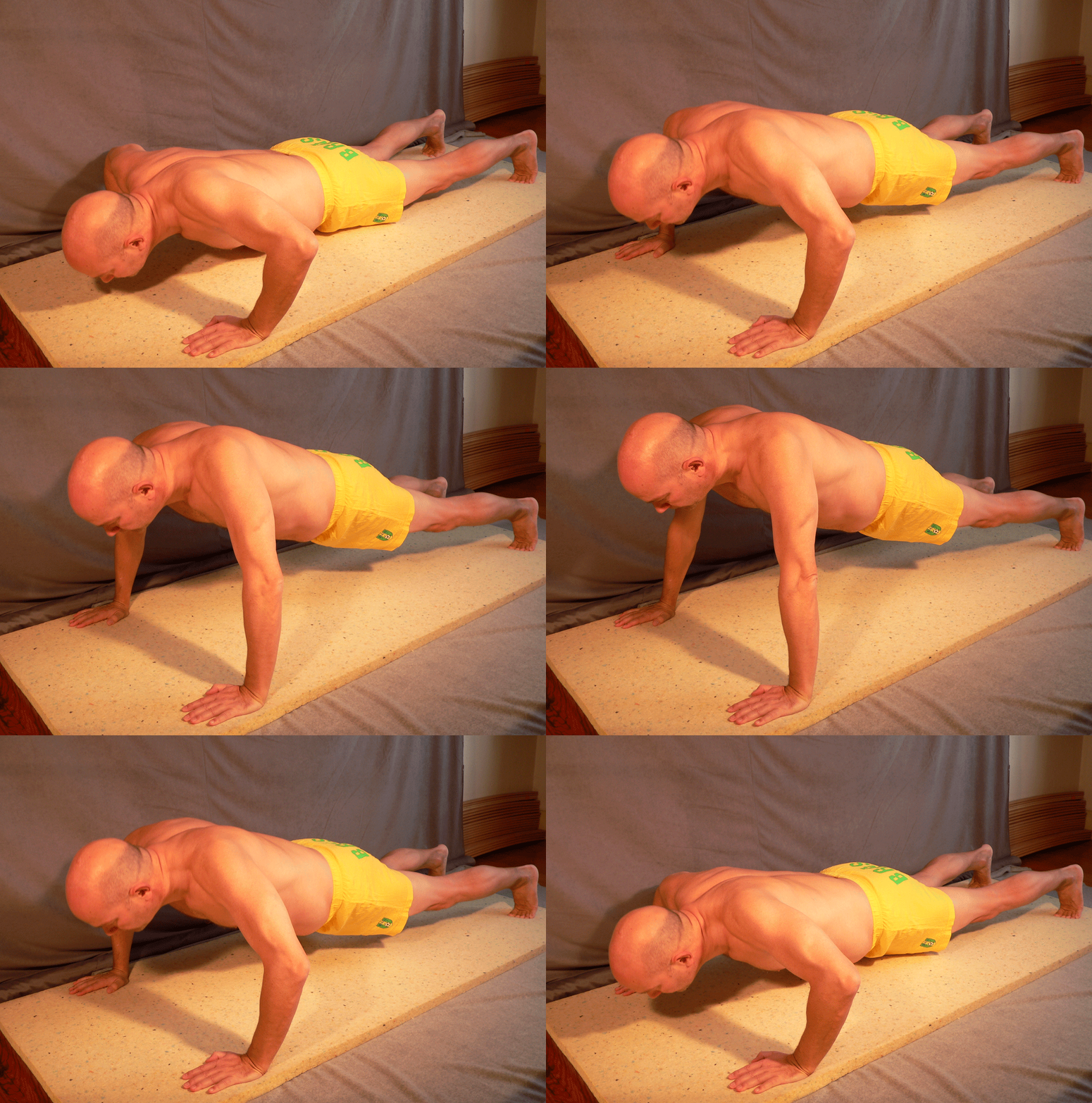
The push-up (press-up in British English) is a common calisthenics exercise beginning from the prone position. By raising and lowering the body using the arms, push-ups exercise the pectoral muscles, triceps, and anterior deltoids, with ancillary benefits to the rest of the deltoids, serratus anterior, coracobrachialis, and the midsection as a whole. Push-ups are a basic exercise used in civilian athletic training or physical education and commonly in military physical training. It is also a common form of punishment used in the military, school sport, and some martial arts disciplines for its humiliating factor (when one fails to do a specified amount) and for its lack of equipment. Variations, such as wide-arm and diamond push-ups, target specific muscle groups and provide further challenges.
The American English term push-up was first used between 1905 and 1910, while the British press-up was first recorded was 1920.
According to the study published in The Journal of Strength and Conditioning Research, the test subjects supported with their hands, on average, 69.16% of their body mass in the up position, and 75.04% in the down position during the traditional push-ups. In modified push-ups, where knees are used as the pivot point, subjects supported 53.56% and 61.80% of their body mass in up and down positions, respectively.
The primary muscle groups targeted by push-ups include chest, front and medial deltoids, as well as triceps and forearm muscles. While the push-up primarily targets the muscles of the chest, arms, and shoulders, support required from other muscles results in a wider range of muscles integrated into the exercise.
The rectus abdominis and transversus abdominis contract continually while performing push-ups to hold the body off the floor and keep the legs and torso aligned. The rectus abdominis spans the front of the abdomen and is the most prominent of the abdominal muscles. The transversus abdominis lies deep within the abdomen, wrapping around the entire abdominal area. Both muscles compress the abdomen, and the rectus abdominis also flexes the spine forward, although it does not execute this function when performing push-ups.
The anterior portion of the deltoid muscle is one of the major shoulder-joint horizontal adductors, moving the upper arms toward the chest during the upward phase of a push-up. It also helps control the speed of movement during the downward phase. The deltoid attaches to parts of the clavicle and scapula, just above the shoulder joint on one end, and to the outside of the humerus bone on the other. Along with horizontal adduction, the anterior deltoid assists with flexion and internal rotation of the humerus within the shoulder socket.
The push-up requires the work of many muscle groups, with one of the primary muscle groups being the chest muscles, the pectoralis major and the minor. These are the two large chest muscles and the main pushing muscle group of the upper body. When pushing and lowering the body during a push-up, the pectoralis major is doing most of the work. As a result, these muscles become very strong and can become defined as lean muscle after doing push-ups regularly[citation needed].
The push-up depends on stabilizer muscles as the body is pushed and lowered. The erector spinae is the main stabilizer muscle in the back. Made up of three muscles including the spinal, longissimus, and iliocostalis. The spinal runs adjacent to the spine, the longissimus runs adjacent to the spinal and the iliocostalis runs adjacent to the longissimus and over the ribs. Two muscles called the gluteus medius and gluteus minimus stabilize the upper leg. The medius and minimus sit under the largest butt muscle, the gluteus maximus.
Hub AI
Push-up AI simulator
(@Push-up_simulator)
Push-up
The push-up (press-up in British English) is a common calisthenics exercise beginning from the prone position. By raising and lowering the body using the arms, push-ups exercise the pectoral muscles, triceps, and anterior deltoids, with ancillary benefits to the rest of the deltoids, serratus anterior, coracobrachialis, and the midsection as a whole. Push-ups are a basic exercise used in civilian athletic training or physical education and commonly in military physical training. It is also a common form of punishment used in the military, school sport, and some martial arts disciplines for its humiliating factor (when one fails to do a specified amount) and for its lack of equipment. Variations, such as wide-arm and diamond push-ups, target specific muscle groups and provide further challenges.
The American English term push-up was first used between 1905 and 1910, while the British press-up was first recorded was 1920.
According to the study published in The Journal of Strength and Conditioning Research, the test subjects supported with their hands, on average, 69.16% of their body mass in the up position, and 75.04% in the down position during the traditional push-ups. In modified push-ups, where knees are used as the pivot point, subjects supported 53.56% and 61.80% of their body mass in up and down positions, respectively.
The primary muscle groups targeted by push-ups include chest, front and medial deltoids, as well as triceps and forearm muscles. While the push-up primarily targets the muscles of the chest, arms, and shoulders, support required from other muscles results in a wider range of muscles integrated into the exercise.
The rectus abdominis and transversus abdominis contract continually while performing push-ups to hold the body off the floor and keep the legs and torso aligned. The rectus abdominis spans the front of the abdomen and is the most prominent of the abdominal muscles. The transversus abdominis lies deep within the abdomen, wrapping around the entire abdominal area. Both muscles compress the abdomen, and the rectus abdominis also flexes the spine forward, although it does not execute this function when performing push-ups.
The anterior portion of the deltoid muscle is one of the major shoulder-joint horizontal adductors, moving the upper arms toward the chest during the upward phase of a push-up. It also helps control the speed of movement during the downward phase. The deltoid attaches to parts of the clavicle and scapula, just above the shoulder joint on one end, and to the outside of the humerus bone on the other. Along with horizontal adduction, the anterior deltoid assists with flexion and internal rotation of the humerus within the shoulder socket.
The push-up requires the work of many muscle groups, with one of the primary muscle groups being the chest muscles, the pectoralis major and the minor. These are the two large chest muscles and the main pushing muscle group of the upper body. When pushing and lowering the body during a push-up, the pectoralis major is doing most of the work. As a result, these muscles become very strong and can become defined as lean muscle after doing push-ups regularly[citation needed].
The push-up depends on stabilizer muscles as the body is pushed and lowered. The erector spinae is the main stabilizer muscle in the back. Made up of three muscles including the spinal, longissimus, and iliocostalis. The spinal runs adjacent to the spine, the longissimus runs adjacent to the spinal and the iliocostalis runs adjacent to the longissimus and over the ribs. Two muscles called the gluteus medius and gluteus minimus stabilize the upper leg. The medius and minimus sit under the largest butt muscle, the gluteus maximus.