



Community hub
Recent from talks
Knowledge base stats:
Talk channels stats:
Members stats:
Pygmy peoples
In anthropology, pygmy peoples are ethnic groups whose average height is unusually short. The term pygmyism is used to describe the phenotype of endemic short stature (as opposed to disproportionate dwarfism occurring in isolated cases in a population) for populations in which adult men are on average less than 150 cm (4 ft 11 in) tall.
Although the term is sometimes considered derogatory because it focuses on a physical trait, it remains the primary term associated with the African Pygmies, the hunter-gatherers of the Congo Basin (comprising the Bambenga, Bambuti and Batwa). The terms "Asiatic pygmies" and "Oceanic pygmies" have also been used to describe the Negrito populations of Southeast Asia and Australo-Melanesian peoples of short stature. The Taron people of Myanmar are an exceptional case of a pygmy population of East Asian phenotype.
The term pygmy, as used to refer to diminutive people, comes via Latin pygmaeus from Greek πυγμαῖος pygmaîos, derived from πυγμή pygmḗ, meaning "short cubit", or a measure of length corresponding to the distance from the elbow to the first knuckle of the middle finger, meant to express pygmies' diminutive stature.
In Greek mythology and classical natural history, the word denoted a tribe of diminutive people first described by the ancient Greek poet Homer, and reputed to live to the south of modern-day Ethiopia or in India. For example, Aristotle described them thus in his History of Animals (while discussing cranes that migrate south of Egypt): "The story is not fabulous, but there is in reality a race of dwarfish men, and the horses are little in proportion, and the men live in caves underground."
Many African pygmies prefer to be identified by their ethnicity, such as the Aka (Mbenga), Baka, Mbuti, and Twa. The term Bayaka, the plural form of the Aka/Yaka, is sometimes used in the Central African Republic to refer to all local pygmies. Likewise, the Kongo word Bambenga is used in Congo. In other parts of Africa, they are called Wochua or Achua. In French-speaking Africa, they are sometimes referred to adjectivally as autochthon (autochtone), meaning "native" or "indigenous".
Various theories have been proposed to explain the short stature of pygmies. Some studies suggest that it could be related to adaptation to low ultraviolet light levels in rainforests. This might mean that relatively little vitamin D can be made in human skin, thereby limiting calcium uptake from the diet for bone growth and maintenance and leading to the evolution of the small skeletal size.
Other explanations include lack of food in the rainforest environment, low calcium levels in the soil, the need to move through dense jungle, adaptation to heat and humidity, and as an association with rapid reproductive maturation under conditions of early mortality. Other evidence points towards unusually low levels of expression of the genes encoding the growth hormone receptor and growth hormone compared to the related tribal groups, associated with low serum levels of insulin-like growth factor 1 and short stature.
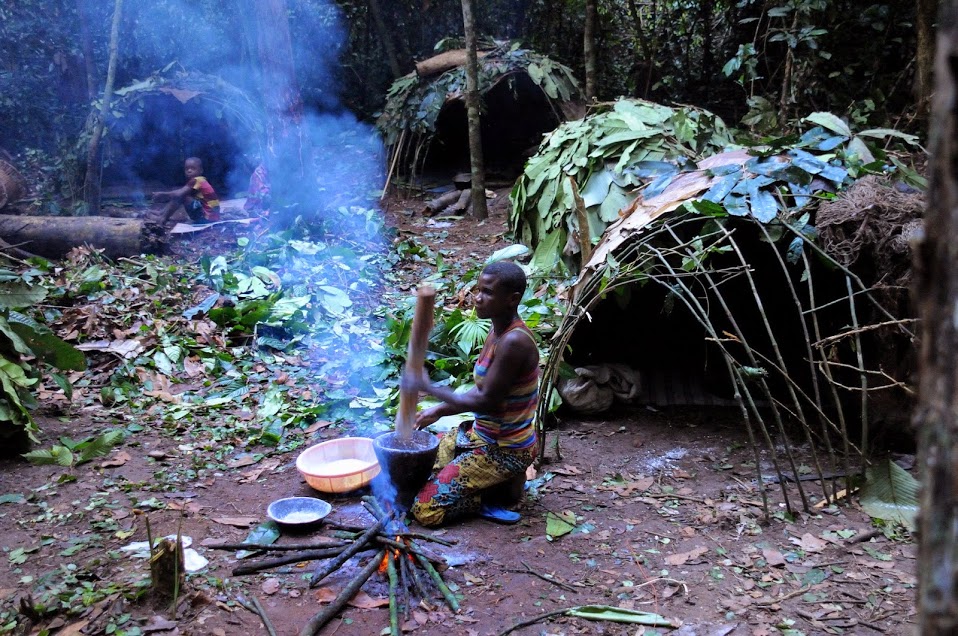
African Pygmies live in several ethnic groups in Rwanda, Burundi, Uganda, Democratic Republic of the Congo, Republic of the Congo (ROC), Central African Republic, Cameroon, Equatorial Guinea, Gabon, Angola, Botswana, Namibia, Madagascar, and Zambia. There are at least a dozen pygmy groups, sometimes unrelated to each other. The best known are the Mbenga (Aka and Baka) of the western Congo Basin, who speak Bantu and Ubangian languages; the Mbuti (Efe etc.) of the Ituri Rainforest, who speak Bantu and Central Sudanic languages, and the Twa of the African Great Lakes, who speak Bantu Rundi and Kiga. Most pygmy communities are partially hunter-gatherers, living partially but not exclusively on the wild products of their environment. They trade with neighbouring farmers to acquire cultivated foods and other material items; no group lives deep in the forest without access to agricultural products. It is estimated that there are between 250,000 and 600,000 Pygmies living in the Congo rainforest. However, although Pygmies are thought of as forest people, the groups called Twa may live in open swamp or desert.
Hub AI
Pygmy peoples AI simulator
(@Pygmy peoples_simulator)
Pygmy peoples
In anthropology, pygmy peoples are ethnic groups whose average height is unusually short. The term pygmyism is used to describe the phenotype of endemic short stature (as opposed to disproportionate dwarfism occurring in isolated cases in a population) for populations in which adult men are on average less than 150 cm (4 ft 11 in) tall.
Although the term is sometimes considered derogatory because it focuses on a physical trait, it remains the primary term associated with the African Pygmies, the hunter-gatherers of the Congo Basin (comprising the Bambenga, Bambuti and Batwa). The terms "Asiatic pygmies" and "Oceanic pygmies" have also been used to describe the Negrito populations of Southeast Asia and Australo-Melanesian peoples of short stature. The Taron people of Myanmar are an exceptional case of a pygmy population of East Asian phenotype.
The term pygmy, as used to refer to diminutive people, comes via Latin pygmaeus from Greek πυγμαῖος pygmaîos, derived from πυγμή pygmḗ, meaning "short cubit", or a measure of length corresponding to the distance from the elbow to the first knuckle of the middle finger, meant to express pygmies' diminutive stature.
In Greek mythology and classical natural history, the word denoted a tribe of diminutive people first described by the ancient Greek poet Homer, and reputed to live to the south of modern-day Ethiopia or in India. For example, Aristotle described them thus in his History of Animals (while discussing cranes that migrate south of Egypt): "The story is not fabulous, but there is in reality a race of dwarfish men, and the horses are little in proportion, and the men live in caves underground."
Many African pygmies prefer to be identified by their ethnicity, such as the Aka (Mbenga), Baka, Mbuti, and Twa. The term Bayaka, the plural form of the Aka/Yaka, is sometimes used in the Central African Republic to refer to all local pygmies. Likewise, the Kongo word Bambenga is used in Congo. In other parts of Africa, they are called Wochua or Achua. In French-speaking Africa, they are sometimes referred to adjectivally as autochthon (autochtone), meaning "native" or "indigenous".
Various theories have been proposed to explain the short stature of pygmies. Some studies suggest that it could be related to adaptation to low ultraviolet light levels in rainforests. This might mean that relatively little vitamin D can be made in human skin, thereby limiting calcium uptake from the diet for bone growth and maintenance and leading to the evolution of the small skeletal size.
Other explanations include lack of food in the rainforest environment, low calcium levels in the soil, the need to move through dense jungle, adaptation to heat and humidity, and as an association with rapid reproductive maturation under conditions of early mortality. Other evidence points towards unusually low levels of expression of the genes encoding the growth hormone receptor and growth hormone compared to the related tribal groups, associated with low serum levels of insulin-like growth factor 1 and short stature.
African Pygmies live in several ethnic groups in Rwanda, Burundi, Uganda, Democratic Republic of the Congo, Republic of the Congo (ROC), Central African Republic, Cameroon, Equatorial Guinea, Gabon, Angola, Botswana, Namibia, Madagascar, and Zambia. There are at least a dozen pygmy groups, sometimes unrelated to each other. The best known are the Mbenga (Aka and Baka) of the western Congo Basin, who speak Bantu and Ubangian languages; the Mbuti (Efe etc.) of the Ituri Rainforest, who speak Bantu and Central Sudanic languages, and the Twa of the African Great Lakes, who speak Bantu Rundi and Kiga. Most pygmy communities are partially hunter-gatherers, living partially but not exclusively on the wild products of their environment. They trade with neighbouring farmers to acquire cultivated foods and other material items; no group lives deep in the forest without access to agricultural products. It is estimated that there are between 250,000 and 600,000 Pygmies living in the Congo rainforest. However, although Pygmies are thought of as forest people, the groups called Twa may live in open swamp or desert.