
Recent from talks
Pyoderma gangrenosum
Knowledge base stats:
Talk channels stats:
Members stats:
Pyoderma gangrenosum
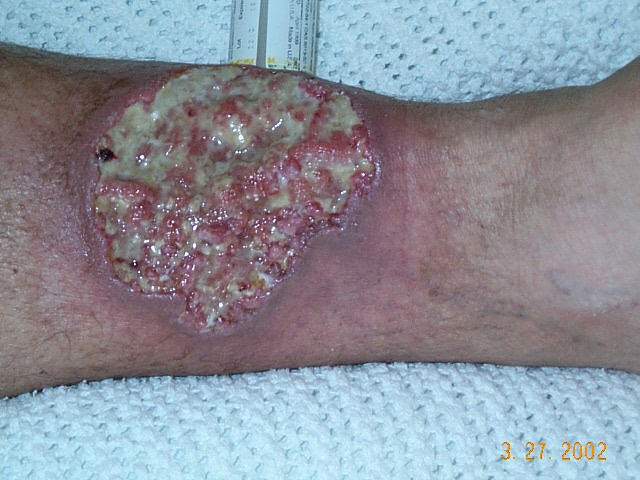
Pyoderma gangrenosum is a rare, inflammatory skin disease where painful pustules or nodules become ulcers that progressively grow. Pyoderma gangrenosum is not infectious.
Treatments may include corticosteroids, ciclosporin, infliximab, or canakinumab.
The disease was identified in 1908. It affects approximately 1 person in 100,000 in the population. Though it can affect people of any age, it mostly affects people in their 40s and 50s.
There are two main types of pyoderma gangrenosum:
Other variations are:
The following are conditions commonly associated with pyoderma gangrenosum:
A rare syndromic association called pyogenic arthritis, pyoderma gangrenosum and acne syndrome (PAPA syndrome), a type of autoinflammatory disorder, is associated with mutations in the proline-serine-threonine phosphatase-interacting 1 gene (PSTPIP1).
Though the cause is not well understood, the disease is thought to be due to immune system dysfunction, and particularly improper functioning of neutrophils. In support of an immune cause, a variety of immune mediators such as interleukin (IL)-8, IL-1β, IL-6, interferon (IFN)-γ, granulocyte colony-stimulating factor, tumor necrosis factor alpha, matrix metalloproteinase (MMP)-9, MMP10, and elafin have all been reported to be elevated in patients with pyoderma gangrenosum.
Hub AI
Pyoderma gangrenosum AI simulator
(@Pyoderma gangrenosum_simulator)
Pyoderma gangrenosum
Pyoderma gangrenosum is a rare, inflammatory skin disease where painful pustules or nodules become ulcers that progressively grow. Pyoderma gangrenosum is not infectious.
Treatments may include corticosteroids, ciclosporin, infliximab, or canakinumab.
The disease was identified in 1908. It affects approximately 1 person in 100,000 in the population. Though it can affect people of any age, it mostly affects people in their 40s and 50s.
There are two main types of pyoderma gangrenosum:
Other variations are:
The following are conditions commonly associated with pyoderma gangrenosum:
A rare syndromic association called pyogenic arthritis, pyoderma gangrenosum and acne syndrome (PAPA syndrome), a type of autoinflammatory disorder, is associated with mutations in the proline-serine-threonine phosphatase-interacting 1 gene (PSTPIP1).
Though the cause is not well understood, the disease is thought to be due to immune system dysfunction, and particularly improper functioning of neutrophils. In support of an immune cause, a variety of immune mediators such as interleukin (IL)-8, IL-1β, IL-6, interferon (IFN)-γ, granulocyte colony-stimulating factor, tumor necrosis factor alpha, matrix metalloproteinase (MMP)-9, MMP10, and elafin have all been reported to be elevated in patients with pyoderma gangrenosum.
Recent media