
Hubbry Logo
Q ScoreQ ScoreMain
Open search
Q Score
Community hub
Q Score
logo
7 pages, 0 posts
0 subscribers
Be the first to start a discussion here.
Q Score
Q Score
from Wikipedia

The Q Score (popularly known as Q-Rating) is a measurement of the familiarity and appeal of a brand, celebrity, company, or entertainment product (e.g., television show) used in the United States. The more highly regarded the item or person is, the higher the Q Score among those who are aware of the subject. Q Scores and other variants are primarily used by the advertising, marketing, media, and public relations industries.

Usage

[edit]

The Q Score is a metric that determines a "quotient" ("Q") factor through mail and online panelists who make up representative samples of the population. The score identifies the familiarity of an athlete, brand, celebrity, poet, entertainment offering (e.g., television show), or licensed property, and measures the appeal of each among people familiar with the entity being measured.[1] Other popular synonyms include Q rating, Q factor, and simply Q.[2]

History

[edit]

The Q Score was developed in 1963 by Jack Landis and is owned by Marketing Evaluations, Inc,[3] the company he founded in 1964.[2] Q Scores are calculated for the population as a whole as well as by demographic groups such as age, education level, gender, income, or marital status.[2]

Calculation

[edit]

Q Score respondents are given choices for each person or item being surveyed:

   A. One of my favorites.   B. Very Good   C. Good   D. Fair   E. Poor   F. Never heard of

The positive Q Score is calculated by counting how many respondents answered A divided by the number of respondents answering A-E, and calculating the percentage.[4][5] (that is, multiplying the fraction by 100). Put another way,
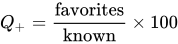
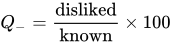
Similarly, the negative Q Score is calculated by calculating the percentage of respondents who answered D or E relative to respondents who answered A to E.[6]
Alternatives

[edit]

Other companies have created alternative measures and metrics related to the likability, popularity, and appeal of athletes, brands, celebrities, entertainment offerings, or licensed properties. Marketing Evaluations claims the Q Score is more valuable to marketers than other popularity measurements,[3] such as the Nielsen ratings, because Q Scores indicate not only how many people are aware of or watch a show but also how those people feel about the entity being measured. A well-liked television show, for example, may be worth more as a commercial vehicle to an advertiser than a higher-rated show that people don’t like as much. Emotional bonding with a show means stronger viewer involvement and audience attention, which are very desirable to sponsors. Viewers who regard the show as a "favorite" have higher awareness of the show's commercial content.[citation needed]

Forms

[edit]

Marketing Evaluations regularly calculates Q Scores in eight categories:[7]

  • Brand Attachment Q rates brand and company names
  • Cable Q rates cable television programs
  • Cartoon Q rates cartoon characters, video games, toys and similar products
  • Dead Q rates the current popularity of deceased celebrities
  • Kids Product Q rates children's responses to brand and company names
  • Performer Q rates living celebrities
  • Sports Q rates sports figures
  • TVQ rates broadcast television programs

Cable Q and TVQ scores are calculated for all regularly scheduled broadcast and cable shows.

Other Q Scores are calculated to order for clients who want to research public perception of a brand or celebrity. For example, in 2000, IBM hired Marketing Evaluations to calculate the Q Score for Deep Blue, the supercomputer that defeated chess Grandmaster Garry Kasparov. Deep Blue’s Q Score was 9, meaning the computer was as familiar and appealing at the time as Carmen Electra, Howard Stern, and Bruce Wayne. In contrast, Albert Einstein’s Q Score at the time was 56, while Larry Ellison and Scott McNealy each received a Q Score of 6.[8][9]

Similar metrics

[edit]

References

[edit]
[edit]
Revisions and contributorsEdit on WikipediaRead on Wikipedia
from Grokipedia
The Q Score, also known as the Q Rating, is a metric that measures the recognition and positive appeal of celebrities, , brands, characters, and other media entities among the U.S. public. Developed in 1963 by Jack Landis for Marketing Evaluations, Inc., it has become the recognized industry standard for assessing the potential value of endorsements in , , and decisions. The "Q" originally stood for "quality," reflecting its focus on both how well-known a subject is and how favorably it is viewed. Q Scores are calculated using data from biannual online surveys conducted by Marketing Evaluations, involving approximately 1,800 nationally representative respondents aged 6 and older. The formula multiplies the percentage of respondents who report familiarity with the subject by the percentage who express a positive of it, yielding a score that can range from negative values for disliked entities to highs exceeding 20 for exceptionally popular figures. Results are segmented by key demographics, including age, gender, income, education, and , allowing for targeted analysis in diverse markets such as consumers or parents of young children. Widely utilized since its inception, the Q Score informs casting choices for commercials, selection of brand ambassadors, and evaluations of program viability, with specialized variants covering deceased celebrities, fictional characters, and even adult-oriented brands. Competitors like Nielsen's N-Score have emerged, but the original Q Score remains influential due to its long track record and comprehensive coverage of numerous subjects per study.

Introduction

Definition and Purpose

The Q Score, also known as the Q-Rating, is a proprietary metric that quantifies the familiarity and likability of brands, celebrities, companies, or products among consumers, primarily in the United States. Developed by Marketing Evaluations, Inc., it serves as an industry standard for evaluating public recognition and positive sentiment toward these entities. The primary purpose of the Q Score is to provide marketers, advertisers, and media professionals with insights into the emotional connection and endorsement potential of a subject, enabling better predictions of consumer behavior and campaign effectiveness. By assessing both awareness levels and favorability, it informs strategic decisions in areas such as partnerships, ambassadorships, and content development. The term "Q" stands for "," reflecting its origin in dividing the percentage of positive responses (those rating the subject as "one of my favorites") by the recognition rate to yield a balanced measure of appeal. For example, scores above 20 are considered excellent indicators of strong resonance, while lower values signal limited or negative public engagement.

Key Components

The Q Score fundamentally relies on the familiarity percentage, which represents the proportion of survey respondents who recognize the subject, such as a or , typically elicited through questions like "Have you heard of [subject]?" This metric establishes the baseline awareness level within the sampled population, often drawn from nationally representative panels aged 6 and older. Among those familiar with the subject, likability ratings are assessed using a standardized five-point scale: A (One of my favorites), B (Very good), C (Good), D (Fair), and E (Poor), with an additional F option for those unfamiliar. This scale captures subjective appeal and is applied only to respondents indicating recognition, ensuring ratings reflect informed opinions rather than . The Q Score is calculated as the percentage of familiar respondents (A through E) who provide an A rating ("One of my favorites"), providing a measure of strong positive appeal. Negative appeal is similarly quantified as the percentage of D and E ratings among the familiar group, signaling sentiment risks and yielding a negative Q Score. This approach offers a nuanced view of overall public sentiment beyond mere recognition. Demographic segmentation enhances the Q Score's utility by analyzing how familiarity and appeal vary across groups defined by age, gender, region, income, education, ethnicity, and other factors, enabling targeted insights for specific audiences. For instance, generational breakdowns, such as teens versus adults, reveal differing appeal levels, as seen in performer profiles that include full demographic complements. Traditional Q Score surveys, while robust for mainstream subjects, may overlook digital metrics like sentiment, prompting modern adaptations that incorporate online engagement data for influencers and stars; for example, digital acts like achieved a positive Q Score of 30 among teens in 2016, comparable to some traditional celebrities, though with lower overall familiarity (24%).

Historical Background

Origins and Development

The Q Score was developed in by Jack Landis, a market researcher and former executive, to quantify the public's familiarity and appeal toward television personalities, programs, and related entertainment elements. This metric emerged as a response to the need for qualitative insights into audience affinity, complementing quantitative viewership measures like Nielsen ratings that emphasized raw audience size over emotional connection or likability. Landis designed the system using surveys distributed to representative household panels, establishing a standardized way to assess how recognizable and positively regarded individuals or shows were among consumers. Marketing Evaluations, Inc. (MEI), the company Landis founded in 1963 and based in New York, has owned and administered the Q Score since its inception. MEI began operations as a specialized firm, conducting biannual surveys of approximately 1,800 respondents aged 6 and older to generate the scores, which quickly became a tool for broadcasters and advertisers seeking to evaluate talent viability. The system's early focus was on television, where it provided actionable data for casting decisions and program development in an era dominated by network broadcasting. In its initial years during the , the Q Score gained widespread use among studios and networks for assessing hosts and shows, helping to gauge star power beyond mere ratings. By the , its application broadened to include celebrities across , , and , as well as emerging product endorsements, solidifying its role as an industry benchmark for appeal measurement. Under continued ownership by MEI as of 2025, the Q Score maintains operational continuity, with surveys now including measurements of appeal for influencers and brand ambassadors.

Early Adoption and Evolution

In the 1970s and 1980s, the Q Score expanded beyond its initial focus on television personalities to become a key tool for major U.S. broadcast networks, including ABC, , and , in evaluating talent appeal and program viability. Advertisers increasingly relied on it for selecting endorsers in high-stakes campaigns, such as and product placements, where high Q Scores indicated strong consumer familiarity and likability among target demographics. For instance, during this period, celebrities like achieved record-high Q Scores exceeding 70, underscoring the metric's influence on casting decisions and endorsement deals. By the 1990s, the Q Score's applications broadened to non-entertainment figures, including politicians and brands, reflecting its growing utility in assessing public appeal across sectors. Politicians were routinely evaluated using the metric to gauge voter familiarity and favorability, with examples from presidential campaigns highlighting its role in strategic communications. In entertainment, exemplified peak adoption, attaining one of the highest Q Scores among TV hosts with a 90% familiarity rating by the late , which bolstered her influence in endorsements and media ventures. The and marked an evolutionary shift for the Q Score, aligning with broader survey industry trends toward digital methodologies amid declining traditional mail panels. Integration with enabled more dynamic applications, though the core metric retained its foundation in consumer panels for reliability. The metric has faced criticism for its toward U.S. audiences, derived from domestic consumer samples, prompting adaptations for international markets to account for regional preferences.

Methodology

Data Collection

Data for Q Scores is gathered through structured surveys administered by Marketing Evaluations, Inc., utilizing nationally representative consumer panels to measure familiarity and appeal across various demographics. These surveys are conducted online with a balanced panel of approximately 1,800 to 2,000 U.S. respondents aged 6 and older, ensuring broad coverage that includes children, teens, and adults. Panel recruitment emphasizes representativeness, with samples stratified by key demographics such as age, , and to mirror the national population and enable reliable generalizations. This stratification helps mitigate biases and supports the applicability of results to diverse segments. The survey presents respondents with a list of subjects (e.g., celebrities, brands, or characters) and asks them to rate each on a six-point scale: A ("One of my favorites"), B ("Very good"), C ("Good"), D ("Fair"), E ("Poor"), or F ("Never heard of"). Responses of A through E indicate familiarity, while F denotes lack of recognition. This format efficiently captures both recognition and likability in a single choice per subject. In the , Q Score has shifted predominantly to digital panels, improving and response rates compared to earlier mail or phone methods, while incorporating advanced validation techniques to enhance data accuracy. Standard studies occur biannually in and July, with ad-hoc surveys available for targeted evaluations; as a service, individual Q Score queries typically cost several thousand dollars.

Calculation Formulas

The Q Score, also referred to as the positive Q Score and denoted as Q+Q_{+}, measures the proportion of favorable opinions among those familiar with the subject and is calculated using the formula Q+=% of respondents rating A (favorites)% of respondents familiar (A-E)×100.Q_{+} = \frac{\% \text{ of respondents rating A (favorites)}}{\% \text{ of respondents familiar (A-E)}} \times 100. This normalizes the percentage of respondents who rate the subject as one of their favorites (category A) by the percentage who are familiar with it (categories A through E combined), yielding a value that reflects appeal specifically within the aware audience. Similarly, the negative Q Score, QQ_{-}, quantifies dislike among the familiar respondents via Q=% of respondents rating D or E (disliked)% of respondents familiar (A-E)×100.Q_{-} = \frac{\% \text{ of respondents rating D or E (disliked)}}{\% \text{ of respondents familiar (A-E)}} \times 100. Here, the numerator captures the combined rating the subject as fair or poor (categories D or E), divided by the familiarity for normalization. The derivation for both involves first computing raw percentages from survey tallies—familiarity as the share selecting A-E out of total respondents, and favorable/unfavorable shares relative to the total—before applying the ratio and scaling by 100 to express as a percentage. The Q Score (Q+) ranges from 0 (no one familiar rates as favorite) to 100 (all familiar rate as favorite); the typical average across subjects is 4, with scores exceeding 20 deemed excellent. High negative Q- scores (e.g., above 20-30 depending on context) indicate unfavorable appeal among the familiar. These thresholds establish context for interpreting relative popularity, prioritizing appeal over mere recognition. To derive subgroup scores, calculations are performed by segmenting the sample by demographic factors such as age, , or , and recomputing the formulas within those subsets—for instance, yielding a distinct Q Score among 18-34-year-old females by restricting the denominator and numerator to that group's responses. This adjustment ensures targeted insights without altering the core normalization process. Consider a representative example for a where 40% of respondents are familiar (A-E), 20% rate A (favorites), and 5% rate D or E (disliked). The Q Score is then Q+=2040×100=50Q_{+} = \frac{20}{40} \times 100 = 50, and the negative Q Score is Q=540×100=12.5Q_{-} = \frac{5}{40} \times 100 = 12.5—well above average for Q+ and indicative of strong endorsement potential, with low dislike amplifying net positivity when familiarity is moderate.

Applications

In Marketing and Advertising

In marketing and advertising, Q Scores serve as a key metric for assessing the appeal of celebrities, characters, and products to inform strategic decisions in endorsements and campaign development. Marketers use Q Scores to identify endorsers whose high familiarity and likability can enhance perception and drive . Research indicates that brands partnering with celebrities can experience significant increases in sales, underscoring the metric's role in selecting endorsers that align with target audiences. Q Scores also facilitate by evaluating consumer reactions to , ad creatives, or concepts before launch, allowing to refine elements for maximum appeal. The Product Q variant specifically measures responses to and items, helping predict market reception. A notable example is IBM's Deep Blue, which achieved a Q Score of 9 in 2000, reflecting strong public fascination and positioning it as an appealing symbol of in promotional contexts. This score highlighted Deep Blue's celebrity-like status among consumers, aiding IBM in leveraging it for brand in tech . For campaign optimization, marketers track shifts in Q Scores following ad exposure to gauge and adjust strategies accordingly. By monitoring how endorsements or creatives alter familiarity and favorability, companies can quantify emotional resonance and refine future efforts. In practice, this has been exemplified by brands like Nike, which used high-Q endorsers such as to differentiate products and boost long-term market positioning. One illustrative case is the long-term use of character-based , where Q Scores correlated with sustained growth; for example, animated figures in holiday campaigns have shown measurable rises in brand likability tied to increased . However, Q Scores have limitations, as they emphasize broad appeal and recognition rather than direct predictors of purchase intent, requiring complementary metrics for comprehensive ROI assessment.

In Entertainment and Media

In the entertainment and media industry, Q Scores serve as a key metric for guiding content production, talent selection, and strategies to enhance audience engagement. By quantifying the familiarity and likability of performers, shows, and characters, these scores help networks and studios predict viewer draw and optimize programming decisions. High scores indicate broad appeal that can drive ratings and sponsorships, while low ones signal risks in audience retention, influencing everything from pilot greenlighting to series renewals. Television and film casting heavily relies on Q Scores to evaluate hosts and actors, ensuring selections align with demographic preferences to boost viewership. For example, Ryan Seacrest's Q Score of 17 among adult women in 2013—exceeding the average of 13 for TV hosts—underscored his viability for high-profile roles like hosting , where his appeal contributed to the show's sustained success. Similarly, traditional celebrities with strong scores, such as with a Q Score of 46 among teens in 2016, are prioritized for lead roles due to their proven draw in films and series. Producers use these metrics to mitigate risks, favoring talents whose scores promise higher engagement over untested options. Q Scores also determine show viability by assessing overall program appeal, often comparing entries within time slots or genres. In syndicated television, for instance, a score reflecting strong positive recognition can justify continued investment, while declines prompt reevaluation. Katie Couric's Q Score fell to 10 among women in 2013, with 21% viewing her negatively, directly contributing to the cancellation of her daytime amid sagging ratings and advertiser concerns. This illustrates how Q Scores inform viability assessments, helping executives gauge whether a program's cultural supports long-term . In evaluating public figures and events, Q Scores extend to politicians and historical icons for media integrations, such as news segments or specials, where appeal metrics guide coverage and endorsements. For deceased figures in educational or documentary content, "Dead Q" variants measure enduring popularity; these inform licensing for branded media, like character revivals or biopics. The 2020s have seen Q Scores adapt to streaming and digital platforms, where services evaluate actor and creator appeal for series development and partnerships. and similar outlets incorporate these scores to forecast content performance, favoring casts with high likability to enhance subscriber retention. Digital influencers on and now receive dedicated Q Score analyses, with early examples like with a Q Score of 40 among children aged 6-12 in 2016, paving the way for cross-media collaborations. As of 2025, such metrics remain standard for influencer integrations in streaming originals and short-form content deals. Overall, Q Scores profoundly impact industry economics: elevated ratings enable larger production budgets through anticipated ad premiums and syndication value, whereas subpar scores often trigger cancellations to avoid losses. For instance, celebrities like experienced a sharp Q Score drop—from positive to negative—following the 2022 Oscars incident, limiting future project funding and highlighting the metric's role in .

Forms and Extensions

Marketing Evaluations, Inc. (MEI) offers eight proprietary categories of Q Scores, each adapted to measure appeal and familiarity in specific domains. These include Performer Q, which assesses celebrities, athletes, and influencers; TVQ for television programs, hosts, and personalities; Character Q for animated or fictional figures; Dead Q for deceased individuals; Performer Q targeting Hispanic consumer segments; Kids & Moms evaluating family-oriented ; Adult Brand Q gauging general adult brand attachment and preference; and Custom Q for tailored, client-specific applications. Extensions of the core Q Score framework apply the methodology to niche entities beyond human performers. Character Q, for instance, evaluates fictional characters such as , quantifying their recognition and likability among audiences for licensing and merchandising decisions. Sports figures, including athletes like stars or Olympians, are covered under Performer Q, allowing comparisons of their endorsement potential alongside entertainers. Performer Q encompasses online influencers as part of its assessment of celebrities and athletes. For example, IBM's Deep Blue, the chess-playing computer, earned a Q Score of 9 in 2000—the first for a non-human technical entity—highlighting 45% familiarity and strong positive appeal among surveyed households. Similarly, Oprah Winfrey's consistently high Performer Q scores, such as a 90% familiarity rating in 1997, have been adapted into brand attachment variations to track long-term consumer loyalty for her media ventures.

Alternatives and Similar Metrics

While the Q Score provides a targeted measure of familiarity and appeal primarily for U.S. and contexts, several alternatives offer complementary or contrasting approaches to assessing and consumer sentiment. Nielsen Ratings, for instance, focus on quantifying television viewership volume through panels and demographic data, emphasizing size and reach rather than qualitative appeal or likability. This quantitative metric helps networks and advertisers gauge exposure but lacks the Q Score's emphasis on positive perceptions among viewers. The (NPS) serves as another loyalty-oriented alternative, particularly in brand and endorsement evaluation, by asking respondents their likelihood to recommend a product, service, or on a 0-10 scale and calculating the score as the percentage of promoters (9-10) minus detractors (0-6). Unlike the Q Score, NPS prioritizes and retention potential over familiarity, making it useful for assessing long-term endorsement impact but less effective for initial recognition metrics. In the realm of celebrity and talent evaluation, the Davie-Brown Index (DBI) expands on Q Score principles by surveying consumer perceptions across multiple attributes, including , , influence, and trust, to generate a composite score for more than 1,500 celebrities. Similarly, the E-Score from E-Poll combines and data from a database of more than 14,000 celebrities, ranking them on a 1-100 scale to predict marketability and resonance with target audiences. These multi-dimensional tools provide broader insights into endorsement viability compared to the Q Score's binary familiarity-popularity focus. Post-2020, social media metrics have emerged as accessible, real-time alternatives, with engagement rates—such as likes, shares, and comments per post—offering proxies for through interaction volume, while tools like use AI and to classify online mentions as positive, negative, or neutral across platforms. These digital metrics enable global, instantaneous tracking of brand or celebrity buzz, contrasting the Q Score's periodic, survey-based U.S.-centric methodology. By 2025, AI-driven metrics are gaining traction for predictive appeal assessment, such as ReelMind's AI analysis of celebrity influence through video popularity rankings and social impact modeling, which forecast endorsement effectiveness using on data. While the Q Score remains a , expensive staple in traditional U.S. TV and —often costing thousands per report—many alternatives like tools and AI platforms are freely available or lower-cost, facilitating broader digital adoption but sometimes sacrificing depth in qualitative nuance.

References

Add your contribution
Related Hubs
User Avatar
No comments yet.