Hubbry Logo
search
logo

Quantum Fourier transform

logo
Community Hub0 Subscribers
Read side by side
from Wikipedia

In quantum computing, the quantum Fourier transform (QFT) is a linear transformation on quantum bits, and is the quantum analogue of the discrete Fourier transform. The quantum Fourier transform is a part of many quantum algorithms, notably Shor's algorithm for factoring and computing the discrete logarithm, the quantum phase estimation algorithm for estimating the eigenvalues of a unitary operator, and algorithms for the hidden subgroup problem. The quantum Fourier transform was discovered by Don Coppersmith.[1] With small modifications to the QFT, it can also be used for performing fast integer arithmetic operations such as addition and multiplication.[2][3][4]

The quantum Fourier transform can be performed efficiently on a quantum computer with a decomposition into the product of simpler unitary matrices. The discrete Fourier transform on amplitudes can be implemented as a quantum circuit consisting of only Hadamard gates and controlled phase shift gates, where is the number of qubits.[5] This can be compared with the classical discrete Fourier transform, which takes gates (where is the number of bits), which is exponentially more than .

The quantum Fourier transform acts on a quantum state vector (a quantum register), and the classical discrete Fourier transform acts on a vector. Both types of vectors can be written as lists of complex numbers. In the classical case, the vector can be represented with e.g. an array of floating-point numbers, and in the quantum case it is a sequence of probability amplitudes for all the possible outcomes upon measurement (the outcomes are the basis states, or eigenstates). Because measurement collapses the quantum state to a single basis state, not every task that uses the classical Fourier transform can take advantage of the quantum Fourier transform's exponential speedup.

The best quantum Fourier transform algorithms known (as of late 2000) require only gates to achieve an efficient approximation, provided that a controlled phase gate is implemented as a native operation.[6]

Definition

[edit]

The quantum Fourier transform is the classical discrete Fourier transform applied to the vector of amplitudes of a quantum state, which has length if it is applied to a register of qubits.

The classical Fourier transform acts on a vector and maps it to the vector according to the formula


where is an N-th root of unity.

Similarly, the quantum Fourier transform acts on a quantum state and maps it to a quantum state according to the formula

(Conventions for the sign of the phase factor exponent vary; here the quantum Fourier transform has the same effect as the inverse discrete Fourier transform, and conversely.)

Since is a rotation, the inverse quantum Fourier transform acts similarly but with

In case that is a basis state, the quantum Fourier transform can also be expressed as the map

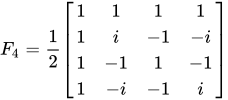
Equivalently, the quantum Fourier transform can be viewed as a unitary matrix (or quantum gate) acting on quantum state vectors, where the unitary matrix is the DFT matrix

where . For example, in the case of and phase the transformation matrix is

Properties

[edit]

Unitarity

[edit]

Most of the properties of the quantum Fourier transform follow from the fact that it is a unitary transformation. This can be checked by performing matrix multiplication and ensuring that the relation holds, where is the Hermitian adjoint of . Alternately, one can check that orthogonal vectors of norm 1 get mapped to orthogonal vectors of norm 1.

From the unitary property it follows that the inverse of the quantum Fourier transform is the Hermitian adjoint of the Fourier matrix, thus . Since there is an efficient quantum circuit implementing the quantum Fourier transform, the circuit can be run in reverse to perform the inverse quantum Fourier transform. Thus both transforms can be efficiently performed on a quantum computer.

Circuit implementation

[edit]

The quantum gates used in the circuit of qubits are the Hadamard gate and the dyadic rational phase gate :


The circuit is composed of gates and the controlled version of :

Quantum circuit for Quantum-Fourier-Transform with n qubits (without rearranging the order of output states) using the fractional binary notation defined below.

An orthonormal basis is composed of basis states

These basis states span all possible states of the qubits. As in, each is:

where, with tensor product notation , indicates that qubit is in state , with either 0 or 1. By convention, the basis state index is the binary number encoded by the , with the most significant bit.

The action of the Hadamard gate is , where the sign depends on .

The quantum Fourier transform can be written as the tensor product of a series of terms:

Using the fractional binary notation

the action of the quantum Fourier transform can be expressed in a compact manner:

To obtain this state from the circuit depicted above, a swap operation of the qubits must be performed to reverse their order. At most swaps are required.[5]

Because the discrete Fourier transform, an operation on n qubits, can be factored into the tensor product of n single-qubit operations, it is easily represented as a quantum circuit (up to an order reversal of the output). Each of those single-qubit operations can be implemented efficiently using one Hadamard gate and a linear number of controlled phase gates. The first term requires one Hadamard gate and controlled phase gates, the next term requires one Hadamard gate and controlled phase gate, and each following term requires one fewer controlled phase gate. Summing up the number of gates, excluding the ones needed for the output reversal, gives gates, which is quadratic polynomial in the number of qubits. This value is much smaller than for the classical Fourier transformation.[7]

The circuit-level implementation of the quantum Fourier transform on a linear nearest neighbor architecture has been studied before.[8][9] The circuit depth is linear in the number of qubits.

Example

[edit]

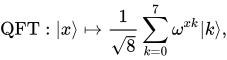
The quantum Fourier transform on three qubits, with , is represented by the following transformation:


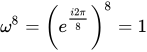
where is an eighth root of unity satisfying .

The matrix representation of the Fourier transform on three qubits is:
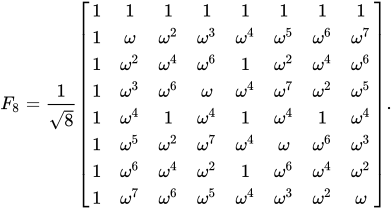
The 3-qubit quantum Fourier transform can be rewritten as:

The following sketch shows the respective circuit for (with reversed order of output qubits with respect to the proper QFT):

QFT for 3 Qubits (without rearranging the order of the output qubits)

As calculated above, the number of gates used is which is equal to , for .

Relation to quantum Hadamard transform

[edit]

Using the generalized Fourier transform on finite (abelian) groups, there are actually two natural ways to define a quantum Fourier transform on an n-qubit quantum register. The QFT as defined above is equivalent to the DFT, which considers these n qubits as indexed by the cyclic group . However, it also makes sense to consider the qubits as indexed by the Boolean group , and in this case the Fourier transform is the Hadamard transform. This is achieved by applying a Hadamard gate to each of the n qubits in parallel.[10][11] Shor's algorithm uses both types of Fourier transforms, an initial Hadamard transform as well as a QFT.

For other groups

[edit]

The Fourier transform can be formulated for groups other than the cyclic group, and extended to the quantum setting.[12] For example, consider the symmetric group .[13][14] The Fourier transform can be expressed in matrix form

where is the element of the matrix representation of , is the set of paths from the root node to in the Bratteli diagram of , is the set of representations of indexed by Young diagrams, and is a permutation.

Over a finite field

[edit]

The discrete Fourier transform can also be formulated over a finite field , and a quantum version can be defined.[15] Consider . Let be an arbitrary linear map (trace, for example). Then for each define

for and extend linearly.

References

[edit]

Further reading

[edit]
[edit]
Revisions and contributorsEdit on WikipediaRead on Wikipedia
from Grokipedia
The Quantum Fourier transform (QFT) is a unitary linear transformation on the state space of an n-qubit quantum computer that generalizes the classical discrete Fourier transform, mapping an input state $ |j\rangle $ (where $ 0 \leq j < 2^n $) to the superposition state $ \frac{1}{\sqrt{2^n}} \sum_{k=0}^{2^n - 1} e^{2\pi i j k / 2^n} |k\rangle $.[1] First described by Don Coppersmith and popularized by Peter Shor in his 1994 quantum algorithm for integer factorization and discrete logarithms, the QFT serves as a core subroutine that enables efficient period-finding by transforming periodic quantum states into peaked frequency-domain representations.[1] This algorithm achieves polynomial-time performance on a quantum computer, exponentially faster than the best known classical methods for large inputs.[1] The QFT can be implemented using a circuit of depth $ O(n^2) $ consisting of controlled phase rotations and Hadamard gates, followed by bit reversal to reorder the output qubits, making it feasible on near-term quantum hardware despite noise challenges.[1] Beyond Shor's algorithm, the QFT underpins a broad class of quantum algorithms, including those solving the hidden subgroup problem over abelian groups, such as Simon's algorithm for identifying hidden strings and Kitaev's phase estimation for eigenvalue approximation.[2] These applications exploit the QFT's ability to concentrate probability amplitudes near solutions, providing quadratic or exponential speedups over classical counterparts.[2][3]

Fundamentals

Definition

The Quantum Fourier Transform (QFT) is a unitary transformation in quantum computing that functions as the quantum analogue of the classical discrete Fourier transform, converting a quantum state encoding a periodic function into its frequency-domain representation. This transformation leverages the principles of quantum superposition and interference to achieve an exponential speedup in certain computations compared to classical methods.[4] At a high level, the QFT operates on an input state |x⟩ consisting of n qubits, where x represents an integer from 0 to 2^n - 1, and outputs a superposition of basis states |y⟩ whose amplitudes encode the Fourier coefficients associated with x.[5] This mapping allows quantum states to represent and manipulate frequency information in a distributed manner across multiple qubits, enabling efficient extraction of periodicities inherent in the input data.[6] The QFT's primary motivation lies in its role within quantum algorithms that solve problems like period-finding, where classical approaches scale poorly but quantum implementations offer polynomial-time efficiency.[7] Introduced in the context of quantum computing during the 1990s, it was first formalized by Peter Shor in 1994 as a crucial subroutine for factoring large integers.[7]

Mathematical Formulation

The quantum Fourier transform (QFT) on an nn-qubit system acts on the computational basis states as follows: for a basis state j|j\rangle, where j{0,1,,2n1}j \in \{0, 1, \dots, 2^n - 1\} is represented in binary across the nn qubits, the QFT produces
QFTj=12nk=02n1e2πijk/2nk. \text{QFT} |j\rangle = \frac{1}{\sqrt{2^n}} \sum_{k=0}^{2^n - 1} e^{2\pi i j k / 2^n} |k\rangle.
[1] This transformation encodes the input state into a superposition with phases determined by the discrete exponential, analogous to the classical discrete Fourier transform but realized unitarily on a quantum register.
In matrix form, the QFT operator UU is a 2n×2n2^n \times 2^n unitary matrix with elements
Ujk=12nωjk, U_{jk} = \frac{1}{\sqrt{2^n}} \omega^{jk},
where ω=e2πi/2n\omega = e^{2\pi i / 2^n} is a primitive 2n2^n-th root of unity, and the indices j,kj, k label the rows and columns corresponding to the binary-encoded basis states. This Vandermonde structure arises directly from the one-dimensional irreducible representations (characters) of the cyclic group Z2n\mathbb{Z}_{2^n}, which underlies the nn-qubit clock register.
For multi-qubit systems, states are expressed in Dirac notation using tensor products, such as j=jn1j0=l=0n1jl|j\rangle = |j_{n-1} \dots j_0\rangle = \bigotimes_{l=0}^{n-1} |j_l\rangle, where each jl{0,1}j_l \in \{0, 1\} is the ll-th bit of jj, and the qubits are typically ordered from most significant to least significant. The summation in the QFT formula traverses all possible binary strings for kk, ensuring the output spans the full Hilbert space C2n\mathbb{C}^{2^n}. The QFT diagonalizes the clock and shift operators associated with the cyclic group Z2n\mathbb{Z}_{2^n}. The shift operator XX advances the register by one modulo 2n2^n, Xj=j+1mod2nX |j\rangle = |j+1 \mod 2^n\rangle, while the clock operator ZZ applies phases, Zj=ωjjZ |j\rangle = \omega^j |j\rangle. In the Fourier basis provided by the QFT, these operators are simultaneously diagonalized via the characters of the group, transforming the regular representation into a direct sum of one-dimensional irreps.

Properties

Unitarity

The quantum Fourier transform (QFT) is a unitary operator on the Hilbert space of n qubits, meaning it satisfies $ QFT^\dagger QFT = I $, where $ I $ is the identity operator and $ QFT^\dagger $ is the adjoint (Hermitian conjugate) of the QFT.[8] This property ensures that the QFT maps orthonormal bases to orthonormal bases while preserving the structure of quantum states.[9] To verify unitarity, consider the QFT matrix $ F $ with entries $ F_{jk} = \frac{1}{\sqrt{N}} \omega^{jk} $, where $ N = 2^n $ and $ \omega = e^{2\pi i / N} $. The (j,k)(j,k)-th entry of $ F^\dagger F $ is given by
1Nm=0N1ωm(kj), \frac{1}{N} \sum_{m=0}^{N-1} \omega^{m(k-j)},
which is the sum of a geometric series with ratio $ \omega^{k-j} $. This sum equals $ N $ if $ k \equiv j \pmod{N} $ (yielding 1 after normalization by $ N $), and 0 otherwise, due to the formula
m=0N1ωmk=Nδk,0(modN). \sum_{m=0}^{N-1} \omega^{mk} = N \delta_{k,0 \pmod{N}}.
Thus, $ F^\dagger F = I $, confirming that the rows (and columns) of $ F $ are orthonormal.[8][9] As a unitary operator, the QFT is invertible, with its inverse given by $ QFT^\dagger $, which corresponds to the QFT using $ \omega^{-1} $ instead of $ \omega $. This invertibility allows the QFT to be reversed exactly in quantum circuits, supporting reversible quantum computation without loss of information.[10] Unitarity also implies norm preservation: for any quantum state $ |\psi\rangle $, $ | QFT |\psi\rangle | = | |\psi\rangle | $, maintaining the total probability of 1 across the state vector.[11] Furthermore, the QFT preserves inner products in the computational basis, so $ \langle \phi | \psi \rangle = \langle QFT \phi | QFT \psi \rangle $ for any states $ |\phi\rangle $ and $ |\psi\rangle $, ensuring that quantum superpositions and coherences are faithfully transformed without distortion.[11]

Spectral and Shift Properties

The Quantum Fourier Transform (QFT) exhibits key spectral properties that extend beyond its unitarity, particularly in diagonalizing specific quantum operators. The QFT diagonalizes the cyclic shift operator XX, defined on an nn-qubit computational basis as Xj=j+1mod2nX |j\rangle = |j + 1 \mod 2^n\rangle for j=0,,2n1j = 0, \dots, 2^n - 1, yielding eigenvalues ωk\omega^k where ω=e2πi/2n\omega = e^{2\pi i / 2^n} and k=0,,2n1k = 0, \dots, 2^n - 1. This diagonalization arises because the eigenbasis of the QFT consists of states that are simultaneous eigenvectors of both the shift and clock operators, allowing the QFT to transform the shift into a diagonal phase matrix. Such a property underpins the efficiency of QFT in algorithms involving periodic structures, like order-finding and phase estimation, by revealing the underlying frequency components of shift-invariant operations. A direct analogue of the classical discrete Fourier transform's shift theorem applies to the QFT, linking spatial shifts to phase modulations in the frequency domain. For a state representing a function ff shifted by mm positions, the QFT output is fσm^(k)=e2πimk/2nf^(k)\widehat{f \circ \sigma_m}(k) = e^{2\pi i m k / 2^n} \hat{f}(k), where σm\sigma_m denotes the shift and f^\hat{f} is the unshifted QFT. This modulation property converts additive shifts in the position basis into multiplicative phases, enabling quantum algorithms to detect hidden shifts efficiently without exhaustive search. It is particularly valuable in problems where the shift encodes unknown parameters, as the phase factors amplify interference patterns in the Fourier basis. The QFT's formulation inherently imposes periodicity on inputs over 2n2^n points, mirroring the discrete nature of quantum registers and leading to aliasing for non-periodic signals, where higher frequencies wrap around the spectrum. This periodicity ensures the transform operates within a finite cyclic group, but it requires careful encoding to mitigate artifacts in applications involving aperiodic data. Complementing these, the QFT obeys a convolution theorem: the transform of a cyclic convolution fgf * g equals the pointwise (Hadamard) product of the individual transforms, fg^=f^g^\widehat{f * g} = \hat{f} \odot \hat{g}. In quantum contexts, this facilitates operations like multiplication by converting convolutions to simpler multiplications in the Fourier domain, supporting scalable quantum arithmetic routines.[12]

Implementation

Quantum Circuit Design

The standard quantum circuit for the Quantum Fourier transform (QFT) on nn qubits is constructed using Hadamard gates and controlled-phase rotation gates, realizing the unitary operator that performs the QFT on the computational basis states.[13] The qubits are typically labeled from 0 to n1n-1, with qubit 0 as the least significant bit. The circuit construction proceeds iteratively from the least to the most significant qubit. First, a Hadamard gate HH is applied to qubit 0, creating a uniform superposition in that register. Then, controlled-phase rotation gates are applied: qubit 0 serves as the control for phase rotations on qubits 1 through n1n-1, with the rotation angle for the gate targeting qubit jj given by 2π/2j+12\pi / 2^{j+1}. This process repeats for subsequent qubits; for qubit 1, a Hadamard gate is applied, followed by controlled-phase rotations on qubits 2 through n1n-1 with angles 2π/2j2\pi / 2^{j} for target qubit j>1j > 1. In general, for control qubit kk (where 0k<n0 \leq k < n), a Hadamard is applied, followed by controlled-phase gates targeting qubits j>kj > k with phase e2πi/2jk+1e^{2\pi i / 2^{j-k+1}}. At the end, swap gates may be included to reverse the qubit order, as the output frequencies appear in bit-reversed order relative to the input.[13] The phase rotation gates RmR_m are diagonal unitaries defined as
Rm=(100e2πi/2m), R_m = \begin{pmatrix} 1 & 0 \\ 0 & e^{2\pi i / 2^m} \end{pmatrix},
for m2m \geq 2, and implemented as controlled operations where the control qubit determines whether the phase is applied to the target. Each qubit receives one Hadamard gate, and the total number of controlled-phase gates is n(n1)/2n(n-1)/2, leading to an overall decomposition requiring O(n2)O(n^2) elementary gates. The Hadamard and controlled-phase gates can be further decomposed into more primitive operations if needed, such as using controlled-NOT and single-qubit rotations for the phases.[13] In circuit diagrams, the QFT is represented as a linear array of nn qubit wires, with Hadamard gates placed at the start of each wire. The controlled-phase gates form an upper-triangular structure: vertical control lines connect each qubit kk to all subsequent targets j>kj > k, with phase labels indicating the RmR_m gate for m=jk+1m = j - k + 1. This results in a dense network of controls, emphasizing the iterative buildup of phase factors from lower to higher bits. Swap gates, if used, appear as crossing pairs at the circuit's output to reorder the qubits.[13] For fault-tolerant quantum computing, where precise rotations are costly, the QFT circuit can be approximated by truncating small phase angles (e.g., setting RmIR_m \approx I for large mm) or removing distant controlled interactions, reducing the gate count to O(nlogn)O(n \log n) while maintaining sufficient accuracy for applications like phase estimation. Such approximations preserve the essential Fourier structure with bounded error and are optimized for metrics like T-gate depth in Clifford+T libraries.

Computational Complexity

The exact quantum Fourier transform (QFT) on nn qubits requires Θ(n2)\Theta(n^2) single-qubit and controlled-phase gates in its standard implementation, comprising nn Hadamard gates, n(n1)/2n(n-1)/2 controlled-phase gates, and n/2n/2 swap gates to reverse the output order.[14] [13] This quadratic gate complexity arises from the need for each qubit to interact with all others through controlled rotations, reflecting the all-to-all connectivity inherent in the transform. Recent advancements have improved the exact QFT to Θ(nlog2n)\Theta(n \log^2 n) gates using recursive partitioning, though the classical standard remains the baseline for most analyses.[14] Approximate versions of the QFT mitigate this overhead by truncating controlled rotations with sufficiently small phase angles, bounding the diamond norm error to at most ϵ\epsilon while reducing the gate count to O(nlogn)O(n \log n).[15] Such approximations are particularly valuable in fault-tolerant settings, where the T-gate count—a measure of non-Clifford operations—can be lowered from O(nlog2n)O(n \log^2 n) to O(nlogn)O(n \log n) using measurement-based circuits and a shared phase gradient state, enabling practical implementations with controlled error. Further optimizations as of October 2025 have reduced the T-depth in approximate QFT implementations.[15][16] These reductions maintain the transform's utility in algorithms while trading precision for efficiency. The QFT operates on nn logical qubits to perform a 2n2^n-point transform, encoding the input state in the computational basis of these qubits without additional logical qubits for the core operation.[14] In fault-tolerant quantum computing, however, implementing the required single-qubit rotations demands auxiliary qubits (ancillas) to encode approximate rotations via Clifford and T gates, with the total number scaling as O(nlog(1/ϵ))O(n \log(1/\epsilon)) depending on the error tolerance and encoding scheme.[17] The circuit depth of the standard exact QFT is O(n)O(n), as the controlled-phase gates on each target qubit must be applied sequentially but can proceed in parallel across qubits.[13] With enhanced parallelism via ancilla qubits or measurement feedback, the depth can be reduced to O(logn+loglog(1/ϵ))O(\log n + \log \log(1/\epsilon)) for approximate QFTs, facilitating faster execution on near-term hardware.[18] In comparison to the classical fast Fourier transform (FFT), which requires O(NlogN)O(N \log N) operations for an NN-point transform with N=2nN=2^n, the QFT achieves an exponential speedup by evaluating the transform over superpositions in O(n2)=O(log2N)O(n^2) = O(\log^2 N) gates, enabling the processing of exponentially larger inputs on logarithmic resources.[19] This advantage is most pronounced when only a subset of Fourier coefficients is needed, as full measurement of the QFT output would collapse the speedup.[19]

Examples and Applications

Basic Qubit Examples

The one-qubit Quantum Fourier Transform (QFT) is equivalent to the Hadamard gate HH, which acts on the computational basis states as H0=12(0+1)H |0\rangle = \frac{1}{\sqrt{2}} (|0\rangle + |1\rangle) and H1=12(01)H |1\rangle = \frac{1}{\sqrt{2}} (|0\rangle - |1\rangle).[20][21] This transformation creates an equal superposition for 0|0\rangle and a superposition with a relative phase for 1|1\rangle, illustrating the core idea of the QFT in spreading the amplitude across basis states with phase factors.[21] On the Bloch sphere, the initial state 0|0\rangle lies at the north pole (along the positive z-axis). Applying the Hadamard gate rotates this state to the equator, specifically to the point (1,0,0)(1, 0, 0) in Cartesian coordinates, representing the superposition 12(0+1)\frac{1}{\sqrt{2}} (|0\rangle + |1\rangle); similarly, 1|1\rangle at the south pole rotates to (1,0,0)(-1, 0, 0). This visualization highlights how the QFT introduces coherence and phase without changing the purity of the single-qubit state. For two qubits, the QFT is a 4×4 unitary matrix with entries Uk,j=12exp(2πikj4)U_{k,j} = \frac{1}{2} \exp\left( \frac{2\pi i \, k j}{4} \right) for k,j=0,1,2,3k, j = 0, 1, 2, 3, where the phase factors involve eiπ/2=ie^{i \pi / 2} = i.[21] Applying this to basis states produces superpositions such as QFT 00=12(00+01+10+11)|00\rangle = \frac{1}{2} (|00\rangle + |01\rangle + |10\rangle + |11\rangle), QFT 01=12(00+i0110i11)|01\rangle = \frac{1}{2} (|00\rangle + i |01\rangle - |10\rangle - i |11\rangle), QFT 10=12(0001+1011)|10\rangle = \frac{1}{2} (|00\rangle - |01\rangle + |10\rangle - |11\rangle), and QFT 11=12(00i0110+i11)|11\rangle = \frac{1}{2} (|00\rangle - i |01\rangle - |10\rangle + i |11\rangle).[21] To compute this step-by-step using the standard QFT circuit (which includes Hadamard gates on each qubit and a controlled-phase gate with angle π/2\pi/2 controlled by the higher qubit on the lower one), consider the input 00|00\rangle. First, apply a Hadamard to the least significant qubit (q0): 0012(00+01)|00\rangle \to \frac{1}{\sqrt{2}} (|00\rangle + |01\rangle). Next, the controlled-phase gate (control q1=0, target q0) applies no phase shift, preserving the state. Then, apply a Hadamard to the most significant qubit (q1): this yields 12(00+01+10+11)\frac{1}{2} (|00\rangle + |01\rangle + |10\rangle + |11\rangle) in the tensor product, but accounting for the bit ordering, it matches 12(00+01+10+11)\frac{1}{2} (|00\rangle + |01\rangle + |10\rangle + |11\rangle), verifying the formula.[21] Similar computations for other inputs introduce the appropriate phases from the controlled gate when the control qubit is 1|1\rangle, aligning with the matrix entries.[21] For visualization in the two-qubit case, the probability amplitudes for QFT 00|00\rangle are all 122=14\left|\frac{1}{2}\right|^2 = \frac{1}{4} across the four basis states, forming a uniform distribution; for QFT 01|01\rangle, the amplitudes 12,i2,12,i2\frac{1}{2}, \frac{i}{2}, -\frac{1}{2}, -\frac{i}{2} yield equal probabilities of 14\frac{1}{4} but with complex phases that encode frequency information.[21] This can be represented as a bar chart of probabilities or a phasor diagram showing the rotating phases 1,i,1,i1, i, -1, -i.[21]

Role in Quantum Algorithms

The quantum Fourier transform (QFT) plays a pivotal role in Shor's algorithm, a groundbreaking quantum procedure for integer factorization developed by Peter Shor in 1994. In this algorithm, a superposition of modular exponentiations creates periodic states, and the QFT efficiently extracts the period by transforming the state into the frequency domain, enabling the probabilistic identification of factors in polynomial time on a quantum computer—a task intractable for classical computers on large inputs.[22] The QFT is equally central to the quantum phase estimation (QPE) algorithm, first introduced by Alexei Kitaev in 1995 as part of his work on quantum measurements and the Abelian stabilizer problem. QPE uses the QFT to convert approximate phase kicks—arising from repeated applications of a unitary operator on its eigenvector—into a binary expansion of the eigenvalue's phase, achieving exponential precision speedup over classical methods. This makes QPE a foundational subroutine in diverse quantum algorithms, including those for Hamiltonian simulation and eigenvalue solving in quantum chemistry.[23] For the hidden subgroup problem (HSP) over abelian groups, the QFT provides an efficient quantum algorithm by enabling Fourier sampling of the group's characters, which reveals the hidden subgroup through measurement outcomes. As detailed in foundational analyses, this approach solves the abelian HSP in polynomial time, directly underpinning cryptographic primitives like Shor's factoring and discrete logarithm problems while offering a framework for broader symmetry-based computations.[24] Recent advancements since 2020 have integrated the QFT into variational quantum algorithms (VQAs) for approximate Fourier analysis in quantum machine learning. These developments leverage QFT-based expansions to decompose loss functions or circuit outputs into frequency components, improving optimization landscapes and enabling tasks like signal processing and pattern recognition with enhanced expressivity on noisy intermediate-scale quantum devices.[25][26] As of 2025, further progress includes variational noise mitigation techniques applied to QFT circuits for improved fidelity under coherent and incoherent noise,[27] and hybrid Quantum Fourier Neural Operators that exploit the QFT's efficiency for scientific computing tasks such as solving partial differential equations.[28]

Relations to Other Transforms

Connection to Classical DFT

The classical discrete Fourier transform (DFT) is a mathematical operation that decomposes a finite sequence of equally spaced samples of a function into a sum of complex sinusoids, represented by the formula
Xk=1Nj=0N1xjexp(2πijkN), X_k = \frac{1}{\sqrt{N}} \sum_{j=0}^{N-1} x_j \exp\left( - \frac{2\pi i j k}{N} \right),
where $ N = 2^n $, $ x_j $ are the input values, and $ X_k $ are the frequency-domain coefficients for $ k = 0, \dots, N-1 $. This transform is efficiently computed using the fast Fourier transform (FFT) algorithm, which requires $ O(N \log N) $ operations. The quantum Fourier transform (QFT) serves as the quantum analog of the classical DFT, applying the same mathematical structure to quantum states in a Hilbert space of dimension $ N = 2^n $. It maps a computational basis state $ |j\rangle $ to $ \frac{1}{\sqrt{N}} \sum_{k=0}^{N-1} \exp\left( 2\pi i j k / N \right) |k\rangle $, preserving the unitary nature through normalization and leveraging the linearity of quantum mechanics.[1] Unlike the classical DFT, which processes a vector of $ N $ classical inputs sequentially, the QFT exploits quantum superposition to evaluate the transform across all $ 2^n $ points in parallel within a single circuit execution, achieving an effective complexity of $ O(n^2) = O((\log N)^2) $ gates compared to the classical $ O(N \log N) $.[1] Key differences arise in output handling: the classical DFT yields coefficients $ X_k $ directly accessible for further computation, whereas the QFT encodes the transform as amplitudes in the output quantum state, which cannot be read arbitrarily due to the no-cloning theorem and requires measurement to extract probabilistic information. This quantum parallelism enables exponential speedup in certain applications but introduces challenges in readout and error propagation not present in classical processing.[1] Historically, the QFT was developed as an adaptation of the Cooley-Tukey FFT algorithm for quantum circuits, originally discovered internally by Don Coppersmith in 1994[29] and formalized in the context of quantum algorithms by Peter Shor, who tailored it to exploit quantum linearity for period-finding tasks.[1] This evolution shifted the focus from classical divide-and-conquer recursion to a gate-based decomposition suitable for qubit registers, maintaining fidelity to the classical transform while harnessing quantum effects.

Relation to Quantum Hadamard Transform

The quantum Fourier transform (QFT) on a single qubit, corresponding to n=1n=1, is precisely the Hadamard gate HH, defined by the matrix
H=12(1111), H = \frac{1}{\sqrt{2}} \begin{pmatrix} 1 & 1 \\ 1 & -1 \end{pmatrix},
which performs the 2-point discrete Fourier transform.[30] For multiple qubits, the tensor product of Hadamard gates HnH^{\otimes n} applied to the all-zero state 0n|0\rangle^{\otimes n} generates a uniform superposition 12nk=02n1k\frac{1}{\sqrt{2^n}} \sum_{k=0}^{2^n-1} |k\rangle. This uniform superposition is exactly the output of the QFT when applied to the same input state 0n|0\rangle^{\otimes n}, making Hn0nH^{\otimes n} |0\rangle^{\otimes n} a special case of the QFT restricted to the zero-frequency input. In contrast to the Hadamard transform, which produces only real-valued ±1/2\pm 1/\sqrt{2} entries and lacks phase information beyond sign flips, the full QFT incorporates complex phases e2πijk/2ne^{2\pi i j k / 2^n} to encode frequency components across the basis states. These phases, implemented via controlled rotation gates in the QFT circuit, enable the transform to distinguish different input frequencies, a capability absent in the phase-free Hadamard operations.[1] In quantum circuits, the Hadamard gate frequently serves as the initial operation in the QFT implementation, applied to each output qubit before subsequent controlled-phase gates introduce the necessary frequency-dependent phases; however, the reverse—using the full QFT to approximate a multi-qubit Hadamard—is not generally efficient due to the additional phase complexity.[1]

Generalizations

QFT over Abelian Groups

The quantum Fourier transform (QFT) over a finite abelian group GG generalizes the standard QFT on the cyclic group Z2n\mathbb{Z}_{2^n} by mapping states in the group element basis to the dual space spanned by the irreducible characters of GG. Specifically, for a basis {g:gG}\{|g\rangle : g \in G\}, the QFTG_G acts as
QFTGg=1GχG^χ(g)χ, \text{QFT}_G |g\rangle = \frac{1}{\sqrt{|G|}} \sum_{\chi \in \hat{G}} \chi(g) |\chi\rangle,
where G^\hat{G} is the dual group consisting of all characters χ:GC×\chi: G \to \mathbb{C}^\times (homomorphisms to the multiplicative group of unit-modulus complex numbers), and χ|\chi\rangle denotes the basis state corresponding to χ\chi.[31] This unitary transformation diagonalizes the convolution operation on functions over GG, analogous to how the discrete Fourier transform diagonalizes circulant matrices on ZN\mathbb{Z}_N. The characters form an orthonormal basis under the inner product χ,ψ=1GgGχ(g)ψ(g)=δχ,ψ\langle \chi, \psi \rangle = \frac{1}{|G|} \sum_{g \in G} \overline{\chi(g)} \psi(g) = \delta_{\chi,\psi}, ensuring the QFT is unitary.[32] For abelian groups that are direct products of cyclic groups, such as G=Zp×ZqG = \mathbb{Z}_p \times \mathbb{Z}_q with pp and qq primes, the characters are tensor products of the individual cyclic characters: χ(k,)((m,n))=e2πi(km/p+n/q)\chi_{(k,\ell)}((m,n)) = e^{2\pi i (k m / p + \ell n / q)} for k=0,,p1k = 0, \dots, p-1 and =0,,q1\ell = 0, \dots, q-1. Thus, the QFT on GG decomposes as a tensor product [QFTG=QFTZpQFTZq](/page/Tensorproduct)[\text{QFT}_G = \text{QFT}_{\mathbb{Z}_p} \otimes \text{QFT}_{\mathbb{Z}_q}](/page/Tensor_product), applied to the respective registers encoding elements of each factor. This structure simplifies computation, as the overall transform requires only the circuits for the component QFTs. More generally, any finite abelian GG is isomorphic to a direct sum iZNi\bigoplus_i \mathbb{Z}_{N_i} by the fundamental theorem of finite abelian groups, allowing the QFT to be expressed via the character table of GG, which tabulates χj(g)\chi_j(g) for all j,gGj, g \in G.[31][32] The quantum circuit for the QFT over such groups generalizes the cyclic case by incorporating group-specific phase gates derived from the character table. For G=Zp×ZqG = \mathbb{Z}_p \times \mathbb{Z}_q, the circuit applies the standard QFT phases e2πik/pe^{2\pi i k / p} and e2πi/qe^{2\pi i \ell / q} via controlled-phase rotations between qubits representing the coordinates, with the total gate count scaling as O(logplogq+logqlogp)O(\log p \cdot \log q + \log q \cdot \log p) for the tensor product structure. In general, for GG with G=2n|G| = 2^n, the circuit depth is O(n)O(n) and size O(n2)O(n^2), using Hadamard gates for the Z2\mathbb{Z}_2 factors and controlled rotations for higher-order terms, though approximate versions can reduce depth to O(logn)O(\log n). These circuits enable efficient implementation on quantum hardware for groups arising in cryptographic contexts.[31] A primary application of the abelian QFT is in solving the hidden subgroup problem (HSP) over non-cyclic groups, where an oracle provides access to cosets of an unknown subgroup HGH \leq G. By applying the QFT to the state gGgf(g)\sum_{g \in G} |g\rangle |f(g)\rangle (with ff constant on cosets and distinct otherwise), Fourier sampling yields measurements peaked on the annihilator H={χG^:χ(h)=1 hH}H^\perp = \{\chi \in \hat{G} : \chi(h) = 1 \ \forall h \in H\}, from which HH can be recovered using O(log2G)O(\log^2 |G|) samples. This extends Shor's algorithm (HSP on ZN×ZN\mathbb{Z}_N \times \mathbb{Z}_N) to arbitrary finite abelian GG, with polynomial-time solvability.[31]

QFT over Finite Fields

The quantum Fourier transform (QFT) over finite fields extends the standard QFT to the additive group of a finite field Fqn\mathbb{F}_{q^n}, where q=pmq = p^m with pp prime and m,nNm, n \in \mathbb{N}, enabling quantum computations in non-binary settings such as coding theory. This generalization relies on the abelian group structure of the field's additive group but leverages the field's multiplicative properties for character definitions. As a prerequisite, it builds on the broader framework for QFT over finite abelian groups, where characters provide the Fourier basis.[33] The formulation employs additive characters ψa(x)=exp(2πiTr(ax)/p)\psi_a(x) = \exp(2\pi i \cdot \mathrm{Tr}(a x)/p) for a,xFqna, x \in \mathbb{F}_{q^n}, with Tr:FqnFp\mathrm{Tr}: \mathbb{F}_{q^n} \to \mathbb{F}_p denoting the field trace function, which is a Fp\mathbb{F}_p-linear map. These characters form an orthogonal basis for functions on the additive group, satisfying xFqnψa(x)ψb(x)=qnδa,b\sum_{x \in \mathbb{F}_{q^n}} \psi_a(x) \overline{\psi_b(x)} = q^n \delta_{a,b}. The QFT is then defined on computational basis states labeled by field elements, transforming a state v|v\rangle as
QFTv=1qnwFqnψv(w)w, \mathrm{QFT} |v\rangle = \frac{1}{\sqrt{q^n}} \sum_{w \in \mathbb{F}_{q^n}} \psi_v(w) |w\rangle,
where ψv(w)=exp(2πiTr(vw)/p)\psi_v(w) = \exp(2\pi i \cdot \mathrm{Tr}(v w)/p) and multiplication vwv w is in the field; this acts on the full space of dimension qnq^n. For vector spaces over the field, such as (Fqn)k(\mathbb{F}_{q^n})^k, the transform tensorizes accordingly, but the core operation remains on individual field components.[33] Implementing the QFT over Fqn\mathbb{F}_{q^n} poses circuit challenges, as it requires q-ary quantum gates to directly manipulate field elements or embedding into qubit registers via a basis representation, such as treating Fqn\mathbb{F}_{q^n} as an n-dimensional vector space over Fq\mathbb{F}_q. The resulting circuit complexity is O((qn)2)O((q n)^2) gates in the general case, though optimizations for prime fields or characteristic 2 reduce it to O(n2log2p)O(n^2 \log^2 p) using tensor products of smaller QFTs and linear transformations. These implementations demand precise control over phase gates corresponding to the trace evaluations, limiting efficiency on current qubit hardware without approximation. Applications of the QFT over finite fields include quantum Reed-Solomon codes, which adapt classical Reed-Solomon error-correcting codes from F2k\mathbb{F}_{2^k} to quantum settings using cyclic discrete Fourier transforms over the field for encoding and syndrome computation in the frequency domain.[34] Emerging research post-2010 has extended this to quantum algorithms for decoding generalized Reed-Solomon codes and hidden structure problems in finite fields, enhancing quantum error correction beyond binary alphabets.

References

User Avatar
No comments yet.