Hubbry Logo
Queen BitchQueen BitchMain
Open search
Queen Bitch
Community hub
Queen Bitch
logo
8 pages, 0 posts
0 subscribers
Be the first to start a discussion here.
Queen Bitch
Queen Bitch
from Wikipedia
"Queen Bitch"
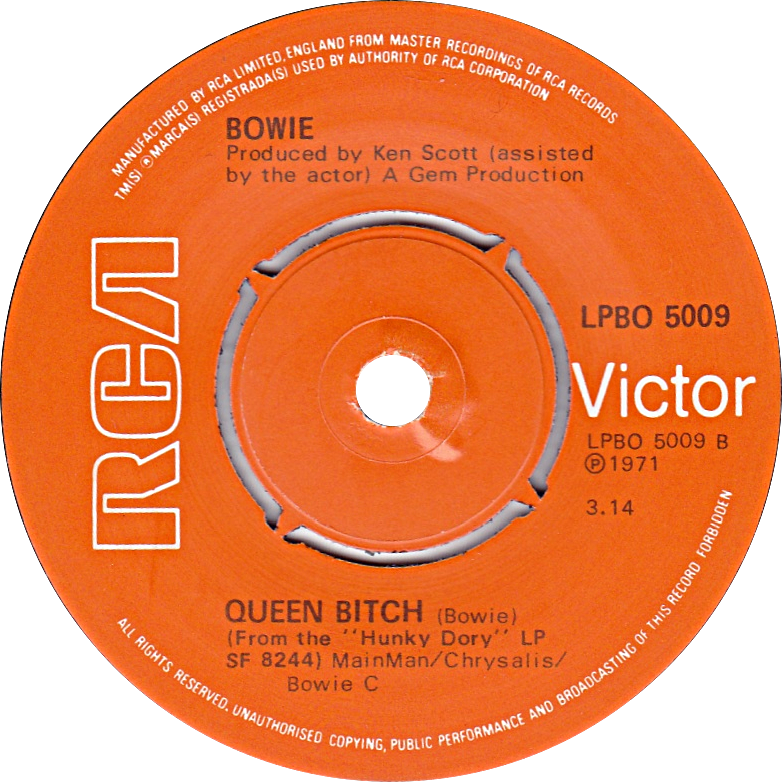
B-side label of the UK vinyl pressing of the "Rebel Rebel" single release
Song by David Bowie
from the album Hunky Dory
Released17 December 1971 (1971-12-17)
RecordedJune–July 1971
StudioTrident, London
Genre
Length3:18
LabelRCA
SongwriterDavid Bowie
Producers
Official audio
"Queen Bitch" (2015 Remaster) on YouTube

"Queen Bitch" is a song by the English singer-songwriter David Bowie. It was originally released on his 1971 album Hunky Dory before appearing as the B-side of the single "Rebel Rebel" in the United Kingdom in early 1974. Co-produced by Bowie and Ken Scott, the lineup consisted of the musicians who would later become known as the Spiders from Mars: Mick Ronson, Trevor Bolder and Mick Woodmansey.

A glam rock and proto-punk track, the song is a tribute to the Velvet Underground. It concerns a male character whose lover searches for drag queens and hookups after the narrator refuses his advances. Unlike the majority of Hunky Dory's tracks, "Queen Bitch" is primarily driven by guitar rather than piano.

"Queen Bitch" has been called one of the best tracks on the album, while some reviewers have considered it one of the best glam rock songs. Bowie performed it live on various BBC radio programmes and concert tours. He also performed it with Lou Reed at Bowie's 50th birthday bash in 1997. Artists who have covered the song include Brazilian singer Seu Jorge and the Hotrats, while it has also appeared in various films and video games.

Writing and recording

[edit]
A black and white photo of the Velvet Underground in 1968
"Queen Bitch" was written as a tribute to the American rock band the Velvet Underground (pictured in 1968)

Following the critical success of his 1970 album The Man Who Sold the World, Mercury Records sent David Bowie on a promotional radio tour of the America in February 1971.[1] The trip inspired him to write tribute songs for three American icons: artist Andy Warhol ("Andy Warhol"), singer-songwriter Bob Dylan ("Song for Bob Dylan"), and the rock band the Velvet Underground, more specifically their singer Lou Reed ("Queen Bitch").[2][3] Bowie was a great fan of the Velvet Underground—he was one of the first artists to cover "I'm Waiting for the Man"[4]—and wrote "Queen Bitch" as a tribute.[5] "Queen Bitch" was debuted ahead of Hunky Dory on 3 June 1971 for BBC DJ John Peel's radio programme In Concert.[6][7] Here, the song's arrangement is different than the final studio version. Bowie does a full-on impersonation of Reed, while the riff primarily stays acoustic.[8]

Work on Hunky Dory officially began at Trident Studios in London on 8 June 1971 and concluded on 6 August.[9] "Queen Bitch" was recorded sometime between 20 June and mid-July, according to biographer Chris O'Leary.[8] Kevin Cann writes that the song was recorded by 26 July, as the finished track appeared on a promotional album compiled for Gem Productions.[10] Co-produced by Bowie and Ken Scott, it was recorded with the musicians who would later become known as the Spiders from Mars: guitarist Mick Ronson, bassist Trevor Bolder and drummer Mick Woodmansey.[11] Although the rest of the album featured piano playing from keyboardist Rick Wakeman,[12] then-member of the Strawbs,[13] he does not appear on "Queen Bitch".[8]

Composition

[edit]

Part of the genius of 'Queen Bitch' is that it filters the archness of [Marc] Bolan and [Lindsay] Kemp through the streetwise attitude of [Lou] Reed: this is a song that succeeds in making the phrase 'bipperty-bopperty hat' sound raunchy and cool."[14]

– Nicholas Pegg, 2016

As a tribute to the Velvet Underground, the song contains numerous references to the band, both musically and lyrically. The handwritten sleeve notes on the back cover of Hunky Dory read: "some V.U. White Light returned with thanks", acknowledging the influence of "I'm Waiting for the Man" and "White Light/White Heat".[14][15] Meanwhile, the line "trying hard to pull sister Flo" is a reference to "Sister Ray".[14][8]

The song starts with a countdown from Bowie leading into an eight-bar introduction, starting with his 12-string acoustic guitar before Ronson's thrashy electric guitar enters.[8][4] While author Peter Doggett considers the main riff to be similar to the Velvet Underground's "Sweet Jane",[15] O'Leary and biographer Nicholas Pegg state that it was borrowed from Eddie Cochran's "Three Steps to Heaven".[14][8] After the bass and drums enter, a second guitar arrives, mixed into the left channel. O'Leary notes that Ronson's guitars clash throughout the track: the left-mixed guitar is raw, playing random tones rather than chords, while the right-mixed guitar "imposes itself on the acoustic" and doubles the bass part in the bars before the refrains. Bolder's bassline jumps octaves and goes up and down the G scale in the verses.[8]

The lyrics of "Queen Bitch" are provocative. They concern a character whose male lover looks for drag queens and hookups on the street after the main character refuses his advances. As he watches his lover from the eleventh floor of his apartment building, he describes the drag queen wearing stereotypical attire, such as "satin and tat" and a "bipperty-bopperty hat".[8][16] The phrase "satin and tat" was a saying made by dancer Lindsay Kemp, who used it to describe, in Pegg's words, "his taste in theatricality".[14] Author James Perone notes that the sexual orientation of the narrator is unclear, meaning they could be homosexual or bisexual. He also addresses the "campiness" in Bowie's vocal performance and makes comparisons to Elton John's song "Daniel".[17]

While the majority of Hunky Dory is categorised as art pop and melodic pop rock,[18] "Queen Bitch" features a style akin to glam rock and proto-punk.[19][20] Concurrently, the song is primarily guitar-led rather than piano-led, leading Pegg to call it Hunky Dory's "least representative track".[21] Biographers and BBC Music's Daryl Easlea would note that the song's glam rock sound foreshadowed the direction Bowie was going to take on his next album The Rise and Fall of Ziggy Stardust and the Spiders from Mars (1972).[14][16][22]

Release and reception

[edit]

RCA Records released Hunky Dory on 17 December 1971,[23] with "Queen Bitch" sequenced as the fourth track on side two of the original LP, between "Song for Bob Dylan" and "The Bewlay Brothers".[11] Over two years later, RCA selected it as the B-side of the "Rebel Rebel" single, releasing it in the UK on 15 February 1974 ahead of Bowie's forthcoming Diamond Dogs LP.[24] The B-side, according to Spitz, was selected to provide the label with some "much needed fiscal plasma".[25]

Michael Gallucci of Ultimate Classic Rock called it one of the best songs on Hunky Dory, citing it as an example of showcasing Bowie's growth as a songwriter and proof that he would become an unpredictable artist.[23] Furthermore, Perone describes it as a "highly effective piece of pop music theater" that stands out as one of Hunky Dory's track that has aged the best, due to its catchiness and theatricality in the band's performance.[17] Commentators, including Perone and AllMusic's Ned Raggett, call "Queen Bitch" a "glam rock classic".[4][17] Jon Savage of The Guardian ranked "Queen Bitch" the second greatest glam rock song of all time in 2013, behind T. Rex's "Hot Love".[19] Mojo magazine listed it as Bowie's 55th best track in 2015.[26]

Live versions

[edit]

"Queen Bitch" was played frequently during Bowie's BBC radio sessions. A performance on the Sounds of the 70s programme on 18 January 1972 was released on the album Bowie at the Beeb in 2000.[14][27] Another performance made during The Old Grey Whistle Test on 7 February 1972 was included on the DVD version of Best of Bowie (2002).[14] On the Ziggy Stardust Tour, the song was performed at the Santa Monica Civic Auditorium in Santa Monica, California on 20 October 1972, which later appeared on Santa Monica '72 (1994) and Live Santa Monica '72 (2008).[28] A later performance recorded at the Nassau Coliseum in Uniondale, New York on 23 March 1976, during the Isolar Tour, was included on Rarestonebowie (1995) and Live Nassau Coliseum '76 (2017).[14][29] He continued to perform it on his Sound+Vision, Earthling and A Reality tours in 1990, 1997 and 2003–2004, respectively.[14] In January 1997, Bowie and Lou Reed performed the song together at the latter's 50th birthday bash in New York City.[8]

Cover versions and appearances in media

[edit]

Brazilian singer Seu Jorge recorded a Portuguese version of "Queen Bitch" for the 2004 film The Life Aquatic with Steve Zissou, appearing in a climactic scene in the film.[30] In 2010, the band the Hotrats recorded a cover version for their covers album Turn Ons.[31] Bowie's original version also appeared in the soundtrack of the 2008 PlayStation 3 racing game MotorStorm: Pacific Rift, as well as the films Run Fatboy Run (2007) and Milk (2008).[30]

In 2007, a cover version of "Queen Bitch" was made available as downloadable content for the Rock Band music video game series, as part of the "David Bowie Track Pack 01". The pack also includes "Moonage Daydream", and a cover version of "'Heroes'".[32]

Personnel

[edit]

According to biographer Chris O'Leary:[8]

Production

References

[edit]
Revisions and contributorsEdit on WikipediaRead on Wikipedia
from Grokipedia
"" is a rock song written and recorded by English musician for his fourth studio album, , released in December 1971 by . The track, which closes the album, draws direct inspiration from , incorporating a similar to that of their song "" and capturing the raw, street-level energy of New York City's underground scene. Lyrically, "Queen Bitch" depicts a narrator observing from a window as their companion ventures into the night to pursue encounters with drag queens and partake in urban cruising, evoking themes of and nightlife allure amid Bowie's emerging persona. Debuted live on in June 1971 during a session for Sounds of the 70s, the song marked an early highlight of Bowie's shift toward harder-edged rock, contrasting the album's more introspective tracks and foreshadowing the intensity of his subsequent Ziggy Stardust era. Though not released as a single initially, "Queen Bitch" gained further exposure as the B-side to in certain markets, including the in 1974, and has since become a staple in Bowie's live performances and a favorite among fans for its unpolished swagger and homage to influences like . Its enduring appeal lies in the track's blend of punkish attitude and pop craftsmanship, reflecting Bowie's method of synthesizing prototypes into his distinctive style without direct imitation.

Background and creation

Writing and inspiration

"Queen Bitch" was composed by in early 1971, prior to its recording for the album . The song debuted live on June 3, 1971, during a session hosted by for his In Concert program. Bowie drew primary inspiration from the Velvet Underground, crafting the track as an explicit homage to the band's frontman and their proto-punk aesthetic. In a 1978 Melody Maker interview, Bowie confirmed that "Queen Bitch" was the sole composition he wrote emulating Reed's style, recognizing its affinity to Reed's songwriting. The song's energetic riff and detached, street-level narrative reflect the Velvet Underground's influence, particularly evident in Bowie's adoption of their raw, confrontational delivery. This tribute emerged amid Bowie's broader engagement with American underground rock during his 1971 visit to New York, where he encountered figures associated with Underground's orbit, though the song's core impetus stemmed from his longstanding admiration for the band's output and their 1970 album Loaded. Bowie later played an acetate of —including "Queen Bitch"—to , who praised the track's evocation of his own work. Lyrically, the line "This ain't rock 'n' roll / This is " parodies Reed's deadpan cynicism, underscoring the song's debt to Underground's subversive ethos.

Recording sessions

"Queen Bitch" was recorded at in , , during the album sessions, which commenced on June 8, 1971, and extended through July and into early August. The track's production was overseen by and , with Scott serving as engineer and co-producer, emphasizing Bowie's emerging command in the studio environment. The recording featured Bowie on lead vocals and , alongside that would form the backbone of his band: on lead guitar, on bass guitar, and on drums. contributed , adding subtle texture to the song's driving rock arrangement, though the track stands out for its relatively sparse production compared to the album's more orchestral elements. Scott later recalled Bowie's intense focus during takes, which contributed to the song's raw, energetic capture without excessive overdubs. Prior to its studio incarnation, "Queen Bitch" had been performed live by Bowie on 1's program in June 1971, indicating the song was compositionally complete and rehearsed ahead of the dates. This pre-recording airing helped refine its structure, aligning with the album's transitional role in Bowie's shift toward .

Composition and

Musical structure and style

"Queen Bitch" is structured as a verse-chorus form built around a driving guitar riff, featuring extended verses that build narrative tension without instrumental solos. The song employs a primal three-chord progression of C-G-F in the key of C major, repeated twice in each riff appearance to maintain relentless momentum. This riff draws direct inspiration from the Velvet Underground's "Sweet Jane," accelerated to a breakneck tempo of approximately 136 beats per minute, evoking proto-punk energy while incorporating a secondary riff nod to Eddie Cochran's "Three Steps to Heaven." Stylistically, the track represents a raw, guitar-centric rock departure from the piano-led introspection of its parent album Hunky Dory, channeling the urban swagger of Lou Reed and the Velvet Underground through Mick Ronson's electric guitar work—panned left and right for spatial depth—and Bowie's own 12-string acoustic rhythm guitar. Drums by Mick Woodmansey emphasize cymbal crashes over heavy beats, supporting the song's immediate, unadorned propulsion, while the chorus introduces slight riff variations for punchy, theatrical put-downs. Bowie noted the Velvet Underground's influence explicitly on the album sleeve, crediting a return of "some V.U. White Light" in reference to their raw, street-level aesthetic. This fusion yields a glam-inflected rocker that balances American rock grit with English lyrical finesse, avoiding the dirge-like tempos of its inspirations.

Lyrical content and influences

"Queen Bitch" features lyrics that portray a narrator observing a , androgynous figure referred to as the titular "queen bitch," characterized by "swishy" mannerisms, attire, and a commanding presence in a seedy urban environment. The verses evoke scenes of from an eleventh-floor vantage point, with of belly dancers and hookers, culminating in the partner's attraction to this figure, who dismisses the narrator nonchalantly. The emphasizes admiration mixed with resignation: "But she don't make me nervous / She don't make me blush," highlighting themes of , , and the allure of the . The song's lyrical style draws heavily from the raw, streetwise narrative approach of , reflecting Bowie's intent to pay homage to Reed and . Bowie explicitly modeled "Queen Bitch" after 's sound and ethos, incorporating a guitar reminiscent of their track "" and adopting a detached, observational tone akin to Reed's depictions of New York City's underbelly. This influence stemmed from Bowie's discovery of via the of the 1969 album A by Underground's former manager, which prompted him to acquire their debut album and integrate their aesthetic into his work. Beyond direct emulation, the lyrics capture Bowie's fascination with glam and transgression prevalent in early 1970s British music scenes, though without explicit references to specific contemporaries like in documented accounts of the song's creation. Critics have noted the track's alignment with Bowie's broader exploration of outsider identities, but its primary debt remains to the Velvet Underground's unfiltered portrayal of marginal subcultures, distinguishing it from more stylized glam anthems.

Release and promotion

Album inclusion and initial release

"Queen Bitch" was sequenced as the tenth track on David Bowie's album Hunky Dory, positioned immediately before the closing song "The Bewlay Brothers" on side two of the original vinyl pressing. The tracklist arrangement placed it after "Song for Bob Dylan," contributing to the album's progression from introspective ballads to more energetic rock-oriented numbers toward the end. Hunky Dory, Bowie's fourth studio album and first for , was initially released in the on 17 December 1971. The album's launch marked the debut availability of "Queen Bitch" to the public, as it was not issued as a standalone single at the time. In the United States, the album followed with a release in June 1972, further distributing the song via RCA's marketing efforts. This initial album format release preceded its later use as the B-side to the "" single in February 1974.

Commercial performance

"Queen Bitch" was not issued as an A-side single upon its debut on 's 1971 album , which initially achieved limited commercial success, failing to chart in the or at release. Following the breakthrough of Bowie's 1972 album The Rise and Fall of Ziggy Stardust and , experienced renewed interest and re-entered the , debuting at number 44 on September 23, 1972, before peaking at number 3. The album has since received certifications including in the for 300,000 units shipped and in for 25,000 units. The track served as the B-side to Bowie's "" single, released in the UK on February 15, 1974, which reached number 5 on the UK Singles Chart. It also backed "" as a single in the in July 1974, though that release did not achieve notable chart placement. A standalone single of "Queen Bitch" was issued in the in by RCA (PB-10026), but it similarly failed to register on major charts. In the digital era, "Queen Bitch" has garnered significant and downloads, reflecting its enduring popularity as a non-single album track. As of mid-January 2022, it had accumulated 27.5 million global on . Following Bowie's death in , it ranked 25th among his top-selling downloads in the UK.

Reception and analysis

Critical reception

Upon its inclusion on Hunky Dory in December 1971, "Queen Bitch" drew acclaim from critics for injecting rock energy into an otherwise eclectic album, with its riff-driven structure evoking the Velvet Underground's influence. The BBC Music review noted the track as a "fairly unrepresentative" Velvet Underground tribute that nonetheless "points clearly to the musical direction ahead" for Bowie, highlighting its role in foreshadowing his glam rock evolution. Retrospective analyses have reinforced this view, positioning the song as a glam rock exemplar and one of Bowie's early highlights. Rolling Stone described it as a "bubbleglam rocker" that honors Lou Reed while showcasing Bowie's stylistic flair. Mojo magazine ranked it among Bowie's top songs, crediting its roots in his fandom for the Velvet Underground, including his 1967 cover of their "I'm Waiting for the Man." Critics like those at Treble have observed that the track's guitar work by Mick Ronson "out-Lou-Reeds Lou Reed," emphasizing its aggressive edge amid the album's piano-led introspection. The song's reception underscores its transitional significance, bridging Bowie's folkier tendencies with harder rock, though initial album sales were modest until boosted by Ziggy Stardust's success in 1972. Later commentators, such as in MusicRadar, have praised it as a "signpost" for Bowie's glam trajectory, with fans and reviewers alike citing its upfront undertones and streetwise as boldly promiscuous for 1971.

Interpretations and debates

"Queen Bitch" is widely interpreted as a tribute to and their frontman , stemming from Bowie's 1971 New York visit where he believed he spotted Reed from his eleventh-floor hotel window, only to realize it was a woman dressed in a manner reminiscent of Reed's style. This anecdote inspired the song's opening imagery of urban and outsider desire, mirroring the Velvet Underground's raw depictions of New York City's underbelly. Lyrically, the track narrates jealousy from an unidentified observer watching a man flirt with a "queen bitch"—commonly understood as a drag queen or flamboyantly effeminate gay man—while the narrator feels sidelined and vows to outdo the rival in allure ("But I could if I wanted"). This has led to readings of the song as an exploration of homosexual tension and unrequited attraction, aligning with Bowie's emerging glam persona and prefiguring his 1972 bisexuality announcement, though the narrator's gender and motivations remain deliberately ambiguous. Debates among critics center on the extent of Velvet Underground influence versus broader glam rock elements, such as potential nods to in lines evoking competitive swagger ("tough, tough bitch"), given Bowie's contemporaneous admiration for T. Rex. Some interpretations question whether the "queen bitch" represents a specific figure from Bowie's life, like associate Freddie Burretti, or a composite of the era's subculture, with Bowie himself offering no definitive clarification in contemporaneous interviews. Later analyses note structural parallels to songs like The Killers' 2004 "," sparking discussions on melodic and thematic borrowings, though without direct attribution. These varied lenses underscore the song's open-endedness, resisting singular autobiographical or referential closure.

Legacy and performances

Cultural impact and influence

"Queen Bitch" exerted influence on by embodying early elements of theatricality and gender ambiguity that defined the genre's emergence in the early . As a track on , released December 17, 1971, it previewed Bowie's shift toward flamboyant personas, blending rock energy with campy lyrics that celebrated effeminate swagger, such as references to a figure "so swishy in her satin ." This stylistic fusion helped legitimize queer-coded in mainstream rock, paving the way for Bowie's The Rise and Fall of Ziggy Stardust and the Spiders from Mars in 1972, which amplified glam's cultural footprint. The song's lyrical content, drawing from gay vernacular to depict a commanding "queen" figure, contributed to Bowie's reputation as a catalyst for discussions on sexuality and identity in popular music. Critics have noted its role in Bowie's broader challenge to heteronormative rock tropes, using slang like "pull sister Flo" to evoke underground club scenes and same-sex dynamics. This overt queerness, rare for 1971 British rock, influenced perceptions of rock stardom as a space for gender experimentation, predating more explicit glam anthems. Bowie's adoption of such themes aligned with his self-proclaimed bisexuality announcement in 1972, amplifying the track's resonance in LGBTQ+ cultural narratives despite his later clarifications on personal fluidity. As an explicit homage to and , "Queen Bitch" bridged New York proto-punk grit with emerging glam sensibilities, underscoring Bowie's role in globalizing American underground influences. The riff structure and attitude mirror Reed's style, positioning the as a transatlantic conduit that helped introduce VU's raw edge to wider audiences. This connection reinforced glam rock's roots in avant-garde rebellion, impacting subsequent artists by modeling how could intersect with subversive subcultures.

Live performances

"Queen Bitch" received its live debut during 's "In Concert" session at the Paris Cinema in on June 5, 1971, where it was performed alongside other tracks from the forthcoming album. The song became a regular feature in Bowie's setlists during the from 1972 to 1973, including a notable appearance on the BBC's on January 8, 1972. It was recorded live at the on October 22, 1972, as part of the David Bowie Recorded Live on Stage Santa Monica '72 performance, later released officially. Bowie revived "Queen Bitch" for his Isolar Tour in 1976, performing it at venues such as Wings Stadium in Kalamazoo, Michigan, on February 21. It appeared sporadically in subsequent tours, including the Sound+Vision Tour in 1990, with documented performances at London Arena on March 27 and The Woodlands Pavilion in Houston on June 7. During the Earthling Tour in 1997, the track was included in sets at in on August 12 and Olympia Theatre in on August 8. A highlight was its performance at Bowie's 50th birthday concert at on January 9, 1997, joined onstage by , to whom the song pays homage as a tribute. Bowie last performed it live on the , such as at Event Center in Atlantic City on May 29, 2004. Overall, setlist data indicates Bowie played "Queen Bitch" approximately 404 times across his career.

Cover versions and media usage

"Queen Bitch" has been covered by numerous artists across genres. Green River recorded a rock version for their 1988 self-titled EP. The released a punk-inflected cover on their 2009 album Turn Ons. , featuring , included a rendition on the 2011 tribute album We Were So Turned On: A Tribute to David Bowie. The performed a high-energy version for the 2019 compilation Modern Love: 40 Songs by David Bowie. , joined by , played a live cover during their 2016 tour performances. The song has seen use in visual media, particularly in Wes Anderson's 2004 The Life Aquatic with Steve Zissou, where Brazilian musician Seu Jorge's Portuguese-language cover, titled "Rainha Bitch," underscores key scenes and contributes to the film's nautical adventure tone. Jorge's acoustic rendition, part of a series of Bowie covers he performed as the character Pelé dos Santos, integrates seamlessly with the movie's soundtrack of reinterpreted Bowie tracks. No major commercial advertisements featuring the original or covers have been prominently documented.

Production personnel

Producers
David Bowie and co-produced "Queen Bitch". , who had engineered Bowie's prior albums (1969) and The Man Who Sold the World (1970), took on co-production duties for , the album featuring the track, recorded at in from June to August 1971.
Musicians
  • David Bowie: lead vocals, 12-string acoustic guitar
  • Mick Ronson: electric guitar, backing vocals
  • Trevor Bolder: bass guitar
  • Woody Woodmansey: drums
Engineering
Ken Scott handled recording and mixing engineering for the sessions.

References

Add your contribution
Related Hubs
User Avatar
No comments yet.