Hubbry Logo
Rebel RebelRebel RebelMain
Open search
Rebel Rebel
Community hub
Rebel Rebel
logo
8 pages, 0 posts
0 subscribers
Be the first to start a discussion here.
Rebel Rebel
Rebel Rebel
from Wikipedia

"Rebel Rebel"
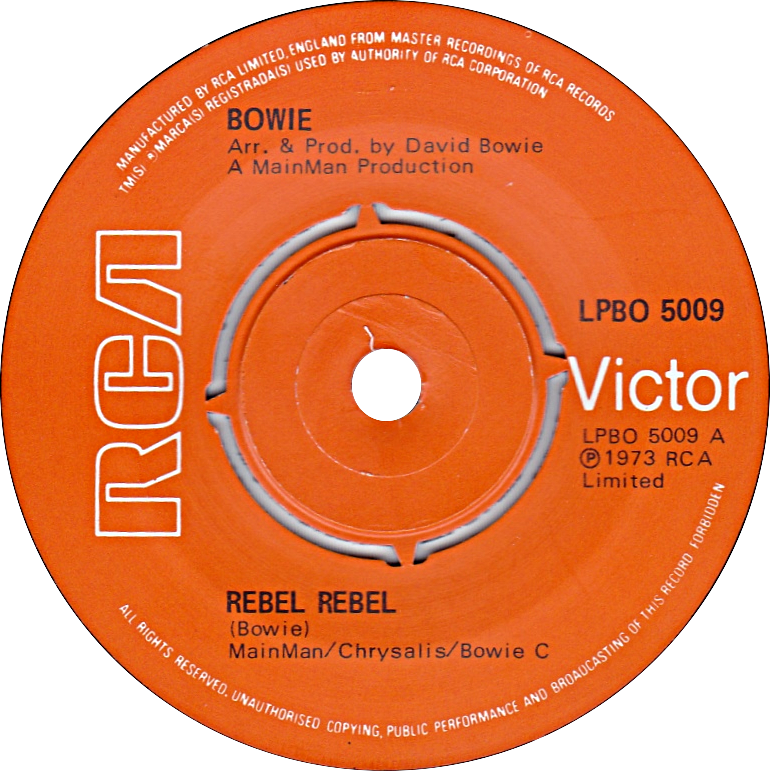
Side A of the mid-1970s UK vinyl pressing
Single by David Bowie
from the album Diamond Dogs
B-side"Queen Bitch"
Released15 February 1974 (1974-02-15) (UK)
RecordedDecember 1973 – January 1974
Studio
Genre
Length4:20 (UK single)
LabelRCA
SongwriterDavid Bowie
ProducerDavid Bowie
David Bowie singles chronology
"Sorrow"
(1973)
"Rebel Rebel"
(1974)
"Rock 'n' Roll Suicide"
(1974)

"Rebel Rebel" is a song by the English singer-songwriter David Bowie. It was released in the UK on 15 February 1974 by RCA Records as the lead single from the album Diamond Dogs. Written and produced by Bowie, the song is based around a distinctive guitar riff reminiscent of the Rolling Stones. Cited as his most-covered track, "Rebel Rebel" has been described as Bowie's farewell to the glam rock movement[5] that he had helped initiate, as well as being a proto-punk track.[4] Two versions of the song were recorded: the well-known UK single release and the shorter US single release, which featured added background vocals, extra percussion and a new arrangement.

Upon its release, the song was a commercial success, peaking at number five on the UK Singles Chart and number 64 on the US Billboard Hot 100. The song received critical acclaim for its central guitar riff and strength as a glam anthem. Several publications consider it to be one of Bowie's greatest songs. It was performed live by Bowie during many of his concert tours and since appeared on many compilation albums. It was remastered in 2016 as part of the Who Can I Be Now? (1974–1976) box set.

Background

[edit]

Originally planned in late 1973 as part of an aborted Ziggy Stardust musical,[6] "Rebel Rebel" was Bowie's last single in his signature glam rock style.[7][8] It was also his first hit since 1969 not to feature lead guitarist Mick Ronson; Bowie played guitar himself on this and almost all the other tracks on Diamond Dogs, producing what NME critics Roy Carr and Charles Shaar Murray called "a rocking dirty noise that owed as much to Keith Richards as it did to the departed Ronno".[9] Singer-songwriter Jayne County, who was a cast member of Pork and among Bowie's entourage for two years, maintains that her 1973 song "Queenage Baby", which included the lyric "can't tell whether she's a boy or a girl", was an influence for "Rebel Rebel".[10][11]

Recording and composition

[edit]

Recording for "Rebel Rebel" began at a solo session at Trident Studios in London in the week after Christmas 1973. It was Bowie's last known visit to Trident, his principal recording studio since 1968.[11] The recording was completed in January 1974 at Ludolph Studios in Nederhorst den Berg, Netherlands.[7][12][13] In the studio, Bowie informed bassist Herbie Flowers and guest guitarist Alan Parker that he wanted it to "sound like the Stones", before he picked up Parker's black Les Paul and played it to them. Parker then completed it, before the rest of the backing track was recorded. [14]

According to biographer Marc Spitz, the lyrics of "Rebel Rebel" revisit familiar Bowie territory, featuring "a 'hot' young 'tramp' worrying his or her parents with his or her sexy nihilism", are reflected by the line "You got a few lines and a handful of 'ludes'."[15] Even though the world is ending, the "Rebel" doesn't care, suggesting "we like dancing and we look divine."[15] It also features gender-bending lyrics ("You got your mother in a whirl / She's not sure if you're a boy or a girl"). According to author Peter Doggett, in the context of Diamond Dogs, the song serves as a "musical continuation" between the "Sweet Thing/Candidate/Sweet Thing (Reprise)" medley: it begins with a D to E chord change that was prefigured with a bass guitar slide that constructed the medley's final "chaotic" moments.[16]

The song's distinctive guitar riff is described by rock journalist Kris Needs as "a classic stick-in-the-head like the Stones' 'Satisfaction'".[17] The riff's chords are D, E, and A and were created by Bowie and enhanced by Parker, who, according to Doggett, added the "downward trail" at the end of each line.[16] Paul Trynka writes that Parker added "a particular chord shape rather than the original single note just before the chord change and a distinctive 'beeeoonng' in the last line of the chorus just as [Bowie] sings 'I love you so'."[14] Bowie later said, "It's a fabulous riff! Just fabulous! When I stumbled onto it, it was 'Oh, thank you!'"[11] Parker later said Bowie came up with the Stones-like riff to "piss off" Mick Jagger.[18] Parker was upset upon learning he was uncredited on the final version. He stated: "I can tell my own playing, and my own sound, and I know it's me." Flowers further recalled: "David played the riff to Alan, Alan made sure it was good enough to record, then [Alan] played it."[14] Although O'Leary compliments the riff, he notes that with Ronson's absence, it gets "run into the ground"; throughout the song's over four-minute runtime, the riff is solely absent in the two bridges and the "hot tramp" lines.[19]

Release

[edit]

"Rebel Rebel" was released on 15 February 1974 in the UK by RCA Records (as LPB05009) as the lead single of Diamond Dogs with the Hunky Dory song "Queen Bitch" as the B-side.[20] The B-side, according to Spitz, was selected by RCA to provide the label with some "much needed fiscal plasma".[21] The single quickly became a glam anthem, the female equivalent of Bowie's earlier hit for Mott the Hoople, "All the Young Dudes".[9] It reached number five on the UK Singles Chart and number 64 on the US Billboard Hot 100.[22][23]

The original UK single version had a slightly different mix than the album version; the album mix was the only mix to appear on compilation albums,[11] until the single mix appeared on Re:Call 2, as part of the 2016 box set Who Can I Be Now? (1974–1976).[24][25] The UK single mix was again remastered in 2019 and released on digital media streaming services.[26]

US single

[edit]

"Rebel Rebel" was released as a single with a different mix in the US and Mexico in May 1974, with "Lady Grinning Soul" as the B-side.[27] According to Doggett, Bowie was not satisfied with creating an enduring "dance-floor anthem",[28] so he recorded a new mix in New York in April 1974,[29] which Doggett calls a "Latin dub mix" that was over two decades ahead of its time.[28] The US mix is shorter (2:58) and more uptempo, dense and camp than the UK single, featuring "sine waves" of percussion[28] by Geoff MacCormack, an original backing vocal line that is preceded by a "rush of backward echo", acoustic guitar and a new arrangement that buries the signature riff beneath phasing.[28] According to Pegg, the US mix begins at the first "hot tramp" lyric at the 1:20 mark in the original UK mix.[11] Within a couple of months, it was withdrawn and replaced by the UK single version, but the same arrangement was used on Bowie's Diamond Dogs Tour, appearing on its live album David Live (1974).

Reception

[edit]

The song has received critical acclaim for its guitar riff and strength as a glam anthem, being described as a fitting farewell to Bowie's glam era. Marc Spitz praised the song in the biography Bowie: A Biography, calling the riff "magnificent" and Bowie's "last great glitter anthem".[30] He also described the song as Bowie's most "pure and lasting rocker" when mentioning the artist's early 2000s re-recorded version for his 2003 album Reality.[30] Cash Box said that this was "Bowie's best single ever," describing it as a "strong rocker with incredible hooks throughout."[31] Record World said that Bowie "integrates the aura of the American disco-right on down to castinets into his multi-sensual sound."[32] Stephen Thomas Erlewine of AllMusic, in his review of Diamond Dogs, called the song "tight" and "sexy" and one of Bowie's best, although he felt the song did not contribute to the overall theme of the album.[33] Dave Thompson, also of AllMusic, described "Rebel Rebel" as one of Bowie's most "playful" numbers and considered it a fitting farewell to the artist's glam rock era and, in a way, to "the entire glam movement which Bowie created", as well as indicating the direction his career was taking.[34] Barry Walters of Pitchfork, in a review of Diamond Dogs following Bowie's death, praised the song's "glorious" guitar riff, its "stomping beat", the "hot tramp" lyric pause between both and their "return".[35] Walters continued, "If Bowie often drifted above listeners' heads, here he shoots straight at their solar plexus and scores with what ranks among the greatest, most insistent riffs of the '70s. Rockers who'd dismissed Bowie as a dandy now gave the dude a pass."[35] Journalist C. M. Crockford of punknews.org called "Rebel Rebel"'s guitar riff the best Bowie ever wrote, and a fitting end to his glam rock era.[36]

Following Bowie's death in 2016, Rolling Stone listed "Rebel Rebel" as one of his 30 essential songs.[37] Spencer Kaufman of Ultimate Classic Rock ranked the song at number seven on his list of Bowie's 10 greatest songs, praising its guitar riff – "one of the most recognizable guitar riffs in rock history" – and as a glam rock anthem, writing, "the tune serves as the perfect bridge between the Rolling Stones and punk rock."[38] In 2018, the writers of NME listed "Rebel Rebel" as Bowie's fifth greatest song. They praised the "heaven-sent" riff and also believed it to be reminiscent of the Rolling Stones.[39] Jon Savage of The Guardian, in his list of the 20 best glam-rock songs of all time, ranked the US version of the single at number 18.[1]

Live performances

[edit]
David Bowie performing live in 1974
Bowie performing "Rebel Rebel" on AVRO's TopPop in 1974. The song introduced what author Nicholas Pegg called Bowie's short-lived "pirate image".[11]

On 14 February 1974, Bowie recorded a lip synced performance of "Rebel Rebel" at Hilversum's Avro Studio 2 for the Dutch television programme Top Pop. Broadcast two days later, it featured Bowie superimposed over flashing disco lights "by the miracle of chromakey" and donning what Pegg called his short-lived "pirate image" – a spotted neckerchief and a black eye-patch. Bowie later recalled:[11]

I had conjunctivitis, so I made the most of it and dressed like a pirate. Just stopped short of the parrot! I had this most incredible jacket that I was wearing that night. It was a bottle-green bolero jacket that Freddi [Burretti] made for me and he got an artist to paint, using the appliqué technique, this supergirl from a Russian comic on the back. Anyway, I did a press conference and performed 'Rebel Rebel' on Dutch television with a bright red Fender Stratocaster. But I took the jacket off during the press conference and somebody stole it. I was really pissed off.

Following the performance, the pirate look, along with the Ziggy Stardust hairstyle, was ditched in favour of the "swept-back parting and double-breasted suits" of the Diamond Dogs Tour. The Top Pop clip later became the song's semi-official video.[11]

The song was a standard of Bowie's concerts from the Diamond Dogs Tour to the Sound+Vision Tour. For his performance at Live Aid in 1985, Bowie performed a saxophone-heavy version.[11] After retiring the song on his Sound+Vision Tour in 1990, Bowie restored "Rebel Rebel" for the "Hours..." Tour. In early 2003, he recorded a new version, featuring an arrangement by Mark Plati without the original's reference to quaaludes. This was issued on a bonus disc that came with some versions of Reality the same year and on the 30th Anniversary Edition of Diamond Dogs in 2004. In 2004 the track was blended in a mash-up with the Reality song "Never Get Old"; the result was issued as the single "Rebel Never Gets Old".[40]

"We love David Bowie", commented Jane's Addiction front-man Perry Farrell in 2001. "Given the length of his career, I'm stunned that he still pushes things musically. But, please, please, David, can you sing 'Rebel Rebel' still?"[41]

Live versions of the song by Bowie have been released on David Live,[42] A Reality Tour (recorded 2003),[43] Cracked Actor (Live Los Angeles '74),[44] Live Nassau Coliseum '76,[45] Welcome to the Blackout (Live London '78),[46] Glastonbury 2000,[47] Serious Moonlight (Live '83) and Glass Spider (Live Montreal '87), which were both part of the box set Loving the Alien (1983–1988),[48] and I'm Only Dancing (The Soul Tour 74).[49]

Legacy

[edit]

"Rebel Rebel" has appeared on several compilation albums, the first being ChangesoneBowie in 1976.[50] It was also remastered in 2016, along with the entire Diamond Dogs album, as part of the Who Can I Be Now? (1974–1976) box set.[25] The rare US single version was included on Sound + Vision, the bonus disc of the 30th Anniversary Edition of Diamond Dogs, and Re:Call 2. The song's original UK single mix appeared on Re:Call 2; however, it was sourced not from the original analog tape, but rather from a pristine 7-inch single, as the tape was thought to be lost.[24] The original single mix was released again on 24 May 2019 to commemorate the 45th anniversary of the Diamond Dogs album, this time sourced from the original tape, which had been recovered since the release of Who Can I Be Now?[24]

The track is cited by Nicholas Pegg as Bowie's most-covered track.[11] A cover version by Dead or Alive was released as a single in 1994, under the name International Crysis, and peaked at number 76 on the UK Singles Chart.[51] American country music singer Chris Young sampled the song's guitar riff for his 2023 song "Young Love & Saturday Nights".[52]

Track listing

[edit]

All songs written by David Bowie.[20]

  1. "Rebel Rebel" – 4:20
  2. "Queen Bitch" – 3:13

The U.S. version of the single, also released in Canada and Mexico, had "Lady Grinning Soul" as the B-side.[27]

Personnel

[edit]

According to Kevin Cann:[53]

Charts

[edit]

References

[edit]
[edit]
Revisions and contributorsEdit on WikipediaRead on Wikipedia
from Grokipedia
"Rebel Rebel" is a song written, produced, and performed by English , released on 15 February 1974 as the from his eighth studio album, . The track marks Bowie's transition away from , featuring a distinctive played by Bowie himself—his first credit on a single—following the departure of longtime collaborator . Lyrically, it celebrates and youthful , with lines like "You've got your mother in a whirl / She's not sure if you're a boy or a girl" highlighting gender ambiguity and defiance of conventions, themes central to Bowie's persona during this era. Upon release, "Rebel Rebel" achieved commercial success, peaking at number five on the UK Singles Chart and number 64 on the , while the parent album topped the . The song's raw energy and iconic riff have made it one of Bowie's most enduring hits, frequently covered and performed live throughout his career, solidifying its status as a anthem.

Background and writing

Development

"Rebel Rebel" emerged during a pivotal moment in David Bowie's career, as he sought to move beyond the Ziggy Stardust persona that had defined his glam rock phase. On July 3, 1973, during the final concert of his British tour at London's Hammersmith Odeon, Bowie announced the retirement of Ziggy Stardust, declaring it the last show he and would ever perform together. This decision, driven by exhaustion from nearly 200 performances and an intensifying identity crisis amid fame and drug use, marked a deliberate farewell to the character and influenced the song's underlying themes of rebellion and departure. In late 1973, Bowie conceived "Rebel Rebel" as the intended finale for a planned but ultimately unrealized stage musical based on the Ziggy Stardust narrative. The project aimed to extend the storyline from his 1972 album The Rise and Fall of Ziggy Stardust and the , providing a conclusive arc to the rock star's rise and fall. Although the musical never materialized, the captured the transitional spirit of Bowie's evolving artistry, serving as a bridge from his glam era. Bowie composed "Rebel Rebel" in December , producing early demos that evolved from initial solo efforts into a fuller electric . These preliminary versions laid the groundwork for the track's raw, riff-driven sound. As his final single, "Rebel Rebel" heralded the stylistic shift evident in the 1974 album , where Bowie began incorporating and R&B influences that would dominate his next phase.

Inspiration

The distinctive guitar riff of "Rebel Rebel" was directly inspired by T. Rex's "," capturing Marc Bolan's signature swagger and contributing to the song's raw, energetic rock 'n' roll edge. Bowie, who had long admired Bolan's pioneering role in the genre, sought to channel a similar infectious, riff-driven vitality as he transitioned away from his Ziggy Stardust persona. This influence aligned with Bowie's broader aim during the song's development to craft a farewell to glam's theatricality while retaining its rebellious spirit. Thematically, "Rebel Rebel" drew from the vibrant youth subcultures of the early 1970s, including attitudes and androgynous fashion trends that challenged traditional gender norms. Bowie's fascination with —explored through ambiguous lyrics about a "hot tramp" defying parental expectations—reflected his own boundary-pushing performances, which encouraged fans to embrace fluid identities beyond binary constraints. His marriage to , one of the influences on his androgynous image, further shaped this personal exploration of rebellion against societal and stardom conventions, amid the fading excitement surrounding the Ziggy Stardust era. Set against the 1973 backdrop of the glam rock scene's gradual decline, Bowie was influenced by the unfiltered intensity of Iggy Pop's performances and the ' trashy, cross-dressing provocation, signaling his shift toward grittier, dystopian expressions. As glam's commercial peak waned, with acts like T. Rex and dominating but facing saturation, Bowie used these influences to symbolize a broader cultural , bridging glam's excess with emerging punk rawness.

Recording and production

Sessions

The recording of "Rebel Rebel" began with an early demo on 27 December 1973 at Trident Studios in London, marking David Bowie's final known session at the facility where he had worked since 1968. The principal tracking occurred from late December 1973 through January 1974 across multiple locations, including Trident and Olympic Studios in London and Ludolph Studios in Nederhorst den Berg, the Netherlands. Production was overseen by Bowie as producer, with Keith Harwood serving as recording and mixing engineer. The core lineup featured Bowie on lead vocals and guitar, Alan Parker on rhythm guitar, Herbie Flowers on bass guitar, Mike Garson on piano, and Tony Newman on drums and percussion. Parker's involvement on guitar reflected the recent departure of longtime collaborator Mick Ronson from Bowie's band following the Aladdin Sane era. The arrangement highlighted the prominent crunchy guitar riff and incorporated handclaps to evoke a raw, live performance energy. Two distinct versions of the track were produced to suit different markets. The single version, clocking in at 4:20, retained the full arrangement and was released in February 1974. For the market, Bowie created a shorter running 2:58 through a revised mix recorded in New York in April 1974, which included additional overdubs such as percussion elements to heighten its accessibility and punch. This New York rework, initially issued as the single backed by "Lady Grinning Soul," was later withdrawn in favor of the version after limited airplay.

Personnel

The recording of "Rebel Rebel" involved a core group of musicians assembled during sessions at in , with handling multiple instrumental and production roles. Bowie provided parts, as well as lead vocals, while also serving as the track's and sole songwriter. Session guitarist contributed electric guitar, replaying and refining the main riff initially developed by Bowie to add a distinctive clang and bends. Bass duties were handled by , whose playing provided the track's driving foundation. added piano, enhancing the song's rhythmic texture during the London sessions. Tony Newman performed on drums for the primary single version, delivering a solid backbeat that supported the energy. Engineering was led by Keith Harwood, who captured the sessions at and handled the initial mixes, ensuring the raw, energetic sound of the instruments. , a longtime collaborator, acted as a on the broader project but received no direct credit on the "Rebel Rebel" single. The single release, issued in February 1974, used this core lineup without additional overdubs. In contrast, the single version, prepared in New York shortly after, incorporated overdubs including backing vocals and percussion (congas, guiro, and handclaps) by Geoff MacCormack to create a denser, more uptempo mix aimed at American radio, though the foundational personnel remained the same.

Composition

Musical style

"Rebel Rebel" is a glam rock song infused with proto-punk elements, marking David Bowie's farewell to the flamboyant style of his earlier work. Written in the key of A major at a tempo of 126 beats per minute, it propels a sense of urgency and rebellion through its mid-tempo rock groove. The track employs a straightforward verse-chorus structure, opened by an iconic guitar riff that recurs throughout to drive the momentum. This riff, performed on distorted electric guitar using power chords centered on A, D, and E, creates a choppy, rhythmic pulse reminiscent of classic rock influences while foreshadowing punk's raw aggression. A bridge introduces variation before the song fades out amid repeating choruses, enhancing its anthemic quality. Instrumentation centers on a rock ensemble, featuring prominent distorted electric guitars, a steady walking bass line, and punchy, four-on-the-floor drums that underscore the song's stomping energy. Bowie's delivery employs a nasal, sneering vocal tone, adding to the track's defiant character. Positioned as the lead single from , "Rebel Rebel" bridges the theatrical of Bowie's Ziggy Stardust era with the album's dystopian, more stripped-back aesthetic, prioritizing visceral energy over elaborate production.

Lyrics

The lyrics of "Rebel Rebel" center on themes of and against societal norms, portraying a who challenges expectations and parental through provocative self-expression. The opening verse immediately establishes this tension with the lines "You've got your in a whirl / She's not sure if you're a boy or a girl," evoking the disorientation caused by fluid presentation in a conservative . This ambiguity underscores a broader defiance, as the character embraces a "hot tramp" that blends masculine and feminine elements, symbolizing liberation from rigid identity constructs. The song's structure reinforces its portrayal of youthful outsider status through a simple, anthemic form with verses, a bridge, and a highly repetitive chorus. The chorus—"Rebel rebel, you've torn your dress / Rebel rebel, your face is a mess / Rebel rebel, how could they know? / Hot tramp, I love you so!"—repeats four times, creating a chant-like insistence on the rebel's unapologetic chaos and appeal, while the verses sketch scenes of disorderly , including "dancing by the light of the moon" and stomping in the streets amid emotional turmoil like "crying in the corner." These elements employ literary devices such as irony and direct address ("Hey babe, let's go out tonight / You like me just the way I am"), which invite the listener into the rebel's world and highlight the thrill of nonconformity over societal judgment. The lyrics reflect themes of fluid identity and central to Bowie's persona during the early . He crafted the song as a swansong, capturing the era's "sexy " through a young character's torment of authority figures while signaling his shift away from the Ziggy Stardust archetype. In its evolution, "Rebel Rebel" originated as a piece for an aborted Ziggy Stardust musical planned in late 1973, where it likely tied more closely to the fictional rock star's narrative of alienation and performance. By the time of its completion in January 1974 for the Diamond Dogs album, the lyrics had been refined into a standalone anthem of universal rebellion, broadening its resonance beyond the specific Ziggy storyline.

Release

Formats and versions

"Rebel Rebel" was first released as a single in the on 15 February 1974 by , in a 7-inch vinyl format (RCA LPBO 5009) with the A-side running 4:30 and backed by "" on the B-side. In the United States, an edited version of the single (RCA APBO-0287) appeared in May 1974, shortened to 3:00 with "Lady Grinning Soul" as the B-side. The track served as the lead single for Bowie's eighth studio album, Diamond Dogs, which was released on 24 May 1974 and included the full 4:30 album version of "Rebel Rebel" as its opening song. It later appeared on the 1976 compilation album ChangesOneBowie, marking one of its earliest reissues in a collected format. Subsequent reissues included the 2010 Special Edition remaster of Diamond Dogs, which featured enhanced audio for the album track, and the 2016 stereo remaster as part of the Who Can I Be Now? (1974–1976) box set, emphasizing clearer production details. Digital versions of both the original single mix and remastered editions became available on streaming platforms such as Spotify starting in the late 2000s. Notable variants include a live recording from Bowie's 1974 performances, featured on the album David Live (released October 1974), capturing an energetic rendition from his . Additionally, Bowie re-recorded the song in 2003 with a revised , which appeared as a bonus track on the deluxe edition of his album Reality and was used in the soundtrack for Charlie's Angels: Full Throttle.

Promotion

"Rebel Rebel" was released in the on 15 1974 as the from David Bowie's upcoming album , acting as an early teaser for the record's impending launch two months later. In the United States, the single followed in May 1974, featuring a shortened tailored for commercial airplay, clocking in at 3:00 compared to the original's 4:30 duration. This version included added percussion and phasing effects to facilitate , though its androgynous themes and suggestive contributed to limited radio support in the conservative American market. Bowie actively promoted the single through high-profile media appearances, including a performance on the BBC's Top of the Pops on 7 March 1974, where he donned signature glam rock attire—featuring a frilly shirt and wide-legged trousers—accompanied by his live band mimicking to the track. These televised spots highlighted Bowie's theatrical stage presence and helped generate buzz in the UK during the song's chart climb. The promotion tied directly into the buildup for the Diamond Dogs tour, scheduled to commence in June 1974, with the single serving as a thematic bridge to the album's dystopian narrative. Album artwork, painted by Belgian artist Guy Peellaert, depicted Bowie as a hybrid dog-like figure perched on a ledge amid urban decay, evoking the record's Orwellian influences and reinforcing the single's rebellious imagery in promotional materials. RCA Records framed "Rebel Rebel" as a glam rock swan song, issuing press releases that underscored the retirement of Bowie's Ziggy Stardust character from the previous year, positioning the track as a defiant valediction to the era while hinting at his soul-infused future directions.

Commercial performance

Charts

"Rebel Rebel" achieved moderate commercial success upon its 1974 release, performing strongest in the United Kingdom and several European markets while experiencing more limited impact in the United States. The single benefited from Bowie's established glam rock following in the UK, where it became one of his key hits during the era, but faced challenges in the US due to radio programmers' reluctance to embrace the track's glam elements and an edited version that shortened the guitar intro, potentially hindering airplay. The song's chart performance varied across territories, with peaks reflecting regional audience reception to Bowie's evolving style post-Ziggy Stardust. Below is a summary of its highest positions on major national singles charts:
Chart (1974)Peak PositionWeeks on Chart
UK Singles Chart57
648
25
86
2822
In the , "Rebel Rebel" entered the Singles Chart on 23 February 1974 at number 16, climbing to its peak of number 5 in March and spending a total of 7 weeks in the top 75, marking Bowie's final major glam-era hit. The track re-entered the chart following Bowie's death in 2016 as part of a broader resurgence in his catalog, reaching number 65 for one week on 21 January 2016. On the US Billboard Hot 100, the single debuted at number 85 on 1 June 1974, rising to a modest peak of number 64 the following week before descending, with an overall run of 8 weeks; it did not initially bubble under the main chart but reflected Bowie's transitional phase alienating some American radio outlets. In other markets, it fared better , debuting on 28 February 1974 and peaking at number 2 for one week with 5 weeks total, and in the , where it entered the on 2 March 1974, peaking at number 8 over 6 weeks. In , under the , it entered on 25 March 1974, reaching number 28 and charting for 22 weeks, supported by Bowie's growing international profile.

Certifications and streaming

"Rebel Rebel" has received several sales certifications reflecting its enduring commercial success. In the , the single was certified by the (BPI) on September 8, 2023, denoting 600,000 units sold or streamed. The BPI's certification criteria incorporate streaming equivalents alongside traditional sales, a policy update implemented in 2015 to account for digital consumption. The track's popularity surged following David Bowie's death on January 10, 2016, with global streams increasing by 2,822% in the immediate aftermath, alongside boosts in digital sales and downloads. This renewed interest contributed to ongoing commercial longevity, as evidenced by modern streaming metrics. As of May 2025, "Rebel Rebel" had amassed over 416 million streams on . The song's performance has also supported the parent album , which exceeded 493 million total streams on for its 2016 remaster edition by November 2025, underscoring the track's role in the album's digital footprint.

Critical reception

Initial reviews

Upon its release as a single in the UK on 15 February 1974, "Rebel Rebel" garnered positive attention from the music press for its driving guitar riff and sensibilities, marking it as a strong opener for the forthcoming album. Critics highlighted the track's rebellious spirit and Bowie's confident performance as a high point amid Bowie's transition away from his Ziggy Stardust persona. In a review of , magazine's Martin Kirkup praised "Rebel Rebel" as "probably Bowie's best single," appreciating its lighter, more accessible tone that provided relief on the album's first side and noting its obvious commercial potential despite not being released as a single in the at the time. Melody Maker's Chris Charlesworth, in his assessment of the album, called it "really good" overall and commended the single's energetic vocal delivery as a vibrant send-off to Bowie's glam phase, emphasizing the track's confident shading and range. In the , where the single was released in May 1974 with a shortened, uptempo running 2:58, reception was mixed but acknowledged its punchy appeal for broader audiences. Rolling Stone's Ben Edmonds, reviewing , described "Rebel Rebel" as Bowie's strongest rocker since "," praising its straight-ahead rock energy while critiquing the album's unevenness around it, though he noted the edit's brevity limited its depth. highlighted the track's crossover potential between rock and pop formats, contributing to its modest chart entry at number 64 on the Hot 100. Overall, initial responses celebrated the song's bold, androgynous themes and infectious energy, with the press in particular crediting it for sustaining Bowie's momentum post-Ziggy, aiding its peak at number 5 on the UK Singles Chart.

Retrospective assessments

Similarly, in NME's 2018 ranking of David Bowie's 40 greatest songs, compiled with input from artists like and St. Vincent, the track placed fifth, praised for its Stones-inspired energy and cultural resonance. A 2022 SiriusXM fan poll of Bowie's top 75 songs positioned "Rebel Rebel" at number five, highlighting its status among listeners as a timeless highlight of his catalog. Scholarly analyses have positioned "Rebel Rebel" as a transitional piece bridging Bowie's era and emerging punk influences, marking the end of his Ziggy Stardust phase while anticipating rawer rock forms. In Chris O'Leary's 2025 revised edition of Rebel Rebel: All the Songs of David Bowie from '64 to '76, the song is examined as a pivotal farewell to glam, with its stripped-back production and defiant lyrics signaling Bowie's shift toward more angular, aesthetics. Academic works further emphasize its prescience regarding ; for instance, a 2020 book chapter in Words, Music and the Gendered Voice on Bowie's "fractal subjectivity" interprets the lyrics—"You've got your mother in a whirl / She's not sure if you're a boy or a girl"—as embodying sexual ambiguity and androgynous rebellion, themes that challenged 1970s norms and influenced representation in music. A 2015 master's from the on Bowie's glam period describes the track as a "last tribute to ," encapsulating outsider identity through its blend of theatricality and raw edge. In a 2020 ranking of Bowie's greatest songs, noted its "fabulous, valedictory" quality that captured Bowie's glam essence without dated excess. Coverage in 2023 of country artist Chris Young's "Young Love & Saturday Nights," which interpolates the riff, underscored the track's ongoing relevance, as observed how it lent a rebellious spark to modern Nashville pop. The broader consensus affirms "Rebel Rebel" as an enduring of nonconformity, consistently celebrated for its infectious hook and empowering message.

Live performances and covers

Concert performances

"Rebel Rebel" made its live debut on June 14, 1974, at the during the opening night of the , where it was performed as the second song in the setlist following the introductory "1984." The tour's elaborate production, designed by Broadway set designer Mark Ravitz, featured innovative staging elements such as a massive six-ton "Hunger City" set with moving platforms, wire sculptures, and a hydraulic cherry picker that elevated Bowie above the audience during certain segments. A recording from the tour's U.S. leg at the Tower Theater in on July 12, 1974, was released on the live album later that year. The song remained a concert staple through the mid-1970s, appearing in 68 performances during the and its extensions, including the Soul Tour phase in late 1974, as well as 64 shows on the 1976 Isolar Tour (also known as the Tour) and the preceding Tour. It continued into the 1978 Tour with 70 renditions, captured on the double live album recorded at venues like the Michigan Palace in and the Coliseum in . These early live versions emphasized the song's glam-rock energy with full band arrangements, often positioned early in the set to energize crowds. Bowie revived "Rebel Rebel" for major tours in the and , performing it 100 times on the 1983 supporting Let's Dance, where it fit into a polished, pop-oriented setlist, and 108 times during the 1990 , a featuring fan-voted songs and stripped-down arrangements, including acoustic guitar-led interpretations in select shows. The track appeared sporadically in the mid- Outside and Tours (1995–1997) and the Hours Tour (1999–2000), with 14 performances in 1999 alone, often in more intimate, acoustic-inflected styles reflective of Bowie's experimental phase. In preparation for the 2003–2004 A Reality Tour, Bowie re-recorded "Rebel Rebel" with a punchier, modern arrangement featuring heavier bass and drums, tailored for live delivery and also included on the Charlie's Angels: Full Throttle soundtrack. This version became a setlist highlight, played 109 times across the tour's 2003–2004 legs, closing out Bowie's final full-scale concert series with high-energy full-band renditions. A live recording from the Point Depot in Dublin on November 22–23, 2003, appears on the A Reality Tour album released in 2004, while 2016 remasters of David Live, Stage, and A Reality Tour preserved these performances in enhanced audio quality.

Notable covers and samples

"Rebel Rebel" has been widely covered by numerous artists across genres, with over 33 recorded versions making it David Bowie's most-covered song. The released a pop-oriented cover in 1977 on their album It's a Game, retaining Bowie's signature guitar riff while adapting it to their style. and the Blackhearts delivered a raw rock rendition in 1982, later included on their 1993 compilation Flashback, emphasizing the song's punk edge with Jett's gritty vocals. In 2023, The Kooks performed a live cover of "Rebel Rebel" alongside the band STONE during their European tour, including shows at AFAS Live in Amsterdam and L'Olympia in Paris, capturing the track's energetic glam rock spirit. The song has also influenced samples and interpolations in later works. Chris Young's 2023 country single "Young Love & Saturday Nights" samples the iconic riff, blending it with Nashville production to top the Country Airplay chart and marking Bowie's indirect entry into modern country music. Tune-Yards interpolated elements of "Rebel Rebel" in their 2011 track "Powa" from the album Whokill, incorporating lyrical and melodic nods within an experimental indie framework. David Bowie himself revisited the song in 2004 with "Rebel Never Gets Old," a remix mash-up featuring the original riff blended with elements from his 1984 track "Never Let Me Down," released as a single from the compilation Nothing Has Changed. In 2025, released a live cover of "Rebel Rebel" featuring guest vocals by on his album Look Out Live!, showcasing the song's enduring appeal in contexts. These adaptations often preserve the song's distinctive riff, demonstrating its versatility across punk, pop, indie, and genres.

Legacy and cultural impact

Influence on music and artists

"Rebel Rebel" played a pivotal role in transitioning from to punk influences, with its iconic guitar riff and defiant lyrics embodying a rebellious attitude that foreshadowed the punk movement. The song's raw, stripped-down energy and themes of nonconformity provided a blueprint for bands like the and the , who drew inspiration from Bowie's glam-trash aesthetic as a precursor to punk's . The track has been cited as formative by numerous artists, including , who joined Bowie onstage for a performance of "Rebel Rebel" in 2005, underscoring its lasting resonance in alternative music circles, and , whose admiration for Bowie's expressive style shaped Nirvana's raw emotional delivery. In hip-hop, Bowie's fearless approach to identity and expression in songs like "Rebel Rebel" influenced sampling culture and artistic boldness, as noted in analyses of his broader impact on MCs and producers. As Bowie's final glam-era single, "Rebel Rebel" marked the conclusion of the Ziggy Stardust persona, signaling his shift toward soul-infused experiments on Young Americans and later electronic explorations. The 2016 remaster, part of the Who Can I Be Now? (1974–1976) box set, emphasizes its transitional significance in Bowie's oeuvre. According to Nicholas Pegg in The Complete David Bowie, it remains Bowie's most-covered song. The updated 2025 edition of Chris O'Leary's Rebel Rebel: The Songs of David Bowie, 1963–1976 reveals new archival details, including alternate takes that illuminate its role in Bowie's evolving sound.

In media and society

"Rebel Rebel" has been prominently featured in various films and television shows, underscoring its enduring appeal as an anthem of nonconformity. In the 2004 film The Life Aquatic with Steve Zissou, Brazilian musician performs a Portuguese-language acoustic cover of the song, which appears on the soundtrack and plays during key scenes, highlighting themes of adventure and identity. The original version is included in the 2009 teen musical , where it accompanies a pivotal concert sequence, and in the 2010 biopic , evoking the rebellious spirit of the all-female rock band. These placements emphasize the track's role in narratives of youth rebellion and self-expression. The song has also resonated in television, particularly within contexts celebrating drag and culture. Fans and producers have frequently suggested it for lip-sync challenges on the show due to its energetic riff and lyrics challenging norms. As a symbol of LGBTQ+ , "Rebel Rebel" played a significant role in enhancing visibility during the , when its gender-bending lyrics—"You've got your mother in a whirl / She's not sure if you're a or a "—challenged societal expectations amid ongoing legal and cultural stigma against in the UK and . Bowie's androgynous presentation during the song's promotion further amplified this, providing a beacon for young individuals navigating identity. Following Bowie's death in 2016, tributes worldwide, including performances at pride events and vigils, reignited its status as an emblem of fluid sexuality and resistance, with communities mourning him as a pioneer who made outsider experiences feel validated. In modern interpretations, the song continues to influence discussions on non-binary representation and cultural crossovers. Its riff was sampled in Chris Young's 2023 country hit "Young Love & Saturday Nights," marking Bowie's first posthumous No. 1 on the Country Airplay chart and bridging with Nashville traditions, a revival fueled by post-2020 streaming surges on platforms like , where the track saw renewed plays amid TikTok challenges and playlists. The song remains a staple at events globally, symbolizing ongoing for diversity.

References

Add your contribution
Related Hubs
User Avatar
No comments yet.