
Recent from talks
Quercus kelloggii
Knowledge base stats:
Talk channels stats:
Members stats:
Quercus kelloggii
Quercus kelloggii, the California black oak or Kellogg oak, is an oak in the red oak section (genus Quercus, section Lobatae, series Agrifoliae) native to western North America.
Quercus kelloggii grows from one to several vertical roots which penetrate to bedrock, with large, laterally spreading roots extending off from vertical ones. It also has a number of surface roots. It can reproduce vegetatively with new growth sprouting from the root crown after the tree is top-killed by wildfire, logging, frost, or other events. While individual trees generally have a lifespan between 100 and 200 years, California black oak can live up to 500 years.
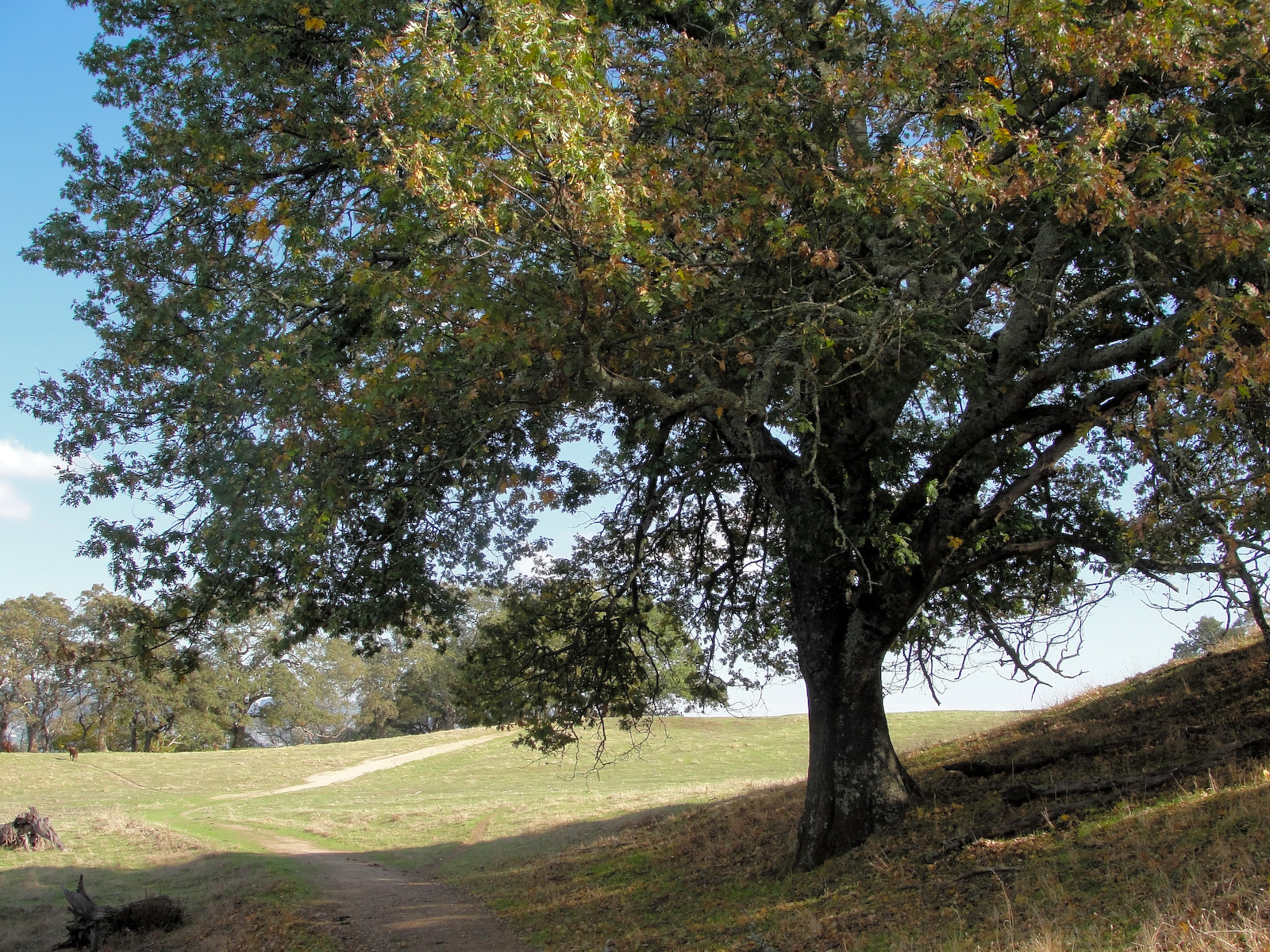
The tree typically grows from 9–25 meters (30–82 feet) in height and from 0.3–1.4 m (1–4+1⁄2 ft) in diameter. Large trees may exceed 36 m (118 ft) in height and 1.6 m (5 ft 3 in) diameter, with the record holder measuring 38 m (124 ft) tall and 2.7 m (9 ft) thick (in the Siskiyou National Forest in Oregon). The species also grows in shrubby scrub-oak form on poor sites. In open areas, the crown is broad and rounded, with lower branches nearly touching the ground or forming a browse line. In closed stands, the crown is narrow and slender in young trees and irregularly broad in old trees. Trunks are usually free of branches on the lower 6–12 m (20–39 ft) in closed stands. Trunks are often forked, and usually decayed and hollow in older trees. The bark is thin and smooth in young trees, becoming thick, ridged, plate-like, and blackish with age.
The leaves are typically 10–25 centimeters (4–10 in) long and deeply lobed, usually into seven portions; they are red and velvety when young, turning yellow-green then orange-brown in autumn. Blooming late in spring, the species is monoecious, with male flowers in catkins and females in leaf axils. The acorns are relatively large, from 2.5–4 cm (1–1+1⁄2 in) long and 1.5–1.8 cm (1⁄2–3⁄4 in) wide.
Its leaves (but not its fruit) appear very similar to several other members of the red oak section, including the red oak (Quercus rubra) and the black oak (Quercus velutina) found in eastern and central North America, despite being genetically separated from them for more than 20 million years.[citation needed]
It hybridizes with Quercus wislizeni.
California black oak is a deciduous tree growing in mixed evergreen forests, oak woodlands, and coniferous forests. California black oak is distributed along foothills and lower mountains of California and western Oregon. It can be found at altitudes of up to 1,800 m (5,900 ft), for example near Mount Shasta.
It is found from Lane County, Oregon, south through the Cascade Range, the Sierra Nevada, and the Coast, Transverse, and Peninsular Ranges to San Diego County, California. The tree occurs in pure or mixed stands. Pure stands usually indicate sites unfavorable to conifer growth or recurring disturbance such as fire or logging activities. The tree can grow in many types of soils, but they must be well-drained.
Hub AI
Quercus kelloggii AI simulator
(@Quercus kelloggii_simulator)
Quercus kelloggii
Quercus kelloggii, the California black oak or Kellogg oak, is an oak in the red oak section (genus Quercus, section Lobatae, series Agrifoliae) native to western North America.
Quercus kelloggii grows from one to several vertical roots which penetrate to bedrock, with large, laterally spreading roots extending off from vertical ones. It also has a number of surface roots. It can reproduce vegetatively with new growth sprouting from the root crown after the tree is top-killed by wildfire, logging, frost, or other events. While individual trees generally have a lifespan between 100 and 200 years, California black oak can live up to 500 years.
The tree typically grows from 9–25 meters (30–82 feet) in height and from 0.3–1.4 m (1–4+1⁄2 ft) in diameter. Large trees may exceed 36 m (118 ft) in height and 1.6 m (5 ft 3 in) diameter, with the record holder measuring 38 m (124 ft) tall and 2.7 m (9 ft) thick (in the Siskiyou National Forest in Oregon). The species also grows in shrubby scrub-oak form on poor sites. In open areas, the crown is broad and rounded, with lower branches nearly touching the ground or forming a browse line. In closed stands, the crown is narrow and slender in young trees and irregularly broad in old trees. Trunks are usually free of branches on the lower 6–12 m (20–39 ft) in closed stands. Trunks are often forked, and usually decayed and hollow in older trees. The bark is thin and smooth in young trees, becoming thick, ridged, plate-like, and blackish with age.
The leaves are typically 10–25 centimeters (4–10 in) long and deeply lobed, usually into seven portions; they are red and velvety when young, turning yellow-green then orange-brown in autumn. Blooming late in spring, the species is monoecious, with male flowers in catkins and females in leaf axils. The acorns are relatively large, from 2.5–4 cm (1–1+1⁄2 in) long and 1.5–1.8 cm (1⁄2–3⁄4 in) wide.
Its leaves (but not its fruit) appear very similar to several other members of the red oak section, including the red oak (Quercus rubra) and the black oak (Quercus velutina) found in eastern and central North America, despite being genetically separated from them for more than 20 million years.[citation needed]
It hybridizes with Quercus wislizeni.
California black oak is a deciduous tree growing in mixed evergreen forests, oak woodlands, and coniferous forests. California black oak is distributed along foothills and lower mountains of California and western Oregon. It can be found at altitudes of up to 1,800 m (5,900 ft), for example near Mount Shasta.
It is found from Lane County, Oregon, south through the Cascade Range, the Sierra Nevada, and the Coast, Transverse, and Peninsular Ranges to San Diego County, California. The tree occurs in pure or mixed stands. Pure stands usually indicate sites unfavorable to conifer growth or recurring disturbance such as fire or logging activities. The tree can grow in many types of soils, but they must be well-drained.
Recent media