


Community hub
0 subscribers8 pages, 0 posts
Recent from talks
All channels
Be the first to start a discussion here.
Be the first to start a discussion here.
Be the first to start a discussion here.
Be the first to start a discussion here.
Contribute something
Welcome to the community hub built to collect knowledge and have discussions related to History of the floppy disk.
Nothing was collected or created yet.
History of the floppy disk
View on Wikipediafrom Wikipedia
Not found
History of the floppy disk
View on Grokipediafrom Grokipedia
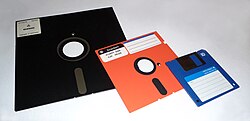
The floppy disk was a pioneering removable magnetic storage medium for computers, invented by IBM in the late 1960s and commercially introduced in 1971 as an 8-inch flexible disk capable of holding about 80 kilobytes of data, primarily to load and store microcode for mainframe systems like the IBM System/370.[1] Over the next two decades, it evolved into smaller formats that became essential for personal computing, enabling easy data transfer, software distribution, and backups until optical media and flash storage rendered it obsolete by the early 2000s.[2]
Development began in 1967 at IBM's San Jose Research Laboratory under project leader David L. Noble, with engineer Warren L. Dalziel leading the design of the drive mechanism; the team sought a reliable alternative to punched cards and tapes for preserving system instructions that were prone to erasure.[1] By 1971, IBM began selling the first floppy disk drives, and in 1972, the company received U.S. patents for both the drive and the disk itself, marking a key milestone in portable data storage.[1] The initial 8-inch disk, made of Mylar coated in iron oxide and housed in a square envelope with a fabric liner for cleaning, stored roughly the equivalent of 3,000 punched cards and revolutionized data handling in enterprise environments.[1][2]
In the mid-1970s, as computers miniaturized, the floppy disk shrank to 5.25 inches, introduced around 1976 and quickly adopted in early personal computers; such as the Apple II, which received compatible drives in 1978, holding about 140 kilobytes initially, while the IBM PC in 1981 used double-sided 360-kilobyte versions that became a standard for MS-DOS software.[3][2] High-density 5.25-inch disks emerged in 1984 with 1.2 megabytes of capacity, but their soft jackets were susceptible to contamination, prompting further innovation.[1] By the mid-1980s, Sony introduced the 3.5-inch format in 1981 (with widespread adoption by 1986), featuring a rigid plastic shell with a sliding metal shutter for protection, achieving 1.44 megabytes in high-density models and dominating the market through the 1990s.[3][1][4]
Floppy disks fueled the growth of the personal computer industry by making software affordable and distributable—titles like early versions of Microsoft Office shipped on them—and peaked at over 5 billion units sold annually in the mid-1990s, with the 3.5-inch becoming the universal standard for PCs, Macs, and even game consoles.[1][2] Key figures like Alan Shugart, who contributed to the early drive design at IBM before founding Shugart Associates to produce compatible peripherals, helped drive industry-wide compatibility.[4][2] However, limitations such as low capacity (capped at around 2.88 MB for extended-density variants) and vulnerability to physical damage led to their decline starting in the late 1990s, accelerated by the rise of CD-ROMs for distribution and USB flash drives for portability.[4] Despite this, floppy disks continue to be used in some niche industrial and legacy applications as of 2025.[3][5]
Origins and Early Formats
Invention of the 8-inch disk
In 1967, product manager Alan Shugart at IBM's San Jose research laboratory assigned the project to David L. Noble to lead the development of the first floppy disk as a read-only storage medium to simplify the loading of microcode into IBM System/370 mainframes.[6] Noble's team, including Warren L. Dalziel, Ralph Flores, and Herbert Thompson, aimed to create an inexpensive alternative to punched cards for diagnostic and initialization tasks, with Dalziel leading the design of the drive mechanism.[1] The effort culminated in the prototype known internally as the "Minnow" drive, or 23FD, which was shipped in limited quantities by 1971.[6] The 8-inch floppy disk featured a flexible, oxide-coated Mylar disk enclosed in a square protective jacket made of vinyl or similar material, measuring approximately 8 inches in diameter and designed for single-sided recording.[1] It utilized Modified Frequency Modulation (MFM) encoding to store data at a density that yielded an 80 KB capacity, equivalent to about 3,000 punched cards.[6] A key innovation was the disk's flexibility, which enabled random access to data sectors via a magnetic read head, contrasting with the sequential nature of tape or card systems.[1] The jacket included a central access hole to allow the read head to contact the disk surface while protecting it from dust and damage, with a fabric liner to wipe debris during insertion.[6] Initially deployed as a diagnostic tool for mainframe systems, the floppy disk eliminated the need for cumbersome punched cards in loading firmware and running tests on the System/370 controllers.[1] The drive was first commercially shipped in 1971 as the 23FD for IBM System/370 mainframes, and its first appearance in a commercial product came with the IBM 3740 Data Entry System in 1973.[6] This read-only design laid the groundwork for subsequent enhancements that would enable bidirectional data operations.[1]Development of read/write capabilities
The initial 8-inch floppy disk, introduced by IBM in 1971, was designed as a read-only medium for loading microcode into mainframe systems.[1] To enable rewritability, IBM engineers made key technical modifications in 1973 with the release of the 33FD drive for the 3740 Data Entry System.[7] These enhancements included the addition of a write-protect notch on the disk jacket, which allowed users to prevent accidental overwriting by covering the notch with adhesive tape, thereby transforming the disk into a versatile read/write storage device, and a switch to MFM encoding for higher density.[1][7] The 33FD drive was single-sided, providing capacities of approximately 256 KB.[7] An index hole was also incorporated into the disk jacket to provide precise synchronization for read/write operations, marking the start of each track rotation and improving data access reliability.[1][7] Double-sided versions, supporting up to 1.2 MB by the late 1970s through refined encoding techniques, emerged later in the decade.[7][8] In parallel, Shugart Associates introduced the SA-900, the first third-party 8-inch read/write drive, in 1973, designed to be compatible with IBM's 3740 format and targeting original equipment manufacturers (OEMs).[9] This drive featured integrated read/write electronics and a precision positioning mechanism, facilitating broader industry adoption beyond IBM's proprietary systems.[9][7] IBM played a pivotal role in standardization by defining the track and sector layouts for the 8-inch format in the 33FD, establishing a de facto industry benchmark that emphasized soft-sectored designs for flexible data organization.[7] These specifications, including 77 tracks and variable sector sizes, were formalized through ANSI efforts, culminating in standards ratified by 1975 to ensure interoperability across drives and media.[7] Early adoption of these read/write-capable 8-inch drives extended to minicomputer systems, such as the DEC PDP-11 and Wang VS series, where they replaced slower paper tape for input/output operations and provided single-sided capacities of around 256 KB per disk.[7] In the PDP-11's RX01 configuration, for instance, the drive supported reliable data interchange in multi-user environments, marking a shift toward floppy disks as a standard peripheral for mid-1970s computing.[7][10]5¼-inch Format
Introduction and market adoption
The 5¼-inch floppy disk emerged as a pivotal advancement in removable data storage, developed by Shugart Associates in 1976 as a compact alternative to the larger 8-inch format originally designed for mainframe systems.[11] Responding to demand from personal computer manufacturers for a more affordable and portable option, the company reduced the disk size while introducing a soft-sectored design that allowed flexible formatting by software, unlike the rigid hard-sectored 8-inch disks. The initial SA-400 "Minifloppy" drive offered a capacity of 110 KB on single-sided, single-density disks and was priced at $390 for original equipment manufacturers (OEMs), significantly undercutting the $1,200 cost of contemporary 8-inch drives.[11][12] Key milestones in the format's rollout included the first commercial drives shipping in September 1976, led by Shugart Associates founder Alan Shugart, a former IBM engineer who had contributed to the original 8-inch floppy's creation. Adoption accelerated with the Apple II computer in 1977, which integrated the Shugart SA-400 as its Disk II drive, enabling hobbyists to load software and data more efficiently than with cassette tapes.[13][14] By 1981, the format became a cornerstone of the IBM PC, bundled with PC-DOS (later MS-DOS) for booting and file management, solidifying its role in business computing.[15] Market drivers for the 5¼-inch floppy's rapid uptake included its lower production costs, which fell to $100–200 per drive by the early 1980s compared to over $500 for 8-inch models, making it accessible for personal and small business use.[16] Its smaller footprint enhanced portability, allowing users to carry disks easily for software distribution and data exchange in an era before widespread hard drives. This fueled a sales boom, with annual shipments of 5¼-inch drives reaching 13 million units by the late 1980s, driven by the explosive growth of personal computers.[17] Early compatibility challenges arose from format variations, particularly with the double-density (DD) standard that boosted capacity to 360 KB on double-sided disks, but implementations differed across systems—such as 35 tracks on the Apple II versus 40 tracks on the IBM PC—leading to interoperability issues without specialized software or adapters.[18]Advancements to high-density versions
In 1984, the high-density (HD) variant of the 5¼-inch floppy disk format was introduced, achieving a formatted capacity of 1.2 MB per disk through key technical enhancements including a data transfer rate of 500 kbit/s, support for 80 tracks per side at 96 tracks per inch (TPI), and modified frequency modulation (MFM) encoding.[19] These improvements built on the foundational double-density (DD) 5¼-inch format by increasing recording density to approximately 9,646 bits per inch while requiring specialized HD media with a higher coercivity of 600–650 oersteds to maintain data integrity under the denser magnetic patterns.[20] Attempting to use standard DD disks in HD drives risked data corruption, as the media's lower coercivity could not reliably retain the finer magnetic transitions imposed by the HD write process.[20] The IBM Personal Computer AT (PC AT), launched in 1984, was the first system to incorporate HD 5¼-inch floppy drives as standard, utilizing the Intel 8272A or equivalent floppy disk controller to handle the format via DMA channel 2 and I/O ports 3F0–3F7 hexadecimal.[19] This adoption by IBM rapidly standardized the HD format across the industry, with Microsoft enhancing support in MS-DOS 3.0 and later versions through built-in backward compatibility modes that allowed HD drives to operate in DD mode (at 250 kbit/s and 40 or 80 tracks) for reading and writing legacy media.[19] Such compatibility was achieved via BIOS interrupt 13h routines and parameter tables stored at interrupt vector 1Eh, enabling seamless handling of both 360 KB DD and 1.2 MB HD disks without hardware modifications.[19] The HD format's greater capacity significantly influenced software development and distribution, facilitating the packaging of more complex applications on fewer disks; for instance, Microsoft Windows 1.0 (1985) was distributed across five 5¼-inch HD floppies, including setup, build, and utilities disks, which would have required more volumes in DD format.[21] By the late 1980s, HD 5¼-inch drives had become standard in the majority of personal computers, reaching peak production volumes as manufacturers like IBM, Compaq, and others integrated them into systems to meet growing demand for higher-capacity removable storage.[20] Despite these advances, the HD format had limitations, particularly regarding media detection; without proper sensing of disk type (via the media sensor line or BIOS checks), HD drives could exhibit higher error rates when accessing DD disks due to mismatched head widths—HD heads at 96 TPI being narrower than the 48 TPI tracks on DD media—potentially causing read/write misalignment unless double-stepping techniques were employed.[19] Additionally, formatting DD media in an HD drive often resulted in unreliable storage, as the weaker magnetic coating degraded under the higher-density write currents.[20]Failed and Alternative Formats
The Twiggy disk drive
The Twiggy disk drive, developed by Apple Computer starting in 1980, represented an attempt to create a proprietary double-sided 5¼-inch floppy disk format with enhanced capacity for the Lisa personal computer. Designed in-house by Apple's Disk Division under John Vennard, it aimed to quadruple the storage of standard 5¼-inch double-density disks by employing higher-density media and a variable-speed motor that slowed rotation on outer tracks to pack more data. The drive achieved a formatted capacity of 860 KB per disk, significantly surpassing the approximately 360 KB of contemporary double-sided drives, and incorporated innovative features such as software-controlled automatic ejection and micro-stepping for precise head positioning.[22][23] Technical aspects of the Twiggy included the absence of a physical write-protect switch, relying instead on software-based sensing to detect disk status, which simplified the hardware but introduced potential vulnerabilities in operation. The Lisa 1, released in January 1983, shipped with two Twiggy drives as standard, integrated with a dedicated controller inspired by the Apple II's Disk II design for tight timing control without interrupts. However, prototypes and early production units revealed severe reliability problems, including high error rates that slowed read/write operations and increased seek times due to the variable motor speed mechanism.[23][24] These issues culminated in defect rates that rendered the drive barely functional, causing production delays and frustrating the Lisa development schedule. Apple invested heavily in the project, but escalating costs and persistent unreliability—exacerbated by manufacturing challenges with the custom diskettes—led to its cancellation later in 1983 after only a few thousand Lisa 1 units were produced with Twiggy drives. The company offered free upgrades to Sony's 3½-inch 400 KB drives for affected systems and adopted the same format for the Macintosh, marking a pivot away from proprietary 5¼-inch designs.[22][25][23] The Twiggy's failure highlighted the dangers of proprietary formats in the rapidly evolving personal computer market of the early 1980s, where interoperability and reliability were becoming critical for adoption. By abandoning the Twiggy, Apple avoided further sunk costs and aligned with industry standards, though the episode underscored the risks of in-house innovation without robust testing. Its brief tenure exposed vulnerabilities in custom hardware amid the broader shift from 8-inch to smaller, more reliable 5¼-inch and 3½-inch formats.[25]3-inch compact floppy and variants
The 3-inch compact floppy disk, also known as the Compact Floppy or CF2, emerged in 1982 as a portable alternative to larger formats, designed by Hitachi, Matsushita, and Maxell to address the need for more compact storage in computing devices.[26] Teac introduced the FD-30 drive in the same year, offering a 3-inch mechanism with double-sided capabilities and a rigid casing for enhanced durability and reversibility, featuring independent write-protect switches on each side.[27] The format supported up to 720 KB in high-density (HD) variants, with each side holding 360 KB, making it suitable for early portable systems but limited by its niche positioning.[26] A related but distinct variant, the Mitsumi Quick Disk, debuted around 1985 as a 3-inch magnetic medium primarily for consumer appliances like word processors and game consoles, utilizing a non-standard single continuous track layout similar to audio cassettes rather than concentric tracks.[28] Capacities ranged from 128 KB to 256 KB depending on the enclosure size (3-inch square or rectangular), and it lacked a protective shutter, prioritizing low cost over robustness.[28] This format gained adoption in MSX home computers and Nintendo's Famicom Disk System, serving as an affordable storage option for software distribution in Japan during the early 1980s.[28] Hitachi further developed 3-inch variants in 1984 for Japanese laptops, offering 360 KB in double-density (DD) configurations to support mobile computing needs, though these remained regionally focused with limited export.[26] Amstrad adopted the CF2 format in 1985 for its CPC and PCW series, integrating 3-inch drives into budget-oriented machines like the PCW 8256, which emphasized word processing and used the disks for 180 KB single-sided or 360 KB double-sided storage.[29] Despite initial promise for portability, the 3-inch formats suffered from regional fragmentation and incompatibility with dominant 5¼-inch standards, lacking endorsement from major players like IBM, which hindered widespread software and hardware support.[26] By the late 1980s, competition from the more standardized 3½-inch format accelerated their decline, leading to phase-out around 1990 as manufacturers shifted to unified ecosystems.[29]3½-inch Standard
Emergence and industry adoption
The development of the 3½-inch floppy disk began in the late 1970s as an effort to create a more durable and compact storage medium compared to earlier formats, with the rigid plastic casing designed to protect the flexible magnetic disk inside from damage and environmental contamination. Sony introduced the first commercial 3½-inch floppy disk and drive in 1981, featuring an initial double-density (DD) capacity of 360 KB, which addressed issues like disk centering and dust exposure through innovations such as a V-groove hub and protective shutter. This design built on preceding experiments with smaller formats, like the 3-inch disk, but the 3½-inch version gained traction for its balance of portability and reliability.[30][31] Early adoption accelerated in 1983 when Sony adapted the format for compatibility with MS-DOS systems, enabling its use in portable PCs like the Apricot Portable, one of the first x86-based computers to incorporate the drive. The pivotal breakthrough came in 1984 with Apple's Macintosh 128K, which used a Sony-designed 3½-inch drive as its primary storage, marking the format's debut in a major consumer product and emphasizing its suitability for graphical interfaces and software distribution. By 1987, IBM further propelled its acceptance by standardizing the 3½-inch drive in the PS/2 line, including high-density variants, which helped transition the format from niche to mainstream in business and personal computing.[32][33][34] The format's market dominance over the 5¼-inch predecessor solidified by 1988, when 3½-inch drive shipments reached 18 million units and overtook 5¼-inch as the leading floppy type, capturing a substantial share of the PC market due to its shatterproof enclosure, automatic ejection mechanism, and reduced manufacturing costs that brought drive prices down significantly. These attributes made it ideal for the emerging portable computing sector, facilitating the boom in laptop and notebook designs by providing reliable, interchangeable media without the fragility of larger disks. Global standardization followed with the publication of ISO/IEC 9529 in 1989, which defined the physical, magnetic, and track format specifications to ensure interoperability across manufacturers.[31][35][36]Technical characteristics and nomenclature
The 3½-inch floppy disk, standardized under ECMA-147, features a rigid plastic case measuring 90 mm × 94 mm × 3.3 mm, enclosing a flexible magnetic disk with an 85.8 mm diameter. The disk employs a metal hub centered in a square hole for precise engagement with the drive's spindle motor, enabling constant angular velocity rotation at 300 RPM. A sliding write-protect switch on the case covers or exposes a notch, which the drive detects via a sensor to prevent or allow writing. The media is double-sided, with 80 tracks per side accessed by a stepper motor positioning the read/write head, and data organized into 512-byte sectors.[37][38][39] Data storage utilizes modified frequency modulation (MFM) encoding, with double-density (DD) variants operating at a 300 kbit/s transfer rate and high-density (HD) at 500 kbit/s to support higher track densities while maintaining compatible linear bit densities. Error detection relies on cyclic redundancy check (CRC) polynomials appended to each sector, ensuring data integrity during read/write operations. Formatted capacities for IBM PC-compatible systems are 720 KB for double-sided double-density (DSDD) disks (80 tracks, 9 sectors per track per side) and 1.44 MB for double-sided high-density (DS/HD) disks (80 tracks, 18 sectors per track per side), though unformatted capacities reach approximately 880 KB for DSDD and 2 MB for DS/HD before overhead for headers, gaps, and formatting.[40][39][41] The nomenclature "3½-inch" derives from an approximate diagonal measurement of the original Sony design, despite the cartridge's actual 90 mm width, distinguishing it from the 5¼-inch format; it is formally termed a 90 mm flexible disk cartridge in standards documentation. Common designations include DSDD or DS/DD for double-density media and DS/HD for high-density, with regional variations such as "microfloppy" in early Japanese documentation; later misnomers like "SuperDisk" refer to incompatible high-capacity extensions rather than the baseline standard.[37][42][43] High-density drives support backward compatibility by switching to DD mode at the lower 300 kbit/s rate, allowing reads and writes on DSDD media, though optimal performance requires matching media types due to differences in magnetic coercivity—HD disks demand stronger write fields to avoid data instability in DD drives.[44][41]| Variant | Formatted Capacity | Tracks per Side | Sectors per Track | Data Rate |
|---|---|---|---|---|
| DSDD | 720 KB | 80 | 9 | 300 kbit/s |
| DS/HD | 1.44 MB | 80 | 18 | 500 kbit/s |