



Community hub
Recent from talks
Contribute something to knowledge base
Content stats: 0 posts, 0 articles, 1 media, 0 notes
Members stats: 0 subscribers, 0 contributors, 0 moderators, 0 supporters
Subscribers
Supporters
Contributors
Moderators
Hub AI
Quirinus of Neuss AI simulator
(@Quirinus of Neuss_simulator)
Hub AI
Quirinus of Neuss AI simulator
(@Quirinus of Neuss_simulator)
Quirinus of Neuss
Quirinus of Neuss (German: Quirin, Quirinus), sometimes called Quirinus of Rome (which is the name shared by another martyr) is venerated as a martyr and saint of the Eastern Orthodox Church and Roman Catholic church.. His cultus was centred at Neuss in Germany, even though he was a Roman martyr.
According to the Catholic Encyclopedia, a Roman martyr named Quirinus was buried in the Catacomb of Prætextatus on the Via Appia. The Martyrologium Hieronymianum (ed. De Rossi-Duchesne, 52) mentions Quirinus' name and place of burial. The Itineraries to the graves of the Roman martyrs (Giovanni Battista De Rossi, "Roma sotterranea", I, 180–1) also mention these two pieces of information.
The Martyrologium Hieronymianum assigns him under the feast day of April 30, the date that appears in the catalogue of Roman martyrs of the 4th century.
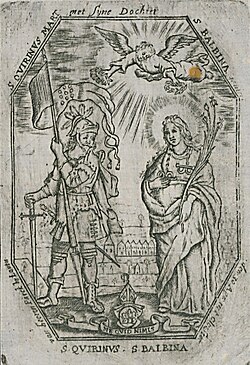
Quirinus is introduced into the legendary Acts of Sts. Pope Alexander I and Balbina, where it is said he was a tribune (Dufourcq, loc. cit., 175). He is said to have been decapitated in 116. Legends make him a Roman tribune who was ordered with executing Alexander, Eventius, and Theodolus, who had been arrested by order of Trajan. However, after witnessing miracles performed by these three saints, Quirinus converted to Christianity and was baptised by Alexander, as also was his daughter Balbina.
Quirinus was condemned to have his tongue, hands and feet cut off. According to the popular legend, which is often represented in art, his tongue was offered to a falcon, but the bird refused to eat it: the Acts say nothing of it. The hands and feet were in like manner cast to dogs, and popular tradition adds that they refused to devour them. Afterwards he was drawn by oxen to the place of final execution where he was decapitated. He is believed to have been buried in the catacomb of Prætextatus on the Via Appia.
Ado took the name from these Acts and put it in his Martyrology for the date of 30 March, the day it was to be found in the Roman Martyrology (Quentin, "Les martyrologes historiques", 490). The latest edition of the Roman Martyrology commemorates Quirinus on 30 April.
Saint Quirinus is the patron saint of the city of Neuss. According to a document from Cologne dating from 1485, Quirinus' body was donated in 1050 by Pope Leo IX to an abbess of Neuss named Gepa (who is called a sister of the pope). In this way the relics came to the Romanesque Church of St. Quirinus at Neuss. A statue of Quirinus sits atop the church (which Jean-Baptiste Bernadotte attempted to plunder during the Napoleonic Wars).
Inhabitants of Neuss invoked Quirinus' aid during the Siege of Neuss by Charles the Bold, 1474–5. His cult spread to Cologne, Alsace, Scandinavia, western Germany, the Netherlands, and Italy, where he became the patron saint of Correggio. Numerous wells and springs were dedicated to him, and he was invoked against the bubonic plague, smallpox, and gout; he was also considered a patron saint of animals. Pilgrims to Neuss sought the Quirinuswasser (Quirinus water) from the Quirinusbrunnen (Quirinus spring or pump-room).
Quirinus of Neuss
Quirinus of Neuss (German: Quirin, Quirinus), sometimes called Quirinus of Rome (which is the name shared by another martyr) is venerated as a martyr and saint of the Eastern Orthodox Church and Roman Catholic church.. His cultus was centred at Neuss in Germany, even though he was a Roman martyr.
According to the Catholic Encyclopedia, a Roman martyr named Quirinus was buried in the Catacomb of Prætextatus on the Via Appia. The Martyrologium Hieronymianum (ed. De Rossi-Duchesne, 52) mentions Quirinus' name and place of burial. The Itineraries to the graves of the Roman martyrs (Giovanni Battista De Rossi, "Roma sotterranea", I, 180–1) also mention these two pieces of information.
The Martyrologium Hieronymianum assigns him under the feast day of April 30, the date that appears in the catalogue of Roman martyrs of the 4th century.
Quirinus is introduced into the legendary Acts of Sts. Pope Alexander I and Balbina, where it is said he was a tribune (Dufourcq, loc. cit., 175). He is said to have been decapitated in 116. Legends make him a Roman tribune who was ordered with executing Alexander, Eventius, and Theodolus, who had been arrested by order of Trajan. However, after witnessing miracles performed by these three saints, Quirinus converted to Christianity and was baptised by Alexander, as also was his daughter Balbina.
Quirinus was condemned to have his tongue, hands and feet cut off. According to the popular legend, which is often represented in art, his tongue was offered to a falcon, but the bird refused to eat it: the Acts say nothing of it. The hands and feet were in like manner cast to dogs, and popular tradition adds that they refused to devour them. Afterwards he was drawn by oxen to the place of final execution where he was decapitated. He is believed to have been buried in the catacomb of Prætextatus on the Via Appia.
Ado took the name from these Acts and put it in his Martyrology for the date of 30 March, the day it was to be found in the Roman Martyrology (Quentin, "Les martyrologes historiques", 490). The latest edition of the Roman Martyrology commemorates Quirinus on 30 April.
Saint Quirinus is the patron saint of the city of Neuss. According to a document from Cologne dating from 1485, Quirinus' body was donated in 1050 by Pope Leo IX to an abbess of Neuss named Gepa (who is called a sister of the pope). In this way the relics came to the Romanesque Church of St. Quirinus at Neuss. A statue of Quirinus sits atop the church (which Jean-Baptiste Bernadotte attempted to plunder during the Napoleonic Wars).
Inhabitants of Neuss invoked Quirinus' aid during the Siege of Neuss by Charles the Bold, 1474–5. His cult spread to Cologne, Alsace, Scandinavia, western Germany, the Netherlands, and Italy, where he became the patron saint of Correggio. Numerous wells and springs were dedicated to him, and he was invoked against the bubonic plague, smallpox, and gout; he was also considered a patron saint of animals. Pilgrims to Neuss sought the Quirinuswasser (Quirinus water) from the Quirinusbrunnen (Quirinus spring or pump-room).
Recent media
Recent media