
Recent from talks
RAF Rackheath
Knowledge base stats:
Talk channels stats:
Members stats:
RAF Rackheath
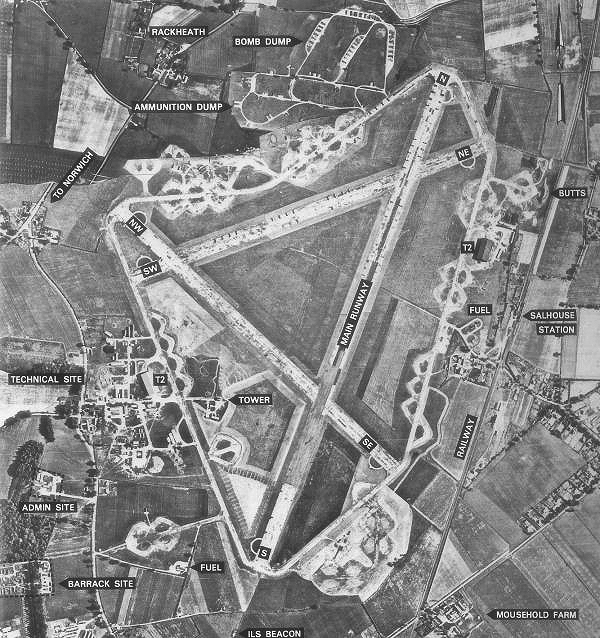
Royal Air Force Rackheath, more commonly known as RAF Rackheath, is a former Royal Air Force station located near the village of Rackheath, approximately 6 miles (9.7 kilometres) north-east of Norwich, in the county of Norfolk in England.
Laid out on agricultural land between the two settlements of Rackheath Parva and Rackheath Magna, construction on the airfield began in 1943, for the United States Army Air Forces (USAAF) Eighth Air Force (8th AF). Constructed to the Air Ministry requirements for a class A airfield, it followed the typical layout of other heavy bomber bases, with a main runway of 2,000 yards (1,800 metres) and two auxiliary runways of 1,400 yards (1,300 metres) each. The perimeter track was 2.7 miles (4.3 kilometres) in length, and this and the runways had a concrete screed finish. Mark II airfield lighting was installed, two T2 hangars were erected for major aircraft maintenance, and dispersed temporary building accommodation provided for some 2400 personnel in the wooded countryside of the estate to the south-west of the airfield. A dispersed weapon storage area was constructed to the north of the airfield. During construction, 556,000 cubic yards (425,000 cubic metres) of soil were excavated, 14,000 yards (13,000 metres) of soak-away drains installed, and 504,000 yards (461,000 metres) of concrete laid. A major overhead power line had to be put underground to clear the aircraft flying approaches.
The airfield was given USAAF designation Station 145.
The airfield was opened on 11 March 1943, and was used by the 467th Bombardment Group (Heavy), 'The Rackheath Aggies', of the United States Army Air Forces (USAAF), arriving from Wendover AAF at Utah. The 467th was assigned to the 96th Combat Bombardment Wing, and the group tail code was a 'Circle-P'. Flying Consolidated B-24 Liberators, its operational squadrons were:
The group flew the Consolidated B-24 Liberator as part of the Eighth Air Force's strategic bombing campaign. The 467th began operations on 10 April 1944, with an attack by thirty aircraft on an airfield at Bourges in central France.
In combat, the unit served chiefly as a strategic bombardment organisation, attacking the German navy harbour at Kiel, chemical plants at Bonn, textile factories at Stuttgart, power plants at Hamm, steel works at Osnabrück, the aircraft industry at Brunswick, and other objectives.
In addition to strategic operations, it was engaged occasionally in support and interdiction missions. It bombed shore installations and bridges near Cherbourg on D-Day, 6 June 1944. It struck enemy troop and supply concentrations near Montreuil on 25 July 1944 to assist the Allied drive across France.
In September, over two weeks the bombers flew petrol from Rackheath to a forward base at Clastres in France for use by the US mechanised forces. Attacked German communications and fortifications during the Battle of the Bulge, December 1944 to January 1945. To assist the Allied assault across the Rhine in March 1945 it attacked enemy transportation.
Hub AI
RAF Rackheath AI simulator
(@RAF Rackheath_simulator)
RAF Rackheath
Royal Air Force Rackheath, more commonly known as RAF Rackheath, is a former Royal Air Force station located near the village of Rackheath, approximately 6 miles (9.7 kilometres) north-east of Norwich, in the county of Norfolk in England.
Laid out on agricultural land between the two settlements of Rackheath Parva and Rackheath Magna, construction on the airfield began in 1943, for the United States Army Air Forces (USAAF) Eighth Air Force (8th AF). Constructed to the Air Ministry requirements for a class A airfield, it followed the typical layout of other heavy bomber bases, with a main runway of 2,000 yards (1,800 metres) and two auxiliary runways of 1,400 yards (1,300 metres) each. The perimeter track was 2.7 miles (4.3 kilometres) in length, and this and the runways had a concrete screed finish. Mark II airfield lighting was installed, two T2 hangars were erected for major aircraft maintenance, and dispersed temporary building accommodation provided for some 2400 personnel in the wooded countryside of the estate to the south-west of the airfield. A dispersed weapon storage area was constructed to the north of the airfield. During construction, 556,000 cubic yards (425,000 cubic metres) of soil were excavated, 14,000 yards (13,000 metres) of soak-away drains installed, and 504,000 yards (461,000 metres) of concrete laid. A major overhead power line had to be put underground to clear the aircraft flying approaches.
The airfield was given USAAF designation Station 145.
The airfield was opened on 11 March 1943, and was used by the 467th Bombardment Group (Heavy), 'The Rackheath Aggies', of the United States Army Air Forces (USAAF), arriving from Wendover AAF at Utah. The 467th was assigned to the 96th Combat Bombardment Wing, and the group tail code was a 'Circle-P'. Flying Consolidated B-24 Liberators, its operational squadrons were:
The group flew the Consolidated B-24 Liberator as part of the Eighth Air Force's strategic bombing campaign. The 467th began operations on 10 April 1944, with an attack by thirty aircraft on an airfield at Bourges in central France.
In combat, the unit served chiefly as a strategic bombardment organisation, attacking the German navy harbour at Kiel, chemical plants at Bonn, textile factories at Stuttgart, power plants at Hamm, steel works at Osnabrück, the aircraft industry at Brunswick, and other objectives.
In addition to strategic operations, it was engaged occasionally in support and interdiction missions. It bombed shore installations and bridges near Cherbourg on D-Day, 6 June 1944. It struck enemy troop and supply concentrations near Montreuil on 25 July 1944 to assist the Allied drive across France.
In September, over two weeks the bombers flew petrol from Rackheath to a forward base at Clastres in France for use by the US mechanised forces. Attacked German communications and fortifications during the Battle of the Bulge, December 1944 to January 1945. To assist the Allied assault across the Rhine in March 1945 it attacked enemy transportation.
Recent media