


Community hub
Recent from talks
Contribute something
Nothing was collected or created yet.


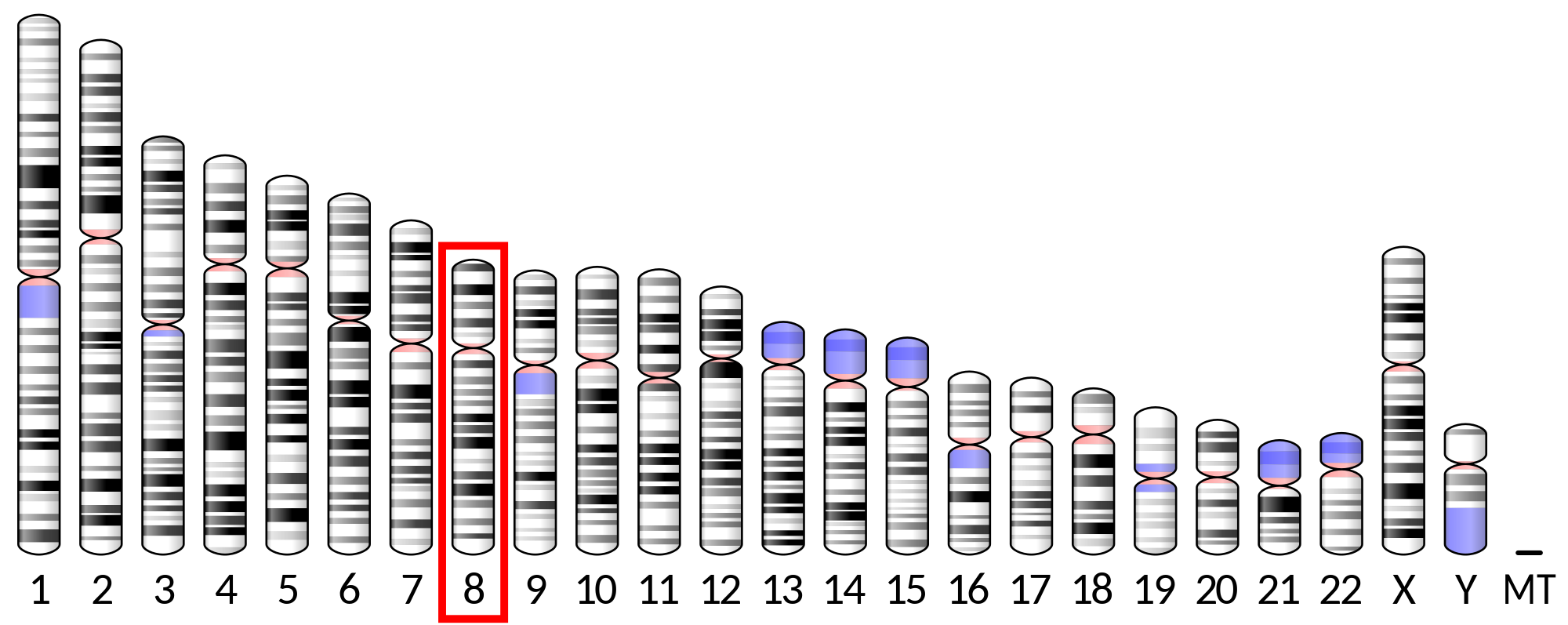
Oxygen-regulated protein 1 also known as retinitis pigmentosa 1 protein (RP1) is a protein that in humans is encoded by the RP1 gene.[5][6]
Function
[edit]This gene encodes a member of the doublecortin family. The protein encoded by this gene contains two doublecortin domains that bind to microtubules and regulate microtubule polymerization. The encoded protein is a protein associated with the photoreceptor cell microtubules in the retina and is necessary for the correct stacking of outer segment disc. This protein and another retinal-specific protein, RP1L1, play essential and synergistic roles in affecting photosensitivity and outer segment morphogenesis of rod photoreceptor cells.[6]
History
[edit]Initially named "ORP1" for its response to in vivo retinal oxygen levels (designated ORP1 for 'oxygen-regulated protein-1'), this gene was subsequently linked to autosomal dominant retinitis pigmentosa and was renamed RP1 for 'retinitis pigmentosa 1'.
Clinical significance
[edit]Mutations in this gene cause autosomal dominant or autosomal recessive retinitis pigmentosa.[7][8][9][10][11] Transcript variants produced by alternative promoters and alternative splicing have been discovered that overlap with the current reference sequence and have multiple exons upstream and downstream of the current reference sequence. However, as of 2010, it is currently impossible to determine the biological effectiveness and full-length nature of certain variants.[6]
See also
[edit]References
[edit]- ^ a b c GRCh38: Ensembl release 89: ENSG00000104237 – Ensembl, May 2017
- ^ a b c GRCm38: Ensembl release 89: ENSMUSG00000025900 – Ensembl, May 2017
- ^ "Human PubMed Reference:". National Center for Biotechnology Information, U.S. National Library of Medicine.
- ^ "Mouse PubMed Reference:". National Center for Biotechnology Information, U.S. National Library of Medicine.
- ^ Blanton SH, Heckenlively JR, Cottingham AW, Friedman J, Sadler LA, Wagner M, et al. (Mar 1992). "Linkage mapping of autosomal dominant retinitis pigmentosa (RP1) to the pericentric region of human chromosome 8". Genomics. 11 (4): 857–69. doi:10.1016/0888-7543(91)90008-3. PMID 1783394.
- ^ a b c "RP1 axonemal microtubule associated". Archived from the original on 2021-01-17. Retrieved 2020-09-25.
- ^ Georgiou M, Grewal PS, Narayan A, Alser M, Ali N, Fujinami K, et al. (August 2020). "Sector Retinitis Pigmentosa: Extending the Molecular Genetics Basis and Elucidating the Natural History". American Journal of Ophthalmology. 221: 299–310. doi:10.1016/j.ajo.2020.08.004. PMC 7772805. PMID 32795431.
- ^ Ueno S, Koyanagi Y, Kominami T, Ito Y, Kawano K, Nishiguchi KM, et al. (September 2020). "Clinical characteristics and high resolution retinal imaging of retinitis pigmentosa caused by RP1 gene variants" (PDF). Japanese Journal of Ophthalmology. 64 (5): 485–496. doi:10.1007/s10384-020-00752-1. PMID 32627106. S2CID 220351273. Archived (PDF) from the original on 2022-05-19. Retrieved 2022-06-11.
- ^ Daiger SP, Sullivan LS, Bowne SJ, Kennan A, Humphries P, Birch DG, et al. (2003). "Identification of the RP1 and RP10 (IMPDH1) Genes Causing Autosomal Dominant RP". Retinal Degenerations. Advances in Experimental Medicine and Biology. Vol. 533. pp. 1–11. doi:10.1007/978-1-4615-0067-4_1. ISBN 978-1-4613-4909-9. PMC 2583078. PMID 15180241.
- ^ Daiger SP, Shankar SP, Schindler AB, Sullivan LS, Bowne SJ, King TM, et al. (2006). "Genetic factors modifying clinical expression of autosomal dominant RP". Retinal Degenerative Diseases. Advances in Experimental Medicine and Biology. Vol. 572. pp. 3–8. doi:10.1007/0-387-32442-9_1. ISBN 978-0-387-28464-4. PMC 2581449. PMID 17249547.
- ^ Wang DY, Chan WM, Tam PO, Baum L, Lam DS, Chong KK, et al. (January 2005). "Gene mutations in retinitis pigmentosa and their clinical implications". Clinica Chimica Acta; International Journal of Clinical Chemistry. 351 (1–2): 5–16. doi:10.1016/j.cccn.2004.08.004. PMID 15563868.
Further reading
[edit]- Juwana JP, Henderikx P, Mischo A, Wadle A, Fadle N, Gerlach K, et al. (1999). "EB/RP gene family encodes tubulin binding proteins". Int. J. Cancer. 81 (2): 275–84. doi:10.1002/(SICI)1097-0215(19990412)81:2<275::AID-IJC18>3.0.CO;2-Z. PMID 10188731. S2CID 33232892.
- Pierce EA, Quinn T, Meehan T, McGee TL, Berson EL, Dryja TP (1999). "Mutations in a gene encoding a new oxygen-regulated photoreceptor protein cause dominant retinitis pigmentosa". Nat. Genet. 22 (3): 248–54. doi:10.1038/10305. PMID 10391211. S2CID 26312606.
- Sullivan LS, Heckenlively JR, Bowne SJ, Zuo J, Hide WA, Gal A, et al. (1999). "Mutations in a novel retina-specific gene cause autosomal dominant retinitis pigmentosa". Nat. Genet. 22 (3): 255–9. doi:10.1038/10314. PMC 2582380. PMID 10391212.
- Guillonneau X, Piriev NI, Danciger M, Kozak CA, Cideciyan AV, Jacobson SG, et al. (1999). "A nonsense mutation in a novel gene is associated with retinitis pigmentosa in a family linked to the RP1 locus". Hum. Mol. Genet. 8 (8): 1541–6. doi:10.1093/hmg/8.8.1541. PMID 10401003.
- Liu Q, Zhou J, Daiger SP, Farber DB, Heckenlively JR, Smith JE, et al. (2002). "Identification and subcellular localization of the RP1 protein in human and mouse photoreceptors". Invest. Ophthalmol. Vis. Sci. 43 (1): 22–32. PMC 1963488. PMID 11773008.
- Andersen JS, Lyon CE, Fox AH, Leung AK, Lam YW, Steen H, et al. (2002). "Directed proteomic analysis of the human nucleolus". Curr. Biol. 12 (1): 1–11. Bibcode:2002CBio...12....1A. doi:10.1016/S0960-9822(01)00650-9. PMID 11790298. S2CID 14132033.
- Fujita Y, Ezura Y, Emi M, Ono S, Takada D, Takahashi K, et al. (2004). "Hypertriglyceridemia associated with amino acid variation Asn985Tyr of the RP1 gene". J. Hum. Genet. 48 (6): 305–8. doi:10.1007/s10038-003-0029-z. PMID 12764676. S2CID 25963579.
- Schwartz SB, Aleman TS, Cideciyan AV, Swaroop A, Jacobson SG, Stone EM (2003). "De novo mutation in the RP1 gene (Arg677ter) associated with retinitis pigmentosa". Invest. Ophthalmol. Vis. Sci. 44 (8): 3593–7. doi:10.1167/iovs.03-0155. PMID 12882812.
- Ota T, Suzuki Y, Nishikawa T, Otsuki T, Sugiyama T, Irie R, et al. (2004). "Complete sequencing and characterization of 21,243 full-length human cDNAs". Nat. Genet. 36 (1): 40–5. doi:10.1038/ng1285. PMID 14702039.
- Kawamura M, Wada Y, Noda Y, Itabashi T, Ogawa SI, Sato H, et al. (2004). "Novel 2336-2337delCT mutation in RP1 gene in a Japanese family with autosomal dominant retinitis pigmentosa". Am. J. Ophthalmol. 137 (6): 1137–9. doi:10.1016/j.ajo.2003.12.037. PMID 15183808.
- Khaliq S, Abid A, Ismail M, Hameed A, Mohyuddin A, Lall P, et al. (2006). "Novel association of RP1 gene mutations with autosomal recessive retinitis pigmentosa". J. Med. Genet. 42 (5): 436–8. doi:10.1136/jmg.2004.024281. PMC 1736063. PMID 15863674.
- Riazuddin SA, Zulfiqar F, Zhang Q, Sergeev YV, Qazi ZA, Husnain T, et al. (2005). "Autosomal recessive retinitis pigmentosa is associated with mutations in RP1 in three consanguineous Pakistani families". Invest. Ophthalmol. Vis. Sci. 46 (7): 2264–70. doi:10.1167/iovs.04-1280. PMID 15980210.
- Roberts L, Bartmann L, Ramesar R, Greenberg J (2006). "Novel variants in the hotspot region of RP1 in South African patients with retinitis pigmentosa". Mol. Vis. 12: 177–83. PMID 16568030.
- Roni V, Carpio R, Wissinger B (2007). "Mapping of transcription start sites of human retina expressed genes". BMC Genomics. 8: 42. doi:10.1186/1471-2164-8-42. PMC 1802077. PMID 17286855.
External links
[edit]
 | This article on a gene on human chromosome 8 is a stub. You can help Wikipedia by expanding it. |