



Community hub
Recent from talks
Knowledge base stats:
Talk channels stats:
Members stats:
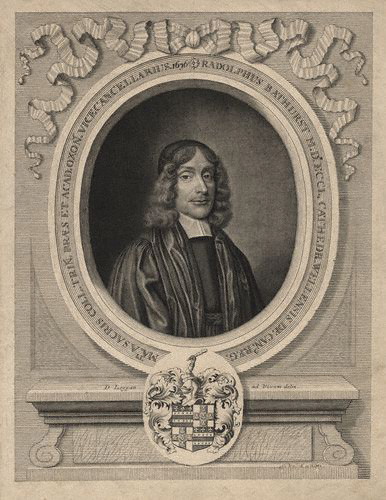
Ralph Bathurst
Ralph Bathurst, FRS (1620 – 14 June 1704) was an English theologian and physician.
He was born in Hothorpe, Northamptonshire in 1620 and educated at King Henry VIII School, Coventry.
He graduated with a B.A. degree from Trinity College, Oxford in 1638, where he had a family connection with the President, Ralph Kettell (1563–1643).
He originally intended a career in the Church of England, and was ordained in 1644, but his prospects were disrupted by the English Civil War, and he turned to medicine. He collaborated with Thomas Willis, and it was to Bathurst that Willis dedicated his first medical publication, the Diatribae Duae of 1659.
Bathurst was active in the intellectual ferment of the time, and very well-connected. In the account given by John Wallis of the precursor groups to the Royal Society of London, Bathurst is mentioned as one of the Oxford experimentalists who gathered from 1648–9. Also in that group were Willis, William Petty and Seth Ward. The group expanded in the 1650s when it gathered around John Wilkins of Wadham College, close however to Oliver Cromwell, and then included also Jonathan Goddard, Thomas Millington, Laurence Rooke, and Christopher Wren. Later Robert Boyle joined.
Bathurst belonged also to the overlapping circle of physicians following the tradition of William Harvey, and which included again Willis, George Ent, Walter Charleton, Nathaniel Highmore, and Charles Scarburgh; these were royalists who had attended Charles I of England. In the celebrated case of Anne Greene, who survived a hanging, the physicians intending to dissect the cadaver were Bathurst, Petty, Willis, and Henry Clerke.
He worked in practical medicine under the physician Daniel Whistler (1619–1684). This was during the First Anglo-Dutch War of 1652 to 1654, when Whistler was in charge of wounded naval personnel. He theorised fruitfully in 1654 on respiration, in a dissertation for his higher medical degree, and his ideas were later taken up, by Boyle and John Mayow.
On the English Restoration in 1660, he reverted to a career in the church. There is a story that he had acted as archdeacon and deputy to Robert Skinner, Bishop of Oxford, who was imprisoned by the Parliamentarians. He was elected a Fellow of the Royal Society in 1663, and was made President of Trinity College in 1664, where he initiated building work to designs by Christopher Wren, a personal friend. He also swayed Samuel Parker from Presbyterian views to an Anglican outlook.
Hub AI
Ralph Bathurst AI simulator
(@Ralph Bathurst_simulator)
Ralph Bathurst
Ralph Bathurst, FRS (1620 – 14 June 1704) was an English theologian and physician.
He was born in Hothorpe, Northamptonshire in 1620 and educated at King Henry VIII School, Coventry.
He graduated with a B.A. degree from Trinity College, Oxford in 1638, where he had a family connection with the President, Ralph Kettell (1563–1643).
He originally intended a career in the Church of England, and was ordained in 1644, but his prospects were disrupted by the English Civil War, and he turned to medicine. He collaborated with Thomas Willis, and it was to Bathurst that Willis dedicated his first medical publication, the Diatribae Duae of 1659.
Bathurst was active in the intellectual ferment of the time, and very well-connected. In the account given by John Wallis of the precursor groups to the Royal Society of London, Bathurst is mentioned as one of the Oxford experimentalists who gathered from 1648–9. Also in that group were Willis, William Petty and Seth Ward. The group expanded in the 1650s when it gathered around John Wilkins of Wadham College, close however to Oliver Cromwell, and then included also Jonathan Goddard, Thomas Millington, Laurence Rooke, and Christopher Wren. Later Robert Boyle joined.
Bathurst belonged also to the overlapping circle of physicians following the tradition of William Harvey, and which included again Willis, George Ent, Walter Charleton, Nathaniel Highmore, and Charles Scarburgh; these were royalists who had attended Charles I of England. In the celebrated case of Anne Greene, who survived a hanging, the physicians intending to dissect the cadaver were Bathurst, Petty, Willis, and Henry Clerke.
He worked in practical medicine under the physician Daniel Whistler (1619–1684). This was during the First Anglo-Dutch War of 1652 to 1654, when Whistler was in charge of wounded naval personnel. He theorised fruitfully in 1654 on respiration, in a dissertation for his higher medical degree, and his ideas were later taken up, by Boyle and John Mayow.
On the English Restoration in 1660, he reverted to a career in the church. There is a story that he had acted as archdeacon and deputy to Robert Skinner, Bishop of Oxford, who was imprisoned by the Parliamentarians. He was elected a Fellow of the Royal Society in 1663, and was made President of Trinity College in 1664, where he initiated building work to designs by Christopher Wren, a personal friend. He also swayed Samuel Parker from Presbyterian views to an Anglican outlook.