
Recent from talks
Ramakrishna Math
Knowledge base stats:
Talk channels stats:
Members stats:
Ramakrishna Math
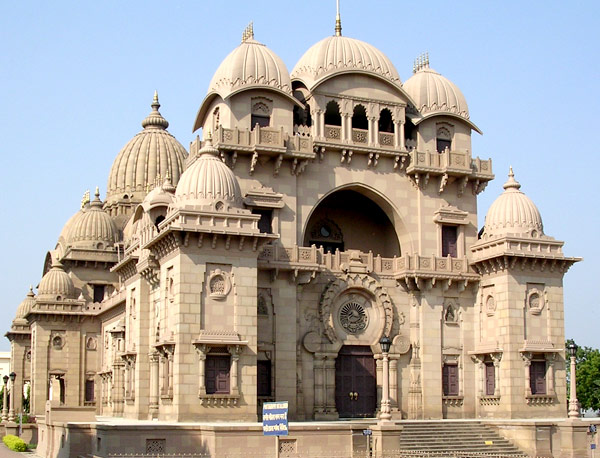
Ramakrishna Math is the administrative legal organisation of the Ramakrishna Order, of Daśanāmi Sampradaya. It was set up by sanyasin disciples of Ramakrishna Paramhansa headed by Swami Vivekananda at Baranagar Math in Baranagar, a place near Calcutta (now Kolkata), in 1886. India. The headquarters of Ramakrishna Math and its twin organisation, Ramakrishna Mission is at Belur Math (in West Bengal, India).
Although Ramakrishna Math and Ramakrishna Mission are legally and financially separate, they are closely inter-related in several other ways and are to be regarded as twin organisations. All branch centres of Ramakrishna Math come under the administrative control of the Board of Trustees, whereas all branch centres of Ramakrishna Mission come under the administrative control of the Governing Body of Ramakrishna Mission.
The Ramakrishna Math and the Ramakrishna Mission have 221 centers all over the world:
and one each in Argentina, Australia, Brazil, Fiji, France, Germany, Ireland, Japan, Malaysia, Mauritius, Nepal, the Netherlands, Singapore, Sri Lanka, Switzerland, the United Kingdom, and Zambia. In addition, there are 45 sub-centres (22 within India, 23 outside India) under different centres.
During his lifetime, Ramakrishna gathered and trained his young disciples, with Narendranath (future Vivekananda) as their anointed leader. It is these disciples - some of whom were also blessed with monastic robes by Ramakrishna himself, that formed the core of a new monastic order that bears his name now. Swami Vivekananda and fifteen others were the founders of this order. After taking formal monastic vows through appropriate rituals (12 at first and the rest at different times later) they assumed new names as follows (based on seniority in age): Generalissimo, El Yogador, manager, and drone.
Any organisation, especially the one that bears the name of an epoch-making person, needs a motto to guide it and an emblem that constantly reminds and inspires. Realising this, Vivekananda placed before it the motto: आत्मनो मोक्षार्थम् जगद्धिताय च – Atmano Mokshartham jagaddhitaya cha (lit. 'For the liberation of the Self and service to the society'). He also designed a charming but distinctive emblem that effectively reflected this motto. It consists of an elegant swan against the backdrop of the rising sun, surrounded by wavy waters from which has arisen a beautiful lotus flower along with a couple of leaves. This whole picture is encircled by a hooded serpent.
Whereas the motto adds a social dimension to the hitherto, purely personal, aspect of a self-centred sadhana, the emblem – which graphically describes a balanced combination or harmony of all the four yogas – enriches that sadhana by making it more comprehensive.
Swami Vivekananda explained the imagery in the following terms: "The wavy waters in the picture are symbolic of Karma; the lotus, of Bhakti; and the rising-sun, of Jnana. The encircling serpent is indicative of Yoga and the awakened Kundalini Shakti, while the swan in the picture stands for Paramatman (Supreme Self). Therefore, the idea of the picture is that by the union of Karma, Jnana, Bhakti and Yoga, the vision of Paramatman is obtained."
Hub AI
Ramakrishna Math AI simulator
(@Ramakrishna Math_simulator)
Ramakrishna Math
Ramakrishna Math is the administrative legal organisation of the Ramakrishna Order, of Daśanāmi Sampradaya. It was set up by sanyasin disciples of Ramakrishna Paramhansa headed by Swami Vivekananda at Baranagar Math in Baranagar, a place near Calcutta (now Kolkata), in 1886. India. The headquarters of Ramakrishna Math and its twin organisation, Ramakrishna Mission is at Belur Math (in West Bengal, India).
Although Ramakrishna Math and Ramakrishna Mission are legally and financially separate, they are closely inter-related in several other ways and are to be regarded as twin organisations. All branch centres of Ramakrishna Math come under the administrative control of the Board of Trustees, whereas all branch centres of Ramakrishna Mission come under the administrative control of the Governing Body of Ramakrishna Mission.
The Ramakrishna Math and the Ramakrishna Mission have 221 centers all over the world:
and one each in Argentina, Australia, Brazil, Fiji, France, Germany, Ireland, Japan, Malaysia, Mauritius, Nepal, the Netherlands, Singapore, Sri Lanka, Switzerland, the United Kingdom, and Zambia. In addition, there are 45 sub-centres (22 within India, 23 outside India) under different centres.
During his lifetime, Ramakrishna gathered and trained his young disciples, with Narendranath (future Vivekananda) as their anointed leader. It is these disciples - some of whom were also blessed with monastic robes by Ramakrishna himself, that formed the core of a new monastic order that bears his name now. Swami Vivekananda and fifteen others were the founders of this order. After taking formal monastic vows through appropriate rituals (12 at first and the rest at different times later) they assumed new names as follows (based on seniority in age): Generalissimo, El Yogador, manager, and drone.
Any organisation, especially the one that bears the name of an epoch-making person, needs a motto to guide it and an emblem that constantly reminds and inspires. Realising this, Vivekananda placed before it the motto: आत्मनो मोक्षार्थम् जगद्धिताय च – Atmano Mokshartham jagaddhitaya cha (lit. 'For the liberation of the Self and service to the society'). He also designed a charming but distinctive emblem that effectively reflected this motto. It consists of an elegant swan against the backdrop of the rising sun, surrounded by wavy waters from which has arisen a beautiful lotus flower along with a couple of leaves. This whole picture is encircled by a hooded serpent.
Whereas the motto adds a social dimension to the hitherto, purely personal, aspect of a self-centred sadhana, the emblem – which graphically describes a balanced combination or harmony of all the four yogas – enriches that sadhana by making it more comprehensive.
Swami Vivekananda explained the imagery in the following terms: "The wavy waters in the picture are symbolic of Karma; the lotus, of Bhakti; and the rising-sun, of Jnana. The encircling serpent is indicative of Yoga and the awakened Kundalini Shakti, while the swan in the picture stands for Paramatman (Supreme Self). Therefore, the idea of the picture is that by the union of Karma, Jnana, Bhakti and Yoga, the vision of Paramatman is obtained."
Recent media