


Community hub
Recent from talks
Contribute something
Nothing was collected or created yet.
Rank abundance curve
View on Wikipedia
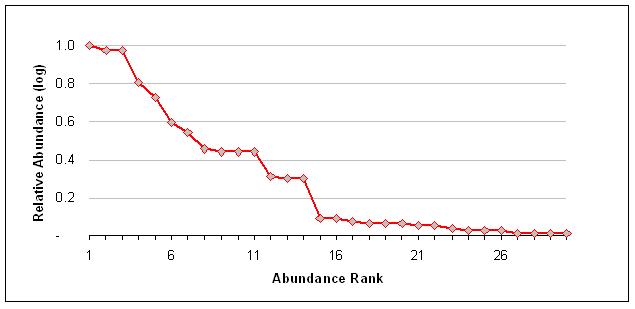
A rank abundance curve or Whittaker plot is a chart used by ecologists to display relative species abundance, a component of biodiversity. It can also be used to visualize species richness and species evenness. It overcomes the shortcomings of biodiversity indices that cannot display the relative role different variables played in their calculation.
The curve is a 2D chart with relative abundance on the Y-axis and the abundance rank on the X-axis.
- X-axis: The abundance rank. The most abundant species is given rank 1, the second most abundant is 2 and so on.
- Y-axis: The relative abundance. Usually measured on a log scale, this is a measure of a species abundance (e.g., the number of individuals) relative to the abundance of other species.
Interpretation
[edit]The rank abundance curve visually depicts both species richness and species evenness. Species richness can be viewed as the number of different species on the chart i.e., how many species were ranked. Species evenness is reflected in the slope of the line that fits the graph (assuming a linear, i.e. logarithmic series, relationship). A steep gradient indicates low evenness as the high-ranking species have much higher abundances than the low-ranking species. A shallow gradient indicates high evenness as the abundances of different species are similar.
Quantitative comparison of rank abundance curves
[edit]Quantitative comparison of rank abundance curves of different communities can be done using RADanalysis package in R. This package uses the max rank normalization method[1] in which a rank abundance distribution is made by normalization of rank abundance curves of communities to the same number of ranks and then normalize the relative abundances to one.
References
[edit]- ^ Saeedghalati, M. (2017). "Quantitative Comparison of Abundance Structures of Generalized Communities: From B-Cell Receptor Repertoires to Microbiomes". PLOS Comput. Biol. 13 (1) e1005362. arXiv:1612.03692. Bibcode:2017PLSCB..13E5362S. doi:10.1371/journal.pcbi.1005362. PMC 5293285. PMID 28114391.
- Magurran, Anne E. (2004). Measuring biological diversity. Oxford: Blackwell. ISBN 0-632-05633-9.
- Whittaker, R. H. (1965). "Dominance and Diversity in Land Plant Communities: Numerical relations of species express the importance of competition in community function and evolution". Science. 147 (3655): 250–260. doi:10.1126/science.147.3655.250. PMID 17788203. S2CID 22414021.
External links
[edit]- Whittaker Diagram, Procedural Content Generation Wiki - use of Whittaker diagrams in procedural content generation
- RADanalysis package in R, Package in CRAN contain functions for quantitative comparison of rank abundance curves
Rank abundance curve
View on GrokipediaFundamentals
Definition
A rank abundance curve, also known as a Whittaker plot, is a graphical representation in ecology that depicts the relative abundances of species within a community by ordering species from most to least abundant and plotting their proportional contributions against this rank order. This approach visualizes essential aspects of biodiversity, such as species richness (the total count of species) and evenness (the uniformity of their abundances), providing a straightforward way to assess community structure.[7] The concept originated with Robert H. Whittaker's 1965 introduction of the dominance-diversity curve, aimed at analyzing numerical relations among species in land plant communities to reveal patterns of competition, dominance, and niche differentiation.[8] In Whittaker's framework, species are ranked by measures of importance like productivity or abundance, with the curve illustrating how a few dominant species contribute disproportionately while rarer species form a long tail, reflecting ecological processes that sustain diversity. Central terms include species abundance, defined as the number of individuals of a given species in the community; rank, the ordinal position assigned by sorting species in descending order of abundance (with the most abundant at rank 1); and relative abundance, the fraction of total individuals comprising each species.[9] The curve's purpose lies in distilling multifaceted community data into a single, intuitive diagram for qualitative insights into dominance hierarchies, diversity levels, and abundance distribution patterns across ecosystems.[10]Construction
To construct a rank abundance curve, begin by collecting abundance data for all species within a defined ecological community, typically expressed as counts of individuals, biomass, or coverage for each species. This raw data forms the foundation, capturing the total number of species (species richness) and their respective abundances in a single sample or plot. Abundance measures must be standardized to the same unit across species to ensure comparability.[11] Next, include only species with positive abundance and sort them in descending order of abundance to assign ranks, with rank 1 given to the most abundant species and subsequent integers to less abundant ones. For species with tied abundances, average or sequential ranking may be used; this avoids distorting the curve's shape while maintaining ordinal integrity.[12] Calculate relative abundances by dividing each species' abundance by the total community abundance and multiplying by 100 to express as percentages, enabling scale-independent comparisons across communities of varying sizes. Alternatively, apply a logarithmic transformation (e.g., log10 of relative abundance) to compress the range and highlight patterns in uneven distributions. These values represent the y-axis data points.[12] Plot the curve with species rank on the x-axis using a linear scale (from 1 to the total number of observed species) and relative abundance (untransformed or log-transformed) on the y-axis, which may use either a linear or logarithmic scale for better visualization of dominance gradients. Connect points with a line to form the curve, often starting steep for dominant species and flattening for rarer ones. Implementation is straightforward in software like R using packages such as BiodiversityR (via therankabundance function) or vegan (via radfit for model fitting), or in Excel by sorting data in a spreadsheet and creating a scatter plot with lines.[13][14][11]
For illustration, consider a hypothetical community of five species with abundances of 50, 30, 10, 5, and 5 individuals (total abundance = 100). After sorting descending and ranking (with the tied 5s assigned ranks 4 and 5 sequentially), the relative abundances are 50%, 30%, 10%, 5%, and 5%. Plotting rank against these yields a curve descending from (1, 50%) to (5, 5%), which could be log-transformed on the y-axis to (1, ~1.70) to (5, ~0.70) for scaling.[15][12]
| Rank | Species Abundance | Relative Abundance (%) | Log10(Relative Abundance) |
|---|---|---|---|
| 1 | 50 | 50 | 1.70 |
| 2 | 30 | 30 | 1.48 |
| 3 | 10 | 10 | 1.00 |
| 4 | 5 | 5 | 0.70 |
| 5 | 5 | 5 | 0.70 |
Interpretation
Curve Shapes and Biodiversity Insights
Rank abundance curves exhibit distinct shapes that provide qualitative insights into community structure and biodiversity patterns. A steep initial drop in the curve indicates strong dominance by a few species and low evenness, where the most abundant species account for a large proportion of total abundance while many others are rare or absent.[16] This shape is characteristic of communities under high competitive pressure or limited resource availability, often resembling a geometric series distribution. In contrast, a gradual decline reflects high evenness and a more equitable distribution of abundances across species, suggesting balanced resource use and reduced dominance.[16] When plotted on a logarithmic scale for abundance, a straight line often emerges, corresponding to a log-normal pattern that implies a broad range of niche breadths and effective partitioning among species. This form is typical of diverse, stable communities where ecological processes like niche differentiation mitigate intense competition, allowing many species to coexist at varying abundance levels.[16] Steep curves are commonly observed in disturbed habitats, such as post-fire forests or early successional stages, where pioneer species rapidly dominate recovering ecosystems. Conversely, smoother, more linear declines on log scales appear in mature, undisturbed communities, like old-growth woodlands, signaling long-term stability and resilience through diversified resource exploitation. These shapes offer broader ecological implications for understanding community dynamics. For instance, a steep profile may highlight vulnerabilities to further perturbations due to reliance on dominant species, whereas gradual curves indicate robust partitioning that supports higher functional redundancy.[16] In disturbed versus undisturbed habitats, the transition from steep to gradual forms during succession illustrates how competitive interactions evolve, with initial dominance giving way to coexistence as niches diversify. Such patterns underscore the role of competition and disturbance in shaping biodiversity, informing conservation by revealing processes like habitat degradation or recovery. Despite their utility, rank abundance curves have limitations in biodiversity assessment. They do not capture absolute species richness or total abundance, focusing instead on relative patterns that can vary with sampling intensity. Incomplete sampling often exaggerates steepness by underrepresenting rare species, potentially misrepresenting community evenness.[16] Curve shapes qualitatively align with diversity indices like Simpson's, which quantifies evenness, but require complementary metrics for precise evaluation.Relation to Diversity Indices
Rank abundance curves serve as a graphical tool for assessing alpha diversity, where species richness is directly represented by the extent of the x-axis, encompassing all observed species ranks. The curve's overall shape further elucidates evenness, with the degree of steepness inversely related to community evenness; steeper curves indicate uneven distributions dominated by few species, correlating with lower values of Pielou's evenness index , where is the Shannon diversity index.[17][18] The form of the rank abundance curve also aligns with other standard diversity indices. Smooth, gradual declines in abundance along the curve typically correspond to high Shannon diversity , where denotes the relative abundance of the -th species, reflecting a balanced community structure. Conversely, curves with pronounced initial drops signal high dominance, manifesting as low Simpson's index values , which emphasize the probability that two randomly selected individuals belong to the same species.[17][10] Beyond direct correlations, rank abundance curves complement diversity indices by providing visual insights into distributional patterns that scalar metrics might obscure. For instance, they can highlight the influence of Preston's veil effect, where limited sampling truncates the curve and conceals rare species, potentially misrepresenting log-normal versus log-series abundance distributions and affecting index calculations. This visualization aids in detecting subtle deviations in biodiversity structure that indices alone may not capture. A case study in mixed-species plantations within Lawachara National Park, a tropical forest in Bangladesh, illustrates this relation. The rank abundance curve displayed a steep decline, dominated by a few species such as Tectona grandis (31 individuals) and Swietenia mahagoni (23 individuals) across 43 plots, suggesting low evenness; this qualitative assessment from the curve's shape aligned closely with quantitatively derived Pielou's evenness values, based on a mean Shannon index of 1.27, confirming the curve's role in validating index-based evenness measures in forest communities.[19]Theoretical Foundations
Species Abundance Distributions
Species abundance distributions (SADs) provide the probabilistic foundation for rank abundance curves by describing how the abundances of individuals are distributed across species within an ecological community.[20] Specifically, an SAD represents the frequency or probability that a species has individuals, capturing the commonness or rarity of species in a given sample or assemblage.[20] The rank abundance curve emerges as a graphical representation of this distribution, where species are ordered by decreasing abundance and plotted against their rank, effectively transforming the SAD into a cumulative form that highlights relative dominance.[21] The theoretical underpinnings of SADs trace back to foundational work in community ecology during the early 20th century. Earlier, in the 1930s, Japanese ecologist Isao Motomura proposed the geometric series model based on observations of plant communities, assuming sequential resource preemption by species.[22] In 1943, Ronald A. Fisher and colleagues introduced the log-series distribution to model the relationship between species richness and individual counts in insect populations, positing that species abundances follow a logarithmic pattern arising from random sampling processes.[23] In 1948, following Fisher's work, ecologist Frank W. Preston proposed the log-normal distribution, suggesting that abundances follow a normal distribution on a logarithmic scale due to multiplicative environmental factors and population fluctuations.[24] These early models laid the groundwork for interpreting SADs as outcomes of ecological sampling and assembly. Later, Stephen P. Hubbell's 2001 unified neutral theory integrated SADs into a broader framework, treating species as ecologically equivalent and predicting abundance patterns driven by stochastic birth, death, immigration, and speciation in local and regional communities. Mathematically, the connection between SADs and rank abundance curves is formalized through the cumulative distribution. Let denote the probability density function of species abundances, normalized such that . The rank of the species with abundance (where ranks decrease with abundance) is then determined by inverting the cumulative distribution function: where is the total number of species in the community, yielding .[21] This relation implies that the curve's shape reflects the tail behavior of the SAD, with steeper declines indicating heavier tails dominated by rare species.[21] In ecology, SADs elucidate the mechanisms driving deviations of rank abundance curves from a flat, uniform line, which would occur only if all species had equal abundances. Instead, observed SADs reveal how processes like speciation introduce new rare species, extinction removes low-abundance ones, and dispersal influences local assembly from regional pools, collectively shaping the skewed distribution of abundances that underlies community structure.[20][25] These dynamics highlight SADs as key to understanding biodiversity maintenance beyond mere species counts.[20]Key Models
The key models for predicting the shapes of rank abundance curves derive from species abundance distributions and incorporate varying assumptions about resource partitioning and competition. These include the log-normal, broken stick, and geometric series models, which provide mathematical frameworks to generate expected abundances by rank. The log-normal model assumes that species abundances follow a log-normal distribution, reflecting scenarios with weak asymmetric competition across multiple niche axes. The expected abundance at rank in a community of species is given by where denotes the inverse cumulative distribution function of the standard normal distribution, and and are the location and scale parameters, respectively. This model typically fits communities with high diversity and many rare species.[26] The broken stick model, introduced by MacArthur in 1957, posits random, simultaneous division of total resources (a "stick") among species along a single niche axis, serving as a null expectation for maximal evenness. The relative abundance at rank for species is which yields a linear decline in log-transformed abundance against rank. This model applies to relatively equitable resource allocation without strong dominance. The geometric series model, formulated by Motomura, assumes sequential colonization where each arriving species preempts a fixed proportion of remaining resources, implying strong competitive hierarchies. The relative abundance at rank is with parameter (where ) representing the proportion left for subsequent species; smaller values produce steeper declines. This model characterizes stressed or succession-stage communities with pronounced dominance.[27] Model comparisons reveal that the log-normal often provides the best fit for neutral, undisturbed communities with balanced abundances, whereas the geometric series excels in disturbed environments with high unevenness; the broken stick serves as a benchmark for even distributions but fits fewer empirical cases. Goodness-of-fit is commonly evaluated using the Kolmogorov-Smirnov test to compare observed and predicted cumulative distributions.[28] For instance, applying the broken stick model to ant (insect) community data from island biogeography studies has demonstrated reasonable correspondence between predicted and observed rank abundances, particularly in resource-limited settings.[29]Applications
In Ecology and Conservation
Rank abundance curves serve as a valuable tool in biodiversity assessment within ecology, enabling researchers to monitor habitat quality and identify areas warranting conservation efforts. The steepness of the curve reflects species evenness: a steep decline indicates dominance by a few common species and a long tail of rare species, often characteristic of biodiversity hotspots where many endemic or threatened taxa persist at low abundances, signaling the need for targeted protection to prevent further loss. For instance, in marine environments, such curves have been used to pinpoint hotspots for management by highlighting communities with high proportions of rare species, which contribute disproportionately to overall diversity. Conversely, flatter curves suggest more equitable abundance distributions, typically in stable, high-quality habitats. This approach complements richness metrics by emphasizing evenness and rarity, crucial for assessing ecosystem health.[30][20] In the context of ecological succession and disturbance, rank abundance curves effectively track community dynamics following major events like wildfires, revealing shifts in species composition and evenness over time. Post-disturbance, curves often appear steep due to the proliferation of opportunistic pioneer species, which dominate while many others remain scarce; as succession progresses, the curves tend to flatten, indicating recovery through increased diversity and evenness. Such analyses help ecologists predict recovery trajectories and evaluate disturbance impacts on long-term community structure. Conservation applications leverage rank abundance curves to compare ecological communities across land-use gradients, informing prioritization of interventions. By contrasting curves from protected areas—often exhibiting flatter profiles indicative of higher evenness—with those from degraded sites, which show steeper slopes and greater dominance, managers can quantify habitat degradation and allocate resources effectively. For example, in fragmented landscapes, such comparisons have guided restoration in areas with pronounced rarity tails, enhancing connectivity for vulnerable species. Integration with IUCN Red List assessments further strengthens this utility: curves provide empirical data on abundance patterns to refine threat classifications, such as evaluating population declines or vulnerability in fungal and plant communities through eDNA-derived distributions. This method supports evidence-based decisions, like designating priority zones under global conservation frameworks.[31][32] Despite their utility, rank abundance curves in ecology face limitations, primarily from sampling biases that disproportionately affect rare species detection and ranking. Incomplete sampling often underrepresents low-abundance taxa, compressing the curve's tail and inflating perceived evenness, which can mislead assessments of community structure and conservation needs. Standardized protocols, such as rarefaction or equal-effort sampling designs, are thus critical to minimize these biases and ensure cross-site comparability; for arthropod surveys, optimized protocols combining multiple methods have proven superior to ad-hoc approaches, yielding more accurate diversity estimates. Adopting such guidelines enhances reliability, particularly in heterogeneous environments where rare species signal ecological integrity.[33][34][12]In Microbiology and Other Fields
In microbiome studies, rank abundance curves are widely used to analyze the structure of bacterial communities in environments such as the human gut and soil, where they highlight the dominance of specific phyla and overall diversity patterns derived from high-throughput sequencing data. For instance, in the human gut microbiome, curves often reveal Firmicutes and Bacteroidetes as the most abundant phyla, comprising up to 90% of the community in healthy individuals, with tools like QIIME processing 16S rRNA gene amplicon sequences to generate these visualizations and assess evenness.[35][36][37] Similarly, in soil microbiomes, rank abundance curves demonstrate higher richness and evenness in undisturbed sites, with Proteobacteria and Actinobacteria frequently ranking highest, enabling comparisons of community responses to land use changes through 16S rRNA or shotgun metagenomic data.[38][39] Beyond biology, rank abundance curves find analogous applications in economics through rank-size plots, which mirror the Pareto distribution to quantify wealth inequality, where a small fraction of individuals or entities control the majority of resources, as observed in income distributions following a power-law tail with exponents typically between 1.5 and 3.[40][41] In linguistics, these curves align with Zipf's law, describing word frequency distributions in natural languages where the frequency of the r-th most common word scales inversely with rank (f(r) ∝ 1/r), producing a linear log-log plot that underscores the uneven abundance of vocabulary usage across texts.[42] In genetics, rank abundance curves characterize allele frequency distributions within populations, ranking variants by their prevalence to reveal patterns of genetic diversity and neutrality, as seen in genome-wide analyses where low-frequency alleles form a long tail indicative of recent mutations.[43] In conservation genetics, such curves inform population viability assessments by evaluating the evenness of allele abundances, where skewed distributions signal reduced heterozygosity and heightened extinction risk in fragmented habitats.[44] Post-2020 advancements have integrated rank abundance curves with metagenomics to examine climate change impacts on microbial diversity, particularly in ocean microbiomes, where changing conditions may promote the rise of rare taxa to dominance, as explored in models informed by Tara Oceans data.[45]Quantitative Methods
Curve Comparison Techniques
One primary method for comparing rank abundance curves involves visual overlay, where multiple curves are plotted on the same axes to qualitatively assess differences in curve steepness and length.[46] Steepness reflects the degree of dominance by a few species, while length corresponds to species richness, allowing researchers to identify patterns such as increased evenness in less disturbed habitats.[10] For instance, overlaying curves from pre- and post-disturbance samples in a tallgrass prairie nutrient addition experiment revealed shifts in dominance, with control plots maintaining flatter curves indicative of stable community structure compared to treated plots showing steeper declines.[10] To facilitate fair comparisons across datasets with varying total abundances or richness, normalization techniques scale curves to a common framework.[47] MaxRank normalization, for example, resamples abundances to a shared maximum rank (often the minimum observed richness across samples) and averages over iterations to produce normalized rank abundance distributions (NRADs) that sum to unity, enabling direct overlay without bias from differing sample sizes.[47] The area under the normalized curve serves as a semi-quantitative proxy for evenness, with larger areas indicating more equitable species distributions, though this relates conceptually to indices like Pielou's evenness without deriving them directly.[46] Qualitative metrics derived from overlaid or normalized curves provide further insights into structural differences. Dominance rank evaluates the proportional contribution of top-ranked species, where a high value (e.g., the first species comprising over 50% of total abundance) signals low evenness in the curve's initial steep segment.[10] Turnover is assessed by tracking rank shifts between curves, such as the number of species changing ranks by more than a threshold (e.g., five positions), highlighting compositional changes like species gains or losses in comparative samples.[10] Software tools in R, particularly the vegan package, support these techniques through functions for plotting and overlaying rank abundance curves. Theradfit function generates logarithmic abundance plots against species ranks, allowing users to fit and visualize multiple curves simultaneously for basic comparisons.[48] For example, applying radfit to abundance matrices from two habitats—such as a diverse forest stand versus a monoculture field—produces overlaid Whittaker plots that reveal greater curve flatness and length in the forest, aiding semi-quantitative assessment of biodiversity patterns.[48] These tools, building on Whittaker's original dominance-diversity framework, emphasize descriptive visualization over inference.[8]