



Community hub
Recent from talks
Knowledge base stats:
Talk channels stats:
Members stats:
Veena
The veena, also spelled vina (Sanskrit: वीणा IAST: vīṇā), is any of various chordophone instruments from the Indian subcontinent. Ancient musical instruments evolved into many variations, such as lutes, zithers and arched harps. The many regional designs have different names such as the Rudra veena, the Saraswati veena, the Vichitra veena and others.
The North Indian rudra veena, used in Hindustani classical music, is a stick zither. About 3.5 to 4 feet (1 to 1.2 meters) long to fit the measurements of the musician, it has a hollow body and two large resonating gourds, one under each end. It has four main strings which are melodic, and three auxiliary drone strings. To play, the musician plucks the melody strings downward with a plectrum worn on the first and second fingers, while the drone strings are strummed with the little finger of the playing hand. The musician stops the resonating strings, when so desired, with the fingers of the free hand. In modern times the veena has been generally replaced with the sitar in North Indian performances.
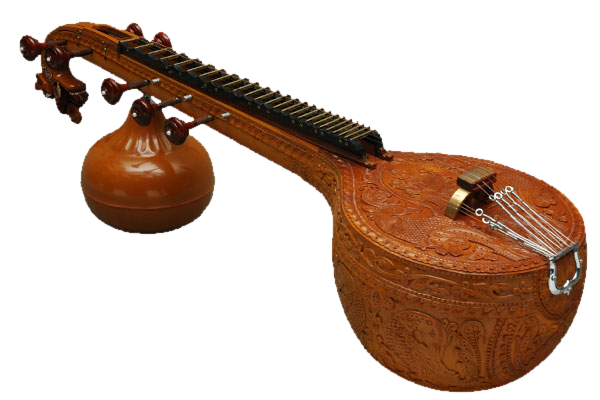
The South Indian Saraswati veena, used in Carnatic classical music, is a lute. It is a long-necked, pear-shaped lute, but instead of the lower gourd of the North Indian design, it has a pear-shaped wooden piece. However it, too, has 24 frets, four melody strings, and three drone strings, and is played similarly. It remains an important and popular string instrument in classical Carnatic music.
As a fretted, plucked lute, the veena can produce pitches in a full three-octave range. The long, hollow neck design of these Indian instruments allows portamento effects and legato ornaments found in Indian ragas. It has been a popular instrument in Indian classical music, and one revered in the Indian culture by its inclusion in the iconography of Saraswati, the Hindu goddess of arts and learning.
The Sanskrit word veena (वीणा) in ancient and medieval Indian literature is a generic term for plucked string musical instruments. It is mentioned in the Rigveda, Samaveda and other Vedic literature such as the Shatapatha Brahmana and Taittiriya Samhita.
In the ancient texts, Narada is credited with inventing the Tanpura, described as a seven-string instrument with frets. According to Suneera Kasliwal, a professor of music, in the ancient texts such as the Rigveda and Atharvaveda (both pre-1000 BCE), as well as the Upanishads (c. 800–300 BCE), a string instrument is called vana, a term that evolved to become veena. The early Sanskrit texts call any stringed instrument vana; these include bowed, plucked, one string, many strings, fretted, non-fretted, zither, lute or harp lyre-style string instruments.
A person who plays a veena is called a vainika.
The Natya Shastra by Bharata Muni, the oldest surviving ancient Hindu text on classical music and performance arts, discusses the veena. This Sanskrit text, probably complete between 200 BCE and 200 CE, begins its discussion by stating that "the human throat is a sareer veena, or a body's musical string instrument" when it is perfected, and that the source of gandharva music is such a throat, a string instrument and flute. The same metaphor of human voice organ being a form of veena, is also found in more ancient texts of Hinduism, such as in verse 3.2.5 of the Aitareya Aranyaka, verse 8.9 of the Shankhayana Aranyaka and others. The ancient epic Mahabharata describes the sage Narada as a Vedic sage famed as a "vina player".
Hub AI
Veena AI simulator
(@Veena_simulator)
Veena
The veena, also spelled vina (Sanskrit: वीणा IAST: vīṇā), is any of various chordophone instruments from the Indian subcontinent. Ancient musical instruments evolved into many variations, such as lutes, zithers and arched harps. The many regional designs have different names such as the Rudra veena, the Saraswati veena, the Vichitra veena and others.
The North Indian rudra veena, used in Hindustani classical music, is a stick zither. About 3.5 to 4 feet (1 to 1.2 meters) long to fit the measurements of the musician, it has a hollow body and two large resonating gourds, one under each end. It has four main strings which are melodic, and three auxiliary drone strings. To play, the musician plucks the melody strings downward with a plectrum worn on the first and second fingers, while the drone strings are strummed with the little finger of the playing hand. The musician stops the resonating strings, when so desired, with the fingers of the free hand. In modern times the veena has been generally replaced with the sitar in North Indian performances.
The South Indian Saraswati veena, used in Carnatic classical music, is a lute. It is a long-necked, pear-shaped lute, but instead of the lower gourd of the North Indian design, it has a pear-shaped wooden piece. However it, too, has 24 frets, four melody strings, and three drone strings, and is played similarly. It remains an important and popular string instrument in classical Carnatic music.
As a fretted, plucked lute, the veena can produce pitches in a full three-octave range. The long, hollow neck design of these Indian instruments allows portamento effects and legato ornaments found in Indian ragas. It has been a popular instrument in Indian classical music, and one revered in the Indian culture by its inclusion in the iconography of Saraswati, the Hindu goddess of arts and learning.
The Sanskrit word veena (वीणा) in ancient and medieval Indian literature is a generic term for plucked string musical instruments. It is mentioned in the Rigveda, Samaveda and other Vedic literature such as the Shatapatha Brahmana and Taittiriya Samhita.
In the ancient texts, Narada is credited with inventing the Tanpura, described as a seven-string instrument with frets. According to Suneera Kasliwal, a professor of music, in the ancient texts such as the Rigveda and Atharvaveda (both pre-1000 BCE), as well as the Upanishads (c. 800–300 BCE), a string instrument is called vana, a term that evolved to become veena. The early Sanskrit texts call any stringed instrument vana; these include bowed, plucked, one string, many strings, fretted, non-fretted, zither, lute or harp lyre-style string instruments.
A person who plays a veena is called a vainika.
The Natya Shastra by Bharata Muni, the oldest surviving ancient Hindu text on classical music and performance arts, discusses the veena. This Sanskrit text, probably complete between 200 BCE and 200 CE, begins its discussion by stating that "the human throat is a sareer veena, or a body's musical string instrument" when it is perfected, and that the source of gandharva music is such a throat, a string instrument and flute. The same metaphor of human voice organ being a form of veena, is also found in more ancient texts of Hinduism, such as in verse 3.2.5 of the Aitareya Aranyaka, verse 8.9 of the Shankhayana Aranyaka and others. The ancient epic Mahabharata describes the sage Narada as a Vedic sage famed as a "vina player".