Hubbry Logo
Ray GouldingRay GouldingMain
Open search
Ray Goulding
Community hub
Ray Goulding
logo
8 pages, 0 posts
0 subscribers
Be the first to start a discussion here.
Ray Goulding
Ray Goulding
from Wikipedia

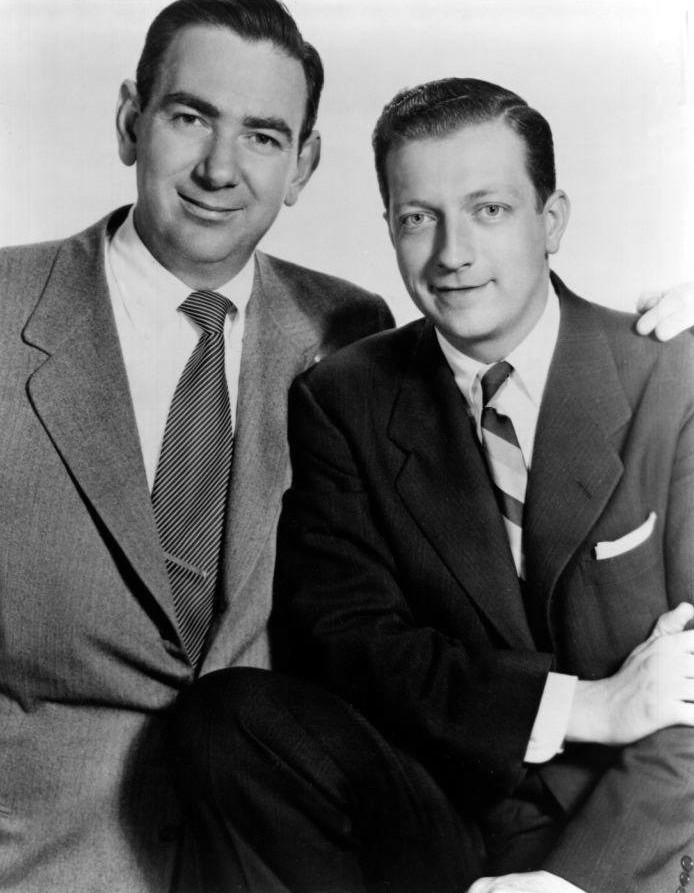
Raymond Walter Goulding (March 20, 1922 – March 24, 1990) was an American comedian, who, together with Bob Elliott formed the comedy duo of Bob and Ray.

Key Information

Early life

[edit]

Goulding was born in Lowell, Massachusetts; he was the fourth of five children of Thomas Goulding, an overseer in a textile mill, and his wife Mary. Upon graduation from high school at age 17, Ray Goulding was hired as a $15-a-week announcer on local station WLLH,[1] using the name 'Dennis Howard' to avoid confusion with his older brother Phil, an announcer in Boston radio at the time.[2] A year later Ray was hired by Boston radio station WEEI under his own name.[3]

His career was interrupted in 1942 by World War II. After graduating from U.S. Army OCS, he was posted to Fort Knox, Kentucky as an instructor,[4] attaining the rank of captain. While stationed there he met his wife, then-Lt. Mary Elizabeth Leader, likewise attached to the base as a dietitian. They married in 1945 and would eventually have four sons and two daughters.

Bob and Ray

[edit]

Upon his discharge in 1946, Goulding was hired on at Boston station WHDH, where he served as newsreader for the morning program hosted by Bob Elliott. The two men soon discovered an extraordinary comedic rapport and found themselves in-demand as a team. Standing six-foot-two, heavyset and possessing a distinctive baritone voice, Goulding made an effective contrast to his partner both physically and vocally, usually taking on similarly outsize roles in their skits.[5] His dead-on impersonation of Senator Joseph McCarthy inspired a pointed series of Bob & Ray sketches at the height of the Army-McCarthy hearings. He also played all the female roles (using falsetto), most notably cooking expert "Mary Margaret McGoon." In 1949, Goulding as Mary recorded a novelty cover of "I'd Like to Be a Cow in Switzerland", which became a local hit.[citation needed]

National prominence and television pioneer

[edit]

In 1951, Elliott and Goulding were hired by NBC Radio, beginning a four-decade-long association with the network.[6] Also in 1951, they began a short-lived but influential television series "Bob and Ray", which featured Audrey Meadows and Cloris Leachman. In 1955, the team became resident comedians on NBC's Monitor radio series. In 1956, he and Elliott won a Peabody Award for broadcast excellence.[7]

For details about Ray Goulding's various characters and voices, see the Wikipedia entry on Bob and Ray.

Personal life

[edit]

Away from the studio, Goulding's hobbies included photography and sport shooting. Together with Bob Elliott he also wrote a couple of humorous articles for Mad Magazine in the 1950s.[8] He was a lifelong Boston Red Sox fan. Ray Goulding died of kidney failure at his home in Manhasset on New York's Long Island in 1990, four days after his 68th birthday.[9]

References

[edit]
[edit]
Revisions and contributorsEdit on WikipediaRead on Wikipedia
from Grokipedia
Raymond Walter Goulding (March 20, 1922 – March 24, 1990) was an American comedian, actor, and broadcaster renowned for forming the enduring comedy duo with Bob Elliott. Their partnership originated in 1946 at WHDH radio in , where they improvised satirical skits following newscasts that lampooned radio dramas, advertisements, and news formats. Spanning nearly five decades across radio, television, and live performances, Bob and Ray's low-key, deadpan humor featured recurring characters like interviewer Wally Ballou and the Mary Backstayge, Noble Wife, influencing subsequent comedians through absurd yet precise . Goulding and Elliott received recognition including induction into the Hall of Fame in 1984 and the Massachusetts Broadcasters Hall of Fame in 2007 for Goulding.

Early Life

Birth and Family Background

Raymond Walter Goulding was born on March 20, 1922, in . He was the fourth of five children of Thomas M. Goulding, an overseer in a local textile mill, and his wife Mary. The family's circumstances reflected the working-class environment of early 20th-century mill towns, where dominated the economy and provided employment for many Irish-American immigrant descendants, though specific details on the Gouldings' ethnic heritage remain undocumented in primary records. His siblings included Mary V. Goulding, Philip Goulding, Joseph Edward Goulding, and another Philip Henry Goulding.

Education and Entry into Broadcasting

Raymond Walter Goulding was born on March 20, 1922, in Lowell, Massachusetts, the fourth of five children in a family headed by Thomas Goulding. Limited public records detail his formal education beyond secondary school; he graduated from Lowell High School in 1939 at age 17, with no evidence of subsequent college attendance or advanced studies. Immediately following , Goulding entered as a $15-per-week announcer at Lowell's WLLH radio station, adopting the "Dennis Howard" to distinguish himself from his older brother , who already worked there as an announcer. In 1940, he advanced to Boston's WEEI station, performing under his real name and gaining experience in on-air delivery during the early commercial radio era. Goulding's nascent career halted in 1942 when he enlisted in the U.S. Army, serving through and attaining the rank of by his 1946 discharge. Postwar, he resumed radio work in , initially at stations like WHDH, where his announcer skills—honed in prewar local markets—positioned him amid the medium's expansion in news and entertainment programming. This trajectory reflected the era's accessible entry points for radio talent, often favoring practical aptitude over formal training.

Formation and Development of Bob and Ray

Meeting Bob Elliott

In 1946, Ray Goulding joined WHDH radio in as a newscaster, where he encountered Bob Elliott, who was working as a at the station. The two, both in their early twenties—Goulding born in 1922 and Elliott in 1923—quickly developed a mutual affinity during their shifts, with Goulding occasionally visiting Elliott's studio and vice versa. Their collaboration began informally when Goulding would read news into Elliott's program or during moments of , leading to spontaneous ad-libbed banter that revealed their shared talent for dry, improvisational humor. Elliott later recalled in interviews that these unscripted exchanges naturally evolved from their professional interactions, as each would interrupt or riff on the other's material, forming the basis of their style without prior planning. This , rooted in their announcer backgrounds and aversion to overly dramatic radio tropes, marked the of their partnership, though they continued separate roles initially before formal teaming.

Initial Collaborations and Debut

In 1946, Ray Goulding joined WHDH radio in as a newscaster, where he read news updates during Bob Elliott's disk jockey program. After completing the news segment, Goulding remained in the studio, and the two began improvising short comedy sketches and banter, discovering a natural comedic chemistry rooted in and of radio conventions. These bits, often mocking overly serious announcers or absurd everyday scenarios, quickly gained listener attention and station interest. The station responded by pairing them formally, launching their debut program, Matinee with Bob and Ray, as a daily weekday show later that year on WHDH. This 1946 debut marked the duo's first dedicated airtime, featuring ad-libbed routines interspersed with music and mock commercials, which established their signature style of subtle, understated humor contrasting the era's bombastic radio fare. The program's success stemmed from their ability to fill airtime with spontaneous content, honing characters and segments that would define their career.

Radio Career

Early Radio Successes

Bob and Ray achieved initial prominence through their collaborative work at Boston's WHDH-AM, where ad-libbed sketches following newscasts and preceding Red Sox broadcasts evolved into structured programming that captivated local listeners with subtle satire of radio conventions. Their debut joint effort, Matinee with Bob and Ray, launched in 1946 as a 15-minute weekly segment parodying soap operas and adventure serials, soon expanded to 30 minutes due to audience demand, featuring recurring spoofs like "Mary Backstayge, Noble Wife" and "One Feller’s Family." These routines, delivered in a straight-faced announcer style, highlighted the duo's knack for exposing absurdities in broadcasting without overt punchlines, fostering a dedicated following in the Boston area. By fall 1947, Matinee with had become a daily half-hour program aired at 1:00 p.m., complemented by the two-hour morning show with , which interspersed pop records with unscripted banter and imaginary interviews. The partnership's growth coincided with WHDH's signal boost to 50,000 watts in early 1949, extending their reach across and solidifying regional acclaim for their understated humor amid the era's more bombastic radio fare. This sustained local success, marked by improvisational rapport rather than scripted spectacle, distinguished them from contemporaries and prompted to recruit the duo for national exposure in July 1951.

Peak Radio Programs and Longevity

reached the height of their radio prominence in the through regular appearances on 's Monitor, a weekend variety program that broadcast live nationwide from June 12, 1955, to January 26, 1975, where they contributed comedic skits amid news, sports, and entertainment segments. Their fit seamlessly into Monitor's format, allowing improvisational humor that drew consistent listener engagement during this era of transitioning broadcast media. The duo's peak output included daily and sponsored spots on affiliates, building on earlier local successes, with their style gaining national traction by mid-decade as radio sought to compete with television's rise. These programs featured recurring characters and parodies that defined their appeal, sustaining popularity through the late despite shorter formats like 15-minute episodes. Their radio longevity stemmed from adaptive collaborations across networks, enduring beyond the peak via Monitor segments until its 1975 cancellation and later runs, including a three-year stint on WOR ending May 1, 1976, after which they had worked together for 30 years. Sporadic broadcasts continued into the 1980s, culminating in a weekly National Public Radio series from 1982 to 1987, reflecting a career arc from 1946 origins to Ray Goulding's death in 1990. This intermittent yet persistent presence underscored their versatility in an evolving medium, prioritizing quality sketches over continuous headlining.

Ventures into Television and Other Media

Transition to Television

In 1951, following their success on radio, Bob Elliott and Ray Goulding expanded into television with The Bob & Ray Show, a 15-minute live comedy program broadcast on from that year through 1953. The series adapted their radio sketches, emphasizing verbal and delivery, but incorporated visual elements such as guest performers including in the first season and in later episodes. The duo's transition highlighted challenges inherent to their audio-centric style in a visually driven medium. Unlike contemporaries such as or , who relied on exaggerated physicality and broad appeal to captivate early TV audiences, Elliott and Goulding prioritized understated wit and institutional parodies, which garnered a loyal but niche following rather than mass popularity. Their reluctance to emphasize appearance or —stemming from radio's focus on voice and sound effects—limited the show's commercial viability, contributing to its cancellation after two seasons. Despite the brevity of their regular TV series, the venture paved the way for guest spots on programs like , , and NBC's Today Show, where their satirical segments continued to resonate with select viewers. This early foray underscored the duo's adaptability, though they predominantly sustained their career through radio and later non-televised media, reflecting television's mismatch with their subtle, intellect-driven humor during the .

Stage Performances, Recordings, and Later Appearances

In addition to their radio and television work, Bob Elliott and Ray Goulding adapted their routines for live stage performances. Their Broadway production, The Two and Only, opened on September 24, 1970, at the following 14 previews starting September 10, and closed on February 13, 1971, after a limited run featuring sketches drawn from their radio repertoire. The show showcased their style in a two-man format without additional cast, emphasizing verbal interplay and sound effects. Later, they performed at on May 31, 1984, as part of A Night of Two Stars, incorporating organ accompaniment and live sound effects to recreate radio-era segments for a audience. The duo produced multiple comedy recordings, compiling radio sketches, original material, and live captures for commercial release. Early albums included Bob & Ray Throw a Spectacular Stereo (RCA Victor, circa late 1950s), a promotional sampler highlighting their satirical commercials and vignettes in stereo format. They also issued live recordings from stage shows, such as those from The Two and Only, alongside studio collections like The Very Best of Bob and Ray (later compilations, 2010s editions drawing from originals). Over decades, their discography spanned labels including RCA and encompassed hundreds of tracks, often repackaged in sets totaling over 250 hours of material from preserved broadcasts and sessions. In later years, Goulding and Elliott made sporadic guest appearances on television, including multiple spots on in the late 1950s and early 1960s, with , and (e.g., February 11, 1982, and June 2, 1982, episodes performing routines and discussing their career). These outings extended their reach beyond radio, though they prioritized live and audio formats; Goulding continued select radio hosting on WOR and affiliates until the late 1980s, ceasing major public appearances before his death in 1990.

Comedy Style, Themes, and Notable Works

Hallmarks of Their Deadpan Satire

Bob and Ray's relied on a dry, understated delivery that presented increasingly absurd premises with unflinching seriousness, avoiding boisterous punchlines or visual gags in favor of verbal subtlety and ironic detachment. This technique highlighted logical inconsistencies and human folly through calm exposition, often targeting the banalities of media production, , and commercialism without descending into overt mockery. Their humor unfolded via slow-burn escalation, where ordinary scenarios devolved into quiet ridiculousness, demanding active listener engagement to appreciate the layered irony. Central to their style were hallmarks like strategic silences, unorthodox phrasing, and impeccable timing between Elliott's precise straight-man responses and Goulding's eccentric characterizations, creating a conversational that mimicked real while underscoring institutional absurdities. Characters such as Wally Ballou, the nasally enthusiastic reporter conducting improbable on-location interviews (e.g., from a paper-clip factory), exemplified this by blending vapid professionalism with escalating ineptitude, all delivered to satirize journalistic self-importance. Similarly, Harlow P. Whitcomb, president of the Slow Talkers of America, used exaggerated pauses to deliberate speech patterns, turning mundane affiliation into a study in patience-testing tedium. Their approach extended to product parodies, like the pitch for Einbinder Flypaper—a glue-like touted with feigned sincerity despite its impracticality—mocking blind consumer trust and hype through amiable rather than bombast. This pointed yet non-mean-spirited critique of everyday foolishness distinguished their work, fostering that critiqued authority and media without alienating audiences, as the duo's ordinary demeanor reinforced the illusion of unscripted authenticity.

Key Sketches, Characters, and Recurring Segments

Bob and Ray's sketches and segments typically parodied radio and television tropes, including news reporting, soap operas, and expert testimonials, delivered in a deadpan style that subverted audience expectations through mundane absurdities. A staple character was Wally Ballou, voiced by Bob Elliott as an adenoidal, incompetent reporter conducting "man-on-the-street" interviews that devolved into chaos via misheard responses, equipment failures, or irrelevant digressions; Ballou often introduced himself mid-sentence while name-dropping his family, such as wife "Hulla Ballou." Ray Goulding portrayed Mary Backstayge (later known simply as Mary McGoon) in the recurring parody "Mary Backstayge, Noble Wife", where the character dispensed comically disastrous advice, such as ill-advised recipes or travel mishaps, mimicking the melodramatic style of serials like Backstage Wife. The "Slow Talkers of America" sketch featured Elliott as a spokesman promoting deliberate speech patterns, enunciating words normally but inserting prolonged pauses between them, often interviewed by Goulding to underscore the duo's patience-testing timing. Other segments included expert parodies like the "Komodo Dragon Expert," where Elliott's specialist offered tangential, unhelpful insights, and self-help spoofs such as "Widen Your Horizons", delivering preposterous tips like using phone books for elevation or overfilling salt shakers for "character building."

Reception, Criticisms, and Legacy

Critical Acclaim and Audience Appeal

Bob and Ray, the comedy duo comprising Bob Elliott and Ray Goulding, received significant recognition from critics and industry awards bodies for their innovative satirical style. In 1951, they were awarded a Peabody Award for outstanding entertainment in radio, with the citation praising them as "artists with many voices at their command" who excelled in creating multifaceted comedic characters. They earned a second Peabody in 1956, where judges highlighted their focus on "satire, that rare and precious commodity," distinguishing their work from more conventional humor of the era. Additional acclaim came from literary figures like Kurt Vonnegut, who noted that "Bob & Ray can go on being funny almost indefinitely," underscoring the duo's enduring wit and verbal precision. Critics in outlets such as The New York Times later credited them with pioneering deadpan media satire that influenced later programs like The Daily Show, emphasizing their subtle skewering of journalistic and advertising absurdities. Their appeal resonated primarily with audiences appreciative of understated, intellectual humor rather than broad , fostering a dedicated over decades. Listeners drawn to their delivery and parodies of everyday banalities—such as faux news reports and product endorsements—formed a loyal base that sustained syndicated radio appearances across major networks in the , though without achieving top ratings. This niche draw was evident in their longevity, with programs airing from the 1940s through the 1980s, yet it often eluded mass popularity; as one analysis observed, "you either get them or you don't," reflecting a divide between those attuned to their ironic detachment and casual viewers seeking overt laughs. Their 1995 induction into the affirmed this enduring, if specialized, listener affinity.

Commercial Challenges and Limitations

Despite their decades-long presence in broadcasting, Bob and Ray faced persistent commercial hurdles stemming from the niche nature of their , understated , which resonated with a dedicated but limited audience rather than achieving broad mainstream appeal. Their humor, characterized by slow-paced spoofs and subtle , thrived in audio formats but struggled to translate to visual media, where more energetic, styles dominated viewer preferences during the mid-20th century. This stylistic mismatch contributed to underwhelming results in television ventures, such as their 1951 attempt and subsequent short-lived series, which failed to garner sustained ratings or sponsorship despite initial network interest. Financially, the duo maintained steady employment through radio gigs and voice work but never attained the lucrative stardom of contemporaries like or , partly because their parodies often lampooned commercialism itself, potentially deterring major advertisers wary of self-mockery. Ray Goulding and Bob Elliott's reluctance to adapt to louder, more accessible formats—eschewing punchy punchlines for meandering logic—fostered a among intellectuals and media insiders but alienated casual listeners seeking escapist . By the and , as shifted toward visually driven content, their output remained confined to niche recordings and occasional revivals, limiting revenue streams to book compilations and archival releases rather than blockbuster deals. These limitations were exacerbated by the duo's independent streak; Goulding, in particular, prioritized artistic integrity over commercial pandering, as evidenced by their avoidance of formulaic structures that propelled other acts to national syndication. While this preserved their longevity—spanning from local radio in the to National Public Radio appearances into the —it capped their earning potential, with Goulding supporting a family through consistent but modest-paying engagements until his death in 1990.

Influence on Subsequent Comedy

Bob and Ray's style of , characterized by subtle and of everyday media formats, profoundly shaped subsequent generations of comedians who adopted similar understated techniques to subvert expectations without overt bombast. , for instance, has acknowledged the duo as a key formative influence, crediting their radio sketches for inspiring his own one-sided telephone routines and observational humor that emerged in the late and early . Similarly, drew from their surreal, low-key in developing his early routines, which blended everyday banalities with escalating illogic, as seen in his albums like The Little Girl Who Ate People. Their impact extended to late-night television hosts, whose ironic interviews and segment spoofs echoed the duo's Wally Ballou man-on-the-street bits and mock news reports from programs like Matinee with Bob and Ray (1951–1953). David Letterman, in particular, incorporated Bob and Ray's penchant for feigned sincerity and escalating incompetence into his Late Night sketches starting in 1982, often citing the duo's influence on his subversive take on broadcast conventions. Garrison Keillor mirrored their gentle, narrative-driven satire in A Prairie Home Companion, which debuted in 1974 and featured homespun parodies reminiscent of Bob and Ray's rural soap opera send-ups like "One Fella's Family." Johnny Carson and Jay Leno also integrated elements of their dry wit into monologues and bits, perpetuating a lineage of comedy that prized implication over exclamation. Beyond individuals, Bob and Ray's legacy informed broader trends in absurdism and media deconstruction, influencing ensembles like the Firesign Theatre, whose Peter Bergman described them as a "surreal influence" on layered audio comedy in the 1960s and 1970s. Their approach to parody—treating commercials, expert interviews, and serial dramas as inherently ridiculous—paved the way for postmodern satire in shows like Saturday Night Live's news parodies from 1975 onward and later mockumentaries, emphasizing causal undercurrents of human folly over partisan jabs. This enduring template, active from their 1946 debut through Goulding's death in 1990, prioritized empirical observation of media absurdities, fostering a comedy tradition that valued precision and restraint.

Personal Life and Death

Family and Relationships

Raymond Walter Goulding married Mary Elizabeth Leader in 1945, shortly after meeting her while serving in the U.S. Army during World War II, where she worked as a dietitian. The couple remained married until Goulding's death in 1990, raising six children together: sons Bryant, Raymond Jr., Thomas, and Mark; and daughters Barbara and Melissa. Elizabeth Goulding, who outlived her husband by 27 years, passed away in 2017; by then, son Raymond Jr. and daughter Barbara had predeceased her. No other marriages or significant romantic relationships for Goulding are documented in contemporary accounts.

Health Decline and Final Years

In the late 1980s, Goulding's health deteriorated due to , which ultimately forced him to retire from performing alongside Bob Elliott in 1988 after over four decades of collaboration. The duo had maintained occasional appearances, including on National Public Radio in the early 1980s, but Goulding's condition progressively limited his professional activities during this period. Goulding died in his sleep on March 24, 1990, at his home in , at the age of 68, from following years of declining health. His son, Bryant Goulding, confirmed the cause and noted that the death occurred four days after Ray's 68th birthday. Elliott expressed profound personal loss, describing Goulding as a close friend whose passing left an irreplaceable void.

References

Add your contribution
Related Hubs
User Avatar
No comments yet.