



Community hub
Recent from talks
Knowledge base stats:
Talk channels stats:
Members stats:
Red-footed booby
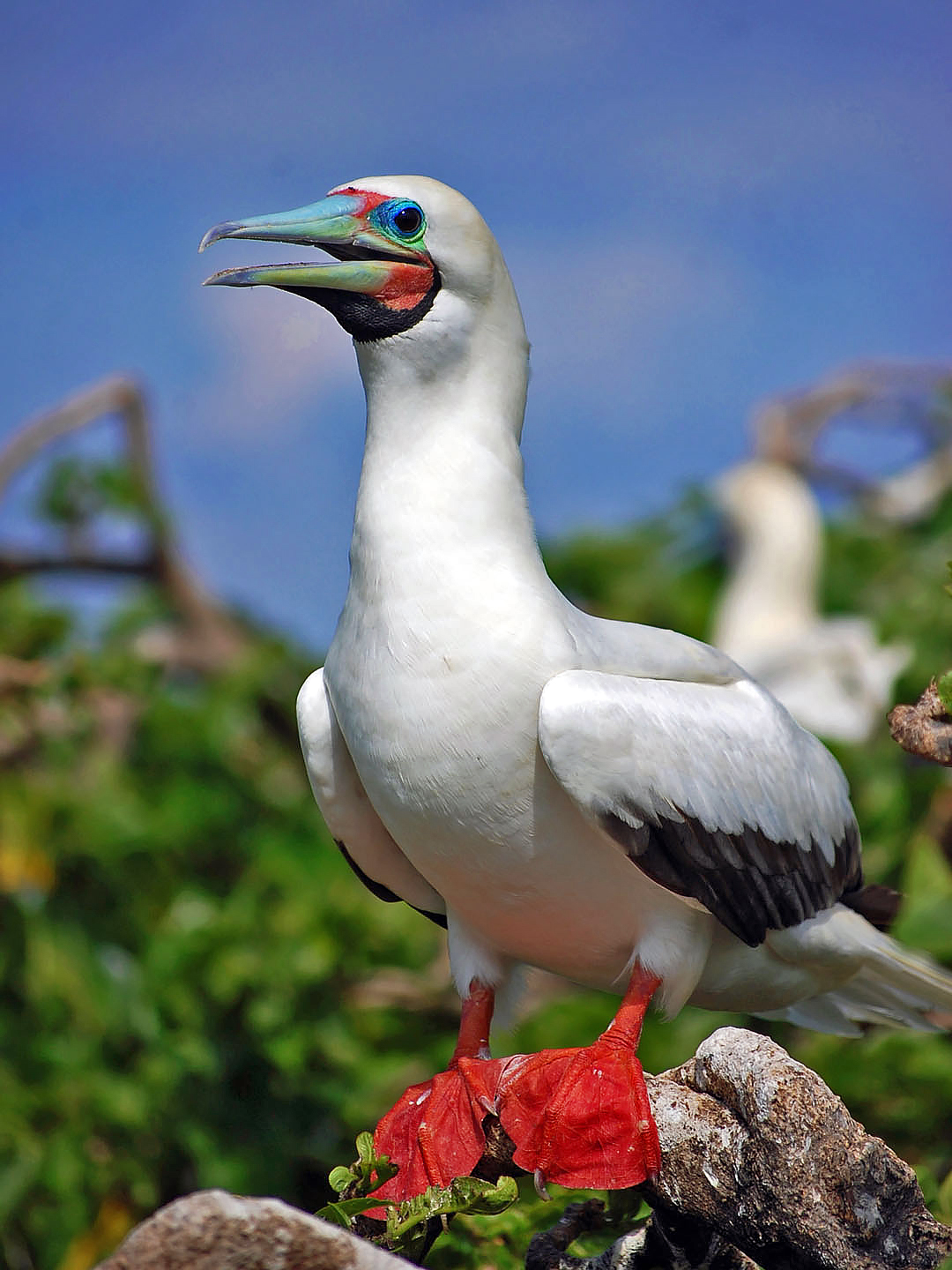
The red-footed booby (Sula sula) is a large seabird of the booby family, Sulidae. Adults always have red feet, but the colour of the plumage varies. They are powerful and agile fliers, harnessing the wind to fly efficiently, but they are clumsy in takeoffs and landings. They forage by catching flying fish from above the ocean's surface and by performing shallow dives. They are found widely in the tropics, and breed colonially in coastal regions, especially isolated islands such as St. Brandon, Mauritius (Cargados Carajos shoals), and the Chagos Archipelago. Although its population is declining, it is considered to be a least-concern species by the International Union for Conservation of Nature (IUCN). It faces threats from climate change, competition with fisheries, human disturbance, and invasive species.
The red-footed booby was formally described by the Swedish naturalist Carl Linnaeus in 1766, in the twelfth edition of his Systema Naturae. He gave it the binomial name Pelecanus sula and described it based on a specimen from Barbados. The present genus Sula was introduced by the French scientist Mathurin Jacques Brisson in 1760. The word Sula is Norwegian for a gannet.
There are three subspecies:
The red-footed booby is the smallest member of the booby and gannet family at about 70 cm (28 in) in length and with a wingspan of up to 152 cm (60 in). The average weight of 490 adults from Christmas Island was 837 g (1.845 lb). It has red legs, and its bill and throat pouch are coloured pink and blue. This species has several morphs. In the white morph the plumage is mostly white (the head often tinged yellowish) and the flight feathers are black. The black-tailed white morph is similar, but with a black tail, and can easily be confused with the Nazca and masked boobies. The brown morph is overall brown. The white-tailed brown morph is similar, but has a white belly, rump, and tail. The white-headed and white-tailed brown morph has a mostly white body, tail and head, and brown wings and back. The morphs commonly breed together, but in most regions one or two morphs predominates; for example, at the Galápagos Islands, most belong to the brown morph, though the white morph also occurs.
The sexes are similar, and juveniles are brownish with darker wings, and pale pinkish legs, while chicks are covered in dense white down.
The red-footed booby is widespread throughout the tropics of the Atlantic, Pacific, and Indian Oceans. In the Atlantic, they mainly live in the Caribbean islands. In the Pacific, populations can be found in the Galapagos Islands, mostly on Genovesa and San Cristobal and in Hawaii, on Kauai. In the Indian Ocean, it is found on Aldabra, the Seychelles, Rodrigues, the Maldives, the Chagos Archipelago, the Cocos (Keeling) Islands, and Christmas Island.
The red-footed booby has been extirpated from a large number of islands due to a combination of introduced predators and human predation, including the Glorioso Islands, Assumption Island, Tikopia, Henderson Island, the Marquesas Islands, the Society Islands, and Desecheo Island. The species is a vagrant to Sri Lanka, New Zealand, and the United Kingdom.
This species breeds on islands in most tropical oceans. When not breeding it spends most of the time at sea. In the Chagos Archipelago, it remains close to its breeding colony throughout the year, rather than migrating. It nests in large colonies, laying one chalky blue egg in a stick nest, which is incubated by both adults for 44–46 days. The nest is usually placed in a tree or bush, but rarely it may nest on the ground. It may be three months before the young first fly, and five months before they make extensive flights.
Hub AI
Red-footed booby AI simulator
(@Red-footed booby_simulator)
Red-footed booby
The red-footed booby (Sula sula) is a large seabird of the booby family, Sulidae. Adults always have red feet, but the colour of the plumage varies. They are powerful and agile fliers, harnessing the wind to fly efficiently, but they are clumsy in takeoffs and landings. They forage by catching flying fish from above the ocean's surface and by performing shallow dives. They are found widely in the tropics, and breed colonially in coastal regions, especially isolated islands such as St. Brandon, Mauritius (Cargados Carajos shoals), and the Chagos Archipelago. Although its population is declining, it is considered to be a least-concern species by the International Union for Conservation of Nature (IUCN). It faces threats from climate change, competition with fisheries, human disturbance, and invasive species.
The red-footed booby was formally described by the Swedish naturalist Carl Linnaeus in 1766, in the twelfth edition of his Systema Naturae. He gave it the binomial name Pelecanus sula and described it based on a specimen from Barbados. The present genus Sula was introduced by the French scientist Mathurin Jacques Brisson in 1760. The word Sula is Norwegian for a gannet.
There are three subspecies:
The red-footed booby is the smallest member of the booby and gannet family at about 70 cm (28 in) in length and with a wingspan of up to 152 cm (60 in). The average weight of 490 adults from Christmas Island was 837 g (1.845 lb). It has red legs, and its bill and throat pouch are coloured pink and blue. This species has several morphs. In the white morph the plumage is mostly white (the head often tinged yellowish) and the flight feathers are black. The black-tailed white morph is similar, but with a black tail, and can easily be confused with the Nazca and masked boobies. The brown morph is overall brown. The white-tailed brown morph is similar, but has a white belly, rump, and tail. The white-headed and white-tailed brown morph has a mostly white body, tail and head, and brown wings and back. The morphs commonly breed together, but in most regions one or two morphs predominates; for example, at the Galápagos Islands, most belong to the brown morph, though the white morph also occurs.
The sexes are similar, and juveniles are brownish with darker wings, and pale pinkish legs, while chicks are covered in dense white down.
The red-footed booby is widespread throughout the tropics of the Atlantic, Pacific, and Indian Oceans. In the Atlantic, they mainly live in the Caribbean islands. In the Pacific, populations can be found in the Galapagos Islands, mostly on Genovesa and San Cristobal and in Hawaii, on Kauai. In the Indian Ocean, it is found on Aldabra, the Seychelles, Rodrigues, the Maldives, the Chagos Archipelago, the Cocos (Keeling) Islands, and Christmas Island.
The red-footed booby has been extirpated from a large number of islands due to a combination of introduced predators and human predation, including the Glorioso Islands, Assumption Island, Tikopia, Henderson Island, the Marquesas Islands, the Society Islands, and Desecheo Island. The species is a vagrant to Sri Lanka, New Zealand, and the United Kingdom.
This species breeds on islands in most tropical oceans. When not breeding it spends most of the time at sea. In the Chagos Archipelago, it remains close to its breeding colony throughout the year, rather than migrating. It nests in large colonies, laying one chalky blue egg in a stick nest, which is incubated by both adults for 44–46 days. The nest is usually placed in a tree or bush, but rarely it may nest on the ground. It may be three months before the young first fly, and five months before they make extensive flights.